The Review Generation Trap: Why Fake Social Proof Is Tanking Your Conversion Rate (And How Successful Dropshippers Build Authentic Feedback Loops)
Northwestern University's Spiegel Research Center produced a finding that should have killed the fake-review industry on the spot: products rated between 4.2 and 4.5 stars convert at higher rates than products sitting at a perfect 5.0. The implication was plain. Shoppers don't trust perfection.
The Review Generation Trap: Why Fake Social Proof Is Tanking Your Conversion Rate (And How Successful Dropshippers Build Authentic Feedback Loops)
Northwestern University's Spiegel Research Center produced a finding that should have killed the fake-review industry on the spot: products rated between 4.2 and 4.5 stars convert at higher rates than products sitting at a perfect 5.0. The implication was plain. Shoppers don't trust perfection. And yet, for years, dropshippers kept buying five-star reviews in bulk, stacking their product pages with glowing testimonials from people who never touched the product. The strategy worked for a while. Then it didn't.
This is the timeline of how that happened, what broke, and what the operators who kept their conversion rates built instead.
The Window When Manufactured Reviews Paid Off
Between 2017 and roughly 2021, buying reviews was straightforward ecommerce math. A Fiverr seller would write 50 reviews for $25. You'd import them through a CSV upload or a third-party review app, populate your product pages overnight, and watch add-to-cart rates climb. For dropshipping stores with zero order history and no brand recognition, this felt like the only way to compete against established sellers.
And it worked, at least by the crude metrics that mattered at the time. Pages with reviews converted better than pages without reviews. That part of the equation has always been true. Products with at least five reviews see significantly higher conversion rates than products with zero, and the data on review-driven conversion lifts is well documented.
The problem wasn't the principle. The problem was what happened when store owners optimized for volume of fake praise instead of genuine customer feedback social proof.
Consumer Skepticism Hit Critical Mass
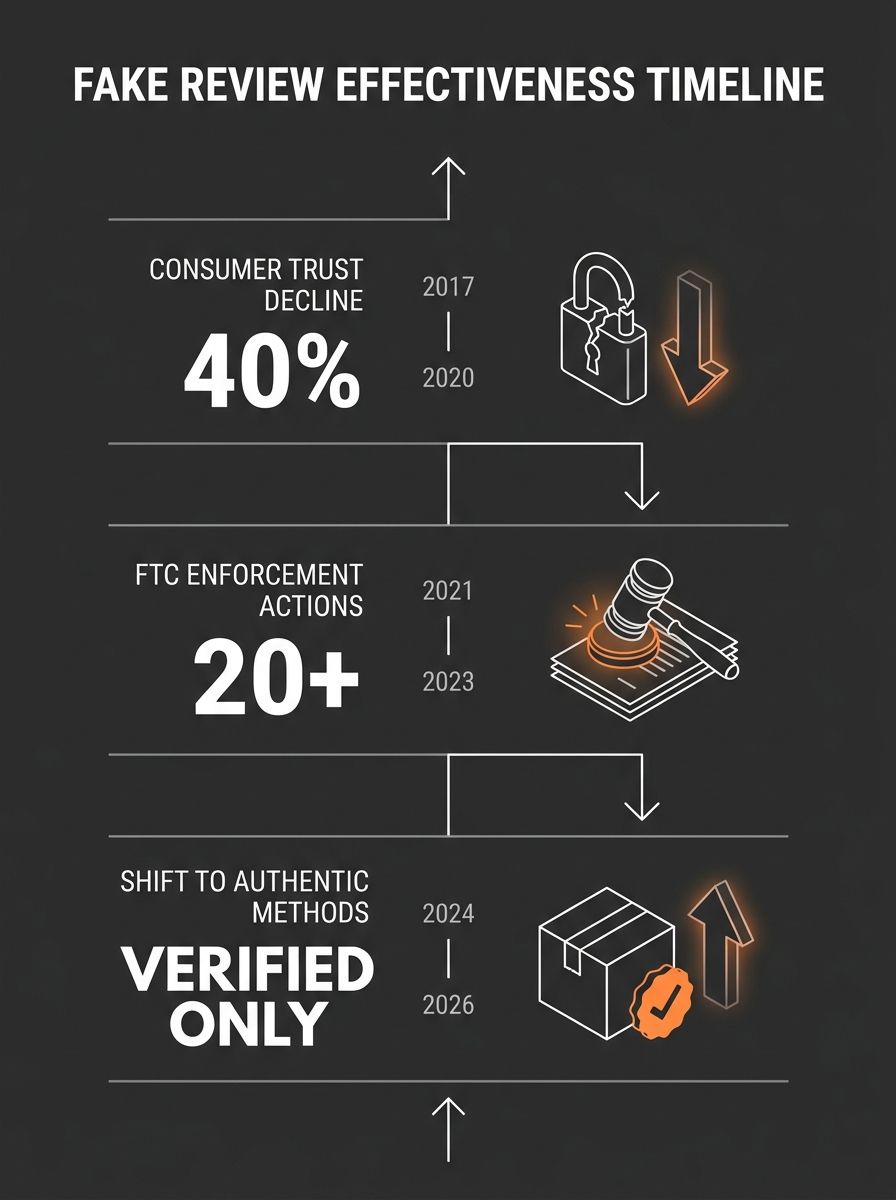
By 2022, the dynamics had shifted. Shoppers who'd been burned by dropshipped products that looked nothing like their reviews started pattern-matching. They learned to spot the tells: reviews posted within 48 hours of a store going live, identical sentence structures across different "customers," five-star ratings with zero photos, and suspiciously generic praise like "great product, fast shipping, would buy again."
The data on this shift is stark. According to research compiled by Shapo, 82% of consumers now encounter fake reviews annually, 67% worry about review authenticity when shopping online, and over half of consumers will avoid purchasing a product entirely if they suspect its reviews are manufactured. That last number is the one that matters for your margin math. Fake reviews don't sit there inertly failing to convince. They actively repel buyers who would have converted on a page with fewer, honest reviews.
Meanwhile, AI-generated review content grew at 80% month-over-month from mid-2023 onward. Platforms were flooded with suspiciously polished, uniform praise. Consumers noticed. And they punished it by closing tabs.
Platform Purges and FTC Enforcement Changed the Risk Calculus
Through 2023 and 2024, the regulatory environment shifted from "technically against TOS" to "financially dangerous." The FTC formalized penalties for fake reviews at $43,792 per violation. Amazon purged millions of suspect reviews and banned thousands of seller accounts. Shopify's app ecosystem saw review generation tools that facilitated fake imports face removal or significant policy changes.
For dropshippers, this meant the ROI equation on manufactured reviews flipped negative. A store running $40 margins per unit on a trending product could see its entire operation wiped out by a single enforcement action. And even without formal enforcement, platforms like Google Shopping began deprioritizing product listings associated with review manipulation signals.
Operators who'd been building trust signals into their product pages through legitimate means didn't feel this pain. Everyone else scrambled.
How Operators Built Real Feedback Infrastructure
The stores that maintained or grew their conversion rates through this period didn't do anything exotic. They built systems to collect authentic product reviews for their dropshipping operations, and they did it with discipline rather than shortcuts.
Post-Purchase Email Sequences
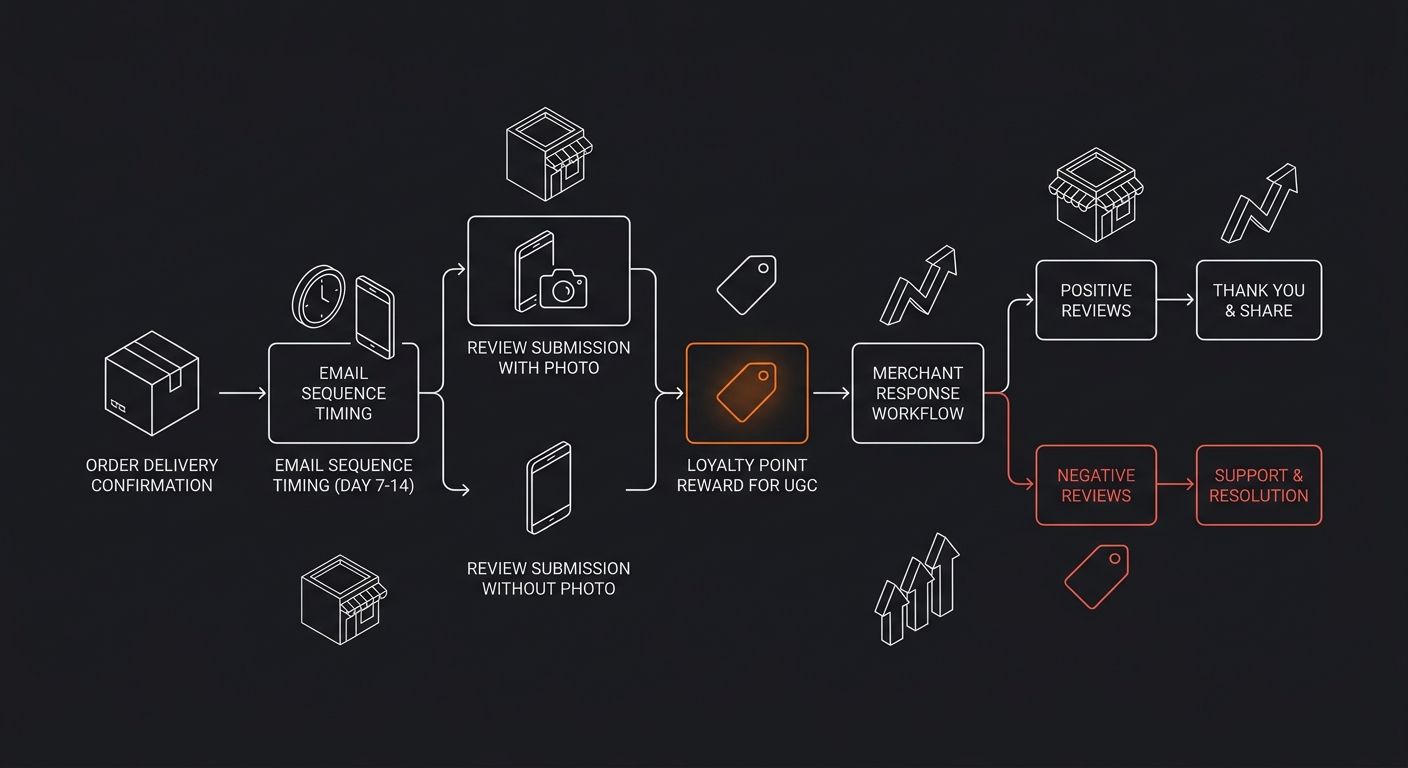
The single highest-ROI investment in review generation is a well-timed email sequence. Send a review request 7-14 days after delivery confirmation (not after order placement, because half your products are still in transit at day 7 if you're shipping from China). Include a direct link to the product page review form. Platforms like Trustpilot and Yotpo automate this, and both integrate with Shopify natively.
If you're running a post-sale audit on your operations, review request timing should be part of that audit. Sending too early, before delivery, generates frustration. Sending too late, 30+ days out, catches customers after they've forgotten the purchase entirely. The sweet spot varies by product category, but 10 days post-delivery is a reliable starting point for most consumer goods.
Responding to Every Review, Including Negative Ones
Responding to at least 25% of reviews can increase earnings by 35%. But the real conversion lift comes from how you handle criticism. A dropshipping store that responds thoughtfully to a two-star review ("We're sorry the sizing ran small. We've updated our size chart and would love to send you an exchange") signals to every future visitor that a real human operates this business.
This matters more for dropshippers than for traditional retailers because the trust deficit is already higher. Shoppers can often tell they're buying from a dropshipping store. Authentic customer engagement through review responses is one of the few signals that counteracts that skepticism, and it costs nothing except 15 minutes per day of attention.
UGC Collection and Display
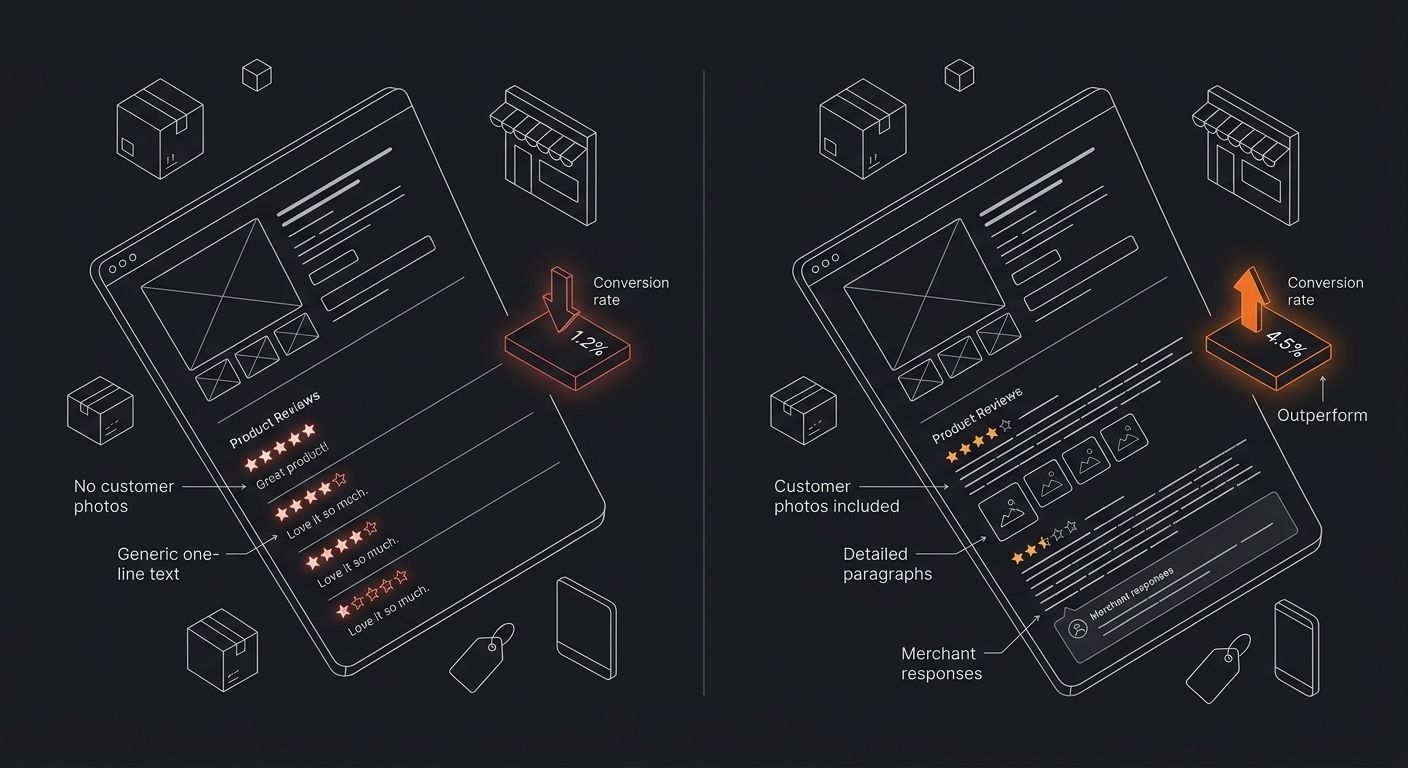
User-generated content like customer photos and videos increases web conversion rates by 29%. For dropshippers building trust in their stores, this is the most powerful form of social proof because it proves the product actually exists and looks like what the listing promises. Fifty-three percent of shoppers say UGC photos give them more confidence than professional product shots.
The operational move: incentivize photo reviews with loyalty points (not discounts on the current order, which the FTC views skeptically) and feature them prominently in your review widgets. Yotpo, Loox, and Judge.me all support photo-first review displays on Shopify. If you're building a community-driven niche store, UGC becomes a compounding asset. Each customer photo makes the next customer more likely to trust the listing, buy, and submit their own photo. The flywheel is slow to start and powerful once it's moving.
Displaying Imperfect Ratings Intentionally
This brings us back to where we started. That 4.2-4.5 sweet spot exists because consumers perceive mixed feedback as credible. A store with 4.3 stars and visible negative reviews looks real. A store with 5.0 stars and exclusively glowing praise triggers the same alarm bells that generic manufacturer copy on product pages does.
Successful operators don't filter negative reviews. They treat them as conversion tools. A product page that shows "3 out of 147 customers reported sizing issues" and includes a visible response from the store owner converts better than a page that hides those three reviews entirely.
Where The Data Looks Like Today
The gap between stores using manufactured social proof and stores running legitimate review generation tools shows up directly in conversion rate data. Products with 100+ authentic reviews can more than double their conversion rates compared to products with zero reviews. Video testimonials increase conversions by 80%. And the impact of fake reviews on conversion rates continues to trend in one direction: downward.
Stores making money from reviews in 2026 treat review collection as a supply chain problem, with the same rigor they apply to supplier vetting and shipping optimization. They track review request send rates, response rates, photo submission rates, and the conversion lift from pages with reviews versus pages without. They measure the time between delivery and review submission, and they A/B test whether a plain-text email or a branded template generates more responses.
The fake review shortcut was always going to expire. Consumer sophistication and platform enforcement made sure of that. What replaced it is less glamorous: email sequences, review response protocols, UGC incentive programs. But it compounds. Every authentic review makes the next sale easier. Every honest three-star review handled well builds credibility that purchased five-star praise never could. The stores that figured this out early are the ones with review pages that actually sell.
365 Dropship Editorial
Editorial team writing about E-commerce, dropshipping, and product discovery — reviews of dropshipping suppliers and platforms, trending niche guides (jewelry, beauty, pets, home, fashion), supplier due diligence, ecom operations, shipping & fulfillment strategy, product research, AOV optimization, and profitable dropshipping case studies.
Related Articles

Honest Product Reviews for Dropshipping Stores: The Testing Protocol That Builds Customer Trust Without Fake Social Proof
Buying reviews will tank your store's conversion rate faster than having no reviews at all. An estimated 30% of online reviews across ecommerce are fake, and shoppers have learned to spot them. Purchased testimonials signal that your store can't earn real ones, and that inference kills sales.

Building Trust Signals into Dropshipping Product Reviews: The Conversion Framework Beyond Generic Descriptions
Spiegel Research Center research, cited widely across e-commerce conversion literature, puts the number at 270%. That's how much displaying authentic customer reviews can increase the likelihood of purchase compared to a product page with none.
Why Review Aggregators Are Actively Misleading Dropshippers About Supplier Quality in 2026
Review aggregators earn subscription and per-order fees from the supplier relationships they're supposed to objectively rate. Platforms like Spocket, Modalyst, and Doba display quality scores as neutral assessments.
Explore more topics