Building Trust Signals into Dropshipping Product Reviews: The Conversion Framework Beyond Generic Descriptions
Spiegel Research Center research, cited widely across e-commerce conversion literature, puts the number at 270%. That's how much displaying authentic customer reviews can increase the likelihood of purchase compared to a product page with none.

Building Trust Signals into Dropshipping Product Reviews: The Conversion Framework Beyond Generic Descriptions
Spiegel Research Center research, cited widely across e-commerce conversion literature, puts the number at 270%. That's how much displaying authentic customer reviews can increase the likelihood of purchase compared to a product page with none. But the number assumes the reviews feel real, address specific concerns, and show up where buyers actually look before clicking "Add to Cart." For dropshippers running stores with thin product catalogs, no brand recognition, and AliExpress supplier photos, that 270% lift might as well be fiction. The gap between knowing reviews matter and building a review ecosystem that actually converts is where most stores lose the sale. This article is about closing that gap with a framework for product review writing that treats trust as an economic input, not a design afterthought.
The Conversion Cost of Looking Like Everyone Else
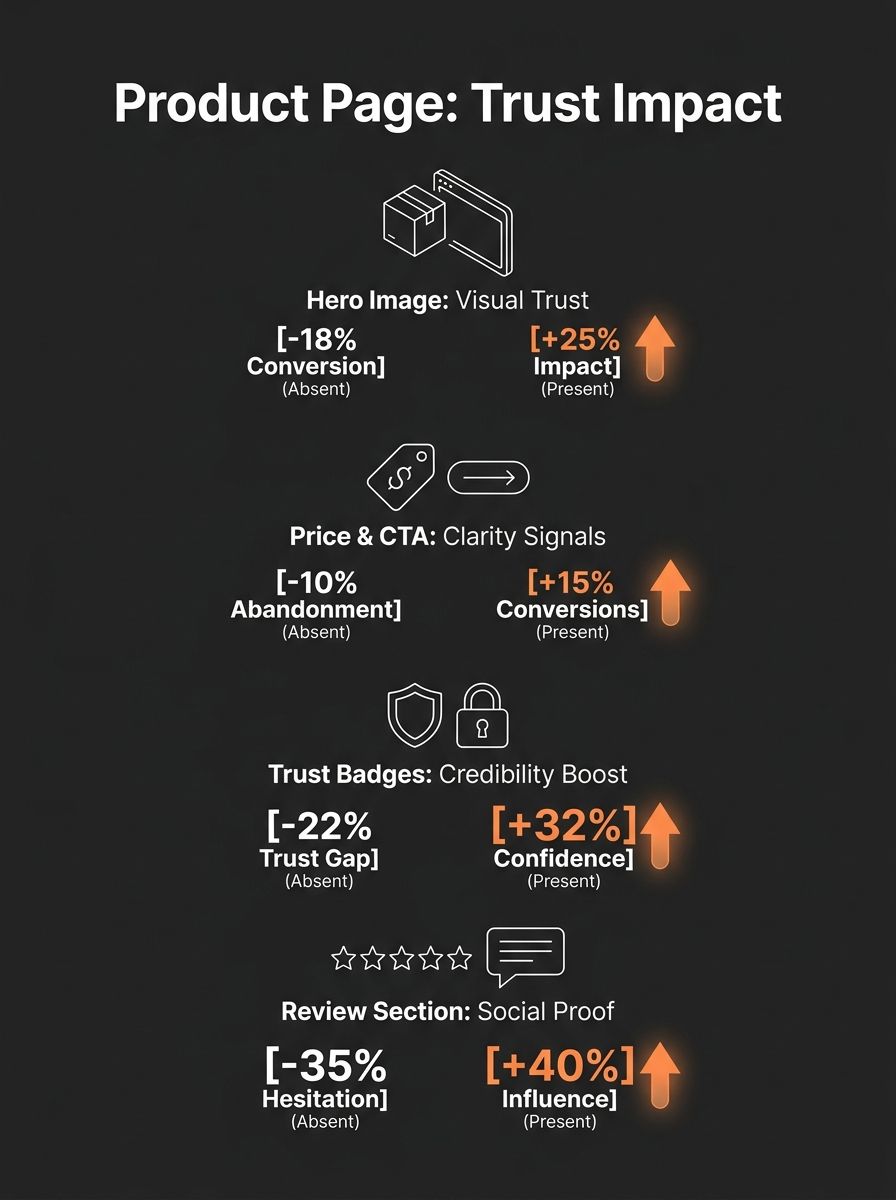
Half of online shoppers have abandoned a cart because they didn't trust the business. That stat, repeated across multiple e-commerce studies and reinforced in Spocket's product page checklist, should alarm any dropshipper running a store that looks like it was assembled from a template in 45 minutes. The problem isn't that your store is ugly. The problem is that it's indistinguishable from the three other stores selling the same posture corrector with the same stock photos and the same five-sentence description copy-pasted from the manufacturer listing.
Generic product descriptions are a conversion killer we've covered before when looking at why manufacturer copy tanks your conversion rate, but the damage extends beyond the description box. When your entire product page reads like a supplier catalog entry, no amount of trust badges or SSL padlock icons will convince a skeptical buyer to enter their credit card number. Trust signals work as a system, and that system starts with the words surrounding your product. Clear, accurate product descriptions help customers understand what they're buying and make informed decisions, as research on building customer trust confirms. When those descriptions are vague or clearly copied, the trust deficit compounds across every other element on the page.
Think about what a first-time visitor actually processes in the 8-15 seconds before they decide to scroll or bounce. They see the product image, scan the price, glance at the headline, and look for social proof. If the review section is empty, or populated with suspiciously uniform five-star praise ("Great product! Fast shipping! Love it!"), they register that something's off. They might not articulate it consciously, but their finger moves toward the back button. Your CAC just went to waste.
Writing Reviews That Function as Conversion Copywriting
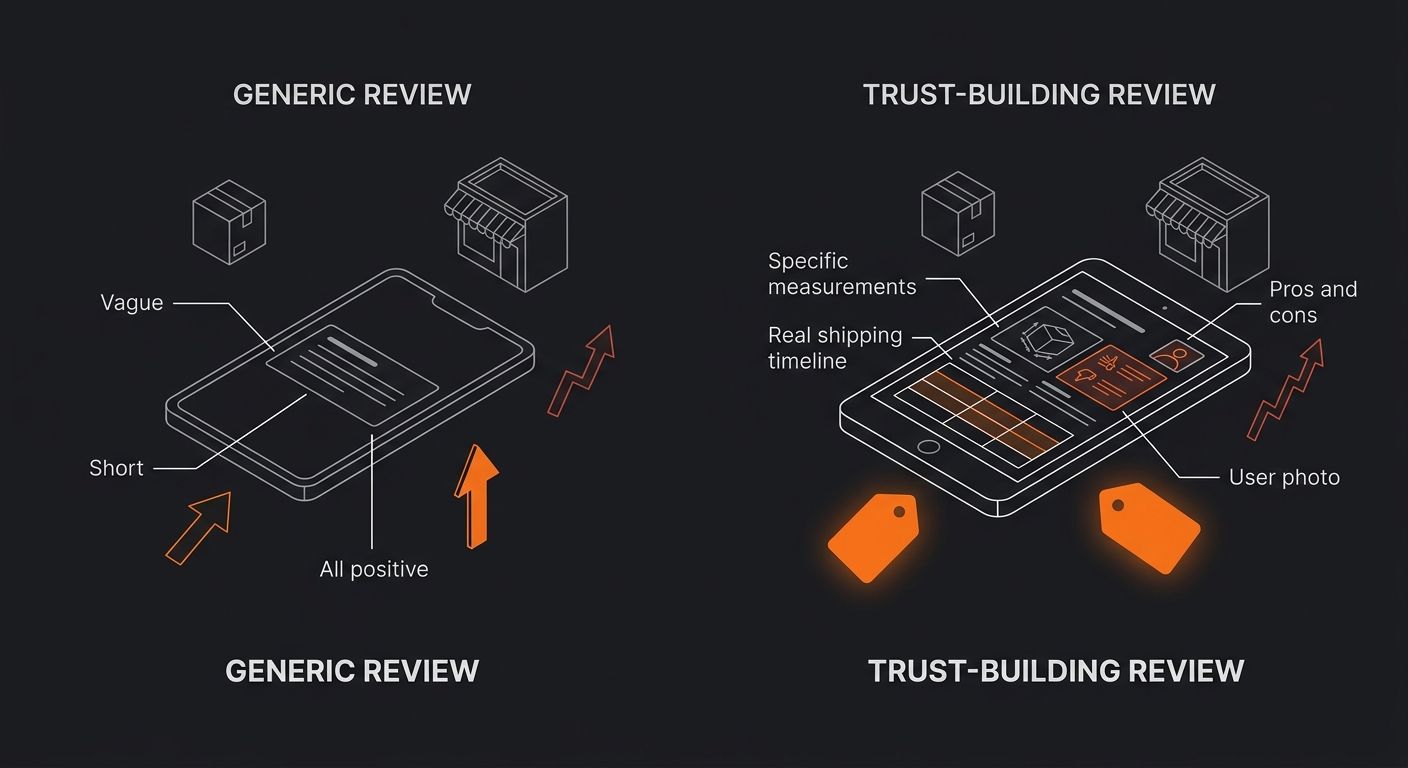
The affiliate marketing world figured out the product review formula years ago: address the buyer's real objections, include genuine pros and cons, and write from a position of actual product knowledge. As Margaret Bourne puts it in her guide on affiliate product reviews that convert, you should write reviews on products you know well enough to share personal stories, anecdotes, and examples. Dropshippers face an obvious challenge here because you often haven't touched the product. This is exactly why running test orders before scaling matters beyond quality assurance. A test order gives you firsthand material for an authentic product review: you can photograph the actual packaging, measure the item against its listed dimensions, note how long shipping took, and describe the texture, weight, or build quality in specific terms that no supplier listing provides.
The structure of an effective product review follows a pattern that's been validated across thousands of affiliate and e-commerce sites. You open with the specific problem the product solves, describe the physical product with enough detail that the reader can picture holding it, present both strengths and weaknesses, and close with a clear assessment of who the product is best for. Pros and cons have been a staple of product reviews since the format existed, and as affiliate24.org's review writing guide points out, no product is perfect, so balancing both the good and the bad establishes credibility. The counterintuitive truth is that including a genuine negative observation — "the clasp feels lightweight and I'd avoid wearing this in the pool" — makes every positive claim more believable.
What separates conversion copywriting from generic description work is specificity. Instead of "high-quality material," you write "the 304 stainless steel band weighs 38 grams and didn't discolor after three weeks of daily wear." Instead of "fast shipping," you write "ordered on a Tuesday, arrived the following Monday via USPS from a warehouse in California." These details serve double duty: they demonstrate that someone actually handled the product, and they preemptively answer the objections (durability, shipping speed, material quality) that Spocket's research identifies as the most common conversion blockers. This kind of affiliate-style product positioning treats the review as a sales asset, not an obligation to fill white space.
Where Trust Signals Belong on the Page
Placement determines whether a trust signal gets processed or ignored. Holabird Sports saw a 21.3% revenue increase after adding trustmarks across their site, but the gains weren't evenly distributed. The most impactful placements were near CTAs and on checkout pages, the exact moments where purchase anxiety peaks. For dropshippers, this means your review content and trust badges should cluster around two zones: immediately below the product description (where a scrolling buyer evaluates legitimacy) and adjacent to the Add to Cart button (where they commit financially).
The instinct to overload every page with badges, seals, and icons actually backfires. As Copyhackers notes in their trust signal breakdown, trust signals work because they make your site look credible, but stacking twelve different badges creates visual noise that reads as desperation. Two or three high-signal elements work better than a dozen generic ones. A "Verified Buyer" tag on a review with an attached customer photo carries more weight than a row of payment processor logos that every Shopify store displays by default. If you've earned a Trustpilot score or been mentioned in a recognizable publication, surface that specifically. If you haven't, don't fake it with vague "As Seen In" banners that link nowhere.
The post-purchase side of trust signals matters more than most operators realize. Val Geisler, an email strategist who has worked with brands like Klaviyo and Shopify, emphasizes that trust isn't a landing page; it's an entire journey, including what happens after the sale. This connects directly to the post-order profitability problems that erode margins. A follow-up email sequence that asks for a review two weeks after delivery (not two days, when the buyer hasn't even used the product) generates more authentic, detailed responses. And those responses become the raw material for your next round of trust signals. Matt McWilliams recommends reaching out to existing customers directly and asking them to leave comments on product review posts, because real testimonials from real buyers add social proof and SEO value simultaneously.

The Tension That Doesn't Resolve Cleanly
There's an uncomfortable friction at the center of this entire framework. Authentic product reviews demand firsthand experience, but the dropshipping model is built on selling products you don't warehouse, often haven't touched, and sometimes haven't even seen outside of supplier photos. You can order test units and write your own detailed review copy, but scaling that process across a catalog of 50 or 200 SKUs gets expensive and slow. You can solicit customer reviews through post-purchase emails, but a new store with twelve orders doesn't have the volume to generate the kind of social proof that moves conversion needles.
The honest answer is that building trust signals in dropshipping is a compounding investment, not a switch you flip. Your first fifty sales will generate your first handful of real reviews. Those reviews improve conversion rate by a few percentage points, which generates more sales, which generates more reviews. The math is slow at the beginning and faster later, which is exactly the opposite of what most operators want to hear when they're watching ad spend burn with a 1.4% conversion rate. The temptation to shortcut this with fake reviews or AI-generated testimonials is real, and plenty of stores do it. The risk is also real: platforms are getting better at detecting synthetic reviews, and buyers are getting better at sensing them. A store that gets flagged or called out on social media for fabricated social proof doesn't recover easily.
What remains genuinely unresolved is how much trust can be manufactured through copy alone versus how much requires the slow accumulation of real customer interactions. The best operators I've observed treat their first 100 orders as a trust-building investment rather than a profit center, pricing aggressively, fulfilling meticulously, and soliciting feedback persistently. They build direct supplier relationships that give them faster shipping and more consistent quality, which in turn generates better reviews organically. The conversion framework described here works, but it works best for stores willing to treat trust as a long-term asset with a real cost basis, not a design trick you bolt on over a weekend.
365 Dropship Editorial
Editorial team writing about E-commerce, dropshipping, and product discovery — reviews of dropshipping suppliers and platforms, trending niche guides (jewelry, beauty, pets, home, fashion), supplier due diligence, ecom operations, shipping & fulfillment strategy, product research, AOV optimization, and profitable dropshipping case studies.
Related Articles

Honest Product Reviews for Dropshipping Stores: The Testing Protocol That Builds Customer Trust Without Fake Social Proof
Buying reviews will tank your store's conversion rate faster than having no reviews at all. An estimated 30% of online reviews across ecommerce are fake, and shoppers have learned to spot them. Purchased testimonials signal that your store can't earn real ones, and that inference kills sales.

The Review Generation Trap: Why Fake Social Proof Is Tanking Your Conversion Rate (And How Successful Dropshippers Build Authentic Feedback Loops)
Northwestern University's Spiegel Research Center produced a finding that should have killed the fake-review industry on the spot: products rated between 4.2 and 4.5 stars convert at higher rates than products sitting at a perfect 5.0. The implication was plain. Shoppers don't trust perfection.
Product Description Red Flags: Why Generic Manufacturer Copy Tanked Your Conversion Rate
"Premium quality material, comfortable to wear, suitable for all occasions, perfect gift for friends and family." That exact sentence, with minor word-order variations, appears across thousands of AliExpress product listings in jewelry, apparel, and home décor.
Explore more topics