Why India's Nonwoven Textile Boom Is Reshaping Dropshipping Niche Economics in 2026
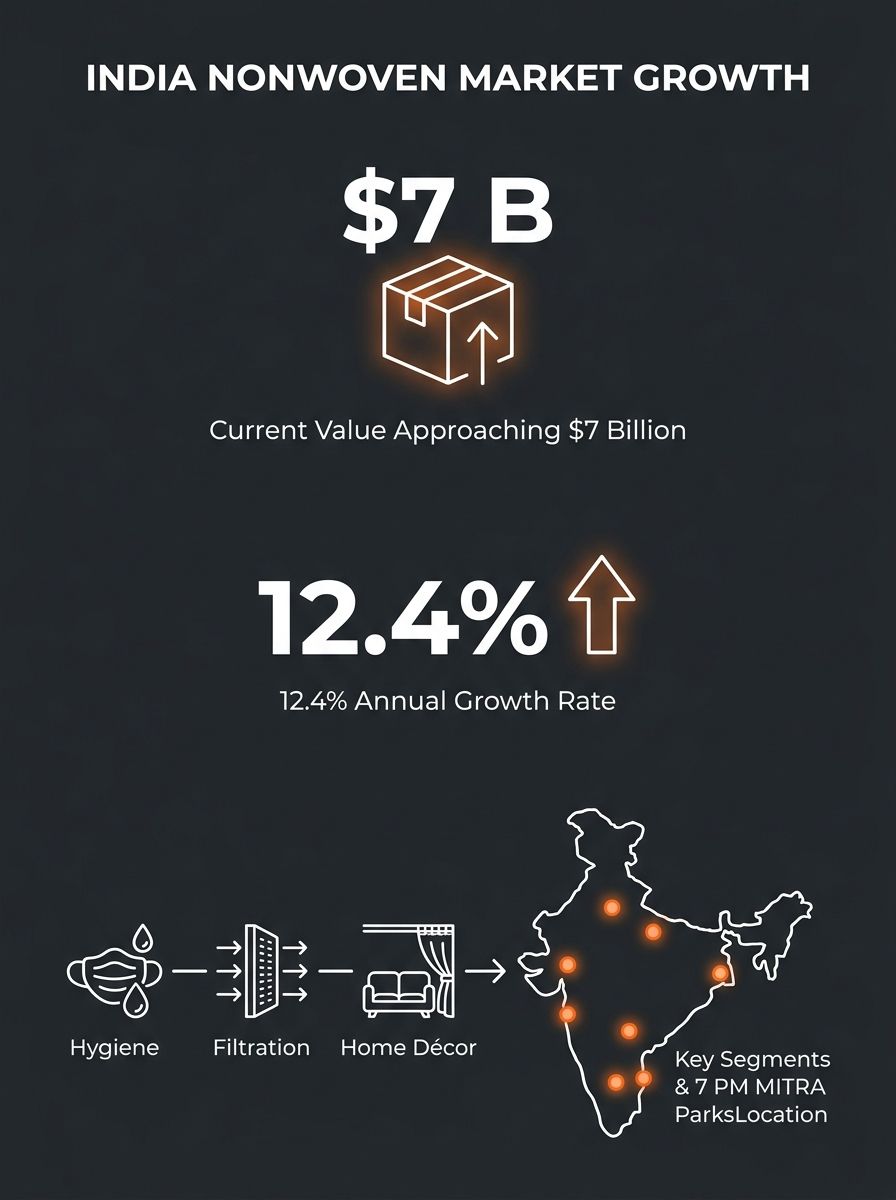
India's nonwoven fabrics market is approaching $7 billion, with annual growth exceeding 12.4%, according to the Association of the Nonwoven Fabrics Industry.
Why India's Nonwoven Textile Boom Is Reshaping Dropshipping Niche Economics in 2026
India's nonwoven fabrics market is approaching $7 billion, with annual growth exceeding 12.4%, according to the Association of the Nonwoven Fabrics Industry. Seven PM MITRA mega textile parks are coming online this year, the rupee is sliding against the dollar, and supplier discovery platforms still haven't caught up. For dropshippers eyeing specialty fabric dropshipping, this gap between industrial capacity and platform coverage is where the margin opportunity lives.
The $7 Billion Buildout and Why Dropshippers Should Care
India's nonwoven sector is an industrial story — driven by healthcare, hygiene, automotive filtration, and geotextiles demand. The government's 2026–27 budget extended export timelines from six to twelve months and doubled down on man-made fiber (MMF) and technical textiles. Domestically, producers are pouring capital into automated carding, cross-lapping, and needle-punching lines to close a capacity gap that's kept Indian output behind competitors like Mitsui Chemicals and Toray Industries in Japan.
None of that sounds like a dropshipping play. And historically, it hasn't been.
But the downstream effect changes things. As Indian manufacturers scale capacity, they're producing surplus volumes of nonwoven materials — polypropylene spunbond for reusable shopping bags, meltblown fabric for filtration products, needle-punched felt for home décor and crafting. These finished and semi-finished goods trickle into wholesale channels, and from there into the hands of Indian textile suppliers willing to fulfill small orders. The Fibre2Fashion industry analysis attributes the 12.4% growth rate partly to "the explosion in the number of disposable income group in India," which has expanded domestic retail channels for nonwoven consumer products.
Abhishek Sharma, writing for the Indian Textile Journal, put the shift in concrete terms: "The future of textile manufacturing will be defined not only by production capacity, but by intelligent supply chains, operational agility, and the ability to adapt quickly to changing market demands."
For your dropshipping niche research, that agility is the signal. Indian manufacturers that previously required 5,000-unit MOQs are now experimenting with low-quantity export fulfillment through intermediary platforms.
Searching "Nonwoven India" on SaleHoo, Spocket, and CJ Dropshipping
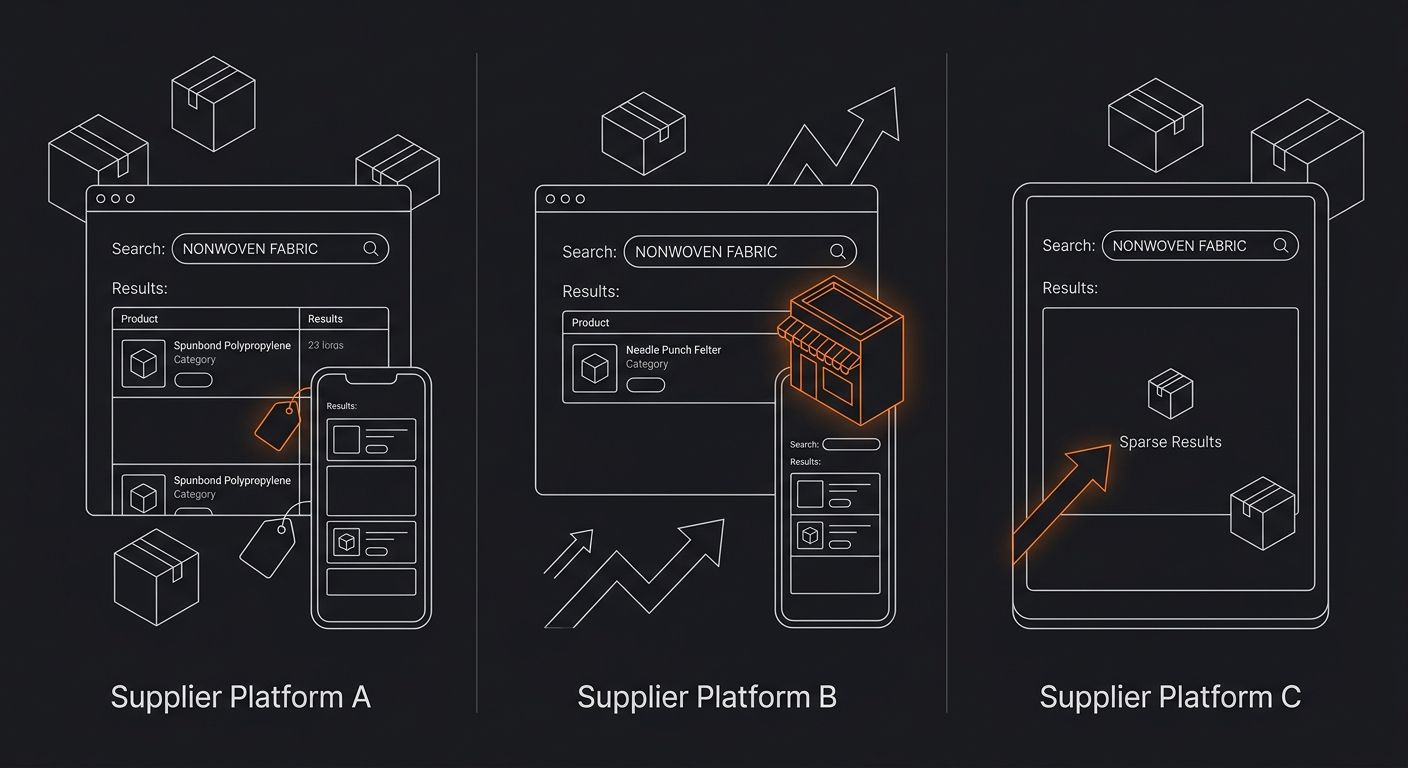
Here's where the App Reviews angle gets real. I ran searches across the major supplier discovery platforms to see how well they surface emerging manufacturer opportunities from India's nonwoven boom. The results expose a clear gap between what's happening on the supply side and what dropshippers can actually access through their current tooling.
SaleHoo has the broadest fabric supplier directory — 113 wholesale fabric suppliers with detailed profiles, customer reviews, and pricing transparency. Searching for nonwoven-specific Indian suppliers, though, returns a thin set. The platform's strength is breadth across textiles (cotton, linen, synthetics), and its supplier profiles do include shipping-time estimates and MOQ data. SaleHoo charges $67/year for full directory access, making it the cheapest entry point for fabric niche research.
Spocket surfaces US and EU-based suppliers more aggressively, with Indian supplier coverage lagging behind. For the nonwoven fabric niche specifically, Spocket's catalog skews toward finished consumer goods — bags, eco-friendly packaging — rather than raw or semi-finished nonwoven materials. The $39.99/month Starter plan gets you access, but you're searching a curated catalog rather than a raw directory. If your angle is branded reusable bags made from Indian spunbond polypropylene, Spocket's sourcing model can work. For anything requiring direct manufacturer relationships, it's a dead end.
CJ Dropshipping offers the most flexible sourcing for niche fabrics because of its product sourcing request feature — you submit the product, and CJ's team locates a supplier. This works well when you already know the specific nonwoven product you want (say, a needle-punched felt desk mat or a meltblown air purifier filter). CJ charges no monthly fee, taking margin on the spread between their supplier cost and your unit price. The tradeoff: less transparency on who's actually manufacturing.
Platform | Indian Nonwoven Supplier Coverage | Monthly Cost | MOQ Flexibility | Sourcing Model |
|---|---|---|---|---|
SaleHoo | Moderate (directory, limited nonwoven) | $5.58/mo (annual) | Varies by supplier | Self-serve directory |
Spocket | Low (finished goods focus) | $39.99/mo | Pre-set by supplier | Curated catalog |
CJ Dropshipping | Variable (request-based) | $0 | Negotiable via sourcing team | Request + fulfillment |
Accio/Alibaba | High (direct manufacturer access) | Free to browse | Often 100–500 units | Direct trade |
The real takeaway: none of these platforms have built a dedicated nonwoven fabric niche vertical, even though the Indian supply side is generating $7 billion worth of product. If you're building a backup supplier network in this category, you're doing manual outreach, not platform-driven discovery.
The Rupee Slide and What It Does to Landed Cost
The Economic Times reported this week that India's weakening rupee is boosting export competitiveness, making Indian goods more affordable globally. For dropshippers running supply chain diversification 2026 strategies, this currency shift directly affects unit economics.
Here's rough margin math on a common nonwoven product — reusable polypropylene tote bags:
Indian supplier cost (post-rupee adjustment): $0.38–$0.55 per unit for 70gsm spunbond PP bags, unprinted
Comparable Chinese supplier cost: $0.50–$0.72 per unit for equivalent spec
CJ Dropshipping sourced price (India-origin): $1.10–$1.40 per unit with branding and fulfillment
Retail price range on Shopify stores: $4.99–$8.99 per unit
Gross margin at $6.99 retail, $1.25 sourced cost: 82.1%
Compare that to a Chinese-sourced equivalent at $1.60 fulfilled cost: margin drops to 77.1% at the same retail price. That 5-point spread is $0.35 per bag. At 1,000 units/month, it's $350 in recovered margin — enough to fund an extra ad set or absorb a shipping rate increase.
The currency tailwind won't last forever. The RBI flagged West Asia headwinds and potential El Niño disruptions to agricultural output, which feeds into cotton and natural-fiber costs indirectly. But for polypropylene-based nonwovens (petroleum-derived), the relevant cost driver is crude pricing, not crop yields. And Indian producers with automated lines are locking in lower conversion costs per ton than their semi-manual competitors.
When you're calculating true cross-border unit costs, the India-origin route carries one less tariff layer than Chinese goods under current trade frameworks. That matters if your store serves US customers.
The Vetting Problem Platform Algorithms Don't Solve
Scale is coming to the Indian nonwoven sector. Avgol Industries launched its Hygiene 360 product line — sustainable, high-performance nonwoven fabrics for hygiene applications — in early 2024, and the technology has since been adopted by downstream manufacturers. Berry Global, Fibertex, Asahi Kasei, Fitesa, and Glatfelter all operate in the Asia-Pacific nonwoven space, according to ResearchAndMarkets. These are industrial-grade operations. The dropshipper-friendly tier sits below them — smaller Indian producers who are building export capability as PM MITRA parks reduce their logistics costs.
And that tier is hard to vet through platform interfaces alone.
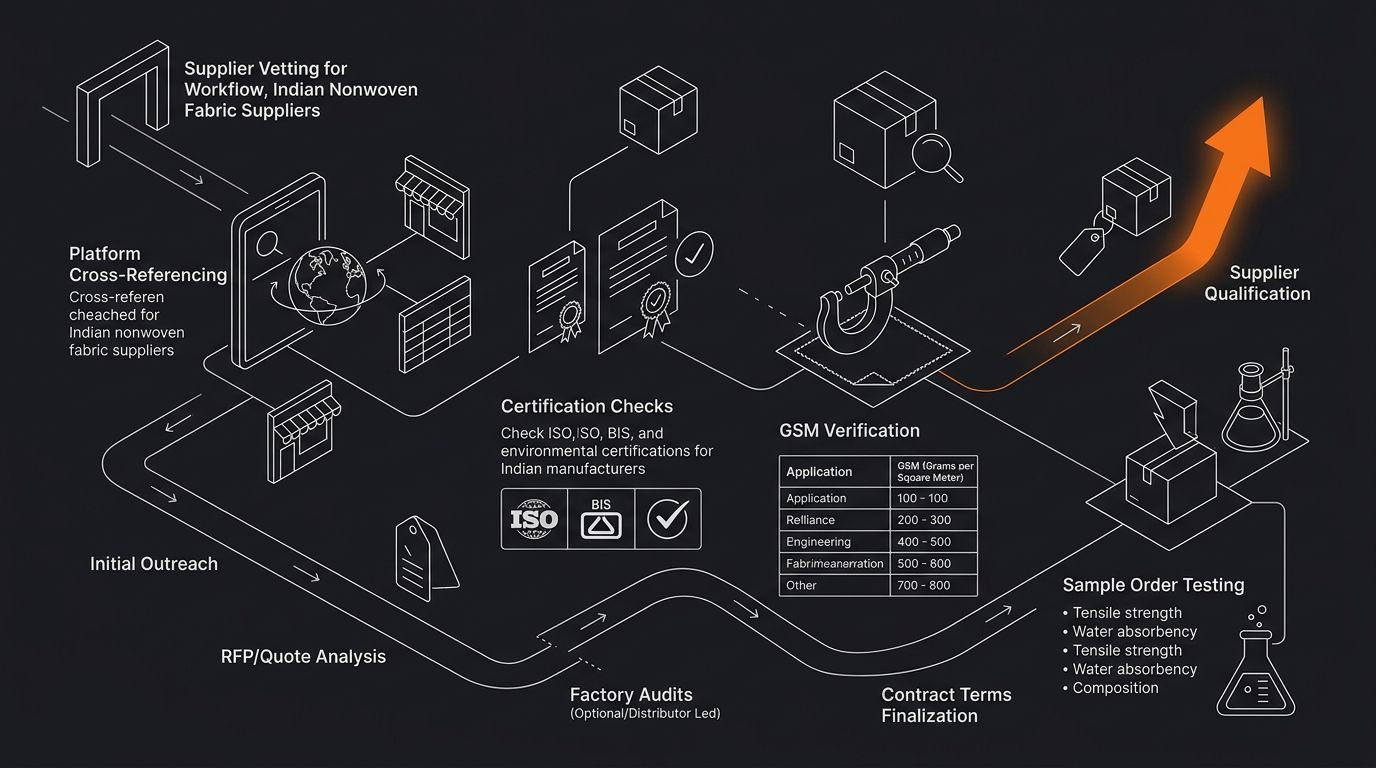
SaleHoo's supplier profiles include customer reviews and basic business verification, but they don't test physical product quality or confirm production capacity for niche nonwoven specs. CJ's sourcing team acts as an intermediary, which insulates you from direct supplier relationships but also hides the quality signal. Running a test order audit on any new supplier is especially critical in this niche because nonwoven fabric weight (measured in GSM — grams per square meter) affects durability, feel, and perceived value. A supplier quoting 70gsm who ships 50gsm product tanks your review scores fast.
If you're evaluating ethical sourcing standards for Indian textile suppliers, look for OEKO-TEX or ISO 9001 certifications specifically. India's textile sector has deep ties to agricultural labor markets, and IBEF reports that the industry serves "a wide spectrum of demand, from affordable mass-market apparel to niche high-value categories." That range means supplier quality varies enormously.
The Platform Gap That Defines This Niche Right Now
The Indian nonwoven buildout is an industrial reality, documented in market reports and government budgets. The dropshipping opportunity is real but narrow — concentrated in finished nonwoven consumer goods (reusable bags, felt craft supplies, filtration inserts, disposable hygiene products) rather than raw fabric rolls. And the supplier discovery platforms serving dropshippers haven't built the indexing depth to make this niche browsable.
That's a structural gap, and structural gaps create pricing power for sellers who close them manually. The concentration risk of sourcing everything from Chinese suppliers keeps growing as tariff frameworks shift and freight economics change. Indian textile suppliers offer a genuine diversification path — one with a currency tailwind, expanding production capacity, and government infrastructure investment behind it.
The platforms will catch up. SaleHoo's directory model is designed for exactly this kind of expansion. CJ's sourcing request workflow already handles it on a case-by-case basis. But right now, the dropshipper who finds and vets an Indian nonwoven supplier directly — through trade directories, Alibaba, or Gartex Texprocess exhibition contacts — has a margin and selection advantage that no app automates yet. The tooling trails the market by 12 to 18 months. That window is the entire play.
365 Dropship Editorial
Editorial team writing about E-commerce, dropshipping, and product discovery — reviews of dropshipping suppliers and platforms, trending niche guides (jewelry, beauty, pets, home, fashion), supplier due diligence, ecom operations, shipping & fulfillment strategy, product research, AOV optimization, and profitable dropshipping case studies.
Related Articles
The Domestic Supplier Advantage: Why US-Based Fulfillment Is Reshaping 2026 Dropshipping Unit Economics
Domesticated fulfillment with bulk DDP imports cuts per-parcel costs by 8–15% for brands shipping 4,000+ US orders monthly, according to Evolution Fulfillment's cost model.
Eighteen Percent of AliExpress Dropshipping Suppliers Exited Platform in First Five Months of 2026 as China's Factory Base Consolidates
An estimated 18% of active AliExpress dropshipping suppliers exited the platform between January and May 2026, folding into larger factory collectives in Guangdong, Foshan, and Yiwu, according to sourcing intelligence firm Syncee's internal supplier index cited in a LooperBuy guide published August

Best AliExpress Dropshipping Suppliers 2024
Three sourcing paths dominate the AliExpress dropshipping supplier landscape: manual vetting directly on the platform, automation tools like DSers and AutoDS layered on top of AliExpress, and hybrid fulfillment services such as CJDropshipping, Spocket, and Zendrop that pull from AliExpress catalogs
Explore more topics