The Cross-Border Tariff Calculator: Building Your True Unit Cost Model Before Supplier Selection
A silicone kitchen spatula classified under HTS 3924.10 costs $4.50 from a Guangdong supplier on AliExpress, with $4.80 shipping via ePacket. That $9.30 declared value now triggers a 3.4% base duty plus a 25% Section 301 tariff — roughly $2.64 in combined duties — plus a $0.
The Cross-Border Tariff Calculator: Building Your True Unit Cost Model Before Supplier Selection
A silicone kitchen spatula classified under HTS 3924.10 costs $4.50 from a Guangdong supplier on AliExpress, with $4.80 shipping via ePacket. That $9.30 declared value now triggers a 3.4% base duty plus a 25% Section 301 tariff — roughly $2.64 in combined duties — plus a $0.50 customs processing fee. The pre-overhead landed cost hits $12.94. Compare that to a nearly identical spatula from a Monterrey-based supplier at $6.80 product cost with $3.20 domestic shipping: $10.00 flat, zero duties under USMCA. The cheaper-looking supplier is actually 29% more expensive per unit.
This kind of cross-border tariff calculation gap is what kills margins before you ever run your first ad. And the tool or method you use to uncover it determines whether your supplier cost comparison reflects reality or fantasy.
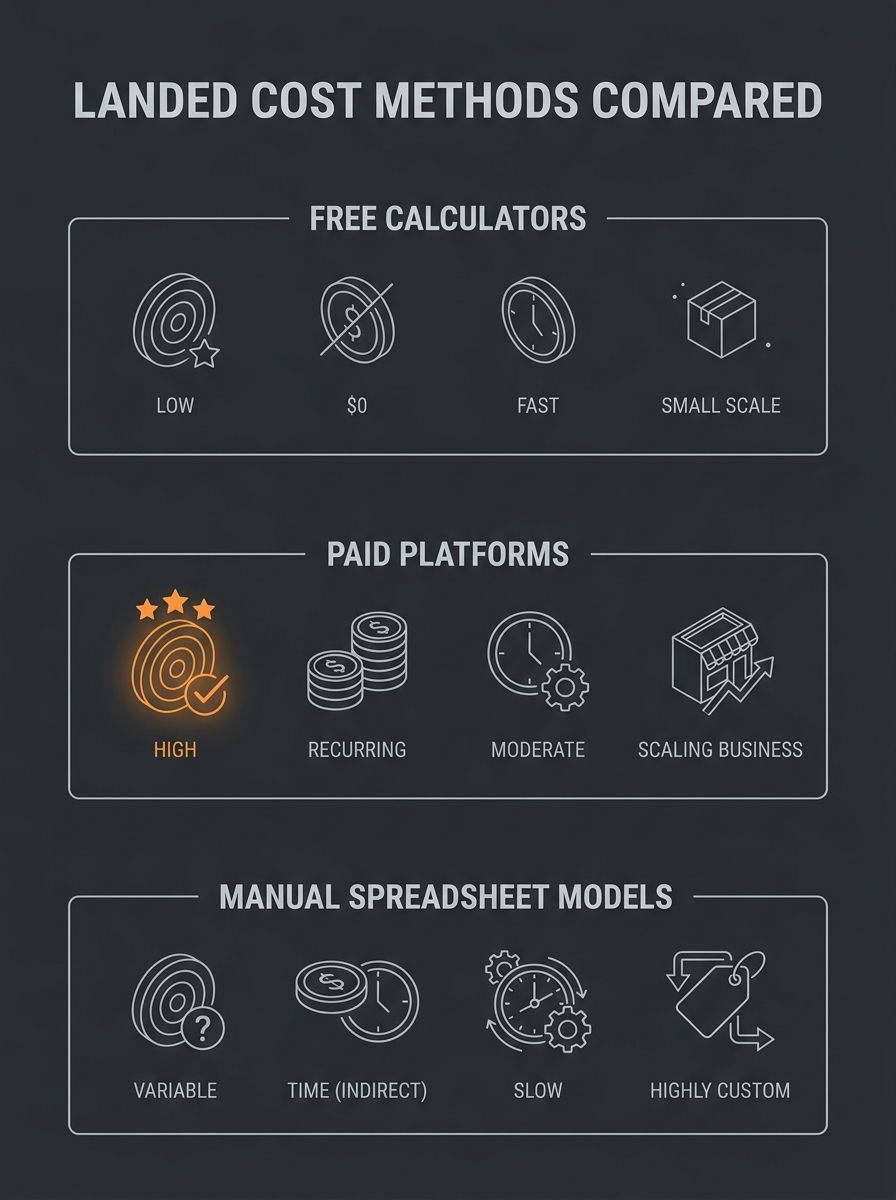
Three approaches dominate how dropshippers model their landed cost today: free online calculators, paid integrated platforms, and manual spreadsheet builds with broker verification. Each carries specific tradeoffs in accuracy, speed, and cost. Here's where each one excels and where each one will burn you.
Free Calculators: Fast Estimates with Dangerous Blind Spots
Tools like the Zonos duties and taxes calculator, FedEx International Shipping Assist, and various free HTS lookup databases give you a number in under two minutes. You punch in origin country, destination, product category, and declared value. Out comes a duty estimate.
The appeal is obvious: zero cost, zero commitment, instant output. For a quick sanity check on whether a product category faces 5% or 50% duties, these tools work fine.
But the blind spots are serious. Free calculators typically miss anti-dumping duties, countervailing duties, and the layered Section 301 tariffs that now push combined rates on many Chinese goods past 28%. They often rely on broad HS code categories rather than the specific 10-digit HTS codes that U.S. Customs actually uses. A silicone spatula and a silicone phone case might fall under different sub-headings with duty rates 15 percentage points apart, and a free tool may lump them together.
Currency conversion spreads are another gap. Platforms like Payoneer and Wise charge 1–3% on cross-border payments. On a $10 product cost, that's $0.10–$0.30 per unit — invisible in a free calculator but visible at 500 units a month.
When free calculators make sense
You're doing initial product research across 20–30 SKUs and need to eliminate the obvious losers. You don't need decimal-point accuracy at this stage. You need directional signals: is this product facing 5% duty or 30%? Free tools answer that question fast enough. If you've already mapped out how tariffs quietly destroy dropshipping margins, you know which product categories to screen out early.
When they'll mislead you
Any time you're making a final supplier selection or setting your retail price based on the output. Free calculators are screening tools, not pricing tools. Treating them as the latter is how people discover a 20–30 percentage point duty gap three weeks into a campaign.
Paid Integrated Platforms: Accuracy at a Monthly Cost
Zonos API, DHL's MyGTS tool, and Easyship's landed cost features represent the next tier. These platforms pull from regularly updated tariff databases, handle multi-country tax calculations (VAT, GST, sales tax), and in some cases integrate directly into your checkout flow for real-time DDP (Delivered Duty Paid) pricing.
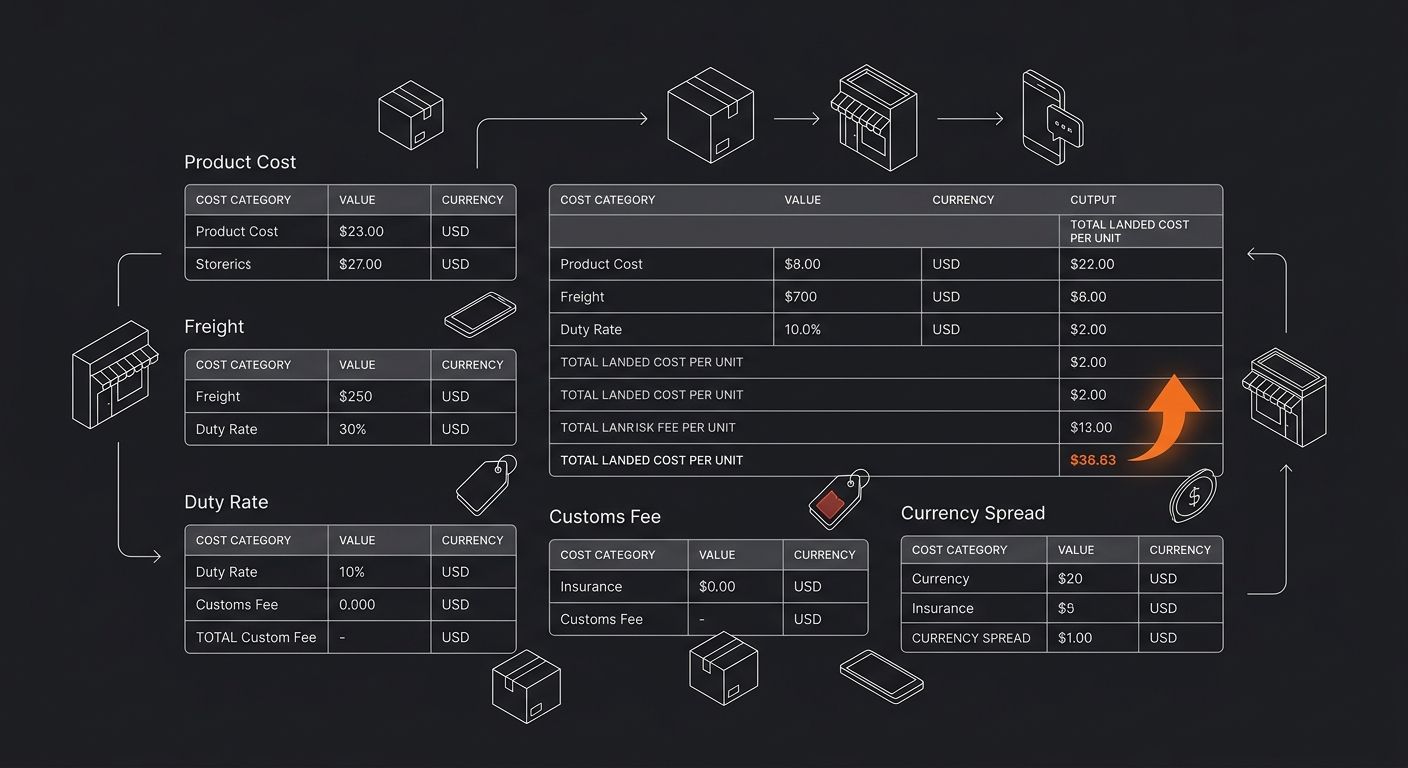
DHL's landed cost guide breaks the formula into its components: product cost, freight, duties and taxes, customs fees, insurance, and currency spread. Paid platforms attempt to automate most of those variables. The Zonos API, for instance, can classify products by HS code using product descriptions and return duty estimates specific to the buyer's country — useful if you're selling to multiple markets simultaneously.
Pricing varies. Zonos charges per transaction or via monthly plans starting around $50/month for small operations. DHL MyGTS is free for DHL customers but limited to DHL shipping lanes. Easyship offers tiered plans with landed cost features built into their shipping infrastructure.
Where paid platforms earn their cost
The real value shows up in two scenarios. First, when you're running multi-country operations where duty rates, VAT, and customs procedures differ wildly between, say, the UK (20% VAT), Australia (10% GST), and Canada (5% GST plus provincial taxes). Manually modeling each destination burns hours. Second, when you want DDP pricing at checkout — absorbing duties into your retail price instead of surprising customers with a customs bill on delivery. Platforms like Zonos handle that calculation in real-time.
For import duty margin modeling across a catalog of 50+ SKUs shipping to 3+ countries, these platforms pay for themselves in time saved and pricing errors avoided.
Where they still fall short
Even paid platforms can miss Section 301-specific tariff layers if their database update cycle lags behind policy changes. U.S. tariff policy shifted four times in Q1 2025 alone. And no automated platform can tell you whether your Chinese supplier is actually shipping goods that match the declared HS code. Misclassification triggers customs inspections, delays, and penalties — a risk that lives entirely outside the calculator. Running a supplier test order to verify declared values, weights, and classifications before committing volume remains essential regardless of which platform you use.
DIY Spreadsheet Model with Broker Verification: Maximum Control, Maximum Effort
The third approach skips software entirely and builds a custom landed cost spreadsheet from raw inputs. You look up HTS codes directly on the U.S. International Trade Commission database, manually layer Section 301 and any anti-dumping duties, add your freight quote, estimate customs processing fees ($0.50–$5 per parcel depending on carrier and entry type), include insurance (typically 0.5–1% of declared value), apply your payment platform's currency conversion spread, and calculate total landed cost per unit.
This is what serious operators building tariff impact unit economics models use when they need to compare three or four suppliers across different countries with full transparency into every cost line.
The ISM's procurement framework recommends running quarterly TCO reviews to refresh baselines and adapt to market changes. A DIY model makes those quarterly refreshes straightforward because you control every assumption. When tariff rates shift or shipping costs spike — and if you've followed how port disruptions reshape unit economics, you know they will — you update one cell and immediately see the margin impact across your entire catalog.
Building the model
The core formula:
Landed Cost per Unit = Product Cost + Freight per Unit + (Declared Value × Combined Duty Rate) + Customs Processing Fee + Insurance + (Product Cost × Currency Spread %) + Allocated Overhead
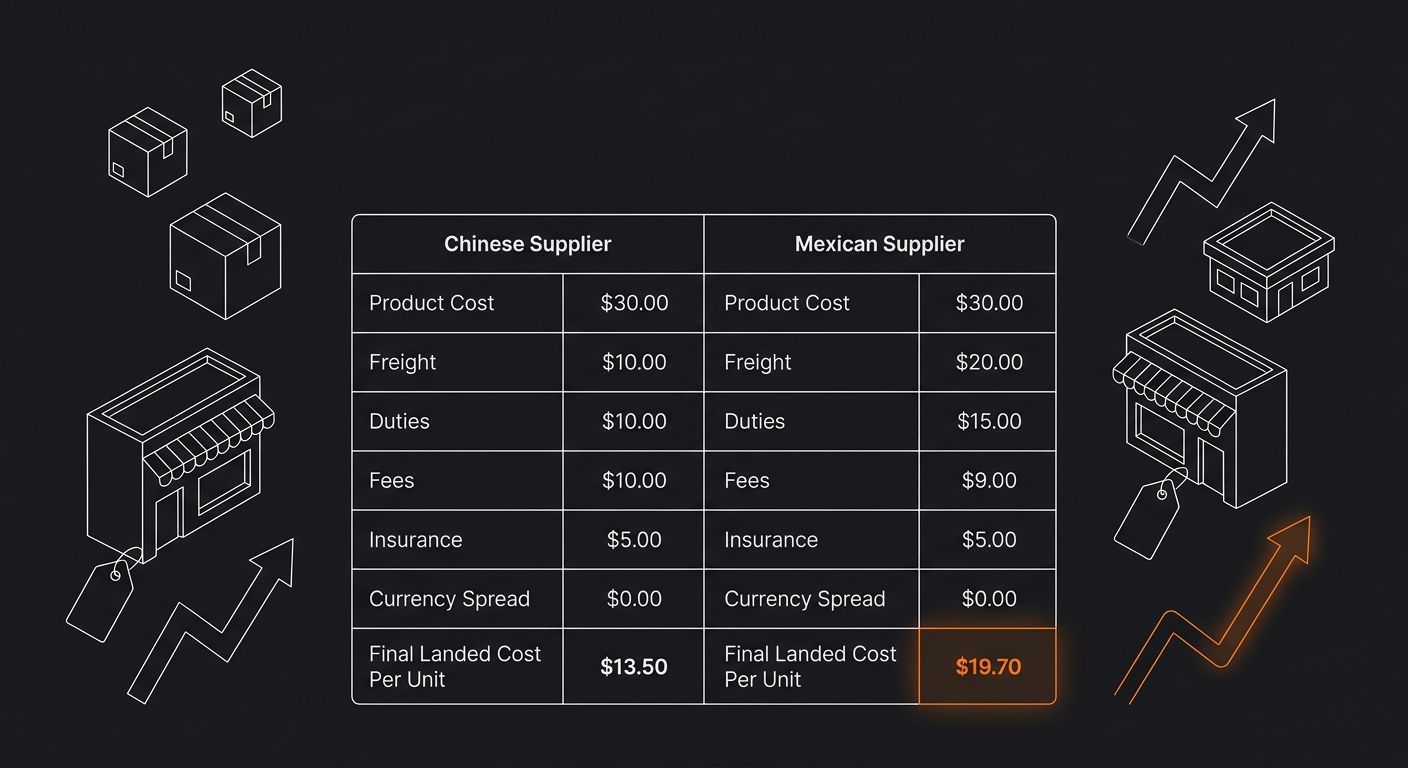
For the spatula example from a Chinese supplier:
Product cost: $4.50
Freight: $4.80
Declared value: $9.30
Combined duty rate: 28.4% (3.4% base + 25% Section 301)
Duties: $2.64
Customs processing: $0.50
Insurance: $0.05
Currency spread (2%): $0.09
Total landed cost: $12.58
Compare to the Mexican supplier:
Product cost: $6.80
Freight (domestic): $3.20
Duties: $0.00 (USMCA, 0% reciprocal rate as of October 2025)
Total landed cost: $10.00
The $2.30 gap per unit adds up to $1,150 on 500 monthly orders. Over a year, that's $13,800 in margin you'd lose by choosing the "cheaper" supplier.
The broker verification step
Where a spreadsheet alone falls short: HS code classification confidence. A customs broker charges $50–$150 for a formal classification ruling on a product, and for your top 5–10 SKUs (the ones generating 80% of revenue), that investment prevents the kind of misclassification that triggers a $5,000 customs penalty. Think of it as insurance that also produces a more accurate model.
Use the spreadsheet for every SKU. Use the broker for the SKUs that matter most. And if you're running the supplier audit flowchart to diagnose margin collapse, plug updated landed costs into that framework so you can isolate whether the problem is tariff math, ad spend, or supplier pricing changes.
When to avoid this approach
If you're testing 3 products and shipping to one country, a DIY spreadsheet is overkill. The setup time (2–4 hours for a well-structured model) doesn't justify itself until you're comparing at least 3 suppliers or shipping to multiple destinations. Below that threshold, a paid platform or even a free calculator with conservative buffers gets you close enough.
The Verdict: Matching the Method to Your Stage
The right landed cost dropshipping calculation method depends on where you are and what you're deciding.
Testing phase (1–10 SKUs, single destination country): Free calculators with a 10% buffer added on top. Screen aggressively, discard products where even optimistic duty estimates push your margin below 30%, and don't over-invest in precision you'll throw away when 8 of those 10 products fail market testing anyway.
Scaling phase (10–50 SKUs, 1–3 destination countries): A paid platform like Zonos or DHL MyGTS. The monthly cost is trivial against the pricing errors it prevents, and the real-time DDP capability protects you from customer chargebacks triggered by unexpected customs bills. If you're building proper contribution margin models that reveal profit gaps between equal-revenue products, accurate landed costs are the foundation those models rest on.
Established operations (50+ SKUs, 3+ countries, or any single SKU doing 500+ monthly units): DIY spreadsheet with quarterly broker verification on your top revenue SKUs. At this volume, the granularity pays for itself many times over, and no automated platform gives you the same visibility into how a 2% tariff rate change ripples through your entire P&L.
Whichever method you pick, build in a 5–10% buffer on every estimate. Tariff policy moves faster than any calculator's database. And the operator who models landed cost accurately before supplier selection — rather than discovering duty charges after the first 200 orders ship — is the one whose margin math actually survives contact with customs.
365 Dropship Editorial
Editorial team writing about E-commerce, dropshipping, and product discovery — reviews of dropshipping suppliers and platforms, trending niche guides (jewelry, beauty, pets, home, fashion), supplier due diligence, ecom operations, shipping & fulfillment strategy, product research, AOV optimization, and profitable dropshipping case studies.
Related Articles
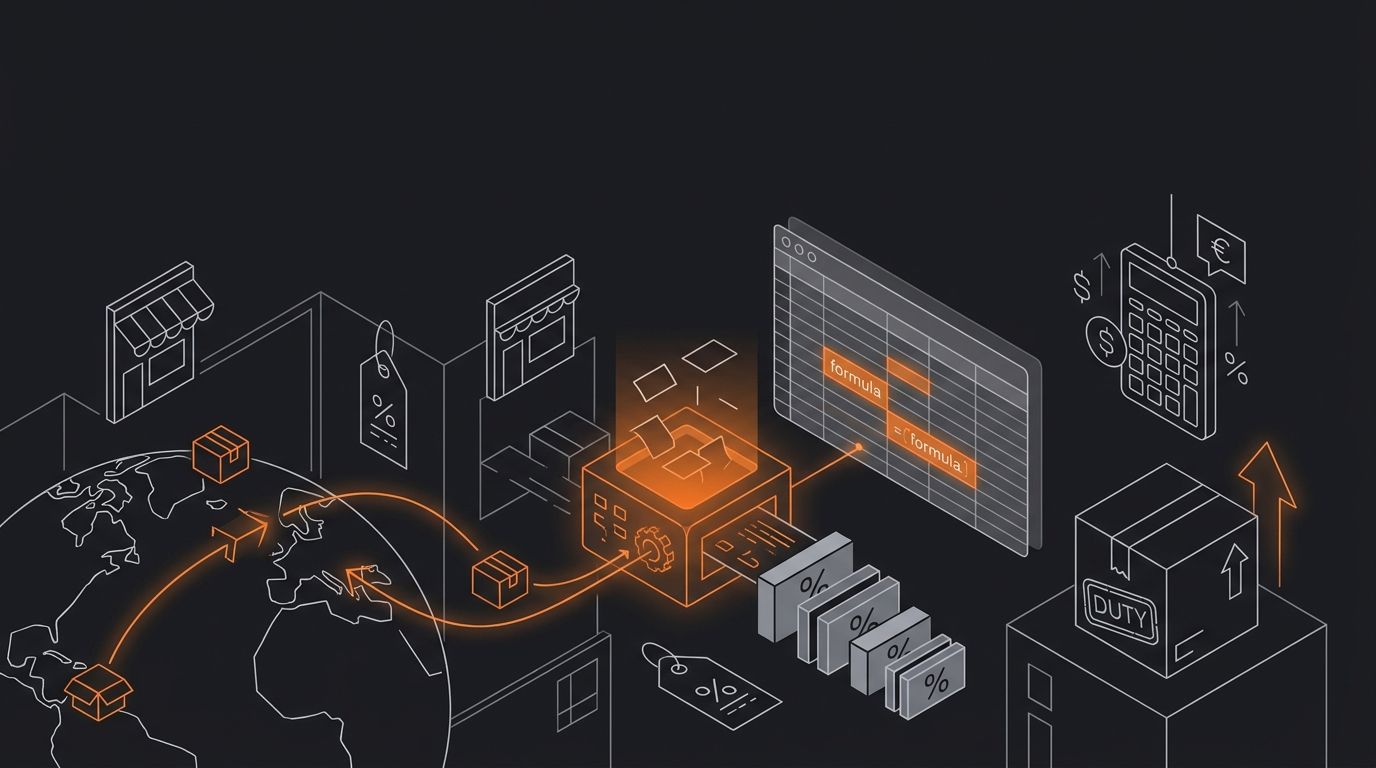
Building a Tariff-Aware Unit Cost Model: The Step-by-Step Framework for Cross-Border Dropshipping Math
A silicone kitchen spatula sourced from Guangdong at $4.50 per unit, with $4.80 in shipping, doesn't land in a U.S. customer's hands at $9.30. After a 28.4% combined duty rate, insurance, and processing fees, the true landed cost hits $12.94, slashing a perceived 60% gross margin to roughly 48%.
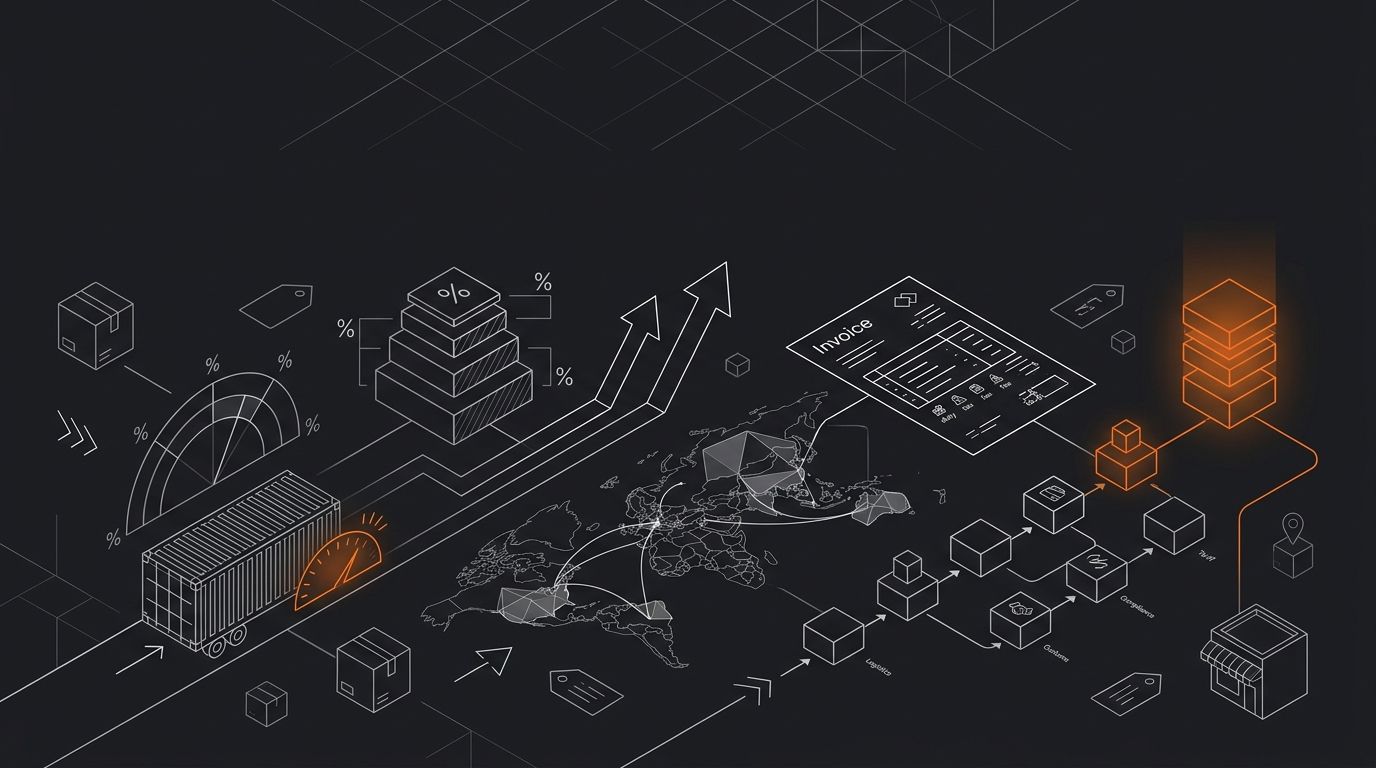
Cross-Border Tariffs & Import Duties: The Hidden Margin Killer Dropshippers Overlook
Every package entering the U.S. from China now triggers a full customs entry.

Container Freight Surges and Dropshipping Unit Economics: Why Port Efficiency Losses Are Reshaping Your 2026 Supplier Costs
Landed cost calculators take your product cost, layer on freight, duties, insurance, and port fees, then output the true per-unit cost of getting inventory to a customer's door.
Explore more topics