How to Do Dropshipping: Complete Beginner's Guide
This guide walks you through how to do dropshipping from zero to first sale in under a week. Seven steps cover niche selection, business registration, store setup, supplier vetting, product pricing, test orders, and ad launch, with specific costs and timelines at each stage.
How to Do Dropshipping: Complete Beginner's Guide
This guide walks you through how to do dropshipping from zero to first sale in under a week. Seven steps cover niche selection, business registration, store setup, supplier vetting, product pricing, test orders, and ad launch, with specific costs and timelines at each stage.
Before You Start
You need four things before step 1:
A budget of $100–$150 for domain, Shopify subscription, sample orders, and initial ad spend. Shopify offers a $1/month trial for the first three months, which keeps platform costs near zero during validation.
A PayPal Business or Stripe account to accept customer payments. Both take about 10 minutes to set up.
A legal entity or intent to register one. You'll form an LLC or sole proprietorship in Step 2, but research your state's filing fees ahead of time ($50 in most states, up to $500 in California and Massachusetts).
Basic comfort with drag-and-drop website builders. You don't need coding skills. If you've used Google Docs, you can build a Shopify store.
Time commitment: 8–15 hours spread across one week for steps 1 through 6. Step 7 (ads and fulfillment) is ongoing.
Step 1, Pick a Niche That Supports 40% Margins
The niche determines everything downstream: your supplier pool, your ad creative, your return rate, and your margin ceiling. Generic stores selling phone cases next to dog toys next to yoga mats confuse ad algorithms and dilute brand identity. As Zendrop's dropshipping framework puts it, the entire system boils down to focused execution: "Master these, and you'll make money".
What actually works: pick a category where products sell for $25–$75 retail, cost $5–$20 from suppliers, and solve a specific problem. Kitchen gadgets, pet accessories, and home office gear consistently hit these numbers. If you're considering apparel, understand that the category carries a 20–30% return rate, the highest in dropshipping.
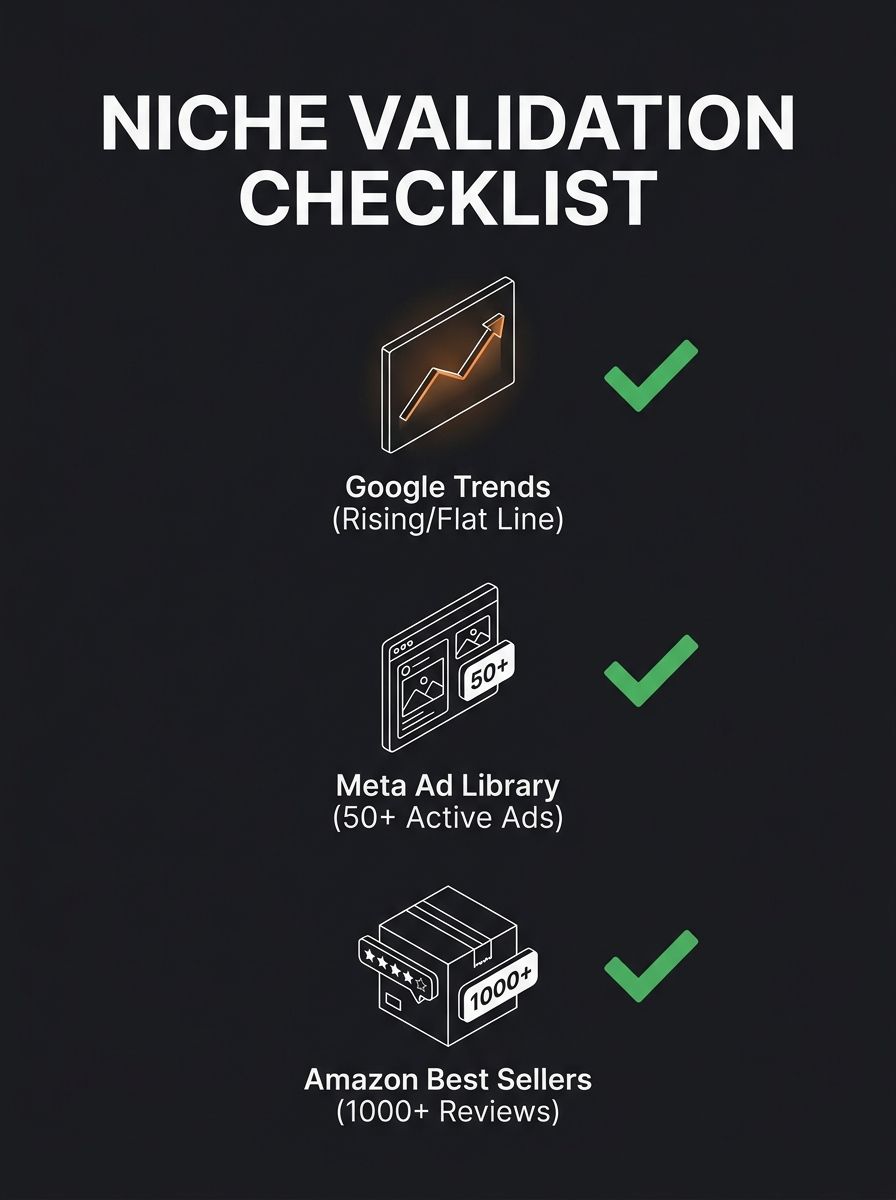
Use these free tools to validate demand:
Google Trends, search your niche keyword and confirm the interest line is flat or rising over 12 months. Declining trends kill stores.
Meta Ad Library, search your niche and count how many active ads you see. 50+ active ads signals proven demand. Zero ads signals no market.
Amazon Best Sellers, browse subcategories in your niche. Products with 1,000+ reviews and 4+ star ratings confirm sustained buyer interest.
You'll know this step is done when you can name your niche in three words or fewer ("ergonomic desk accessories," "dog training gear") and you've confirmed 50+ active Meta ads in that space.
Step 2, Register Your Business
Dropshipping is legal in the US, EU, UK, Canada, and Australia, and no legislation in any of these markets bans the fulfillment model. But you still need a registered business entity to open wholesale supplier accounts and accept payments without personal liability.
File an LLC through your state's Secretary of State website. Filing fees range from $50 (most states) to $500 (California, Massachusetts). Processing takes 1–7 business days. Skip the $300+ "formation services" that crowd your search results; you can file directly for the base fee.
After filing, get these two items:
EIN (Employer Identification Number), free from the IRS website, issued instantly online. You need this for business bank accounts and tax filings.
Sales tax permit, required in most states before you collect sales tax. Apply through your state's Department of Revenue. Free in most jurisdictions.
You'll know this step is done when you have an LLC confirmation document, an EIN letter, and a sales tax permit number.
Step 3, Build Your Storefront on Shopify
Shopify controls roughly 29% of the US ecommerce platform market and offers the deepest integration ecosystem for dropshipping apps. Start with their $1/month trial plan, which gives you full store functionality for three months before you're charged the standard $39/month.
Here's the build sequence:
Buy a
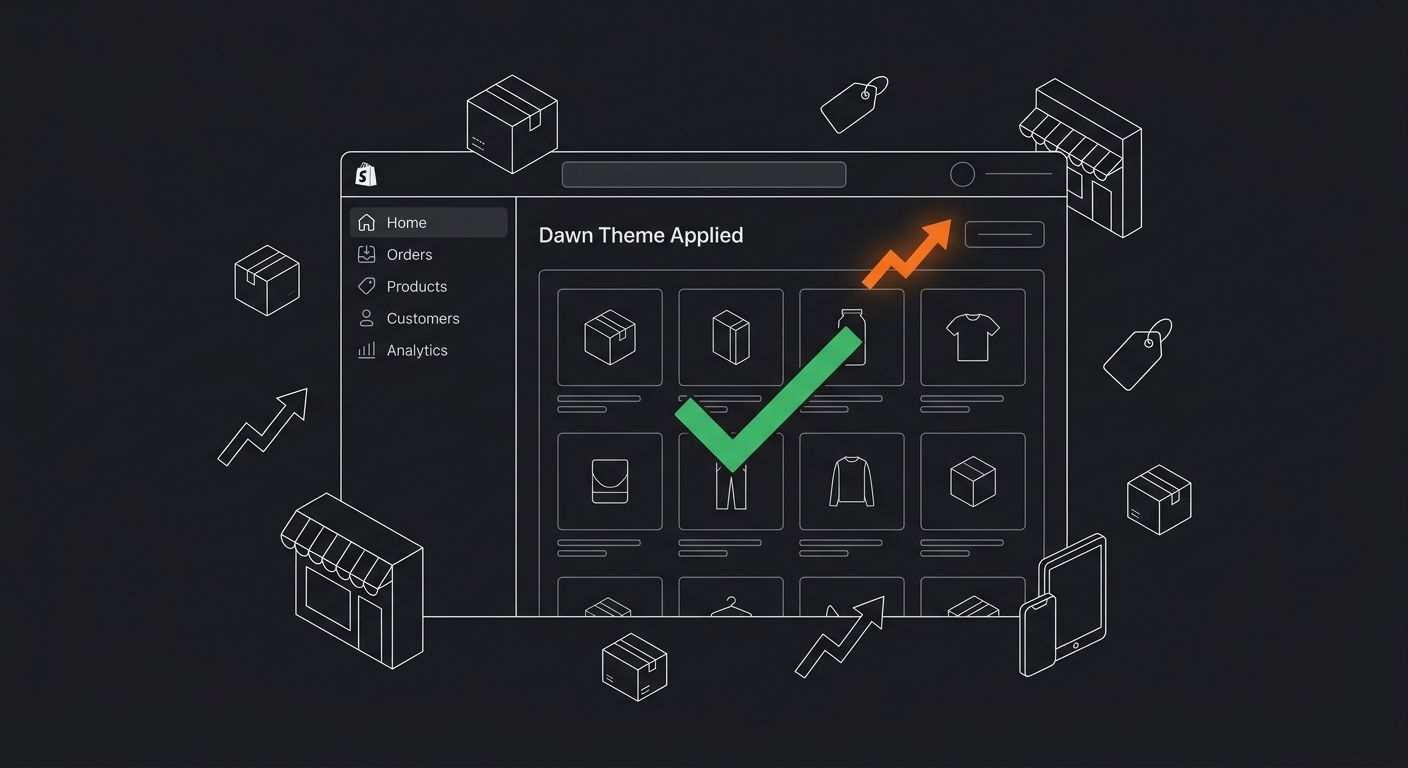
.comdomain ($12–$15/year through Shopify or Namecheap). Your domain should be brandable, not keyword-stuffed. "CozyDeskCo.com" beats "BestErgonomicDeskAccessoriesShop.com."Pick a free theme (Dawn or Refresh). Paid themes aren't necessary at launch.
Create five core pages: Home, Shop, About, Contact, Shipping & Returns Policy.
Set up Shopify Payments (Stripe-powered, built in) so you avoid the 2% transaction fee Shopify charges for external payment gateways.
Install Google Analytics 4 and the Meta Pixel. Both are free. You need tracking in place before you spend a dollar on ads.
Shopify's own comparison documentation states that "Dropshipping can offer minimal start-up costs, since there's no inventory to purchase, and no need for inventory management". That advantage is maximized when your platform costs stay under $20/month during validation.
Stores with mobile load times above 2.5 seconds lose roughly half their traffic before a single product page renders. Test with Google PageSpeed Insights after setup.
You'll know this step is done when your store loads in under 2.5 seconds on mobile, your payment gateway processes a $1 test transaction, and your Meta Pixel fires on every page (verify in Meta Events Manager).
Step 4, Find and Vet Your Suppliers
Supplier quality determines whether your store survives past month two. When order volume hits 5–10 orders per day, poor suppliers generate complaints and refund requests that eat your margin and tank your ad account reputation. One experienced dropshipper on r/dropshipping noted that platforms like "Drophippo, Zendrop, Sup Dropshipping, Wiio" are more reliable than AliExpress but still have limitations at scale.
Where to source:
Platform | Shipping to US | Typical Delivery | Monthly Fee | Best For |
|---|---|---|---|---|
Spocket | US/EU warehouses | 3–7 days | $39/mo | US-based fast shipping |
Zendrop | US/China warehouses | 5–12 days | $0–$49/mo | Beginners, branded invoicing |
CJ Dropshipping | China + US warehouses | 7–15 days | Free | Custom packaging, bulk |
AliExpress | China direct | 15–30 days | Free | Product research, testing |
The supplier vetting checklist (three non-negotiable criteria):
Response time under 24 hours. Send a test message before you commit. If they take 48+ hours to reply when they're trying to win your business, they'll take a week when you have a problem.
Documented return/refund policy. As TopDawg's retailer guide advises, "Look for suppliers with consistently positive feedback from other retailers" and verify that clear policies on returns, refunds, and minimum order quantities are published.
Positive retailer feedback. Check reviews from other store owners, not end consumers. A supplier with 4.8 stars from buyers but complaints from retailers about late shipping is a red flag you'll discover painfully.
Be aware that 18% of AliExpress dropshipping suppliers exited the platform in the first five months of 2026 as China's factory base consolidates. Vet for longevity, not just price.
You'll know this step is done when you've identified 3–5 suppliers in your niche, received a response from each within 24 hours, and confirmed their return policies in writing.
Step 5, Import Products and Set Prices
Import 15–25 products to start. Enough variety to test what sells, few enough to write real product descriptions for each one. Copy-paste manufacturer descriptions are an SEO death sentence and signal to customers that you're a resale operation.
Pricing formula: multiply your total landed cost (product cost + shipping to customer) by 2.5×. If a product costs $8 from your supplier and shipping runs $4, your landed cost is $12 and your retail price is $30. That gives you an $18 gross margin (60% gross) before ad spend, which leaves room for a 40% gross margin after typical Meta ad costs of $8–$12 per acquisition.
Work through your profit margin calculations for each product before importing. Products that can't sustain a 2.5× markup at a competitive retail price get cut from the catalog.
For each product listing, write:
A benefit-first title (what it does for the buyer, not just what it is)
3–5 bullet points covering dimensions, materials, and use cases
5+ product photos, with at least one lifestyle image showing the product in use
You'll know this step is done when you have 15–25 products live with original descriptions, accurate pricing at 2.5× landed cost, and at least one sample ordered per supplier.
Step 6, Place a Test Order
Before any customer touches your store, buy something from it yourself. Use a real credit card. Go through the full checkout flow. This catches broken discount codes, incorrect shipping rates, missing confirmation emails, and payment gateway errors that are invisible from the admin side.
Track the order through to delivery. Time it. If your supplier promises 5–7 day delivery to the US and your package arrives in 14 days, you have a supplier problem to resolve before launch. Record the unboxing, because that footage becomes your first piece of authentic ad creative.
You'll know this step is done when you've received your own order, confirmed the product quality matches the listing, and documented the actual delivery time.
Step 7, Launch Ads and Start Fulfilling Orders
Meta ads drive roughly 68% of traffic for successful dropshipping stores. Start with a $20/day budget split across 3–4 ad sets, each targeting a different interest audience within your niche. Use the sample product you received in Step 6 for your creative: short-form video (15–30 seconds) showing the product in use outperforms static images by wide margins.
Ad structure for your first campaign:
Campaign objective: Sales (not traffic, not engagement)
Budget: $20/day, campaign budget optimization (CBO)
Audience: US only, age 25–55, 3–4 different interest targets per ad set
Creative: One video ad, one carousel ad per ad set
Landing page: Direct to product page, not homepage
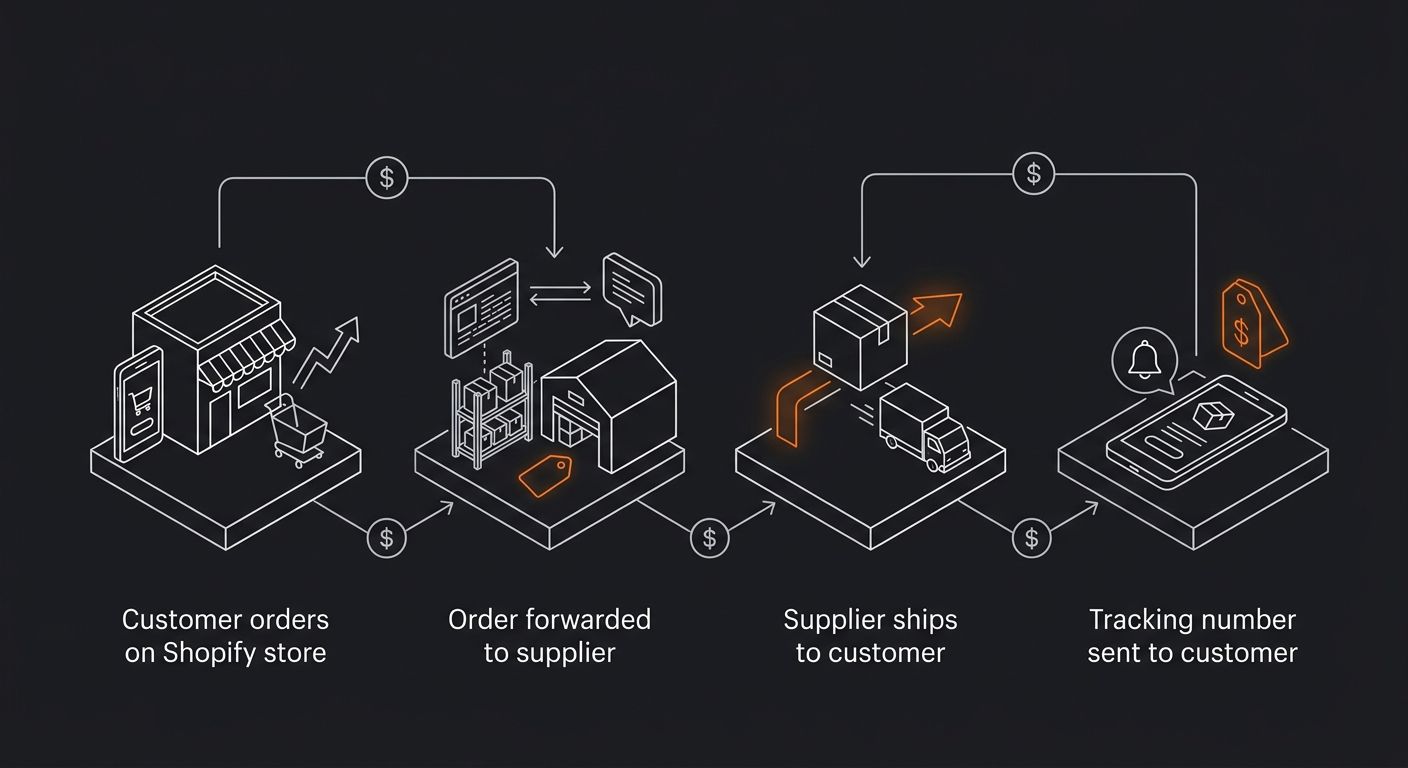
When orders come in, your fulfillment workflow runs four stages: customer places an order on your Shopify store, you (or your automation app) forward the order to your supplier with the customer's shipping address, the supplier ships directly to the customer, and you receive a tracking number to forward via Shopify's order notifications.
If you're processing more than 5 orders per day manually, install a dropshipping automation app like DSers or AutoDS to handle order forwarding automatically.
You'll know this step is done when your first paid order arrives at a customer's door with a tracking number, and your ad account shows a cost per purchase under $15.
When Things Break
Three problems hit almost every new dropshipping store in the first 30 days:
Ads spend money but generate zero sales. Your product page is the usual culprit, not the ad itself. Check your page load speed (must be under 2.5 seconds), verify your product photos aren't blurry supplier stock images, and confirm your price isn't 40% higher than competitors selling the same item. If your click-through rate is above 1% but conversion is zero, the landing page needs work. If CTR is below 0.5%, the ad creative needs replacing.
Supplier ships late or sends wrong items. This is why you vetted multiple suppliers in Step 4. Switch to your backup supplier immediately. Don't apologize to the customer and keep using the same unreliable source. One late shipment is a fluke. Two is a pattern. Three means you've lost that customer forever and earned a chargeback.
Payment processor holds your funds. Stripe and PayPal both flag new accounts with sudden revenue spikes. Keep your refund rate below 1%, respond to disputes within 24 hours, and expect a rolling reserve (they hold 10–30% of revenue for 90 days) during your first few months. This is normal for new accounts, not a punishment.
Where to Go From Here
Your store is live, orders are flowing, and you understand how to do dropshipping from niche selection through fulfillment. The first $1,000 in revenue validates the model. The next decisions shape whether this stays a side project or becomes a real business.
At 10+ orders per day, migrate your best-selling products to US-based suppliers with 3–5 day shipping windows even if the per-unit cost is higher. The reduction in refund requests and increase in repeat purchases more than offsets the margin hit. At 30+ orders per day, consider private labeling your top 2–3 products, which means adding your brand to the packaging and product itself. Private labeling typically adds 15–20 percentage points to gross margin because you're no longer competing on the same commodity listing as everyone else sourcing from the same factory.
And if figuring out how to.do dropshipping felt overwhelming at the start, look back at what you actually built: a registered business, a functioning storefront, vetted suppliers, real products with real margins, and a paid acquisition channel driving customers to your door. Everything from here is optimization, not reinvention.

Ryan Torres
Ryan Torres is a former Amazon FBA seller turned dropshipping consultant who has generated over $2.8M in ecommerce revenue across 14 product launches. He specializes in supplier vetting, margin optimization, and scaling DTC operations for sub-$1M brands. Ryan focuses on actionable frameworks that drive measurable results for independent operators.
Frequently Asked Questions
- How much does it cost to start a dropshipping business?
- You can start a dropshipping business for under $150, which covers a domain ($12–$15/year), Shopify's $1/month trial for three months, sample orders from suppliers, and initial ad spend. An LLC registration adds $50–$500 depending on your state.
- What profit margins should I target for dropshipping products?
- Look for products with at least 40% gross margins. Use the 2.5× markup formula: multiply your total landed cost (product cost plus shipping) by 2.5× to set your retail price, which typically gives you a 60% gross margin before ad costs.
- How do I find a good dropshipping supplier?
- Vet suppliers by checking response time (under 24 hours), documented return/refund policies, and positive feedback from other retailers. Order samples from at least 3–5 suppliers in your niche before importing their products to confirm quality.
- What should I include in my dropshipping product listing?
- Write a benefit-focused title, 3–5 bullet points covering dimensions and materials, and at least 5 product photos including one lifestyle image showing the product in use. Write original descriptions instead of copying manufacturer text.
- How long does it take to launch a dropshipping store?
- You can complete steps 1 through 6 (niche selection through test orders) in 8–15 hours spread across one week. Step 7 (ads and ongoing fulfillment) continues indefinitely.
- What is the best platform for dropshipping in 2024?
- Shopify controls roughly 29% of the US ecommerce platform market and offers the deepest integration ecosystem for dropshipping apps. Start with their $1/month trial plan for full store functionality before switching to the standard $39/month plan.
- How should I price my dropshipping ads?
- Start with a $20/day budget split across 3–4 ad sets using Meta ads, which drive roughly 68% of traffic for successful dropshipping stores. Use short-form video creative (15–30 seconds) showing your product in use, as video outperforms static images.
- What causes dropshipping stores to fail in the first 30 days?
- The three most common problems are ads spending money with zero sales (usually due to page load speed, blurry product photos, or uncompetitive pricing), suppliers shipping late or sending wrong items, and payment processors holding funds due to sudden revenue spikes on new accounts.
Related Articles
Dropshipping How to: Complete Beginner's Guide
Every step of launching a dropshipping store fits into a single weekend: niche selection, LLC registration, Shopify storefront, supplier vetting, product import, and a live test order. Total startup cost sits under $150, and you'll have a functioning store accepting real orders by Sunday night.
What is Dropshipping: Complete Beginner's Guide
The global dropshipping market is projected to hit $537.8 billion in 2026, expanding at a 23.6% compound annual growth rate through 2032. Dropshipping is an ecommerce fulfillment model where you sell products online without purchasing or storing inventory.
Shopify and Dropshipping: Complete Setup Guide
Configuring a Shopify dropshipping store from account creation through first live product takes roughly 90 minutes across six steps.
Explore more topics