Dropshipping Apparel: Complete Startup Guide
Apparel carries a 20–30% return rate in ecommerce, the highest of any dropshipping category, and sizing errors drive the majority of those returns.
Dropshipping Apparel: Complete Startup Guide
Apparel carries a 20–30% return rate in ecommerce, the highest of any dropshipping category, and sizing errors drive the majority of those returns. This guide walks you through supplier selection, app setup, size-chart configuration, and launch marketing so you can open a profitable apparel dropshipping store within one week.
Before You Start
You need five things in place before Step 1 makes sense:
A Shopify account ($39/month for Basic). WooCommerce works too, but Shopify's app ecosystem is deeper for apparel dropshipping and the supplier integrations are more reliable. A recent platform cost comparison from BuckyDrop breaks down the differences.
A domain name (~$14/year through Shopify or Namecheap).
A working budget of $500–$1,500 for your first three months. According to Ship To The Moon's 2026 startup cost breakdown, many guides claim you can start with "just a few hundred dollars," but proper product testing, cash-flow survival, and legal compliance push the real number higher.
A Canva account (free tier is fine) for social content and product mockups.
4–6 hours of uninterrupted setup time to get through Steps 1–5 in a single session.
Your knowledge level: you should understand basic ecommerce concepts (what a product listing is, how checkout works) and be comfortable installing Shopify apps. No coding required.
Step 1: Pick a Niche Within Apparel
The goal here is to narrow "clothing" down to a sub-category specific enough to target with ads but large enough to sustain $5K–$15K/month in revenue.
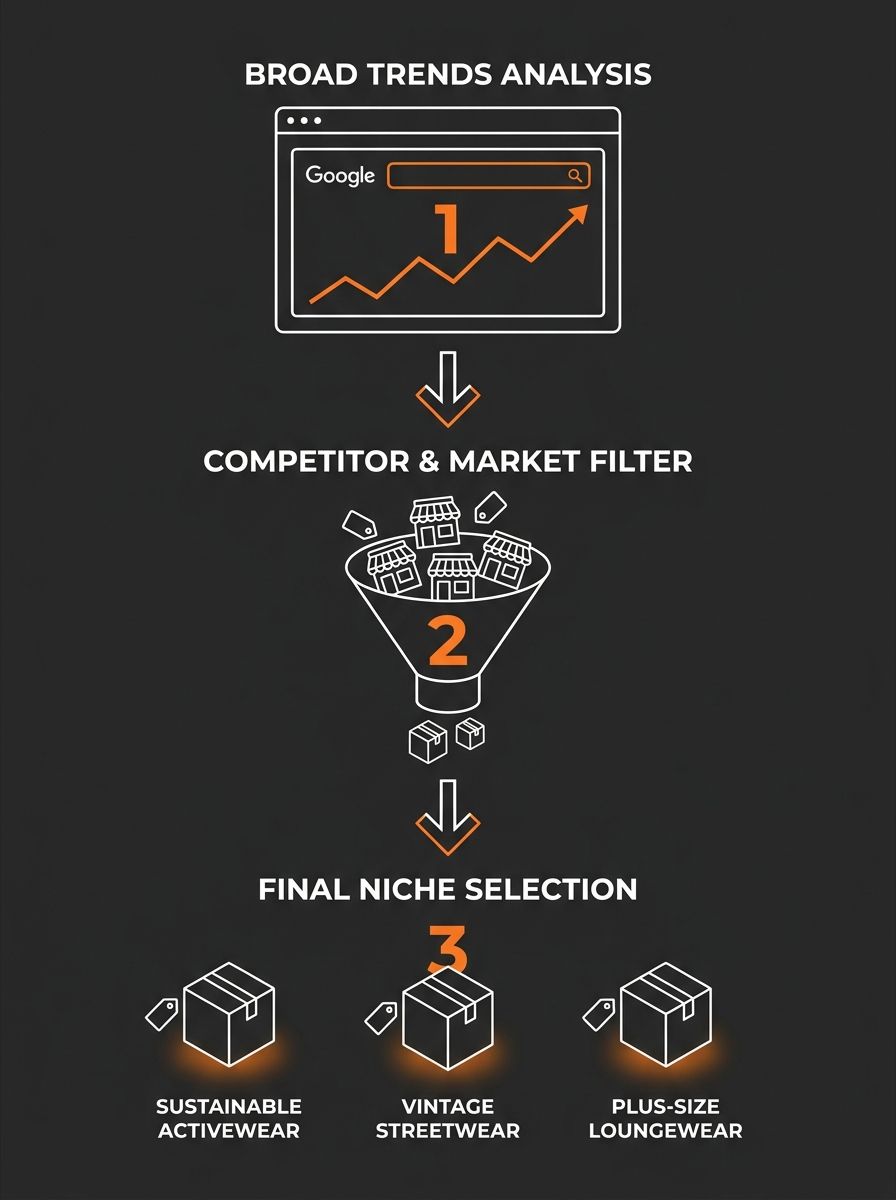
Fashion holds a 38.5% share of global ecommerce through 2035, and the global online apparel market is projected to exceed $1.9 trillion. The market is enormous, which means generic stores get buried. Sub-niches that are working right now: modest fashion, hybrid workwear (office-to-gym pieces), extended sizing (2XL–5XL), and streetwear accessories.
The action: Open Google Trends and search your candidate niche term (e.g., "modest fashion dress" or "oversized streetwear hoodie"). You want steady or rising interest over 12 months, not a spike that's already fading. Cross-reference with the approach we covered in our eBay product research guide to validate demand on a second platform.
You'll know it worked when you've identified 1 niche with stable search interest and at least 3 competitor stores already selling in that space (competitors prove demand exists).
Step 2: Choose Your Supplier Platform
This is where apparel dropshipping diverges sharply from general product dropshipping. You're choosing between two models: print-on-demand (POD), where a supplier prints your custom designs onto blank garments, and pre-made inventory, where you list existing products from a supplier's catalog.
Printify notes that POD "is perfect for dropshipping because there are no minimum orders or upfront costs." Pre-made inventory suppliers like Trendsi offer faster shipping but less brand differentiation.
Supplier | Monthly Fee | Avg US Ship Time | Min Order | Best For |
|---|---|---|---|---|
Printify | Free–$29.99 | 2–7 days | None | POD, comparing print providers |
Printful | Free (pay per item) | 2–5 days | None | POD, custom branding |
Trendsi | Free | 2–5 days | $59 | Women's fashion, pre-made catalog |
Bloom Dropship | $69.95+ | 2–5 days | None | Established brands, social sellers |
CJ Dropshipping | Free | 7–15 days (China warehouse) | None | Budget items, wide variety |
Bloom Dropship starts at $69.95/month and targets established brands doing enough volume to justify the subscription. If you're launching your first store, Printify or Trendsi are better starting points because they don't charge monthly fees until you scale.
The action: Sign up for 1–2 supplier platforms. Browse their apparel catalogs and confirm they carry products in your chosen niche. Order 2–3 samples to yourself ($15–$40 total) so you can photograph actual product quality and verify sizing.
You'll know it worked when you're holding physical samples and can confirm fabric weight, print quality (for POD), and accurate sizing against the supplier's charts.
Step 3: Connect Your Store and Install Apps
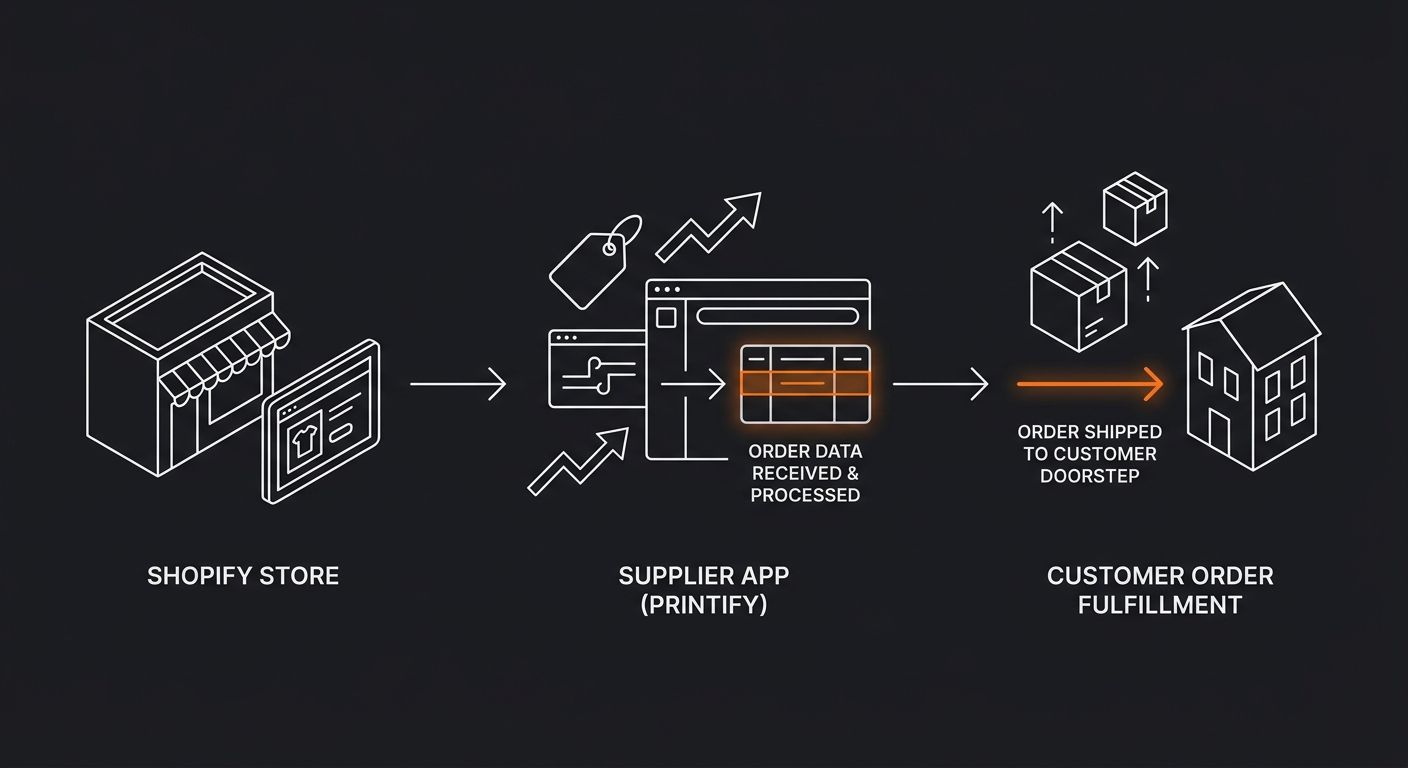
The goal is a functioning Shopify store with your supplier app integrated and auto-syncing orders.
The action sequence:
Open Shopify, create your store, and pick a free theme (Dawn works well for apparel).
Install your supplier's app from the Shopify App Store (Printify, Spocket, CJ Dropshipping, or DSers depending on your Step 2 choice). We reviewed the best Shopify dropshipping apps if you want a deeper comparison.
Connect your supplier account to the app.
Install a size-chart app (Kiwi Size Chart is free and handles per-product charts).
Install a reviews app (Judge.me's free plan collects photo reviews, which matter heavily for apparel conversion).
You'll know it worked when you can click "Add to Store" on a supplier product and it appears as a draft listing in your Shopify admin within 60 seconds.
Step 4: Build Your First Product Catalog
Printful's 2026 startup guide recommends starting with 10–25 products for one audience and one style direction. A new store doesn't need 100 products. Overwhelm kills conversion rates.
The action: Import 10–25 products from your supplier into Shopify. For each product:
Write a unique description (don't copy-paste the supplier's default text).
Set your price at a 3x markup on landed cost. If a t-shirt costs you $8.50 from the supplier plus $4.50 shipping, your landed cost is $13. Your retail price should be ~$39. Use a margin formula spreadsheet to model this across your catalog.
Upload the supplier's product photos, but also add your own sample photos if you ordered in Step 2.
You'll know it worked when you have 10–25 published products with consistent pricing, original descriptions, and a mix of supplier and original photography.
Step 5: Configure Size Charts and Returns
Sizing accuracy is the single biggest profitability lever in apparel dropshipping. The industry-average 20–30% return rate eats margins alive, and most returns happen because a customer guessed wrong on sizing.
The action:
Open your size-chart app (Kiwi or similar).
For every product, create a chart using actual garment measurements in both inches and centimeters. Don't use generic S/M/L descriptions. List chest width, body length, and sleeve length for each size.
Add model context to your product pages: "Model is 5'7", wearing size S, chest 34"." This single line reduces size-related support tickets dramatically.
Write a returns policy that accounts for sizing exchanges. A 15-day exchange window (not refund, exchange) keeps customers in your ecosystem instead of losing the sale entirely.
You'll know it worked when each product page shows a size chart with 3+ measurements per size and at least one line of model context.
Step 6: Set Up Your First Marketing Channel
Effective apparel marketing in 2026 runs on original UGC-style video, not polished brand content. TikTok and Instagram Reels reward authenticity, and micro-influencers deliver better ROI than paid placements for sub-$1M brands.
The action:
Create a TikTok Business account and an Instagram Professional account.
Film 3–5 short videos (15–30 seconds) showing your sample products in real settings. Phone camera, natural light, no studio.
Reach out to 5–10 micro-influencers (1K–50K followers) in your niche. Offer free product in exchange for a video post. Budget $0–$50 per influencer at this stage.
Set up a Meta Ads account with a $20/day test budget. Run traffic to your best-selling product page, not your homepage.
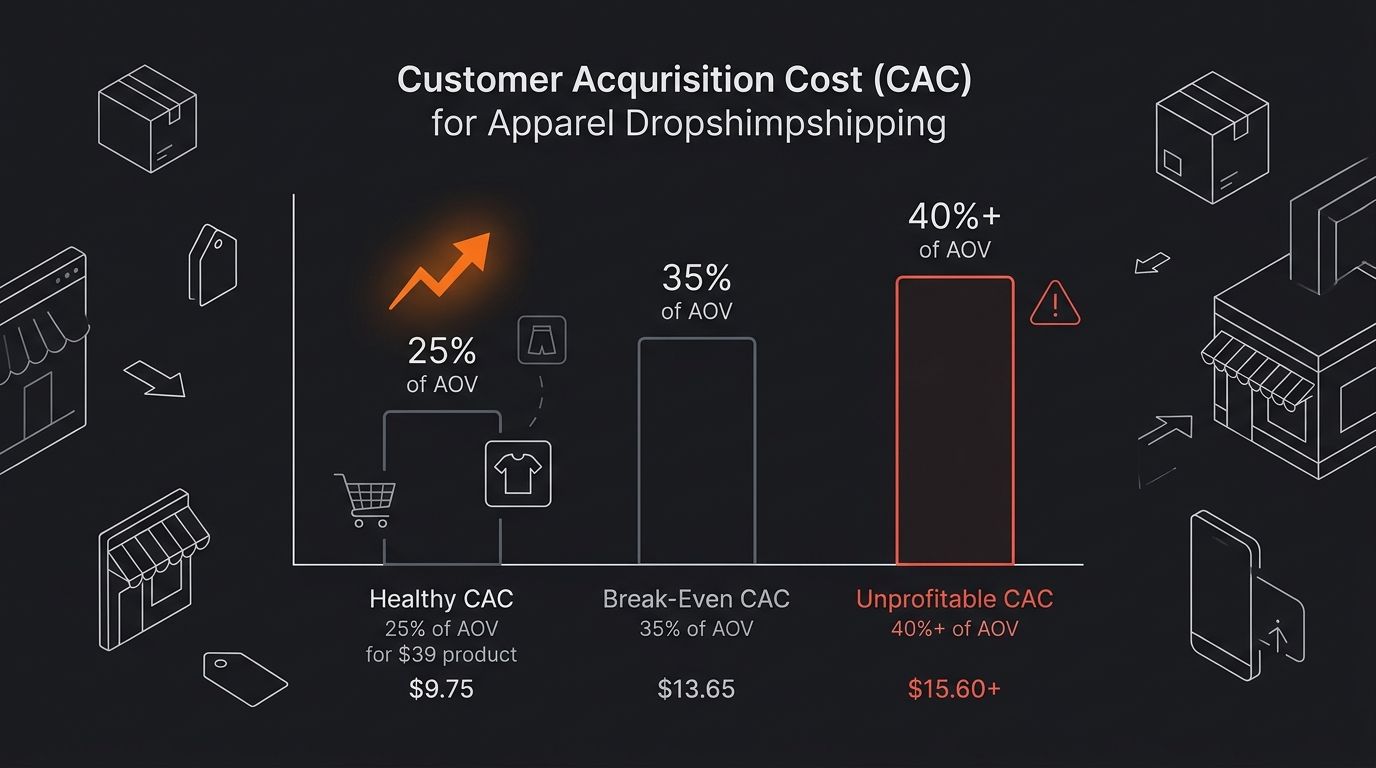
Keep your blended Customer Acquisition Cost (CAC) below 25–30% of your Average Order Value (AOV). On a $39 t-shirt, that means spending no more than $9.75–$11.70 to acquire each customer. If you're above that threshold after 7 days of spend, pause the ad and test a different creative or audience.
You'll know it worked when you've published at least 3 pieces of video content and have a test ad running with trackable conversions in your Shopify dashboard.
Troubleshooting: Three Things That Break First
Sizing complaints flooding your inbox. This means your size charts are either missing or using the supplier's generic sizing instead of actual garment measurements. Fix: order one unit of each size, measure it yourself, and update the charts. Twenty minutes of measurement saves hundreds of dollars in returns.
Shipping takes 15+ days and customers open disputes. You're likely selling products fulfilled from a Chinese warehouse without realizing it. Fix: filter your supplier catalog by fulfillment location and switch to US/EU warehouse stock. If your supplier doesn't offer domestic fulfillment, check the carrier-specific shipping breakdowns to set accurate delivery expectations on your product pages.
Inventory sync failures cause overselling. Your supplier app shows a product as in stock, a customer orders it, and then the supplier cancels because the item is actually sold out. This happens more often with pre-made inventory suppliers than POD. Fix: set your app to sync inventory every 2–4 hours (not daily), and keep your catalog small enough that you can manually verify stock on your top 5 sellers weekly.
Where to Go From Here
Once you've completed 20–30 orders and confirmed your return rate, margin, and CAC are within the benchmarks above, you're ready for the next phase. Expand your catalog to 40–60 products within the same niche. Test a second marketing channel (email collection via Klaviyo's free tier, which covers up to 500 contacts). And if you find a winning product doing $50+/day consistently, explore moving it from dropshipping to wholesale. As Trendsi's model comparison notes, "dropshipping requires low investment but offers lower profit margins," while wholesale buying in bulk leads to higher per-unit profits and more control over branding. That transition from dropshipping to wholesale on your proven winners is where real margin expansion happens, and it's a natural second act once your first apparel store is generating consistent daily revenue.

Ryan Torres
Ryan Torres is a former Amazon FBA seller turned dropshipping consultant who has generated over $2.8M in ecommerce revenue across 14 product launches. He specializes in supplier vetting, margin optimization, and scaling DTC operations for sub-$1M brands. Ryan focuses on actionable frameworks that drive measurable results for independent operators.
Frequently Asked Questions
- What is the average return rate for apparel dropshipping?
- Apparel carries a 20–30% return rate in ecommerce, the highest of any dropshipping category, with sizing errors driving the majority of those returns.
- How much money do I need to start an apparel dropshipping store?
- You should budget $500–$1,500 for your first three months to cover product testing, cash-flow survival, and legal compliance, though many guides underestimate this figure.
- What are the best dropshipping suppliers for apparel?
- The top suppliers for apparel are Printify and Printful (print-on-demand with no monthly fees), Trendsi (pre-made inventory for women's fashion), and CJ Dropshipping (budget items with wide variety).
- How should I price apparel products for dropshipping?
- Price apparel at a 3x markup on landed cost (supplier price plus shipping). For example, if a t-shirt costs $8.50 from the supplier plus $4.50 shipping, your landed cost is $13, so your retail price should be around $39.
- How do I reduce returns in an apparel dropshipping store?
- Create detailed size charts with actual garment measurements in inches and centimeters for each size, add model context like height and measurements, and implement a 15-day exchange window instead of refunds to keep customers in your ecosystem.
- What marketing strategies work best for apparel dropshipping in 2026?
- Effective apparel marketing relies on original UGC-style video content on TikTok and Instagram Reels, micro-influencers (1K–50K followers) offering free products for posts, and Meta Ads with a $20/day test budget targeting your best-selling product page.
- What is the ideal Customer Acquisition Cost for apparel dropshipping?
- Keep your blended Customer Acquisition Cost (CAC) below 25–30% of your Average Order Value (AOV); on a $39 t-shirt, spend no more than $9.75–$11.70 to acquire each customer.
- Why do apparel dropshippers experience long shipping times?
- Stores shipping orders directly from Chinese warehouses report up to 50% more customer complaints than those using US or EU warehouse stock, and shipping can take 15+ days, leading to customer disputes.
Related Articles
Shopify and Dropshipping: Complete Setup Guide
Configuring a Shopify dropshipping store from account creation through first live product takes roughly 90 minutes across six steps.
Dropshipping How to: Complete Beginner's Guide
Every step of launching a dropshipping store fits into a single weekend: niche selection, LLC registration, Shopify storefront, supplier vetting, product import, and a live test order. Total startup cost sits under $150, and you'll have a functioning store accepting real orders by Sunday night.
How to Do Dropshipping: Complete Beginner's Guide
This guide walks you through how to do dropshipping from zero to first sale in under a week. Seven steps cover niche selection, business registration, store setup, supplier vetting, product pricing, test orders, and ad launch, with specific costs and timelines at each stage.
Explore more topics