Product Description Red Flags: Why Generic Manufacturer Copy Tanked Your Conversion Rate
"Premium quality material, comfortable to wear, suitable for all occasions, perfect gift for friends and family." That exact sentence, with minor word-order variations, appears across thousands of AliExpress product listings in jewelry, apparel, and home décor.
Product Description Red Flags: Why Generic Manufacturer Copy Tanked Your Conversion Rate
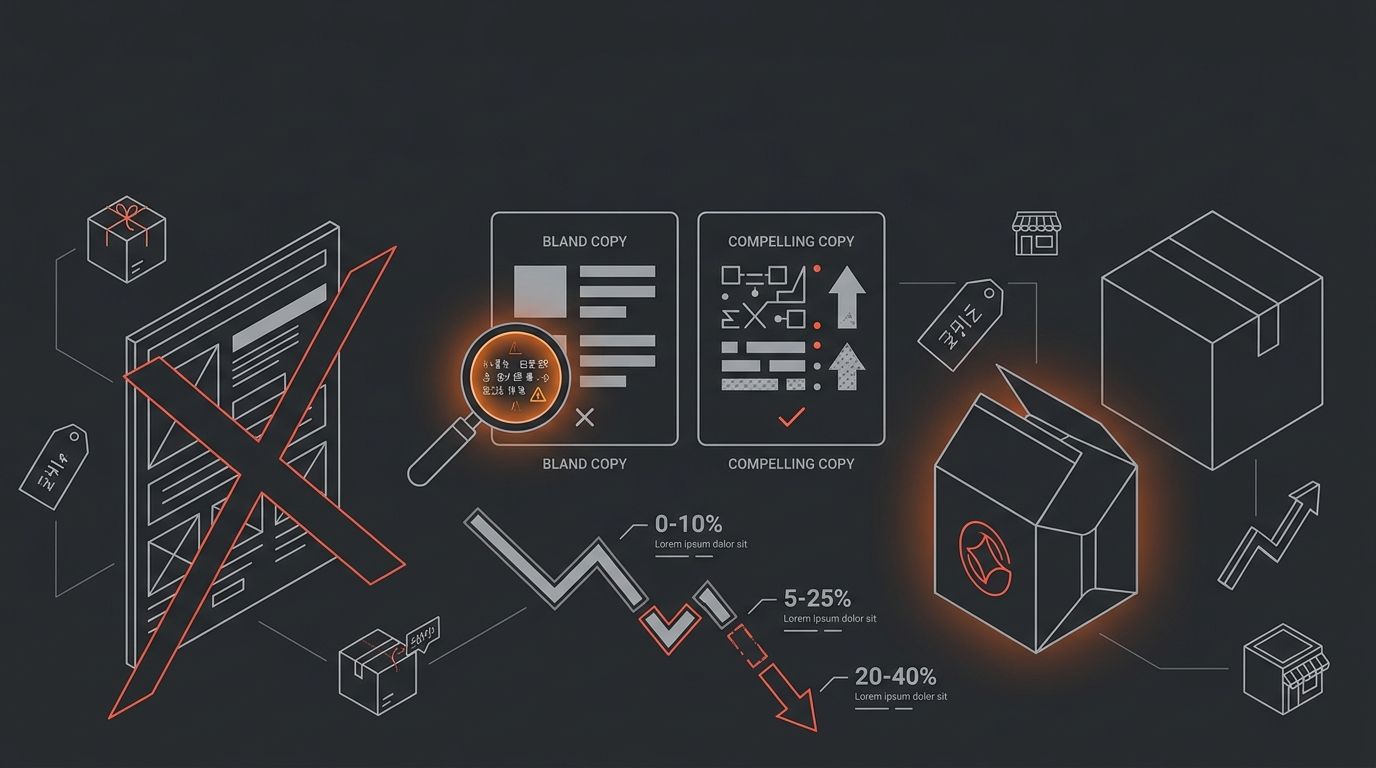
"Premium quality material, comfortable to wear, suitable for all occasions, perfect gift for friends and family." That exact sentence, with minor word-order variations, appears across thousands of AliExpress product listings in jewelry, apparel, and home décor. If you've pasted anything resembling it into your Shopify store, your conversion rate already tells the story: ecommerce benchmarks compiled by Smart Insights place average rates between 1.5% and 3.5%, and stores running unedited supplier copy consistently cluster at the bottom of that range. The gap between manufacturer copy vs branded messaging shows up directly in your revenue per session, your return rate, and your CAC payback period.
Product description copywriting dropshipping operators tend to skip is the single highest-ROI task on the to-do list. The six rules below cover where generic supplier descriptions fail, why they fail, and what to write instead when conversion rate optimization descriptions are a priority for your store.
Never paste the manufacturer's bullet points into your product page
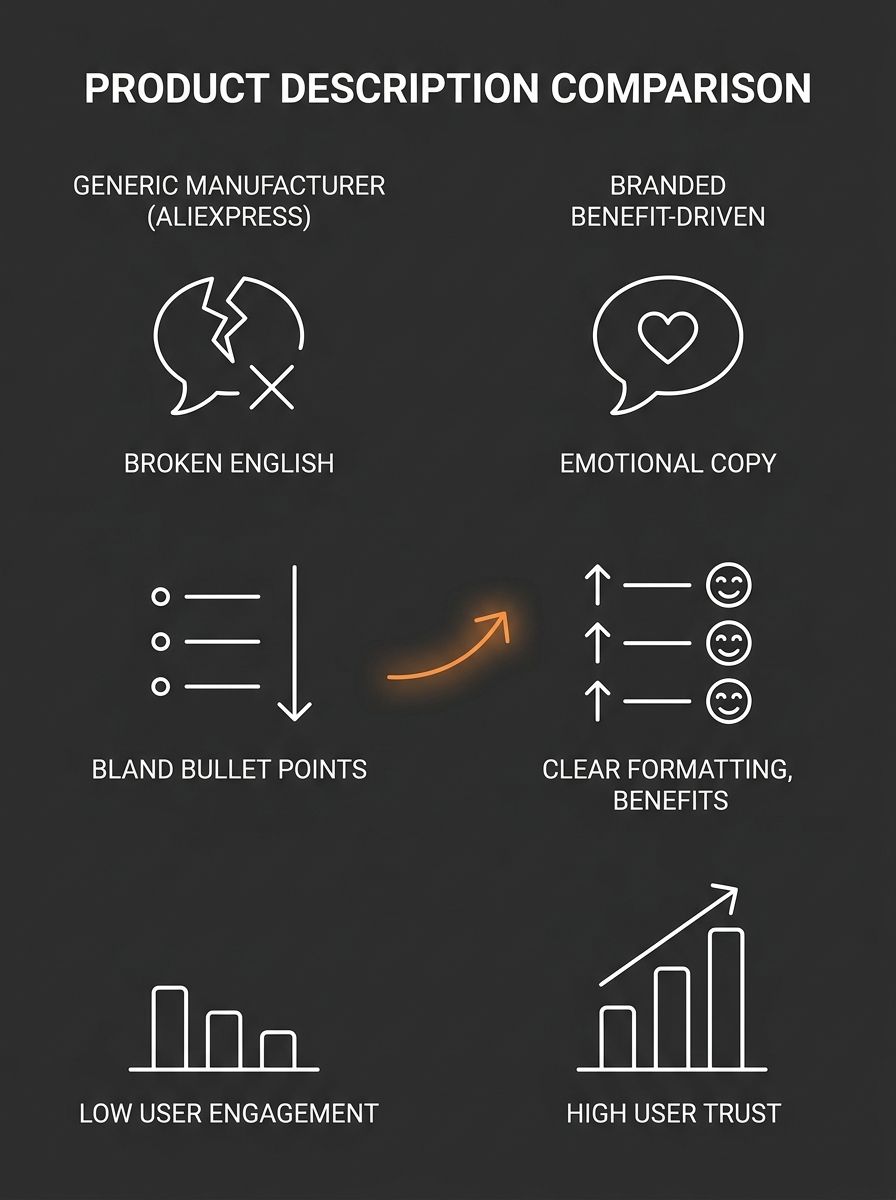
This is the most common mistake and the easiest to fix. Supplier catalogs on AliExpress, CJ Dropshipping, Spocket, and Zendrop are written for wholesale buyers evaluating bulk orders, not for end consumers making emotional purchasing decisions. The copy is feature-dense, benefit-absent, and usually machine-translated from Mandarin or Turkish.
When you copy that text and drop it into your store, three things happen simultaneously:
Duplicate content penalty: Google sees identical descriptions across dozens or hundreds of competing stores. No single page earns ranking authority. An r/SEO discussion on unique product descriptions confirmed this finding: page accessibility, schema, and layout matter enormously, but starting with unique copy gives you the baseline Google needs to index you properly.
Zero differentiation: If your product page reads identically to 47 other stores selling the same tungsten ring, the shopper picks whoever has the lowest price. You lose the margin race every time.
Trust erosion: 87% of consumers rate product content as extremely or very important when deciding to buy. Poorly translated manufacturer copy signals a store that doesn't care about accuracy, and 60% of shoppers have returned products due to misleading descriptions.
Before you scale ad spend on any product, rewrite every description from scratch. The manufacturer's spec sheet is a starting point for research, not publishable content. If you've already built a process around validating supplier quality before your first sale, this becomes a natural extension of that same diligence.
Write the benefit before you name the feature
Supplier copy lists specs: "316L stainless steel, 18K gold plated, 45cm chain length, lobster clasp." These are facts. They tell the shopper what the product is. They don't tell the shopper why they should care.
A benefit-first rewrite of that same necklace might read: "Won't tarnish in the shower, won't turn your neck green, and sits right at the collarbone for a layered look. Made from surgical-grade 316L stainless steel with 18K gold plating."
The feature list is identical. The order is different. And that reorder matters because shoppers scan product pages in an F-pattern, spending roughly 80% of their reading time on the first two lines. If those lines are specs, you've lost the scroll.
This applies especially when you're building your unique value proposition product copy. Invesp documented a case where enhancing value proposition copy to match visitor expectations produced a 90% increase in conversions. The mechanism is straightforward: visitors who immediately see why a product solves their problem stay on the page longer, which reduces bounce, increases add-to-cart rates, and shortens the purchase decision window.
If you've already done the work to vet your suppliers, you know the product's actual strengths from your test orders. Put those strengths in the first sentence, not buried after a wall of specifications.
Kill every adjective that could describe any product
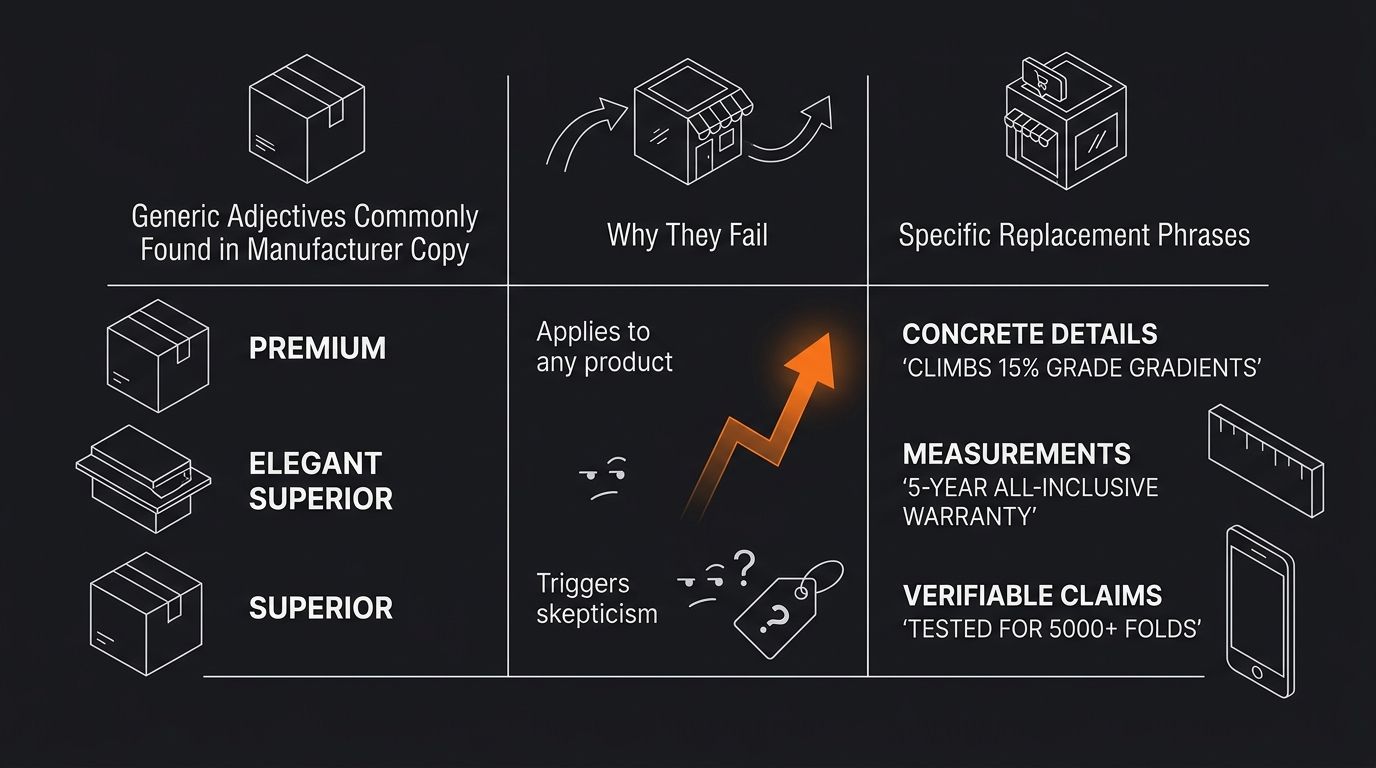
"Premium quality." "Elegant design." "Durable construction." "Perfect gift."
Strip these from every listing in your store. They describe literally anything, which means they describe nothing. When a phrase could apply equally to a $4 phone case and a $400 watch, it carries zero informational weight for the shopper trying to decide between your product and a competitor's.
Replace vague adjectives with specific, verifiable claims:
Instead of "High-quality material" → Write "Double-stitched 12oz canvas that passed our 50-wash fade test"
Instead of "Comfortable fit" → Write "Stretches 2 inches at the waist without losing shape"
Instead of "Premium craftsmanship" → Write "Hand-polished by the same factory that supplies [comparable brand name if true]"
The specificity does two things. It makes your claim believable (vague superlatives trigger skepticism), and it gives the shopper a concrete mental image of owning and using the product. Branded products already account for 40% of the dropshipping market and show a 15% higher conversion rate than non-branded items, according to PagePilot's analysis. A big piece of that gap comes down to copy quality and the trust it creates.
Match your SEO keyword density to how people actually search
Keyword stuffing is dead, but keyword absence is equally expensive. The sweet spot for SEO keyword density ecommerce pages land on is roughly 1-2% for primary terms, with natural language variations spread through the description. Shopify's own guide to SEO product descriptions is direct about this: weave target keywords into your descriptions naturally, but avoid stuffing at all costs.
Here's where manufacturer copy fails in a less obvious way. Supplier bullet points tend to use industry jargon ("IP68 waterproof rating," "CRI>90") without the consumer-facing search terms people actually type into Google ("waterproof smartwatch for swimming," "natural-light desk lamp"). Your product page needs both the technical spec for credibility and the plain-language phrase for search visibility.
A practical workflow for every product you list:
Pull your target product's top 10 Google results and note the exact phrases in their titles and H1s
Check Google's "People Also Ask" box and the autocomplete suggestions for your product category
Write your description using those phrases as the skeleton, then layer in specs and benefits around them
Run the finished description through a word-frequency check to make sure your primary keyword appears 2-4 times in a 300-word description without feeling forced
This is also where your contribution margin framework connects to copy. Two products at the same revenue can have wildly different profit depending on conversion rate, and SEO-driven organic traffic is the cheapest conversion channel you have. Every description you write should be pulling its weight in search.
A/B test your value proposition before scaling ad spend
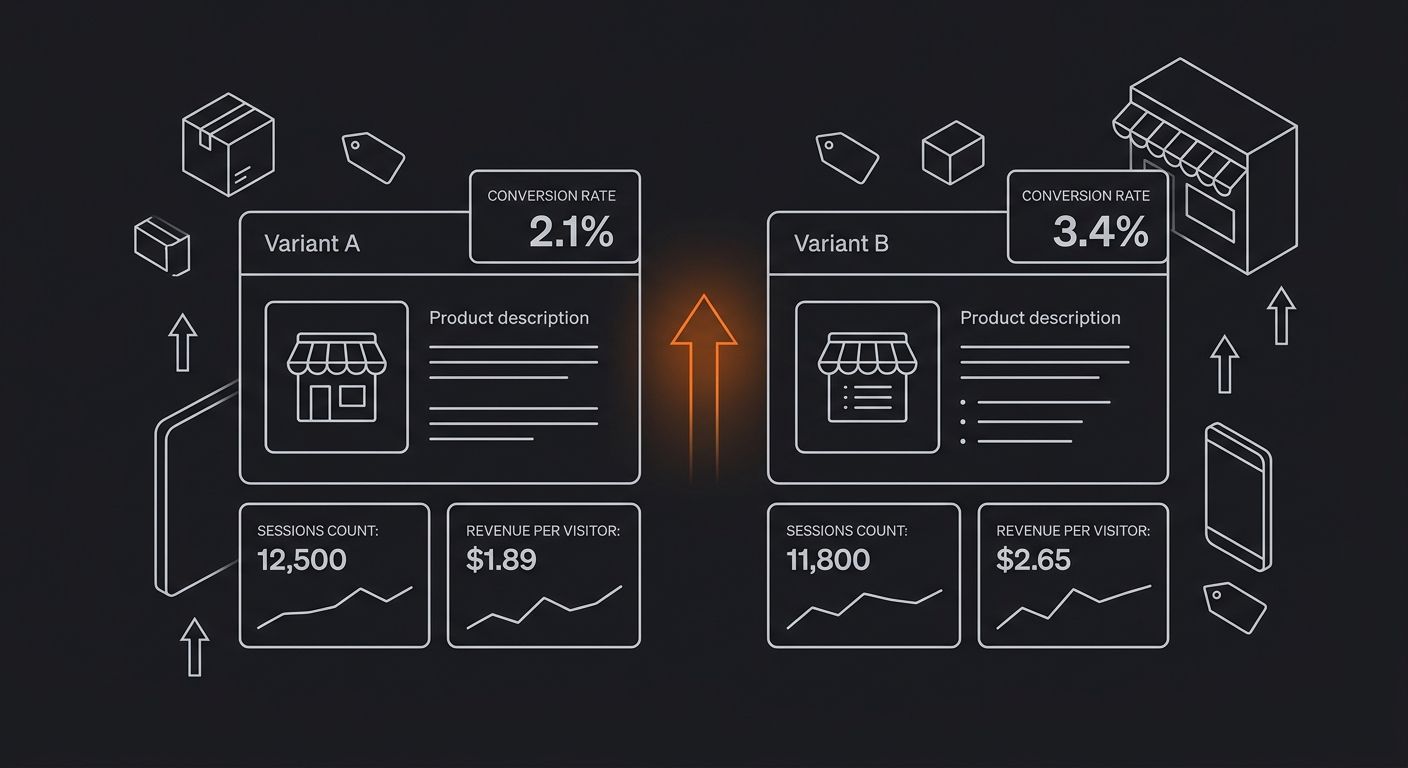
Writing better descriptions is the first step. Knowing which version actually converts is the second. CXL's Peep Laja recommends message-mining customer language to pinpoint high-converting value propositions, and then testing multiple phrasings against each other because small wording changes can produce disproportionate lifts.
For dropshipping operators running paid traffic, this is especially critical. You're already paying $15-40 CPM on Meta or TikTok. Sending that traffic to an untested product page with manufacturer copy is burning money. Even a 0.5% conversion rate improvement on a page getting 10,000 monthly visitors at a $45 AOV means an extra $2,250/month in revenue before you touch your ad budget.
Here's a testing framework that takes about 15 minutes to set up:
Version A: Feature-led description (specs first, benefits second)
Version B: Benefit-led description (outcome first, specs as proof points)
Version C: Social-proof-led description (customer quote or UGC reference first, then benefits and specs)
Run each version for a minimum of 200 sessions before drawing conclusions. If you're on Shopify, page builders let you duplicate product pages and split traffic without coding. We've reviewed GemPages in detail and its A/B functionality is one of the better implementations for stores under $50K/month revenue.
Conversion rate optimization descriptions require iteration. Your first rewrite will beat manufacturer copy. Your third rewrite, informed by test data, will beat your first rewrite by another 15-30%.
Treat your product page like a landing page, not a catalog entry
Manufacturer copy assumes the shopper has already decided to buy and needs specs to confirm their choice. That assumption is wrong for cold traffic, which is most of your visitors if you're running ads. Your product page is the landing page for every single click, and it needs to do the full persuasion job: identify the problem, present the solution, prove the claim, and reduce perceived risk.
A complete product page built for conversion rate optimization descriptions should include:
Opening hook (1-2 sentences): Who this is for and why they'll care
Benefit block (3-5 bullet points): What the product does for the buyer, not what it's made of
Proof section: Materials, specs, dimensions, and sourcing details that back up the benefit claims
Social proof: Customer reviews, UGC photos, or usage stats
Risk reversal: Shipping timeline, return policy, and guarantee stated clearly on the page itself
Stores that have done the upfront work of building direct supplier relationships have an advantage here because they can get product details, usage photos, and material certifications that resellers working through aggregators often can't access. Those details become your copy's raw material.
And don't underestimate formatting. Walls of text kill readability regardless of how well-written your descriptions are. Use bullet points for scannable benefits, short paragraphs for storytelling, and bold text for the one claim you most want the shopper to remember. The r/SEO community's consensus backs this up: page layout and accessibility matter as much as the words themselves for both ranking and conversion.
When These Rules Break Down
These six rules assume you're selling to end consumers through your own branded store. A few scenarios shift the calculus.
Marketplace listings on Amazon or Walmart follow different optimization rules. Amazon's A9 algorithm weights backend keywords, bullet-point structure, and review velocity differently than Google's organic ranking. The core principle of product description copywriting dropshipping sellers need still applies: write unique, benefit-driven copy. But the format constraints are tighter. If you're moving toward U.S.-based suppliers for Amazon and Walmart, study each platform's listing guidelines before applying these rules wholesale.
Technical or compliance-heavy products (supplements, electronics, medical accessories) sometimes require manufacturer language for regulatory reasons. In those cases, keep the required spec language intact but wrap it in benefit-driven context that helps the shopper understand what the numbers actually mean for their daily use.
Extremely high-volume, low-AOV products (under $10) may not justify 45 minutes of custom copywriting per SKU. For these, a templated approach works: write one strong benefit-first template per product category, then customize the specific details for each SKU. You'll still beat manufacturer copy by a wide margin, but you'll do it in 10 minutes per product instead of 45.
The underlying principle across all of these exceptions holds: the words on your product page are the closest thing to a salesperson your online store has. Generic manufacturer copy is the equivalent of a sales rep who reads the barcode aloud and walks away. Every minute you spend rewriting descriptions pays back in conversion rate, organic traffic, and reduced return rates for months after you publish.
365 Dropship Editorial
Editorial team writing about E-commerce, dropshipping, and product discovery — reviews of dropshipping suppliers and platforms, trending niche guides (jewelry, beauty, pets, home, fashion), supplier due diligence, ecom operations, shipping & fulfillment strategy, product research, AOV optimization, and profitable dropshipping case studies.
Related Articles

Building Trust Signals into Dropshipping Product Reviews: The Conversion Framework Beyond Generic Descriptions
Spiegel Research Center research, cited widely across e-commerce conversion literature, puts the number at 270%. That's how much displaying authentic customer reviews can increase the likelihood of purchase compared to a product page with none.
The Review Generation Trap: Why Fake Social Proof Is Tanking Your Conversion Rate (And How Successful Dropshippers Build Authentic Feedback Loops)
Northwestern University's Spiegel Research Center produced a finding that should have killed the fake-review industry on the spot: products rated between 4.2 and 4.5 stars convert at higher rates than products sitting at a perfect 5.0. The implication was plain. Shoppers don't trust perfection.

Ebay Product Research
This guide walks you through eBay product research from raw data pull to validated listing in about 90 minutes. You'll use Seller Hub's built-in Terapeak tool and ZIK Analytics to identify products with proven demand, healthy margins, and beatable competition.
Explore more topics