Print-On-Demand Integration Models for E-Commerce Platforms Focus on Data Flow and Catalog Management
Retailers integrating print-on-demand services with e-commerce platforms are prioritizing system connectivity models that handle product variant mapping, order synchronization, and artwork file transfer, according to a June 30 analysis published by Retail Technology Innovation Hub. The technical rev

Print-On-Demand Integration Models for E-Commerce Platforms Focus on Data Flow and Catalog Management
Retailers integrating print-on-demand services with e-commerce platforms are prioritizing system connectivity models that handle product variant mapping, order synchronization, and artwork file transfer, according to a June 30 analysis published by Retail Technology Innovation Hub. The technical review examines three core integration approaches—native marketplace apps, API-first connections, and middleware automation tools—and their operational implications for sellers managing customizable product catalogs on platforms like Etsy.
The analysis arrives as Etsy sellers and independent DTC operators expand POD offerings to reduce inventory risk while maintaining product diversity. Integration architecture directly influences time-to-market for new designs, order exception rates during demand spikes, and the administrative workload required to maintain listing accuracy across personalized product options.
Three Integration Architectures Handle Different Operational Scales
Native integrations built directly into e-commerce platforms provide standardized features suited to typical product ranges and lower order volumes, the report states. These pre-built connections offer convenience but limited customization for shops with complex workflows or compliance requirements.
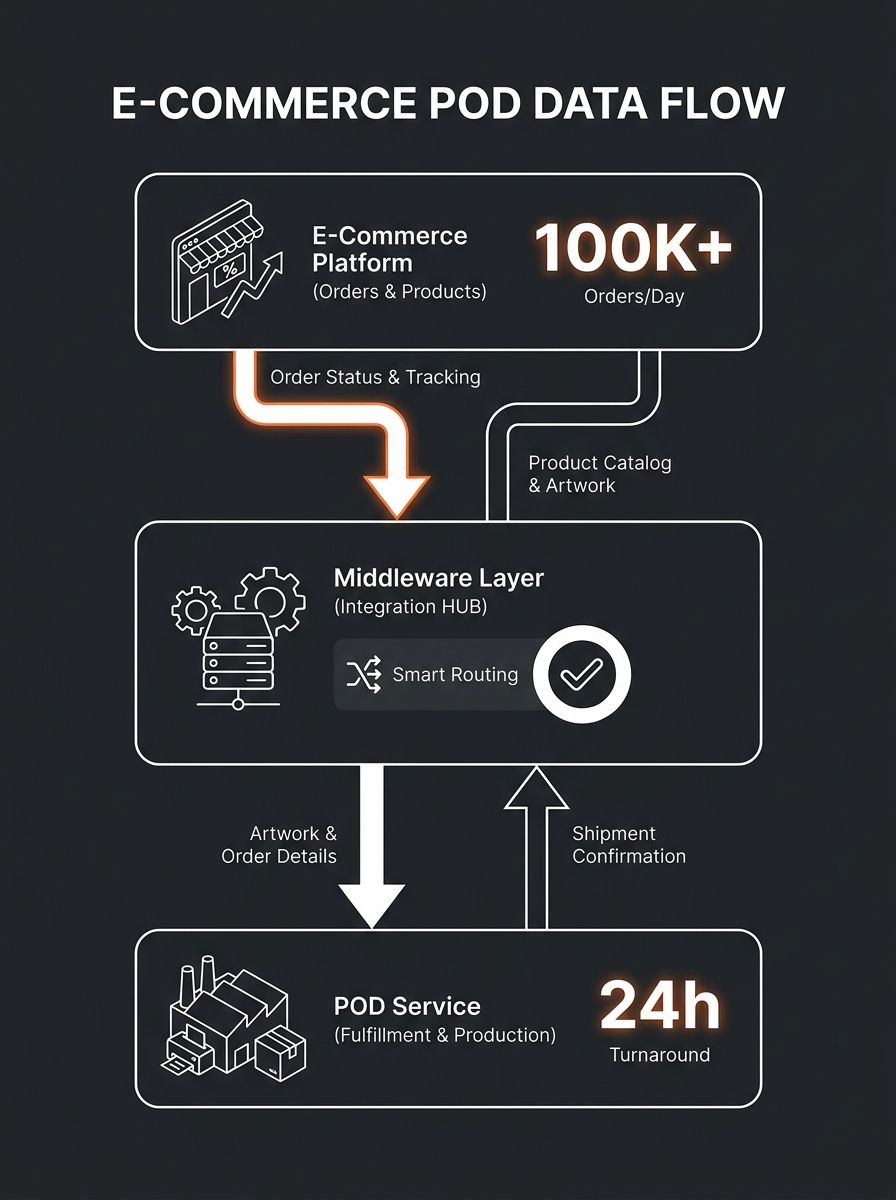
API-based integrations deliver flexibility for operators customizing product data, fulfillment settings, and multi-marketplace inventory coordination. "API first connections" allow sellers to define how product attributes, pricing, and artwork uploads map between their storefront and production partner, according to the technical breakdown.
Middleware and automation tools bridge platforms by handling order mapping, product synchronization, and customer data flow. The analysis positions these solutions as particularly relevant for sellers managing multiple storefronts or coordinating inventory across several marketplaces simultaneously.
Data Synchronization Requirements Extend Beyond Basic Order Flow
Robust POD integration must handle product creation, variant management, price updates, and artwork file uploads as core data exchanges, the report details. Order status updates must reflect accurately within the seller's admin dashboard, enabling quick intervention for changes or exceptions during high-volume periods.
Notification systems and customer messaging depend on reliable synchronization, especially on marketplaces where buyer communications face close monitoring. Integration supporting order queues, automatic retries, and structured error handling maintains consistent fulfillment performance as shops scale.
Etsy sellers managing product catalogs with numerous SKUs across sizes, colors, and personalization options require integrations that map attributes, images, and pricing accurately between production partner and storefront. Automated syncing of product options reduces administrative workload while maintaining listing accuracy—factors the analysis identifies as essential for customer-centric marketplace environments.
Operational reliability metrics center on monitoring demand spikes, retrying failed transactions, and tracking exceptions across the entire workflow. Integration models supporting transparent reporting enable operators to address issues before they affect customers, the report notes.
Margin and Scale Considerations for POD-Based Product Lines
For dropshippers and DTC sellers evaluating POD expansion, integration architecture affects unit economics through administrative time costs and order exception rates. Manual order processing or frequent synchronization failures add operational overhead that compounds at scale, eating into per-order margins that typically run tighter in POD models compared to bulk-purchased inventory.
The analysis emphasizes SLA definitions and error-handling protocols as factors reducing delayed or missed delivery risks—outcomes that directly impact repeat purchase rates and store review scores. Sellers running POD alongside traditional dropshipping inventory must ensure integrations handle both fulfillment models without manual intervention, according to the operational framework outlined.
Data protection requirements have intensified for POD sellers handling customer artwork files and personalized order details. Audit trails, secure file transfers, and regulated access ensure transaction traceability while maintaining compliance with platform data standards and broader privacy regulations, the report states.
Integration performance metrics such as order exception rates, fulfillment speed variance, and system uptime become critical evaluation factors when selecting POD partners. Operators comparing providers should test how integration handles peak order volumes, variant complexity, and artwork file processing before committing production capacity, according to the technical guidance.
The analysis notes that migration planning between POD providers requires assessing not only product catalog transfer but also how existing order history, customer data, and artwork libraries move between systems. Poor migration planning creates gaps in order tracking and customer communication that damage store reputation during transition periods.
Reading Between the Lines
Print-on-demand represents zero-inventory product expansion for operators willing to accept tighter per-unit margins in exchange for eliminated holding costs and broader catalog testing capability. The technical infrastructure connecting storefront to production facility determines whether that trade-off delivers operational use or creates a new administrative burden.
Integration architecture decisions made early constrain how quickly sellers can launch new designs, test seasonal products, and respond to customer personalization requests—all velocity factors that compound in competitive niches. Operators treating POD integration as a simple plugin installation discover scaling limits when order volumes expose synchronization gaps, variant mapping errors, or artwork file handling failures that weren't visible at 10 orders per day.
The margin math for POD-based stores depends heavily on minimizing per-order administrative friction. Every manual intervention to fix a syncing error, update a variant, or chase a fulfillment status represents labor cost that shrinks already-modest product margins. For sellers considering POD expansion alongside traditional dropshipping operations, the integration model determines whether adding personalized products improves unit economics or simply adds operational complexity without corresponding revenue lift.

Ryan Torres
Ryan Torres is a former Amazon FBA seller turned dropshipping consultant who has generated over $2.8M in ecommerce revenue across 14 product launches. He specializes in supplier vetting, margin optimization, and scaling DTC operations for sub-$1M brands. Ryan focuses on actionable frameworks that drive measurable results for independent operators.
Related Articles

Printify: Complete App Review & Guide
Printify is a print-on-demand marketplace that routes your orders to a network of over 100 independent print providers who manufacture and ship products under your brand.

Dropshipping Platform Guide Breaks Down Storefront vs. Sourcing Trade-offs Across Nine Provider Categories
Dropshipping operators choosing between marketplace listings and standalone storefronts face fundamentally different cost structures, shipping timelines, and quality control requirements, according to a platform comparison guide 4Topic published June 22. The analysis separates nine provider categori

Printful's 479-Product Catalog Outweighs Tapstitch's Apparel Quality Edge in New POD Platform Comparison
Printful's 479-product catalog spanning apparel, home decor, and accessories gives it a decisive edge over Tapstitch's 400-blank apparel-only range despite Tapstitch's vertically integrated quality advantage in streetwear fulfillment, according to a platform comparison published July 8 by Ecommerce-
Explore more topics