Spocket vs. AutoDS in 2026: Which Dropshipping Automation Platform Actually Delivers Margin at Scale
AutoDS outperforms Spocket for margin at scale when stores cross the 200-weekly-order threshold, driven by end-to-end fulfillment automation, access to 500M+ products across 25+ global suppliers, and AI-powered repricing that Spocket's curated US/EU catalog can't match at volume.
Spocket vs. AutoDS in 2026: Which Dropshipping Automation Platform Actually Delivers Margin at Scale
AutoDS outperforms Spocket for margin at scale when stores cross the 200-weekly-order threshold, driven by end-to-end fulfillment automation, access to 500M+ products across 25+ global suppliers, and AI-powered repricing that Spocket's curated US/EU catalog can't match at volume. Spocket holds a defensible edge for branded, high-AOV stores prioritizing fast domestic shipping over raw throughput.
Where Automation Depth Creates the Margin Gap
The difference between these two dropshipping automation platforms shows up the moment you try to run hands-off. AutoDS automates the entire order lifecycle: product importing, fulfillment, tracking number uploads, inventory syncing, and dynamic price adjustments. Spocket automates product imports and order placement to suppliers, but pricing updates, inventory reconciliation at scale, and multi-store coordination still require manual work. As an in-depth AutoDS review from EComposer noted, the platform's "sophisticated automation tools reduce errors and enhance business scalability, and cut down on manual work for serious dropshippers." That distinction sounds abstract until you calculate the labor cost of managing 300 orders per week with partial automation versus full automation.
AutoDS users report saving over 20 hours per month on fulfillment tasks alone, according to aggregate user data compiled across multiple platform reviews in early 2026. At even a modest $20/hour VA rate, that's $400/month in recovered labor cost, or roughly $4,800 annually, which drops straight to your bottom line. Spocket doesn't publish comparable time-savings data, and the reason is structural: Spocket's backend automation stops at the order-placement layer. Everything downstream (price monitoring against supplier cost changes, bulk inventory status updates across stores, tracking number syncing for non-Shopify channels) requires either manual intervention or third-party middleware.
This gap matters less for stores doing 30 to 50 orders a week. At that volume, you can manually check Spocket's dashboard twice a day and keep things running. But the equation flips hard once you're past 200 weekly orders or managing more than one storefront. AutoDS's bulk-edit tools, search filters, and multi-store management features let operators manage inventory across several stores from a single dashboard. Spocket's interface, praised by beginners for its simplicity, becomes a bottleneck at that scale because it was designed for curation-first browsing, not high-volume operations.
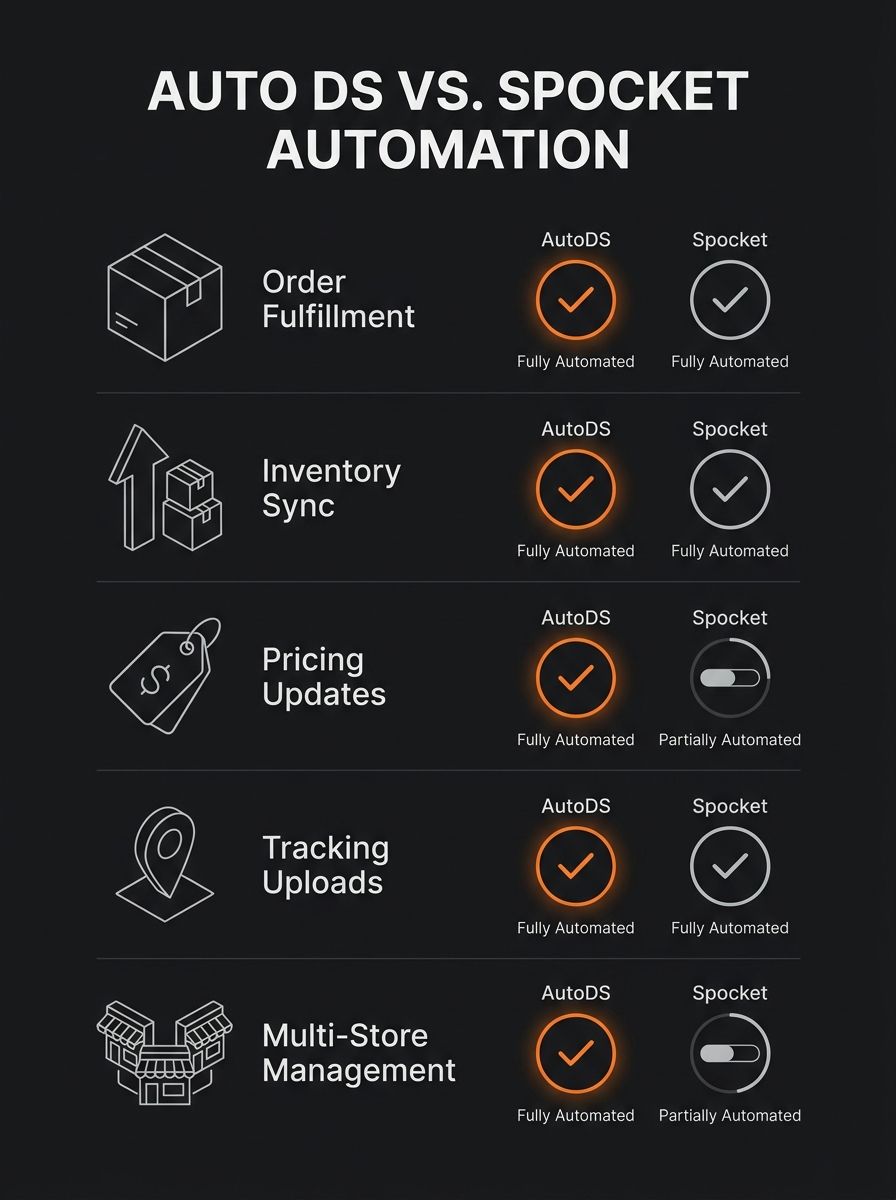
And the automation gap has a compounding effect on margin. If your pricing doesn't update automatically when a supplier raises costs by $1.20 on a $14 product, you eat that margin erosion silently across every order until you catch it. AutoDS's automated repricing flags and adjusts for supplier cost changes in near real-time. Spocket shows exact product and shipping costs upfront, which is useful at the sourcing stage, but doesn't auto-adjust your storefront pricing when those costs shift. For anyone who's watched how aggregator platforms layer hidden fees between factory price and your cost of goods, that blind spot is a margin leak waiting to happen.
Supplier Networks, Product Access, and the Real Cost Floor
Why does sourcing breadth matter for margin at scale? Because your cost floor is determined by supplier competition within your platform, and Spocket's curated approach deliberately limits that competition. Spocket maintains a vetted network of US and EU suppliers, which delivers 2-to-5-day shipping on domestic orders and higher perceived product quality. The tradeoff is a smaller catalog and higher per-unit product costs compared to platforms sourcing from China, Turkey, and Southeast Asia alongside Western warehouses.
AutoDS integrates with 25+ global suppliers and indexes over 500 million products. That catalog depth enables aggressive product testing because you can list, test, and kill products at a pace that Spocket's catalog doesn't support. Where a Spocket seller might test 15 to 20 products per month from a curated selection, an AutoDS seller can test 50 to 100 with one-click imports and AI-powered trend-spotting tools that surface products already performing on competitor stores. The cost difference at the sourcing level is significant: on comparable products (phone accessories, home décor, pet supplies), AutoDS's Chinese supplier pricing typically runs 30% to 50% lower than Spocket's US/EU equivalents before shipping.
But cheaper sourcing doesn't automatically mean better margin. Spocket's US/EU supplier network produces tangible benefits that show up in post-sale economics. Faster shipping reduces "where is my order" support tickets, which cost $3 to $8 each to resolve depending on your support model. Faster delivery also reduces refund requests: a Decide Advisory Services review recommended aiming for "a realistic post-refund margin of 20% to 40% for many niches, depending on ad costs and returns." Spocket sellers who maintain tight domestic shipping windows often land in the upper range of that bracket because their return rates run 3 to 5 percentage points lower than sellers shipping 12-to-20-day ePacket from China. If you've studied how return rates silently destroy dropshipping margins, you know that a 5-point return rate difference on a $30 product can swing your effective margin by 8% to 12%.
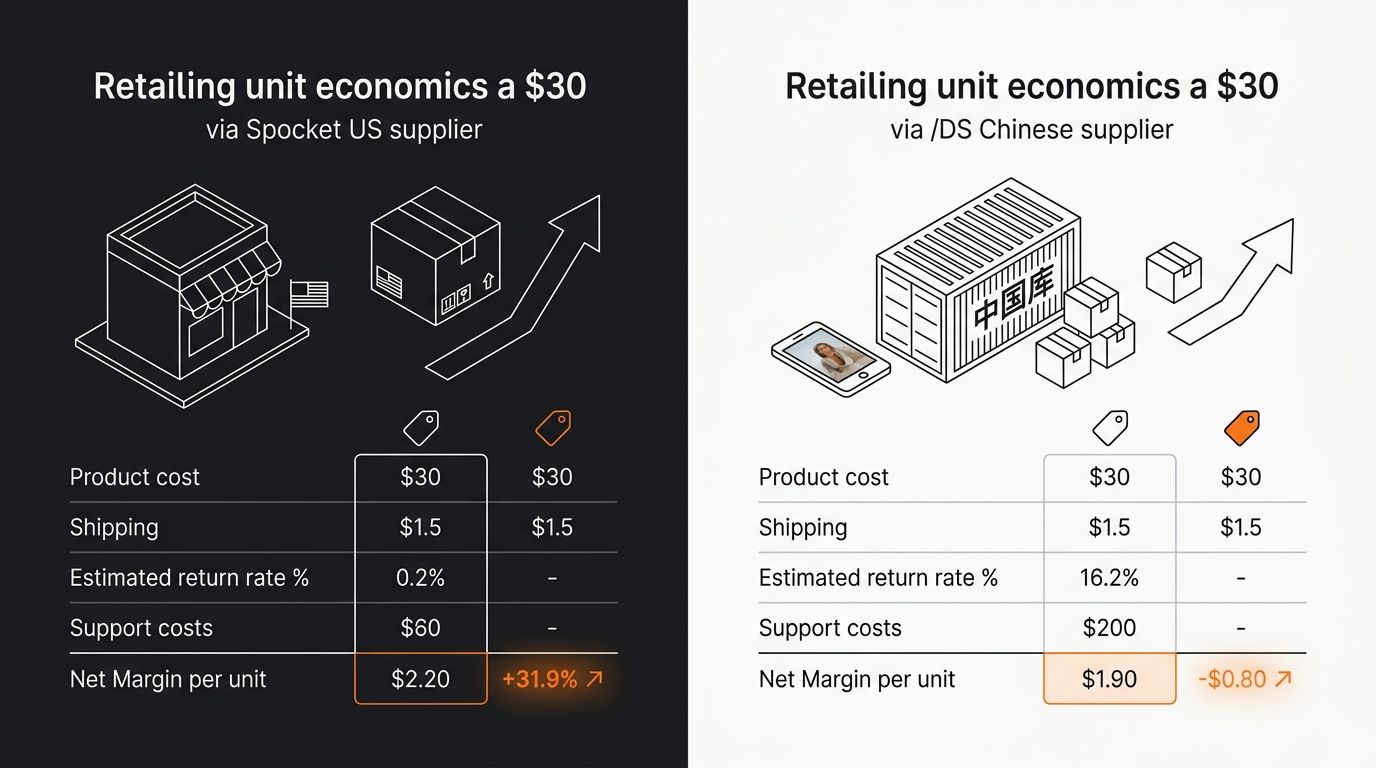
The honest math looks like this: AutoDS gives you a lower cost floor and broader product selection, which means higher gross margin on paper and faster product validation cycles. Spocket gives you a higher cost floor but lower post-sale costs (returns, support, chargebacks), which can yield comparable or better net margin on a per-order basis for branded stores targeting US and EU customers. The platform that "wins" on supplier economics depends entirely on whether your business model optimizes for volume and speed or for per-order profitability and brand equity.
Platform Reach and the Scaling Ceiling
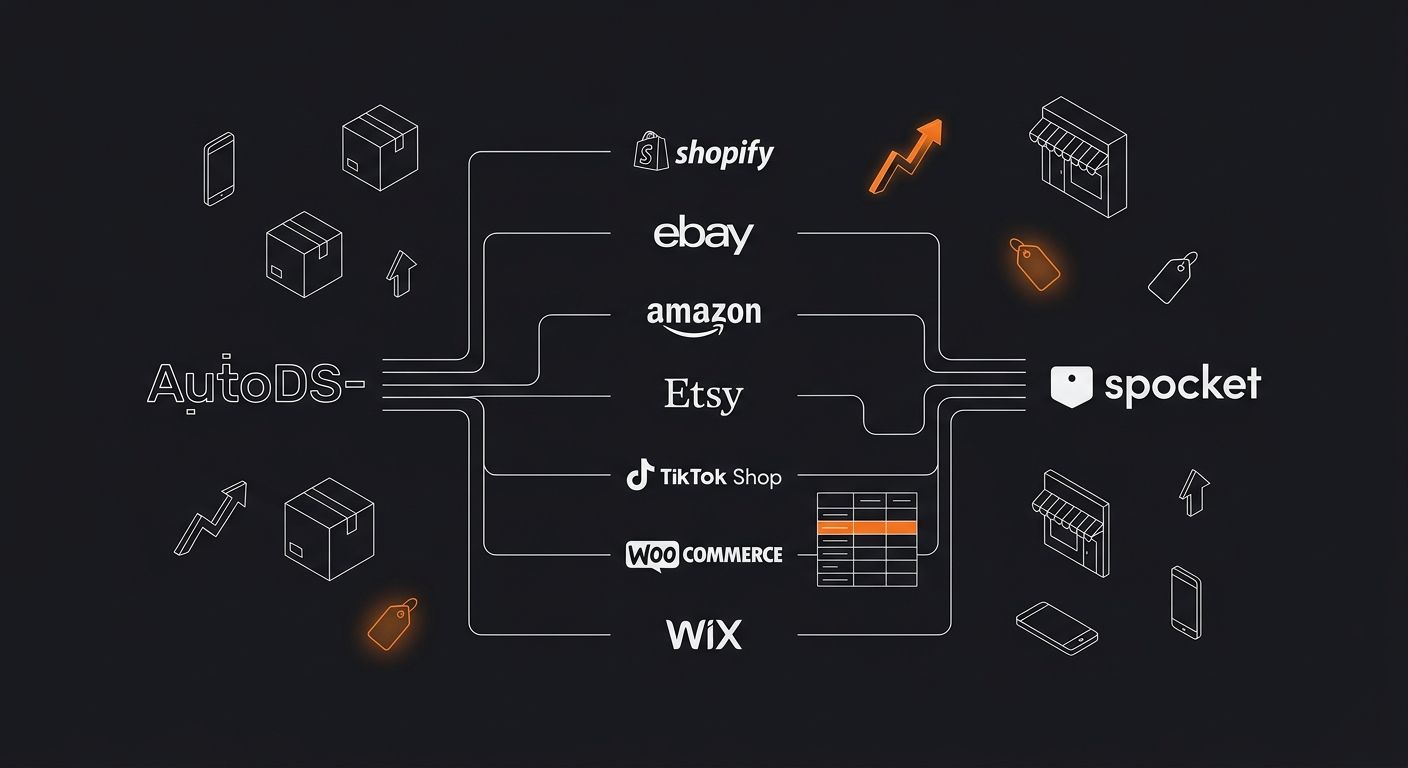
AutoDS supports multi-channel selling across Shopify, eBay, Amazon, Etsy, TikTok Shop, and WooCommerce. Spocket integrates with Shopify, WooCommerce, and Wix. That integration gap determines your scaling ceiling if expansion beyond a single Shopify store is part of your 12-month plan. A store doing $40K/month on Shopify that wants to test eBay or TikTok Shop can extend its AutoDS catalog to those channels without switching platforms or re-importing products. A Spocket seller faces a full rebuild on any channel outside Shopify, WooCommerce, or Wix.
This matters because multi-channel expansion is now the primary scaling lever for dropshipping operations that have saturated their initial channel. Startup Plugs' 2026 supplier platform comparison noted that "automation works best when you already understand the dropshipping fundamentals," and the corollary is that operators who do understand those fundamentals quickly outgrow single-channel tools. AutoDS's architecture was designed for exactly that progression. The platform's AI-driven product title optimization, trend detection, and automated repricing function across all connected channels, which means the operational overhead of adding a new channel is minimal compared to the manual re-listing process Spocket's channel limitations require.
Cost structure at the plan level adds another dimension to this supplier platform comparison. AutoDS includes AI product research, automated order processing, and multi-store management across all paid plans. Spocket and competing platforms like Zendrop often gate premium supplier access, higher order volumes, or advanced analytics behind higher-tier plans, and some impose per-order surcharges on lower tiers that erode margin precisely when you're trying to scale. If you've fallen into the automation tool selection trap where feature parity doesn't translate to profit growth, plan-level cost escalation is usually the culprit. AutoDS's pricing is more predictable as you scale; Spocket's pricing model introduces friction at the exact inflection point where stores need smoother operational throughput.
That said, Spocket's constrained channel approach has an underappreciated upside: focus. Operators building a single branded Shopify store with curated US/EU products and strong product bundling strategies aimed at $120+ cart values don't need six-channel distribution. They need tight supplier relationships, fast fulfillment, and a polished customer experience. Spocket was built for that use case, and trying to use AutoDS's sprawling catalog and global supplier network for the same purpose often introduces complexity (and cost) that degrades the very brand experience the operator is trying to create.
The Uncomfortable Part
The honest AutoDS review 2026 verdict and Spocket review 2026 verdict aren't opposites of each other. They answer different questions. AutoDS answers: how do I process the most orders with the least manual labor and the lowest cost of goods? Spocket answers: how do I build a brand-forward store with domestic shipping that justifies premium pricing? The uncomfortable part is that most operators asking "which platform is better" haven't yet decided which of those questions their business is actually trying to answer.
Sellers who pick AutoDS for its AI and automation depth but then try to build a premium branded experience with 2-day US shipping are fighting the platform's design. Sellers who pick Spocket for its curated suppliers but then try to scale past 200 weekly orders on three channels are fighting its architecture. The margin difference between these platforms at scale isn't primarily a function of features or pricing. It's a function of whether the operator's business model matches the platform's structural strengths. A growing number of operators now run both: Spocket for a curated branded storefront and AutoDS for high-volume product testing and multi-supplier operations where concentration risk matters. That hybrid approach adds operational complexity, but it acknowledges a truth that neither platform's marketing wants to admit: no single dropshipping automation platform optimizes for both volume efficiency and brand-quality customer experience simultaneously. Choosing well means knowing what you're building, and being honest about which tradeoff you can actually afford.
365 Dropship Editorial
Editorial team writing about E-commerce, dropshipping, and product discovery — reviews of dropshipping suppliers and platforms, trending niche guides (jewelry, beauty, pets, home, fashion), supplier due diligence, ecom operations, shipping & fulfillment strategy, product research, AOV optimization, and profitable dropshipping case studies.
Related Articles
Best AliExpress Dropshipping Suppliers 2024
Three sourcing paths dominate the AliExpress dropshipping supplier landscape: manual vetting directly on the platform, automation tools like DSers and AutoDS layered on top of AliExpress, and hybrid fulfillment services such as CJDropshipping, Spocket, and Zendrop that pull from AliExpress catalogs
dropshipping io Review: Features & Pricing
Dropship.io, AutoDS, and SaleHoo attack the same problem from three different angles: finding products worth selling on Shopify. Dropship.io bets on competitor intelligence and sales tracking at $39–$99/month. AutoDS wraps product research inside full-store automation.
How to Start Dropshipping: A Beginner's Guide
Starting a dropshipping store requires three connected layers: a storefront platform (Shopify leads), a supplier automation app (DSers, Spocket, or Zendrop), and a payment-plus-shipping configuration.
Explore more topics