BuckyDrop Publishes Platform Cost Comparison Positioning Shopify Against WooCommerce and BigCommerce for 2026 Dropshipping Operations
BuckyDrop released a three-platform comparison guide on July 15 mapping Shopify, WooCommerce, and BigCommerce against dropshipping workflow requirements and total software costs, according to the company blog.
BuckyDrop Publishes Platform Cost Comparison Positioning Shopify Against WooCommerce and BigCommerce for 2026 Dropshipping Operations
BuckyDrop released a three-platform comparison guide on July 15 mapping Shopify, WooCommerce, and BigCommerce against dropshipping workflow requirements and total software costs, according to the company blog. The guide positions Shopify as the first-test platform for nontechnical founders using suppliers with maintained Shopify integrations, WooCommerce for operators with existing WordPress expertise, and BigCommerce for merchants evaluating whether plan-included features reduce third-party app dependency.
The comparison arrives as platform switching costs climb. Moving a live store between ecommerce systems requires SKU remapping, payment gateway reconfiguration, customer data migration, and supplier feed reconnection. The guide documents order workflow mapping as the first evaluation step before comparing feature lists or subscription prices.
"A platform can process a clean test order while still creating problems during a cancellation, partial refund, PayPal dispute, variant mismatch, or Black Friday inventory spike," the guide states. It recommends documenting how SKUs sync, how paid orders reach suppliers, how tracking data returns to the storefront, and where stockouts or failed syncs surface before committing to a platform.
Subscription Pricing Across Three Models
BuckyDrop verified U.S. pricing on July 14, 2026, finding identical entry-level and mid-tier subscription prices across Shopify and BigCommerce but fundamentally different cost structures beyond the base monthly fee.
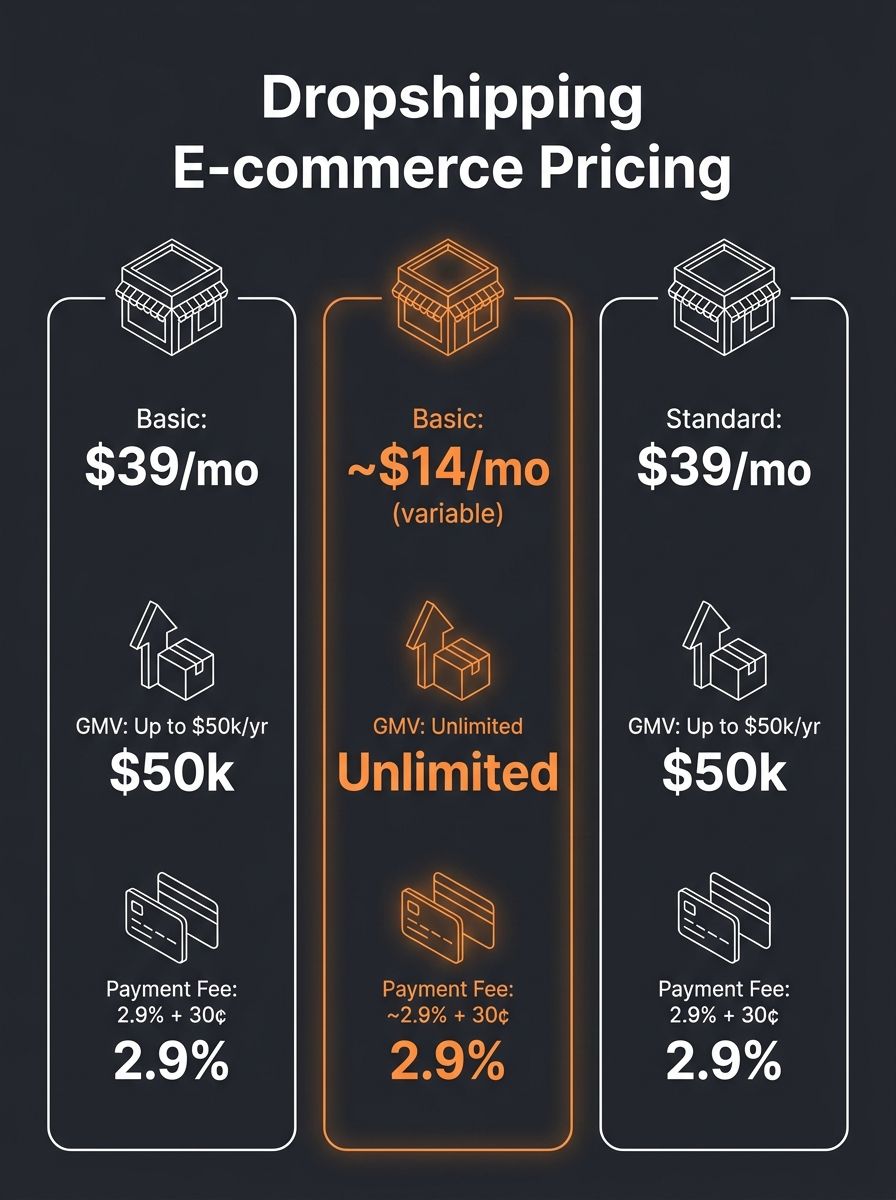
Shopify currently lists Basic at $39 monthly or $29 on annual billing, Grow at $105 monthly or $79 annually, and Advanced at $399 monthly or $299 annually. The guide notes that Shopify includes hosting and TLS/SSL certificates but charges third-party transaction fees when merchants use payment providers other than Shopify Payments, with fee rates varying by plan tier.
WooCommerce publishes its core platform as free open-source software. The platform's own cost framework estimates hosting at $25 to $350 per month for most stores and paid extensions at $29 to $299 per year per extension. The guide emphasizes that these are WooCommerce-published ranges, not guaranteed budgets, and that actual costs depend on hosting provider selection, required extensions, backup systems, and developer maintenance.
BigCommerce lists Core at $39 monthly or $29 annually, Growth at $105 monthly or $79 annually, and Scale at $399 monthly or $299 annually. The platform applies GMV thresholds: Core carries a $30,000 trailing-12-month inclusive GMV cap, Growth carries a $100,000 threshold, and Scale uses a monthly GMV calculation with overage fees. BigCommerce changed its self-service plan structure effective June 1, 2026, introducing Core, Growth, Scale, and Performance tier names alongside revised GMV treatment and Open Payment Provider Fees.
Hidden Costs Beyond the Subscription Line
The guide identifies recurring app subscriptions as Shopify's primary hidden cost. Product sourcing, order routing, review collection, shipment tracking, returns management, email automation, customer support ticketing, and reporting dashboards each typically require separate apps with monthly fees. "The subscription is rarely the complete software bill," the comparison states.
WooCommerce's hidden costs center on hosting responsibility, extension compatibility, and maintenance labor. The guide notes that WooCommerce may produce lower total software cost when a team already maintains WordPress competently but may cost more when frequent developer intervention is needed for updates, performance issues, payment gateway conflicts, or extension failures.
BigCommerce's hidden costs stem from GMV threshold enforcement, plan upgrade triggers, and payment-provider fee structures. The guide recommends modeling current sales volume and gateway usage against BigCommerce's 2026 fee rules before migration.
Merchants evaluating total cost should price their complete software stack—not just the storefront subscription. A $29-per-month Shopify Basic plan may carry $150 in monthly app fees. A free WooCommerce core may require $200 in monthly hosting and $500 in annual extension renewals. A $29-per-month BigCommerce Core plan may trigger forced upgrades at $30,000 GMV.
Platform Fit by Operational Capacity
BuckyDrop positions Shopify as the first platform worth testing for nontechnical founders using suppliers with maintained Shopify integrations. Hosting, TLS/SSL configuration, core platform maintenance, and the store administration environment are included in the subscription. The documented tradeoff is dependence on the Shopify app ecosystem and the recurring cost of the final app stack.
The guide describes WooCommerce as better suited to merchants who already have WordPress expertise or dependable technical support. The core platform is open source, but the merchant remains responsible for hosting provider selection, backup systems, security updates, extension compatibility testing, performance optimization, and recovery procedures. "WooCommerce may produce a lower total software cost when a team already maintains WordPress competently," the comparison notes.
BigCommerce belongs on the shortlist when a merchant wants hosted infrastructure and needs to test whether plan-included features reduce reliance on specific third-party apps, according to the guide. The 2026 GMV thresholds and Open Payment Provider fee rules require modeling against actual sales forecasts and gateway configuration before committing to the platform.
The comparison explicitly states these are editorial recommendations based on operating models, not universal platform rankings. Side-hustlers evaluating Shopify for dropshipping should map their supplier's integration model and technical capacity before choosing a platform based on brand familiarity alone.
What Happens Next
BuckyDrop's comparison introduces order-workflow mapping as the first platform evaluation step, positioning subscription price comparison as secondary to operational fit. Merchants following the guide's workflow checklist will document how SKUs sync between supplier and storefront, how inventory updates propagate, when paid orders transmit to suppliers, how carriers return tracking data, and where failed syncs surface before testing checkout flows or comparing theme libraries.
The guide's explicit cost warnings—Shopify's app dependency, WooCommerce's maintenance ownership, BigCommerce's GMV triggers—address the most common post-launch surprises documented in platform migration case studies. Operators modeling total software cost across 12 months before launching will avoid budget shocks when monthly app subscriptions, hosting overages, or forced plan upgrades materialize in month three.
Platform evaluations that skip order-failure scenarios and cost projections reliably underestimate switching costs once a store goes live. The BuckyDrop comparison pushes workflow mapping and 12-month cost modeling to the front of the evaluation process, reflecting the operational consequences of platform choice after the first 100 orders ship.

Ryan Torres
Ryan Torres is a former Amazon FBA seller turned dropshipping consultant who has generated over $2.8M in ecommerce revenue across 14 product launches. He specializes in supplier vetting, margin optimization, and scaling DTC operations for sub-$1M brands. Ryan focuses on actionable frameworks that drive measurable results for independent operators.
Related Articles
Shopify vs. WooCommerce for Dropshipping in 2026: Total Cost of Ownership When Margins Are Already Thin
Shopify holds 27% of the ecommerce platform market while WooCommerce powers 36–38% of online stores, yet those market-share numbers reveal nothing about which platform actually costs less to operate a dropshipping business on.
Dropshipping Platform Guide Breaks Down Storefront vs. Sourcing Trade-offs Across Nine Provider Categories
Dropshipping operators choosing between marketplace listings and standalone storefronts face fundamentally different cost structures, shipping timelines, and quality control requirements, according to a platform comparison guide 4Topic published June 22. The analysis separates nine provider categori
How to Start Dropshipping: A Beginner's Guide
Starting a dropshipping store requires three connected layers: a storefront platform (Shopify leads), a supplier automation app (DSers, Spocket, or Zendrop), and a payment-plus-shipping configuration.
Explore more topics