Product Research Surveys: Complete Guide
By the end of this guide, you'll know how to build and deploy a product research survey that returns data specific enough to drive SKU-level decisions. The whole process takes about 3-4 hours for your first survey, faster every time after that.

Product Research Surveys: Complete Guide
By the end of this guide, you'll know how to build and deploy a product research survey that returns data specific enough to drive SKU-level decisions. The whole process takes about 3-4 hours for your first survey, faster every time after that.
Before You Start
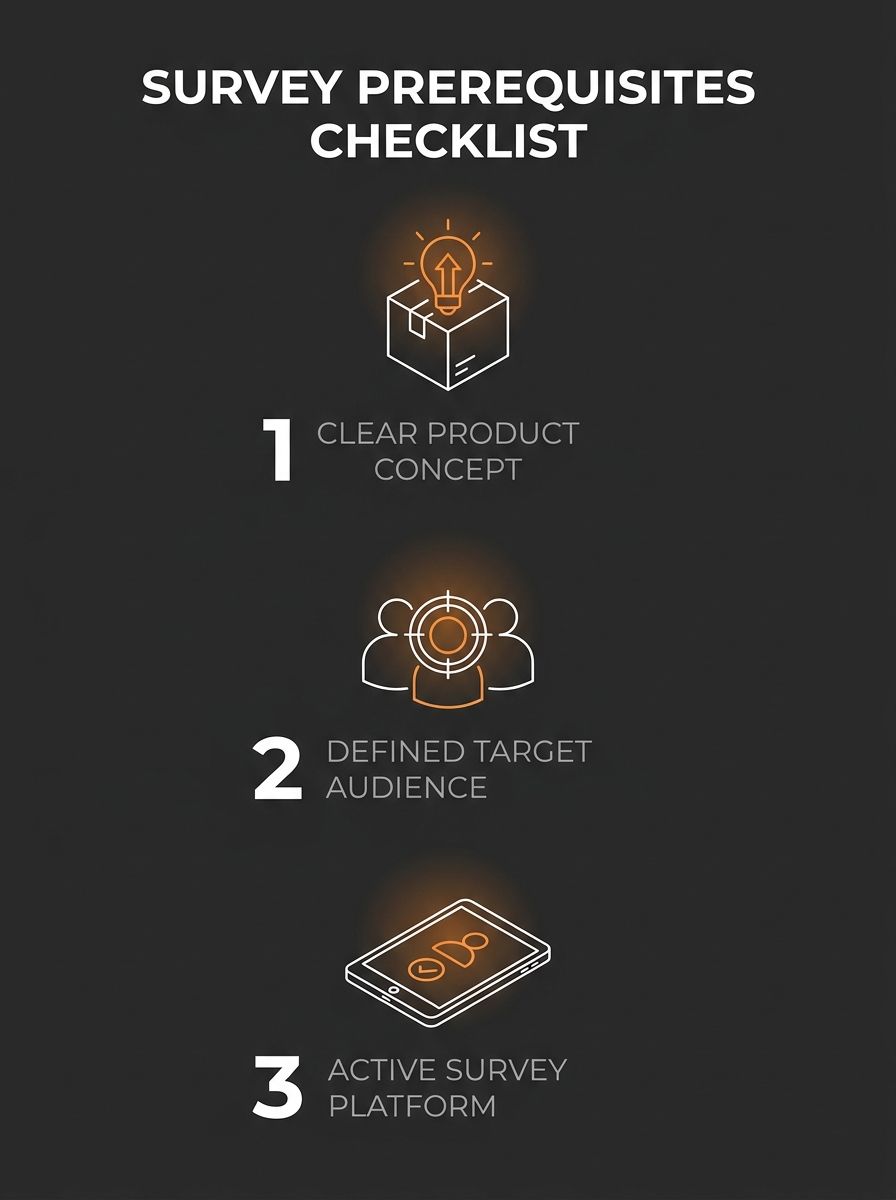
You need three things in place before writing a single question:
A product idea or existing product to validate. This can be a new SKU you're considering, a feature addition, or a pricing change on a current product. Surveys without a specific decision attached produce decoration, not data.
An audience to survey. This means an email list (even 200 subscribers works), social media following, existing customer base, or budget for paid panel respondents. No audience, no responses.
A free or paid survey tool account. I'll cover specific options below, but you can start with a free SurveyMonkey or Typeform tier to test the process before committing money.
If you're still narrowing your niche, do that first. Product research surveys work best when you already know who you're selling to.
Defining the Single Decision Your Survey Answers
Every effective product research survey starts with one question you need answered. Not five. One. According to SurveyMonkey's product research methodology, you want to understand why a customer uses a product by asking about their motivations and behaviors through open-ended questions.
Here's how that looks in practice for dropshipping and DTC operators:
Demand validation: "Would my audience buy a heated camping blanket at $49?"
Price sensitivity: "At what price does this product feel too expensive for my existing buyers?"
Feature priority: "Which of these three product variations should I order first?"
Competitive gap: "What frustrates my audience about products they already own in this category?"
Write your decision statement down before you touch any survey tool. Tape it to your monitor if you have to. Every question in your survey should feed back into this single decision. If a question doesn't help you answer it, cut the question.
85% of market research professionals use surveys as their primary quantitative validation tool, according to 2026 industry data. The ones who get usable results are the ones who scope tightly. The ones who get garbage are running 25-question surveys that try to answer everything at once.
Picking Your Format and Tool
Two decisions here: survey format and the tool to run it.
Format depends on where your audience lives. If you have an existing store or app, in-app micro-surveys (2-3 questions triggered by specific user behavior) outperform email surveys on response rate by a wide margin. As Chameleon's product survey guide explains, in-app surveys appear when the experience is fresh: a user completes onboarding, hits an error, or churns out.
For pre-launch validation when you don't have a store yet, email surveys and social media polls are your main channels. You're trading response rate for reach.
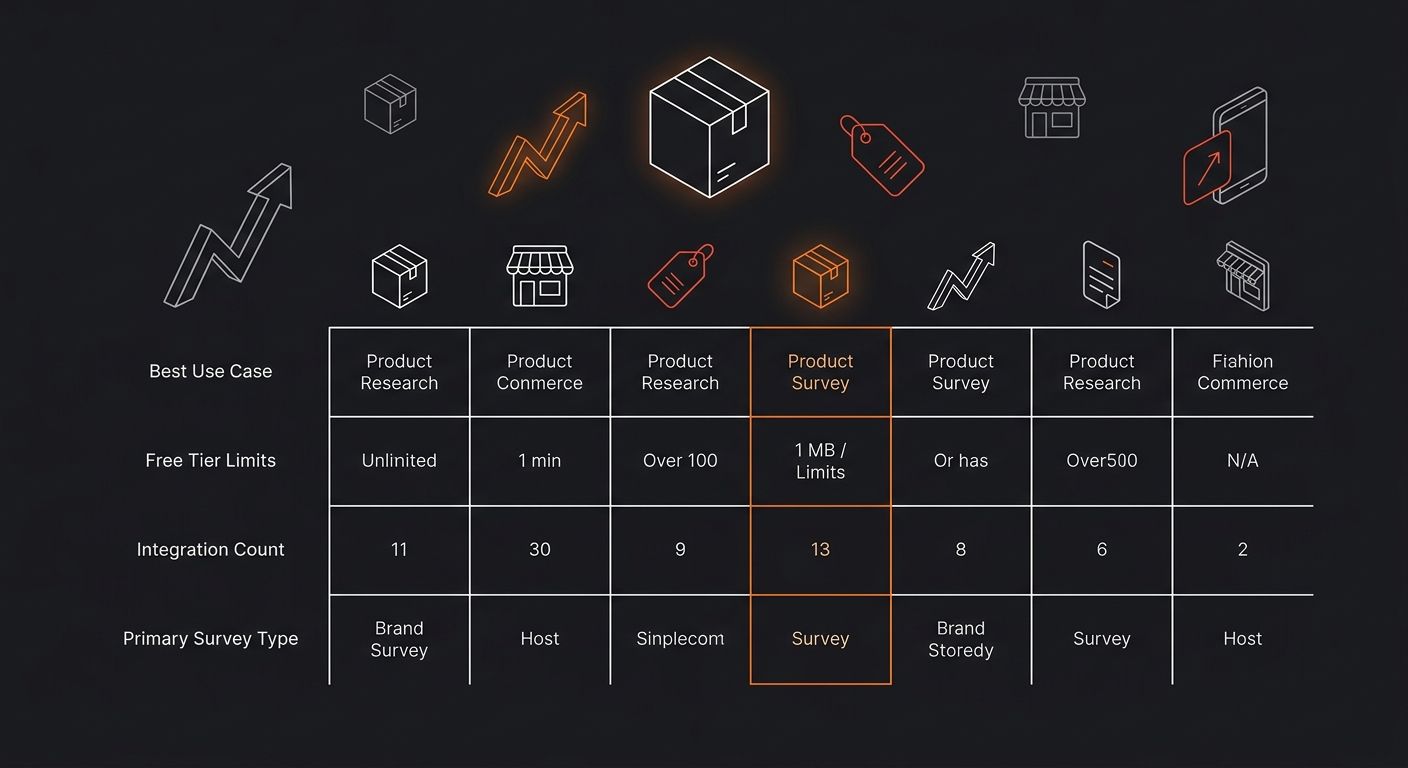
Tool selection matters less than you think at the start. Here's how the top platforms compare based on the 2026 Zonka Feedback review benchmarking 12 tools:
Tool | Best For | Free Tier | Native Integrations | Survey Type |
|---|---|---|---|---|
SurveyMonkey | Broad market research | Yes (10 questions/survey) | 200+ (CRM, email, analytics) | Email, web, link |
Typeform | Visual, conversational surveys | Yes (10 responses/mo) | 120+ via Zapier | Email, web, embed |
Survicate | Website/in-product feedback | Yes (25 responses/mo) | Strongest embed integration | In-app, web, email |
Refiner | SaaS micro-surveys | Yes (limited) | Segment, Mixpanel | In-app, NPS/CSAT |
Hotjar | Behavior + feedback combo | Yes (limited) | Google Analytics, Slack | On-site, heatmap-paired |
Google Forms | Zero-budget validation | Yes (unlimited) | Google Workspace | Link, embed |
For operators doing product research across platforms like eBay or running early validation on a new niche, Google Forms or SurveyMonkey's free tier will handle the job. You don't need Survicate until you have a live store generating traffic.
Writing Questions That Produce Actionable Data
This is where 90% of product research surveys fail. The questions are either too vague to act on ("How do you feel about our products?") or too leading to trust ("Don't you think this product would solve your problem?").
Follow this structure for a 5-7 question survey. Alchemer's survey best practices research confirms: start with quick, easy questions that respondents can answer with little effort, then build toward more specific ones.
Screening question (multiple choice): "Have you purchased [product category] in the last 6 months?" This filters out people who aren't your buyers.
Behavior question (multiple choice): "Where do you typically buy [product category]?" Options: Amazon, brand website, retail store, other. This tells you your competitive landscape.
Pain point question (open-ended): "What's the most frustrating thing about [product category] products you've used?" Open-ended is critical here. Don't pre-fill answers. Let them tell you.
Concept test (image + multiple choice): Show 2-3 product images or mockups. "Which of these would you be most likely to purchase?" Greenbook's market research methodology identifies concept testing as one of the most valuable survey applications during product development.
Price sensitivity (multiple choice with ranges): "What would you expect to pay for [product description]?" Give 4-5 price ranges. This directly feeds your margin math.
Purchase intent (scale): "How likely are you to buy this product in the next 30 days?" Use a 1-5 scale, not 1-10. A 10-point scale produces mushy middle data.
Follow-up permission (yes/no + email field): "Can we contact you with a discount when this launches?" This converts respondents into leads.
Verification: You'll know your questions are right when you can read each one and immediately say which part of your product decision it feeds. If you can't draw that line, the question is filler.
Targeting and Distribution
The best-written survey sent to the wrong people produces misleading data. A 95% product launch failure rate traces back to inadequate research, and bad targeting is the primary driver.
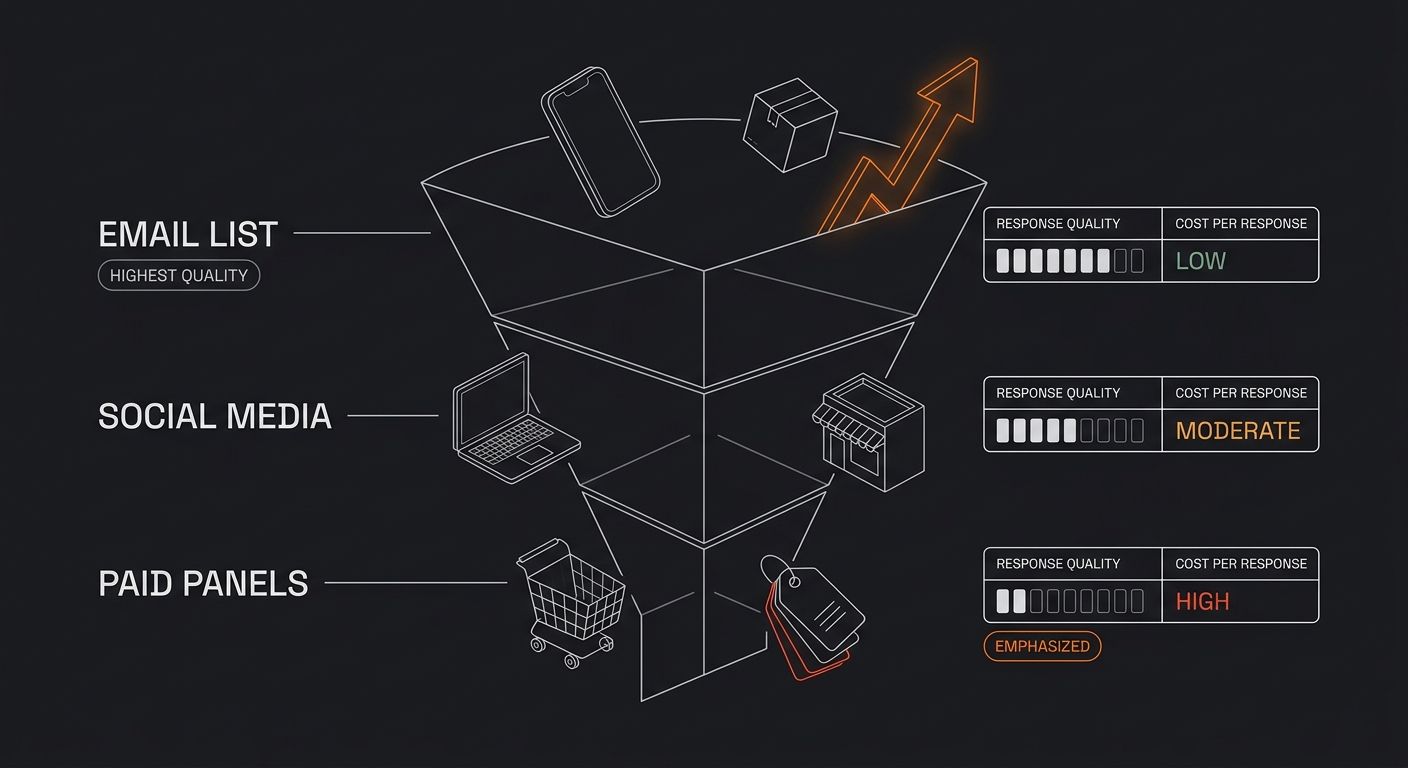
Three distribution methods ranked by data quality:
Existing customer email list. Highest quality. These people have already bought from you. Segment by purchase history if possible. Target customers with at least 2 weeks of active engagement for Product-Market Fit questions to avoid artificially deflated scores.
Social media audience. Medium quality. Your followers self-selected into your niche but may not be buyers. Post the survey link with context about what you're building and why their input matters. Instagram Stories polls work for quick 1-question validation; link to a full survey in bio for deeper research.
Paid panel respondents. Variable quality. Services like Prolific or SurveyMonkey Audience let you buy responses from screened demographics. Budget $1-3 per complete response. You need minimum 50 responses for quantitative patterns, 100+ for statistical confidence.
Verification: You'll know your targeting worked when your screening question (Question 1) filters out fewer than 30% of respondents. If more than 30% get screened out, you're reaching the wrong audience.
Turning Raw Responses Into a Decision
Don't sit on survey data. Set a response deadline (7-10 days for email, 3-5 days for social), then close the survey and analyze.
For quantitative questions (multiple choice, scales), the analysis is straightforward: export to a spreadsheet, calculate percentages, look for clear winners. If you're comparing price ranges, map responses against your margin calculations to see which price point delivers both buyer enthusiasm and profitable unit economics.
For open-ended questions, read every response and tag recurring themes. You're looking for patterns across 3+ respondents. A single passionate response about a feature isn't a signal. The same complaint from 8 out of 40 respondents is.
Segment results by respondent type when possible. What your existing customers want and what your social followers want are different data sets pointing at different product decisions. SurveyMonkey's product development guidelines emphasize testing a few specific concepts against each other rather than asking abstract preference questions, because direct comparisons produce clearer winners.
The output of this step is a decision, not a report. Write one sentence: "Based on [X] responses, we're going with [product/price/feature] because [data point]." If you can't write that sentence, your survey didn't work and you need to figure out why before running another one.
When Things Go Wrong
Three common failures and their fixes:
Low response rate (under 10% of recipients). Your survey is too long, your subject line is weak, or you're sending at the wrong time. Cut questions to 5 max, rewrite the email subject to emphasize what's in it for them ("Help us build what you actually want"), and send Tuesday-Thursday between 10am-2pm in your audience's timezone. Consider incentives: a 10% discount code or entry into a $50 gift card drawing.
Contradictory data. Respondents say they want Product A but their purchase intent scores are higher for Product B. Trust the purchase intent scores over stated preferences. People are bad at predicting their own behavior. Behavioral data beats opinion data every time.
Vague open-ended responses. If you're getting answers like "It's fine" or "Nothing," your question is too broad. Instead of "What do you think about this product?" ask "What's one thing you'd change about this product if you could?" Specificity in questions produces specificity in answers.
Where to Go From Here
Pair your survey data with competitive research tools like Terapeak to cross-reference what respondents say they want against what's actually selling. Survey data tells you about intent. Sales data tells you about behavior. The overlap between those two data sets is where your best product decisions live.
Run your first survey this week. You don't need perfect questions or a massive audience. Fifty responses to five focused questions will tell you more about your next product decision than three months of guessing. Then run another survey in 30 days with refined questions based on what you learned. The operators who build survey feedback into their regular product development cycle catch demand shifts before their competitors notice them.

Ryan Torres
Ryan Torres is a former Amazon FBA seller turned dropshipping consultant who has generated over $2.8M in ecommerce revenue across 14 product launches. He specializes in supplier vetting, margin optimization, and scaling DTC operations for sub-$1M brands. Ryan focuses on actionable frameworks that drive measurable results for independent operators.
Frequently Asked Questions
- How many questions should I include in a product research survey?
- Keep product research surveys to 5-7 questions maximum, with 5 questions being the ideal sweet spot for dropshipping and DTC operations. Each question beyond 7 drops your completion rate by roughly 5-10%, and every question should directly feed into your single product decision.
- What are the best survey distribution channels for product validation?
- The top three distribution methods ranked by data quality are: existing customer email lists (highest quality), social media audiences (medium quality), and paid panel respondents like Prolific or SurveyMonkey Audience (variable quality at $1-3 per response). Email to existing customers produces the most reliable data.
- How do I structure a product research survey to get actionable data?
- Use this 5-7 question structure: a screening question to filter non-buyers, a behavior question about where they purchase, an open-ended pain point question, a concept test with product images, a price sensitivity question with ranges, a purchase intent scale question, and a follow-up permission question. Keep total completion time under 3 minutes.
- What should I do with survey responses after collecting them?
- Set a response deadline of 7-10 days for email or 3-5 days for social, then close and analyze. For quantitative questions, export to spreadsheet and calculate percentages; for open-ended questions, tag recurring themes from 3+ respondents. Write one-sentence decision: 'Based on [X] responses, we're going with [product/price/feature] because [data point].'
- What is the minimum number of survey responses I need for reliable data?
- You need a minimum of 50 responses to identify quantitative patterns and 100+ responses for statistical confidence. However, 50 focused responses to five solid questions will produce more actionable insights than months of guessing.
- Why do most product research surveys fail to produce useful results?
- 90% of product research surveys fail because questions are either too vague to act on ('How do you feel about our products?') or too leading to trust ('Don't you think this product would solve your problem?'). The key is writing specific, behavior-focused questions that directly support one clear product decision.
- Should I trust stated preferences or purchase intent scores when respondents give contradictory answers?
- Trust the purchase intent scores over stated preferences, as people are poor at predicting their own behavior. Behavioral data and direct comparisons between product options consistently beat opinion data and abstract preference questions.
- How long does it take to build and deploy a product research survey?
- Your first survey takes about 3-4 hours from start to finish, and subsequent surveys get faster once you understand the process. The entire cycle from survey creation through analysis and decision-making should be completed within 7-10 days.
Related Articles

Why Your Product Research Is Producing Low-Margin Losers: 6 Validation Mistakes and How to Correct Them
80/20 Sourcing's product selection analysis names tool-dependent research as the top mistake that sinks ecommerce businesses before they ship a first order.
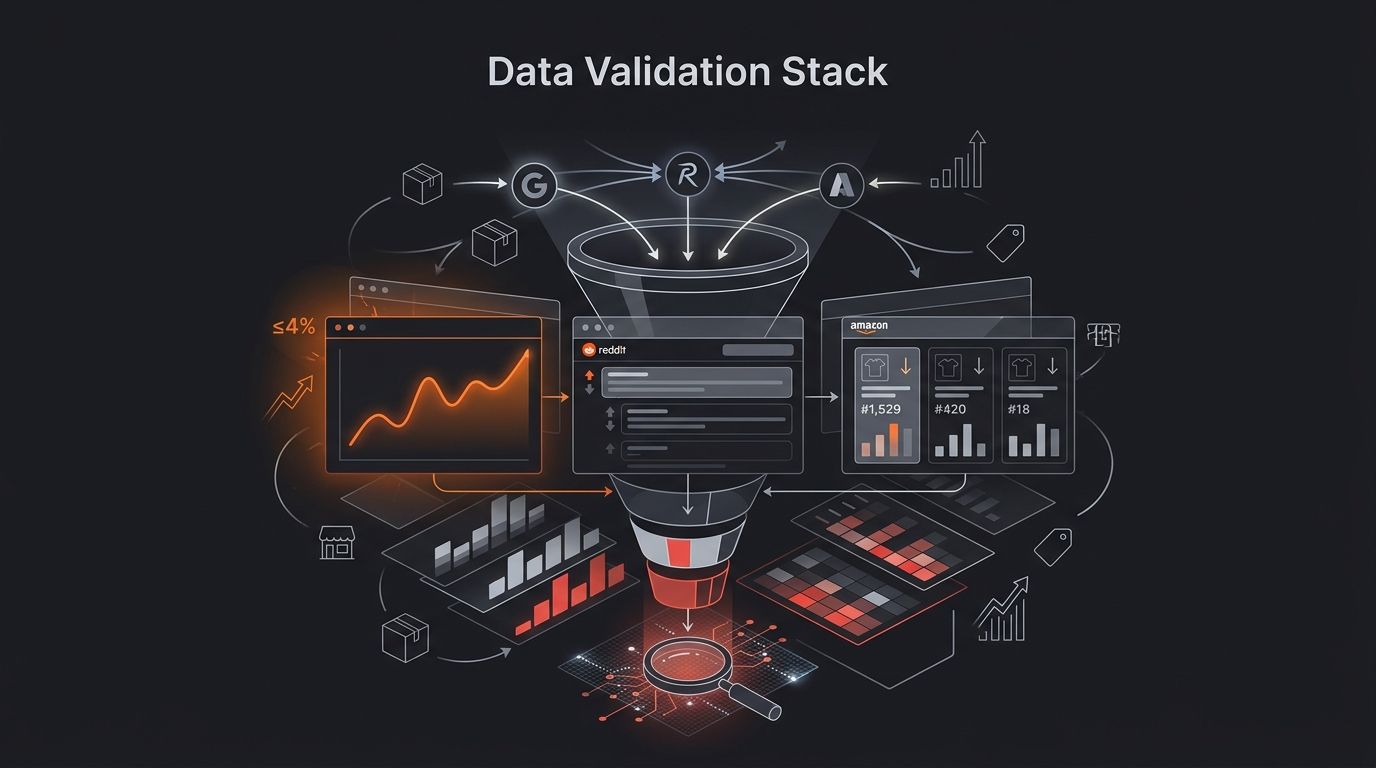
How to Build a Niche Demand Validation Stack Using Google Trends, Reddit, and Amazon BSR Before You Source a Single Product
Novadata's 2026 Amazon BSR guide identifies subcategory rank, not main-category rank, as the actionable metric for niche competitive analysis.

When Spy Tools Become a Liability: How Competitive Intelligence Blinds You to Sustainable Niche Selection
Spy tools trained you to pick niches your competitors already validated, which means every product you launch enters a market where margins are compressing in real time.
Explore more topics