Profitable Niches for Dropshipping: Top 10
Dropship.io, SEMrush, and Meta Ad Library each claim to surface profitable dropshipping niches, but they pull from fundamentally different data pools: product sales databases, organic search volume, and paid ad spend.
Profitable Niches for Dropshipping: 3 Research Tools That Actually Surface Them
Dropship.io, SEMrush, and Meta Ad Library each claim to surface profitable dropshipping niches, but they pull from fundamentally different data pools: product sales databases, organic search volume, and paid ad spend. The tool you choose shapes which niches you'll find and how confidently you can bet on them.
How These Three Tools Were Evaluated
Each tool was tested against three criteria: niche discovery speed (how fast it surfaces viable categories), data depth (revenue estimates, search volume, or ad frequency), and margin signal (whether it helps you calculate contribution margin before you order samples). Price, learning curve, and Shopify integration were secondary factors. Tools focused solely on product sourcing, like CJ Dropshipping's catalog browser, were excluded because they don't provide competitive intelligence.
Dropship.io Tracks What Stores Actually Sell
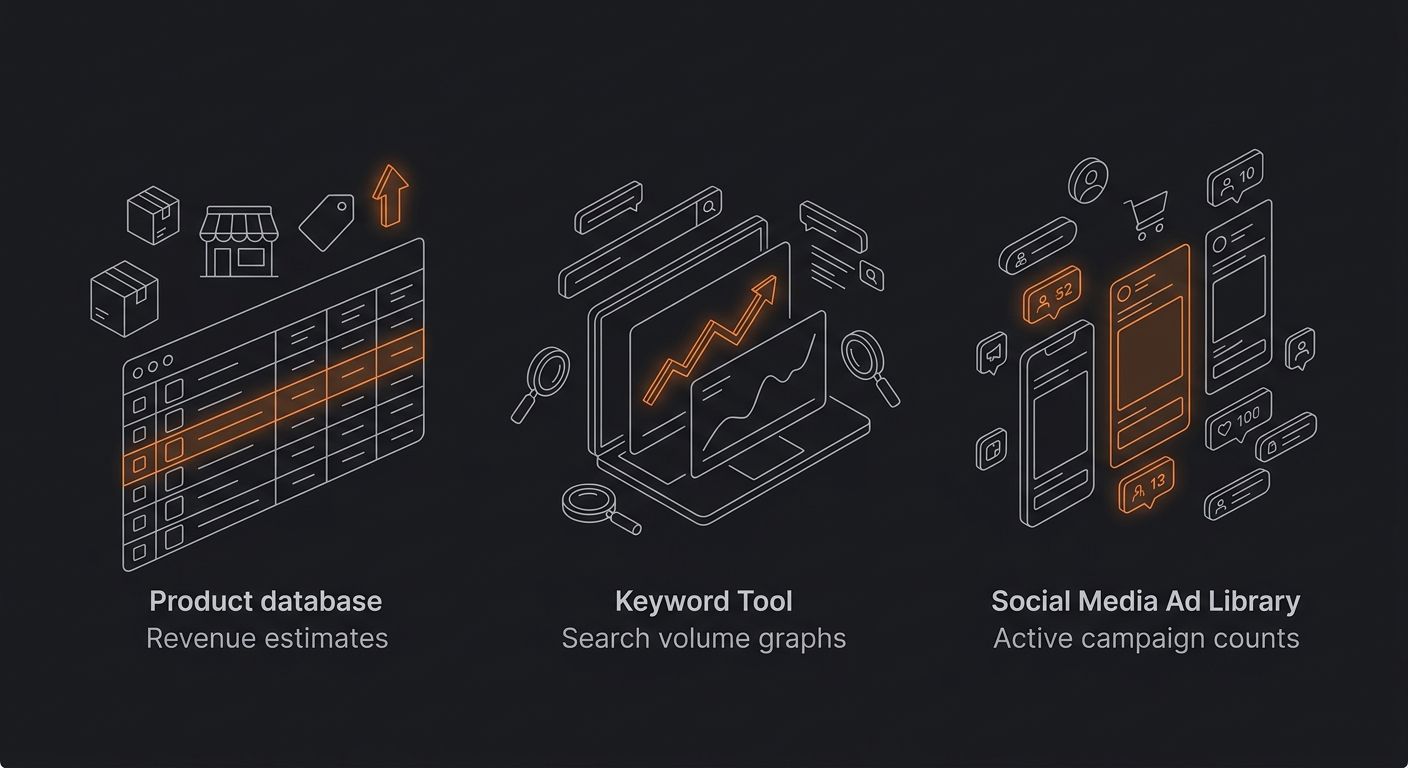
Dropship.io maintains a database of Shopify stores and their estimated revenue, which means you're seeing niches validated by actual sales data rather than search interest or trend curves. The platform aggregates Facebook ad campaigns so you can analyze competitor ad spend, identify which product categories attract paid investment, and reverse-engineer what's working.
The niches that surface consistently through Dropship.io's database include phone accessories (MagSafe products, portable chargers), fitness recovery tools, and pet wellness items. Dropified's 2026 niche analysis notes these categories "are experiencing the strongest growth, driven by technological advances and consumer sustainability trends." Phone accessories specifically have shown a steady five-year search trend, peaking in winter months and maintaining demand year-round, according to Shopify's niche research team.
Where Dropship.io earns its subscription cost is the revenue estimation layer. You can filter stores by monthly revenue range, isolate stores in specific niches, and compare what competing stores charge against supplier costs. If you're evaluating whether pet wellness items carry enough margin, you get real pricing benchmarks rather than guesswork.
The tradeoff: Dropship.io's database skews heavily toward Shopify stores. If your competitors sell on WooCommerce, Etsy, or Amazon, you're working with incomplete competitive intelligence. Pricing starts at $29/month for the basic plan, and the ad spy features sit behind higher tiers. For a deeper look at the full feature set, we published a separate Dropship.io review covering pricing and capabilities.
SEMrush Validates Search Demand Before You Commit
SEMrush wasn't built for dropshipping, but its keyword and competitive intelligence data answers a question Dropship.io can't: how many people are actively searching for products in your target niche, and how hard will it be to rank for those terms? DSers' competitive analysis guide recommends using SEMrush to "query the keyword rankings of competitors and lock in high-traffic and low-difficulty keywords" while pairing it with Ahrefs to map backlink opportunities.
The niches that look strongest through an SEO lens differ from what ad-spy tools surface. Beauty and personal care dominates search volume across every keyword tool. Carro's 2026 ecommerce statistics report values the beauty market at $672.2 billion with a 23.6% CAGR, making it the single largest addressable category for dropshippers willing to compete on content. Wall art is another category with outsized search interest relative to competition: Nextools values the global wall art market at $48.50 billion in 2021, projected to reach $72.61 billion. Eco-friendly home products and baby accessories round out the top categories by search volume with manageable keyword difficulty scores.
The real power of SEMrush for niche selection is the Keyword Magic Tool paired with competitive gap analysis. You input a competitor's domain, pull their top organic keywords, and identify product categories where they rank but you don't. This works especially well for operators building content-driven stores where organic traffic reduces CAC over a 6-12 month horizon.
The tradeoff: SEMrush tells you what people search for, not what they buy. High search volume for "best massage gun" doesn't confirm that dropshipped massage guns convert at profitable margins after ad spend. Plans start at $139.95/month, which is a tough sell for operators running sub-$10K/month stores. You'll extract more value if you're already using it for SEO across multiple projects.
Meta Ad Library Shows Where Competitors Put Money
Meta Ad Library is free, requires no subscription, and shows every active ad running on Facebook and Instagram. For finding profitable niches for dropshipping, the method is straightforward: search product-category terms, filter by country and active status, and study which product types have the most live campaigns. High ad density in a category signals that operators are spending because the unit economics justify it.
Printful's 2026 niche guide identifies four signals of a profitable dropshipping niche: "consistent demand, repeat-purchase potential, clear audience identity, and product pricing that leaves room for production, shipping, taxes, transaction fees, and ad costs." Meta Ad Library lets you validate at least two of those signals: consistent demand (visible through ad longevity) and clear audience identity (visible through the ad creative itself).
The niches with heaviest ad density in mid-2026 include home office ergonomics, baby products (especially organic and non-toxic positioning), content creator gear, and emergency preparedness items. Electronics broadly accounts for 30% of North American dropshipping according to Carro's reporting, and gadget-adjacent niches dominate Meta's ad feeds. Sustainable home products and specialized hobby equipment like golf training tools also show strong ad presence, with Dropified noting these categories maintain low competition relative to demand.
The tradeoff: Meta Ad Library shows you ads exist, but it doesn't show spend amounts, ROAS, or conversion rates. Shopify's product research guide notes directly that the Ad Library "doesn't show ad spend." You're reading directional signals: a campaign running for 90+ days probably works, but you can't confirm it. And free access means everyone has the same data, so you're competing on execution speed rather than information advantage.
Side-by-Side Comparison
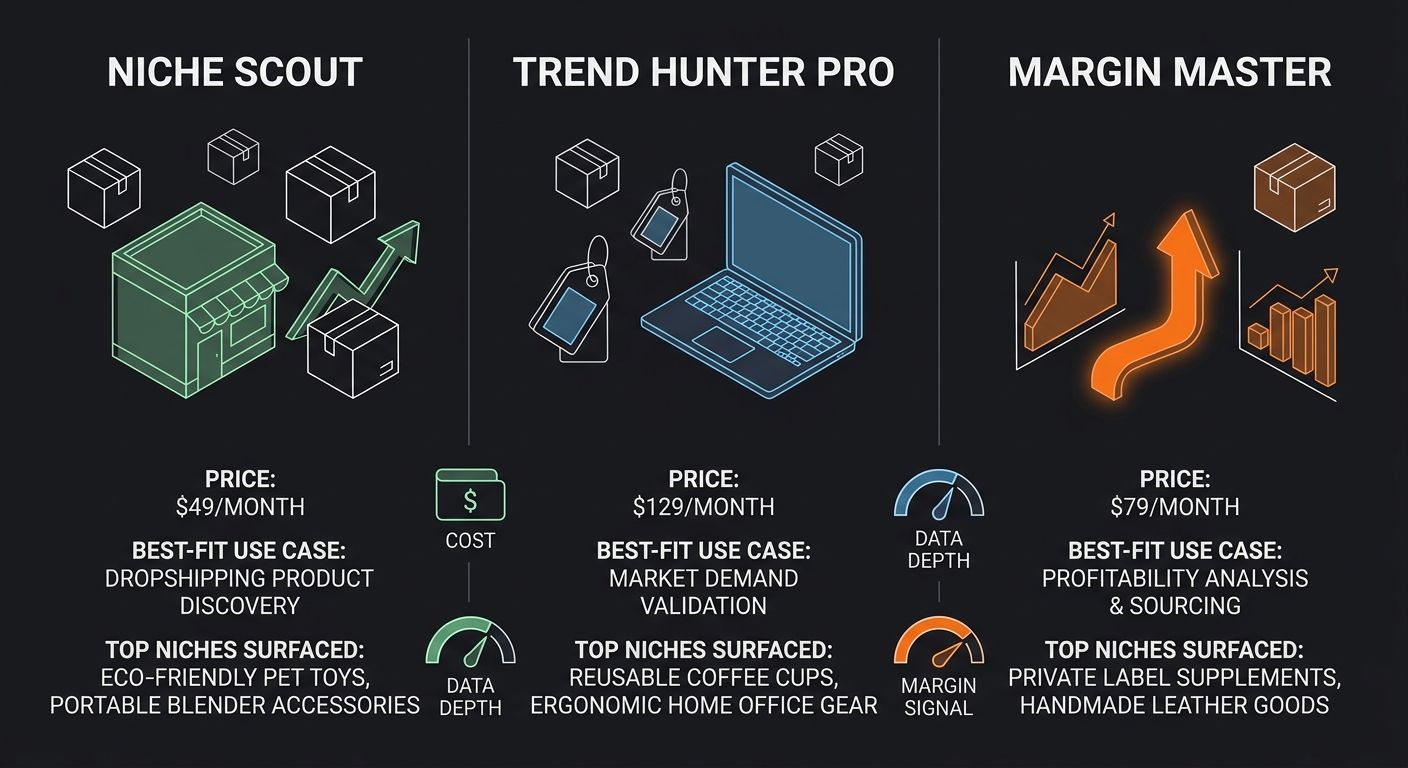
Attribute | Dropship.io | SEMrush | Meta Ad Library |
|---|---|---|---|
Monthly Cost | $29–$79 | $139.95–$249.95 | Free |
Data Source | Shopify store sales estimates + Facebook ads | Search volume, keyword difficulty, backlinks | Active Facebook/Instagram ad creatives |
Best For | Validating niche revenue potential | Quantifying search demand + SEO opportunity | Spotting ad-heavy niches on zero budget |
Top Niches Surfaced | Phone accessories, pet wellness, fitness tools | Beauty, wall art, eco-friendly home | Home office, baby, creator gear |
Margin Signal | Indirect (competitor pricing visible) | None (search ≠ purchase intent) | None (ad presence ≠ profitability) |
Learning Curve | Low (built for dropshippers) | High (enterprise SEO tool) | Low (simple search interface) |
Biggest Gap | Shopify-only store data | No sales or conversion data | No spend or ROAS data |
Who Should Pick Which
Pick Dropship.io if you're running a Shopify store and want to validate niches against actual revenue data before spending on samples and ads. The tool pays for itself fastest when you're choosing between 2-3 profitable dropshipping niche candidates and need sales volume confirmation. Pair it with proper margin math to filter out categories where unit economics don't survive ad costs.
Pick SEMrush if you're building a content-driven store where organic traffic is part of the growth model. SEMrush earns back its $140+/month when you're publishing product comparison content, building topical authority, and reducing CAC through SEO over a longer time horizon. It's overkill for a single-product store running pure paid acquisition.
Pick Meta Ad Library if you're pre-revenue, testing niche ideas on a zero-dollar research budget, and willing to accept directional signals instead of hard data. Start here, build a shortlist of 3-5 niches with heavy ad activity, then graduate to Dropship.io or SEMrush once you've validated initial demand through a small test campaign.
If you're sourcing products from AliExpress suppliers for any of these niches, run your supplier vetting process in parallel with niche research. We've covered the full AliExpress dropshipping workflow separately, including supplier red flags and shipping timelines that affect which niches remain profitable after fulfillment costs. The niches that look best inside a research tool can fall apart when 15-day shipping windows push return rates above 8%, so validate logistics before you commit ad budget to a category you haven't shipped from yet.

Ryan Torres
Ryan Torres is a former Amazon FBA seller turned dropshipping consultant who has generated over $2.8M in ecommerce revenue across 14 product launches. He specializes in supplier vetting, margin optimization, and scaling DTC operations for sub-$1M brands. Ryan focuses on actionable frameworks that drive measurable results for independent operators.
Frequently Asked Questions
- What are the most profitable dropshipping niches in 2026?
- Top profitable niches include phone accessories (MagSafe products, portable chargers), pet wellness items, fitness recovery tools, beauty and personal care, wall art, eco-friendly home products, baby accessories, home office ergonomics, content creator gear, and emergency preparedness items. Electronics broadly account for 30% of North American dropshipping.
- What tools can I use to research dropshipping niches?
- The three main tools are Dropship.io (validates niche revenue through Shopify store data), SEMrush (quantifies search demand and keyword difficulty), and Meta Ad Library (free tool showing competitor ad activity). Each pulls from different data sources and serves different research purposes.
- What is contribution margin and why does it matter for dropshipping?
- Contribution margin is the money left after deducting product cost, shipping, payment fees, and ad spend from your selling price. If contribution margin falls below 20% for a product, the niche is likely unprofitable at scale regardless of search volume or ad activity.
- Should I use SEMrush for dropshipping niche research?
- SEMrush works best if you're building a content-driven store where organic traffic reduces customer acquisition cost over 6-12 months. At $140+/month, it's overkill for single-product stores running pure paid acquisition, but valuable when paired with content marketing strategies.
- Is Meta Ad Library useful for finding dropshipping niches?
- Meta Ad Library is a free tool that shows which product categories have heavy ad activity on Facebook and Instagram, signaling that operators believe the unit economics work. However, it doesn't reveal ad spend, ROAS, or conversion rates, so it provides directional signals rather than hard profitability data.
- Why does shipping time affect dropshipping profitability?
- Long shipping windows (like 15+ days from AliExpress suppliers) can push return rates above 8%, making previously profitable niches unprofitable after fulfillment costs. Logistics must be validated alongside niche research before committing ad budget.
- What is the best dropshipping research tool for beginners?
- Meta Ad Library is best for pre-revenue testing on a zero-dollar budget, allowing you to build a shortlist of 3-5 niches with heavy ad activity. Once you've validated initial demand through a small test campaign, graduate to Dropship.io or SEMrush for deeper validation.
Related Articles
dropshipping io Review: Features & Pricing
Dropship.io, AutoDS, and SaleHoo attack the same problem from three different angles: finding products worth selling on Shopify. Dropship.io bets on competitor intelligence and sales tracking at $39–$99/month. AutoDS wraps product research inside full-store automation.
When Spy Tools Become a Liability: How Competitive Intelligence Blinds You to Sustainable Niche Selection
Spy tools trained you to pick niches your competitors already validated, which means every product you launch enters a market where margins are compressing in real time.

The Demand Curve Mechanics of Trending Niches: Why Viral Products Have a Different Margin Profile Than Evergreen Categories
Viral products follow a spike-crash demand curve that compresses margins through a predictable four-stage sequence: rising CPMs, supplier price hikes, competitor flooding, and demand collapse.
Explore more topics