Terapeak Product Research: Complete Guide
EBay absorbed Terapeak into Seller Hub under the label "Product Research," giving every seller with a Seller Hub account access to up to three years of completed transaction data.

Terapeak Product Research: Complete Guide
EBay absorbed Terapeak into Seller Hub under the label "Product Research," giving every seller with a Seller Hub account access to up to three years of completed transaction data. That historical depth, compared to the 90-day window in standard sold-listings filters, is what makes real pricing and sourcing decisions possible on the platform.
What Terapeak Product Research Actually Is
Product Research is eBay's internal market intelligence tool, formerly sold as a standalone subscription under the Terapeak brand. eBay acquired the company and folded it into Seller Hub, making the core keyword-search and sales-data features free for all sellers. As Yaballe's seller guide documents, "Product Research is available to sellers with access to Seller Hub. Sourcing Insights is available to business sellers with a Basic Store subscription or higher." That distinction still trips up newer sellers because older guides treat both tools as a single product.
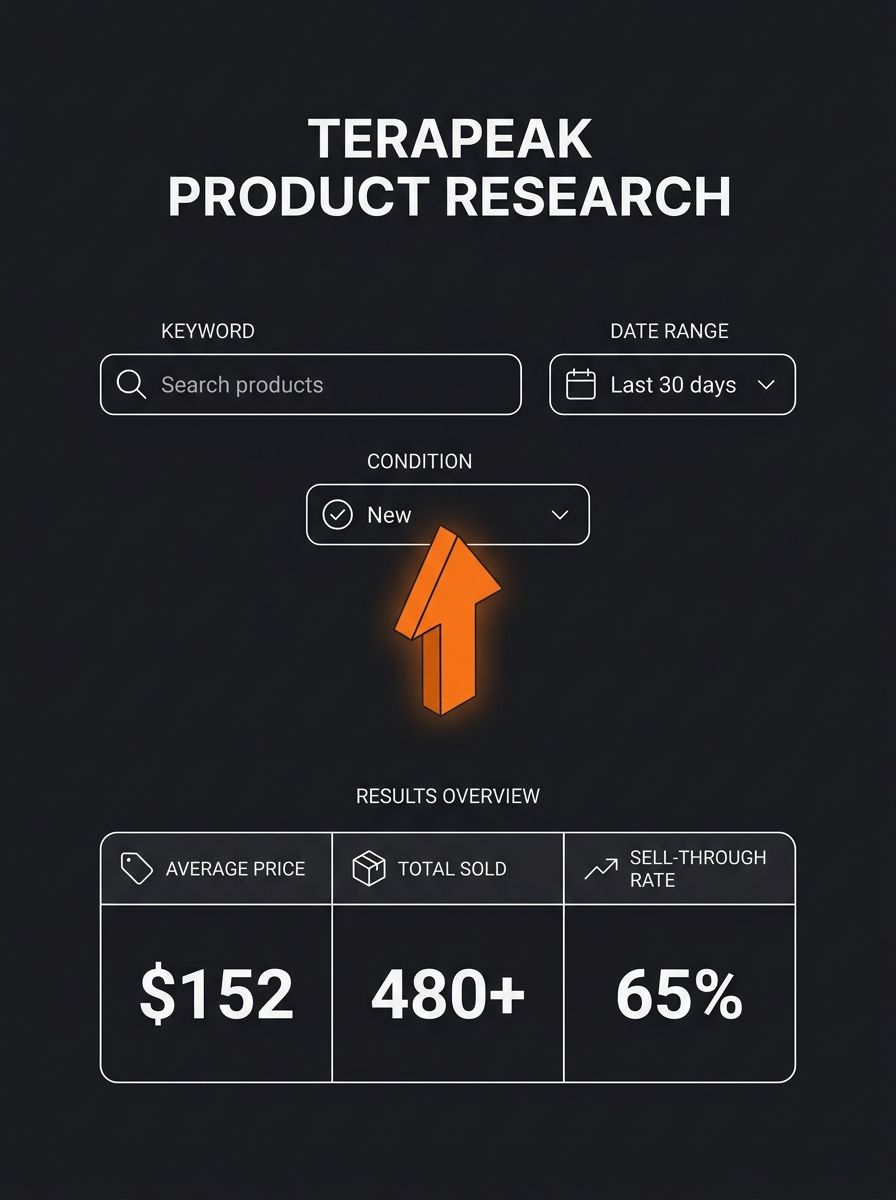
The tool pulls from eBay's actual transaction database. Every completed sale, every accepted Best Offer, every auction close price feeds into the dataset. When you search a keyword like "vintage Levi's 501," the system returns total units sold, average sold price, sell-through rate, and active listing count for your selected date range. You're looking at real buyer behavior, not wishful-thinking list prices.
How the Search Engine Indexes Transactions
According to LitCommerce's 2026 guide, the process starts with "searching the keyword on the Terapeak eBay search engine," which returns "information about listings sold within your selected date range." You type a keyword, select an eBay marketplace (US, UK, DE, AU, and others), pick a time window, and the system queries its transaction index.
The date range matters more than most sellers realize. Standard eBay sold-listings search only goes back 90 days. Product Research extends that window to three years of historical data. For seasonal products like Christmas decorations or patio furniture, 90 days of data during the off-season tells you nothing useful. Three years shows you the demand spike timing, peak pricing, and how competition levels shift quarter to quarter.
Filters make or break the results. You can segment by item condition (new vs. used vs. refurbished), listing format (auction vs. fixed price), and price range. Searching "iPhone 14 Pro Max" without filtering by condition mixes $200 cracked-screen units with $800 mint-condition phones, producing an average sold price that represents neither market. Always split new and used into separate searches.
Sell-Through Rate Drives Every Decision
Sell-through rate is the single most important metric inside terapeak product research, and the one most sellers gloss over in favor of average price. The calculation divides total units sold by total active listings, expressed as a percentage. A sell-through rate above 50% signals strong demand relative to supply. Below 20% means the category is either oversaturated or demand is weak.
Here's how to read it in practice. If a keyword shows 1,000 units sold and 500 active listings over the last 30 days, the sell-through rate hits 200%. Sellers in that niche are moving inventory fast. If the same keyword shows 1,000 sold and 10,000 active, the rate drops to 10%. You'd need aggressive pricing or highly differentiated listings to compete.
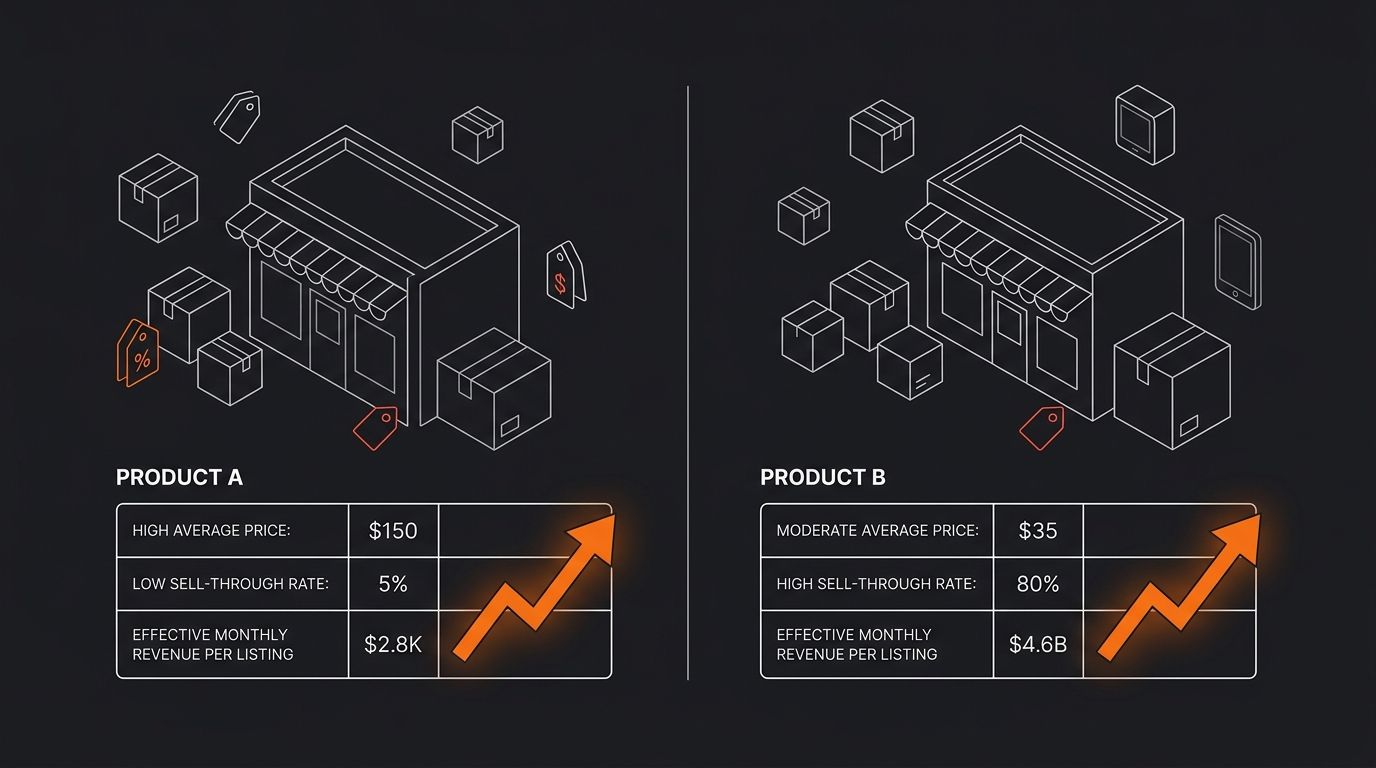
The trap is chasing high average sold prices in low sell-through categories. A product averaging $150 with a 5% sell-through rate means 95% of sellers listing that item aren't making a sale. Compare that to a $35 item with an 80% sell-through rate, where most listings convert within 30 days. When you're calculating your profit margins on the high-ASP item, factor in that your capital might sit idle for months before you see a return.
The Split Between Product Research and Sourcing Insights
Why does eBay run two separate research interfaces under one roof? Because they solve opposite problems. Product Research shows transaction history for keywords you already have in mind. Sourcing Insights works in reverse: it identifies categories with high demand and low supply, surfacing opportunities you haven't considered.
The access requirements differ. Product Research comes free with Seller Hub. Sourcing Insights requires a Basic Store subscription ($7.95/month) or higher. For sellers exploring profitable niches for their operations, Sourcing Insights is the more valuable tool because it pulls you toward underserved categories instead of confirming what you already suspect.
Sourcing Insights displays category-level data: average sell-through rate across a product category, average listing price, total active competition, and trend direction (rising or declining demand). When you find a category showing rising demand with fewer than average active listings, that's a supply gap worth investigating. Cross-reference it with Product Research by searching specific keywords within that category to validate individual product viability.
Best Offer Pricing and What the Numbers Reveal
"Every other tool on this page hands you a dashboard and asks you to interpret a market," Ecomli's analysis notes in its comparison of Terapeak alternatives. The Best Offer data inside Product Research is where that interpretation demands the most care.
On standard eBay search, a completed Best Offer listing shows "Sold" but hides the actual accepted price. Product Research reveals the real number. If you're researching a $200 collectible and see 40 completed sales, the average sold price might show $165. Without Best Offer data, you'd assume most items sold at or near $200. With it, you might discover that 25 of those 40 sales were Best Offer acceptances averaging $140, while the remaining 15 auction/fixed-price sales averaged $195. Your true market price depends entirely on which selling format you plan to use.
If you're running a model where you need to calculate your actual profit percentage, pricing based on the inflated average without accounting for Best Offer discounts eats directly into your margin. Segment the data by listing type before you build your cost model.
Competitor Title Analysis as a Pricing Signal
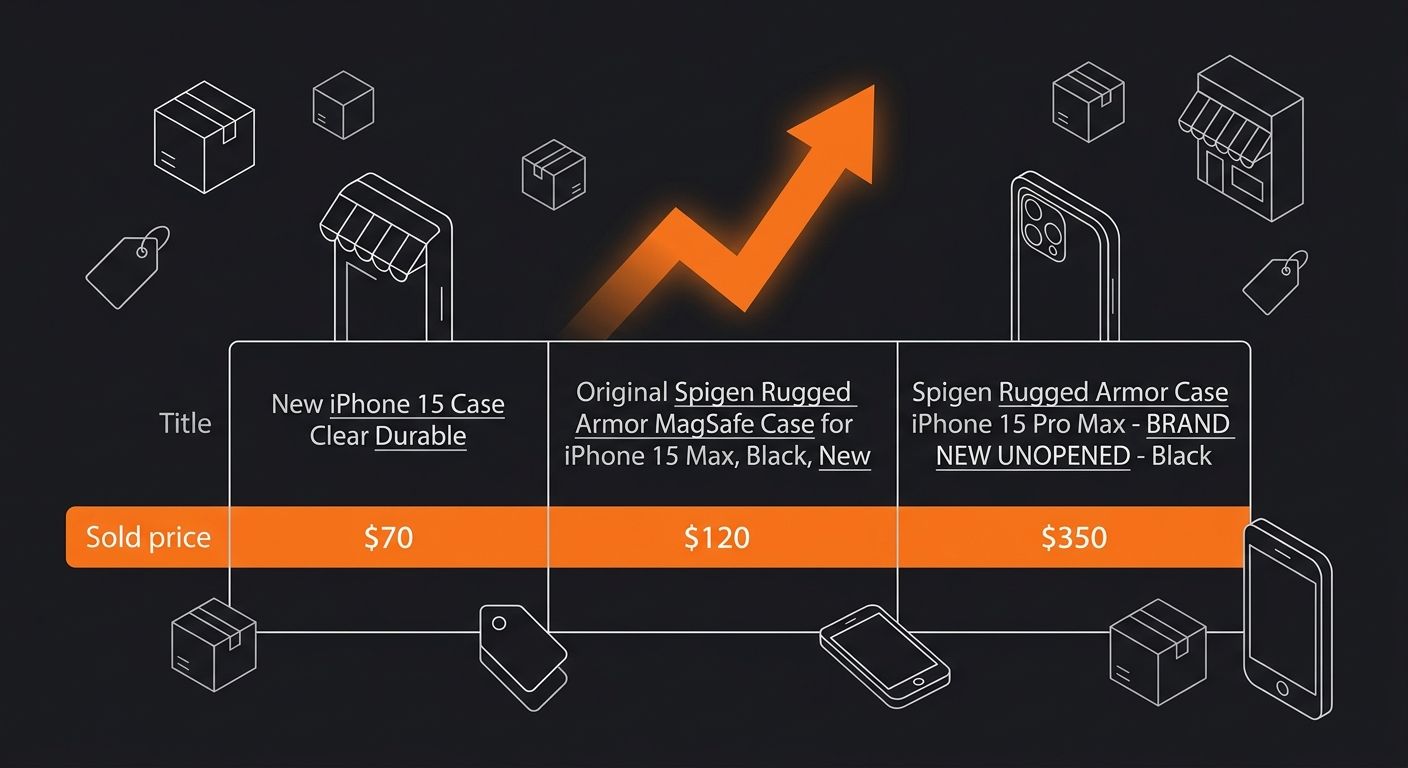
Beyond raw numbers, Product Research exposes the exact titles, item specifics, and selling prices of top-performing listings. Sorting completed sales by highest price reveals which keyword combinations and listing attributes command premium pricing.
A practical example: searching "mechanical keyboard" and filtering for sold items above $100 might reveal that listings including "hot-swappable," "gasket-mount," or specific switch brand names (Cherry MX, Gateron) consistently sell at 30% to 60% higher prices than generic titles. Those terms aren't random. They're buyer intent signals that the data surfaces.
For sellers doing eBay product research across multiple categories, this title-mining technique scales. Document the top 3 to 5 highest-priced sold listings per keyword, extract the differentiating terms, and incorporate them into your own titles. You're reverse-engineering what buyers actually pay premiums for.
Where the Data Breaks Down
Product Research pulls from eBay's transaction index, and that index has blind spots. Off-platform sales don't exist in the data. If a product category is migrating toward Amazon, Etsy, or direct-to-consumer channels, eBay's sell-through rate might look healthy while total addressable demand is actually shrinking. The tool tells you what happens on eBay. It tells you nothing about what happens everywhere else.
Category-level averaging hides outliers. A single viral listing selling 500 units at $9.99 can drag down the average sold price for an entire keyword where most sellers price between $25 and $30. Always look at the distribution of sales, not the mean alone.
Geographic filtering has limits too. You can select a specific eBay marketplace (ebay.com, ebay.co.uk, ebay.de), but you can't filter by buyer location within a marketplace. If you're evaluating shipping economics from Chinese suppliers, the data won't tell you whether buyers in that category tolerate 15-day delivery windows or demand 3-day domestic shipping.
And the three-year historical window, while longer than standard search, still truncates long-term trends. Products with 5-year or 10-year demand cycles (certain collectibles, vintage electronics) only show partial patterns. The data refreshes with a slight lag as well, so the most recent 24 to 48 hours of transactions may not appear immediately.
Common Questions
Is Terapeak free?
Product Research is free for any eBay seller with access to Seller Hub. No store subscription required. Sourcing Insights, the companion tool that identifies high-demand/low-supply categories, requires a Basic Store subscription at $7.95/month or higher. The legacy standalone Terapeak subscription no longer exists as a separate product.
How far back does Terapeak data go?
Product Research provides up to three years of completed transaction data. Standard eBay sold-listings search only covers 90 days. The extended window is critical for seasonal products, slow-moving inventory, and year-over-year trend analysis.
Can I use Terapeak on mobile?
Yes. The tool is accessible through the eBay mobile app under the Selling tab. The mobile version includes barcode scanning for in-store sourcing, letting you scan a product and pull sell-through rates, average sold prices, and competition levels on the spot.
What's a good sell-through rate?
Above 50% indicates strong demand relative to active supply. Between 20% and 50% is moderate, meaning competitive but viable with well-optimized listings. Below 20% signals either weak demand or heavy oversupply. Always pair sell-through rate with average sold price to evaluate whether the margin justifies entering the category.
Are there alternatives to Terapeak?
ZIK Analytics, Jungle Scout, and Ecomli are the most cited alternatives in 2026. ZIK Analytics partners directly with eBay data for market insights and competitor analysis. Ecomli takes a different approach with automated scraping that interprets market data rather than presenting raw dashboards. For Amazon-focused research, Jungle Scout covers that ecosystem, while Terapeak remains eBay-specific.

Ryan Torres
Ryan Torres is a former Amazon FBA seller turned dropshipping consultant who has generated over $2.8M in ecommerce revenue across 14 product launches. He specializes in supplier vetting, margin optimization, and scaling DTC operations for sub-$1M brands. Ryan focuses on actionable frameworks that drive measurable results for independent operators.
Frequently Asked Questions
- Is Terapeak free for eBay sellers?
- Product Research is free for any eBay seller with access to Seller Hub. Sourcing Insights, which identifies high-demand/low-supply categories, requires a Basic Store subscription at $7.95/month or higher.
- How far back does Terapeak historical data go?
- Product Research provides up to three years of completed transaction data, compared to the standard eBay sold-listings search which only covers 90 days. This extended window is critical for analyzing seasonal products and year-over-year trends.
- What is a good sell-through rate on Terapeak?
- A sell-through rate above 50% indicates strong demand relative to supply. Between 20% and 50% is moderate and competitive, while below 20% signals weak demand or oversupply. Always pair sell-through rate with average sold price to evaluate profit potential.
- What is the difference between Terapeak Product Research and Sourcing Insights?
- Product Research shows transaction history for keywords you search and is free with Seller Hub. Sourcing Insights works in reverse, identifying high-demand/low-supply categories you may not have considered, and requires a Basic Store subscription at $7.95/month or higher.
- Does Terapeak show Best Offer prices?
- Yes, Terapeak reveals the actual accepted Best Offer prices, while standard eBay search hides them. This is crucial because Best Offer sales often occur at significant discounts from list prices, directly affecting your true profit margins.
- Can I use Terapeak on my mobile phone?
- Yes, Product Research is accessible through the eBay mobile app under the Selling tab. The mobile version includes barcode scanning for in-store sourcing, allowing you to pull sell-through rates and pricing data in real-time.
- What are the limitations of Terapeak data?
- Terapeak only shows eBay transactions and misses sales on Amazon, Etsy, or other platforms. It also can't filter by buyer location within a marketplace, and category-level averages can hide outliers. The data refreshes with a 24-48 hour lag.
Related Articles
Terapeak eBay: Complete Seller Research Tool
EBay acquired Terapeak in 2017, spent four years rebuilding it inside Seller Hub, then made the core product research module free to every seller in April 2021.
Terapeak Review: Features, Pricing & Best Uses
Three eBay product research tools dominate the seller conversation right now: Terapeak (free inside Seller Hub), ZIK Analytics ($29.99/month standalone), and Ecomli (freemium with paid tiers).

Ebay Product Research
This guide walks you through eBay product research from raw data pull to validated listing in about 90 minutes. You'll use Seller Hub's built-in Terapeak tool and ZIK Analytics to identify products with proven demand, healthy margins, and beatable competition.
Explore more topics