Best Payable App Reviews: Top Picks 2024
Gartner rates Bill.com at 4.4 out of 5 for accounts payable automation, PCMag awards Apple Pay its Editors' Choice for mobile wallets, and PayPal dominates peer-to-peer transfers.

Best Payable App Reviews: Top Picks for Ecommerce Operators
Gartner rates Bill.com at 4.4 out of 5 for accounts payable automation, PCMag awards Apple Pay its Editors' Choice for mobile wallets, and PayPal dominates peer-to-peer transfers. These three payable app categories solve fundamentally different cash-flow problems, and ecommerce operators consistently pick the wrong one.
How We Scored Each Category
Every payable app review below was evaluated on four criteria specific to ecommerce operators doing under $1M in annual revenue: transaction fees as a percentage of gross margin, approval and settlement speed, security and fraud protection, and integration depth with Shopify, WooCommerce, or standalone storefronts. We excluded enterprise-only solutions requiring custom procurement cycles and platforms without mobile functionality. The data pulls from NerdWallet's AP software ratings, PCMag's mobile payment testing, Gartner peer reviews, and FinancesOnline's analysis of 21 mobile payment products.
Accounts Payable Software for Supplier Invoice Management
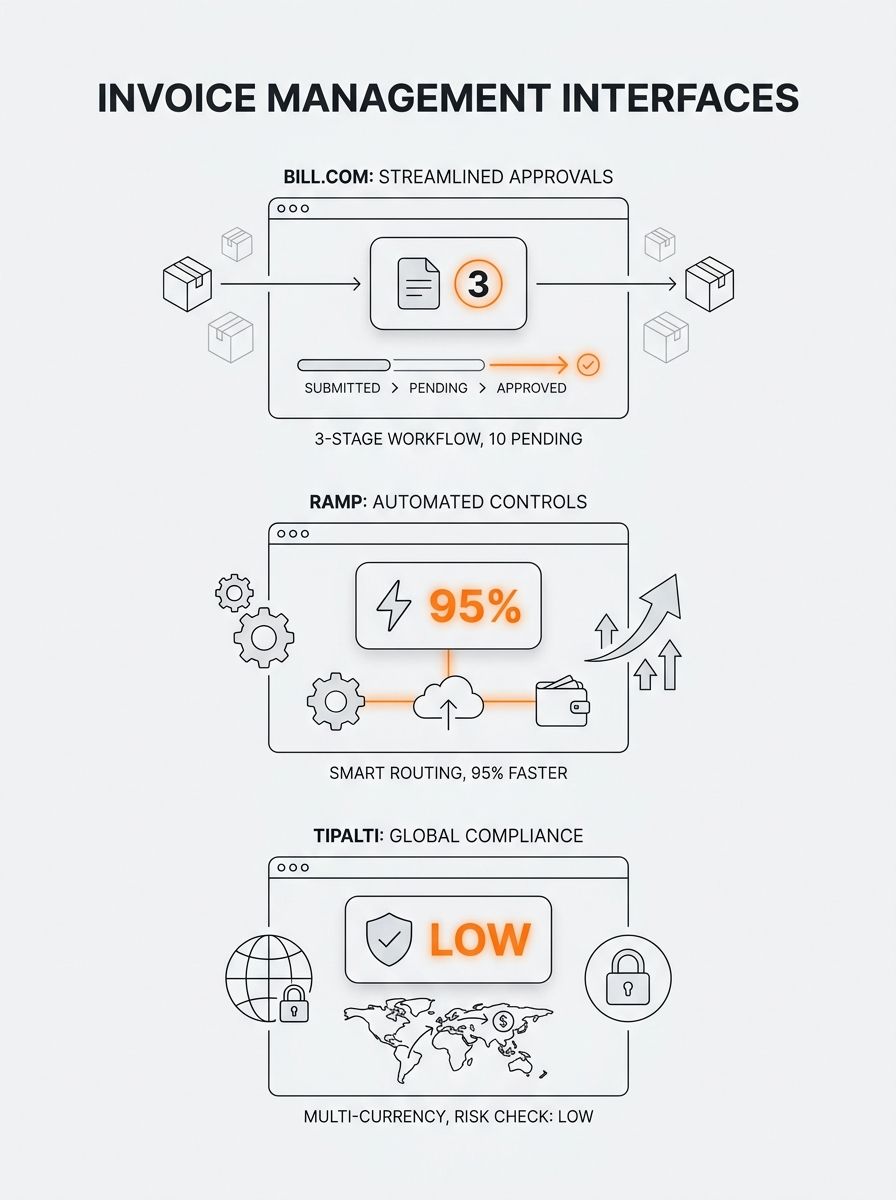
Bill.com, Ramp, and Tipalti are the three AP tools worth evaluating if you process recurring supplier invoices and want automated approval workflows. Pick this category when you're paying 5+ suppliers monthly and manual bank transfers eat more than two hours of your week.
Bill.com
Bill.com's core strength is automated invoice capture paired with configurable approval chains. The platform scans incoming invoices, matches them against purchase orders, and routes them to the right team member for sign-off. Gartner peer reviewers give it a 4.4/5, and 84% of AP software users flag general ledger integration as a critical feature, which Bill.com handles natively with QuickBooks, Xero, and NetSuite syncs.
The fee structure is where it gets real: plans start at $45/user/month for the Essentials tier. For a solo operator or two-person ecommerce team, that's $540-$1,080 per year before you send a single payment. ACH transfers carry an additional per-transaction fee. If your average supplier invoice is $200 and you're running 15% net margins, that $30 per order margin means Bill.com's subscription needs to save you meaningful labor hours to justify the cost. Run the numbers using a margin calculation spreadsheet before committing.
Ramp
Ramp bundles corporate cards, expense management, and AP automation into a single platform. The AI-powered reconciliation engine auto-categorizes transactions across your general ledger, and the platform issues cards in 35+ countries, which matters if you're paying international suppliers directly. No annual fee on the card side, which is rare.
The tradeoff: Ramp requires underwriting approval, and businesses under $250K in annual revenue often get declined or receive low credit limits. If you're scaling a dropshipping operation from $0 to $50K, Ramp probably won't approve you yet.
Tipalti
Tipalti scores 4.2/5 from Gartner reviewers and targets businesses with global payable needs. Its automated tax compliance engine handles W-9/W-8BEN collection and 1099 filing for US-based sellers paying domestic contractors, and it supports multi-currency payouts to international suppliers. According to a Tipalti-published case study, comparable AP automation delivers 90% more efficient document filing, 70% faster approvals, and $62,000 in annual labor cost savings.
The catch is pricing. Tipalti doesn't publish rates publicly; everything runs through custom quotes. In my experience vetting AP tools for sub-$1M brands, "custom quote" almost always means $15K+ annually, which puts it firmly in the "you better be doing serious volume" camp.
P2P Payment Apps for Quick Supplier Transfers
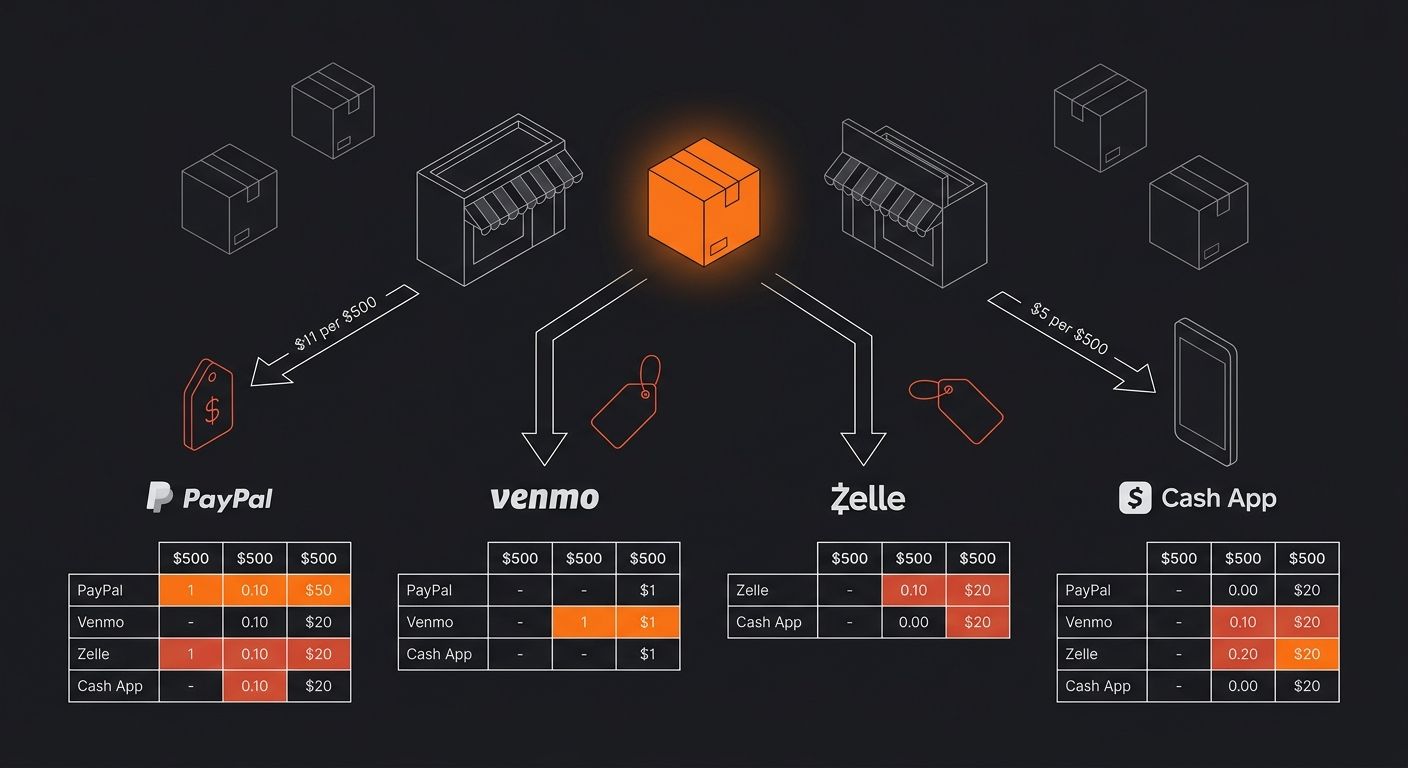
PayPal, Venmo, Zelle, and Cash App serve a different purpose entirely: fast money movement between two parties with minimal setup. Choose this category if you're paying a handful of suppliers or contractors and value speed over automation.
PayPal remains the default for ecommerce operators because suppliers worldwide accept it, and its Buyer Protection program offers a dispute resolution layer that raw bank transfers don't. PayPal's standard fee for commercial transactions is 2.99% + $0.49 per domestic transaction. On a $500 supplier payment, that's $15.44 in fees. Multiply that across 20 monthly payments, and you're spending $308.80/month on processing alone.
Zelle cuts that to zero, since it's a direct bank-to-bank transfer with no fees on either end. The limitation: Zelle is US-only and has no buyer protection. If your AliExpress supplier sends the wrong product, Zelle won't reverse the payment.
Venmo (owned by PayPal) supports business profiles with a 1.9% + $0.10 fee structure, which undercuts PayPal's standard rate. Cash App charges 0.5%-1.75% for instant deposits. Both work well for domestic contractor payments, but neither offers the multi-currency support or invoice tracking that a growing operation eventually needs.
Security across all four apps includes tokenization, encryption, and two-factor authentication or biometric verification. The weak point is human error, not technical vulnerability. Sending $2,000 to the wrong Zelle contact with no reversal mechanism is the real risk for operators moving fast.
Mobile Wallets for Customer-Facing Checkout
Apple Pay and Google Wallet win PCMag's Editors' Choice awards for mobile payment apps, and they solve the opposite problem from AP software: they're about accepting money from your customers, not sending money to your suppliers.
Near-Field Communication (NFC) technology allows both platforms to transmit encrypted payment data to point-of-sale terminals faster than chip-and-PIN. For ecommerce operators with a physical retail component or pop-up presence, enabling Apple Pay and Google Wallet at checkout reduces friction at the exact moment a customer decides to buy.
Online, both wallets integrate as express checkout buttons on Shopify and WooCommerce. The conversion impact is measurable. Stores that add Apple Pay as an express checkout option typically see 1-click purchase rates increase because customers skip the 14-field billing form. If you're already evaluating Shopify dropshipping apps, adding wallet checkout is a five-minute configuration that compounds over thousands of sessions.
The economics are straightforward: Apple Pay and Google Wallet don't charge merchants directly. Your payment processor (Stripe, Shopify Payments, Square) handles the transaction at its standard rate, typically 2.9% + $0.30 per online transaction. The wallet is a frontend convenience layer, not an additional cost center.
The tradeoff: wallets help you collect revenue faster, but they do nothing for managing outbound supplier payments. An operator who accepts Apple Pay at checkout but manually sends bank wires to five suppliers each week has solved only half the cash-flow equation.
Side-by-Side Comparison
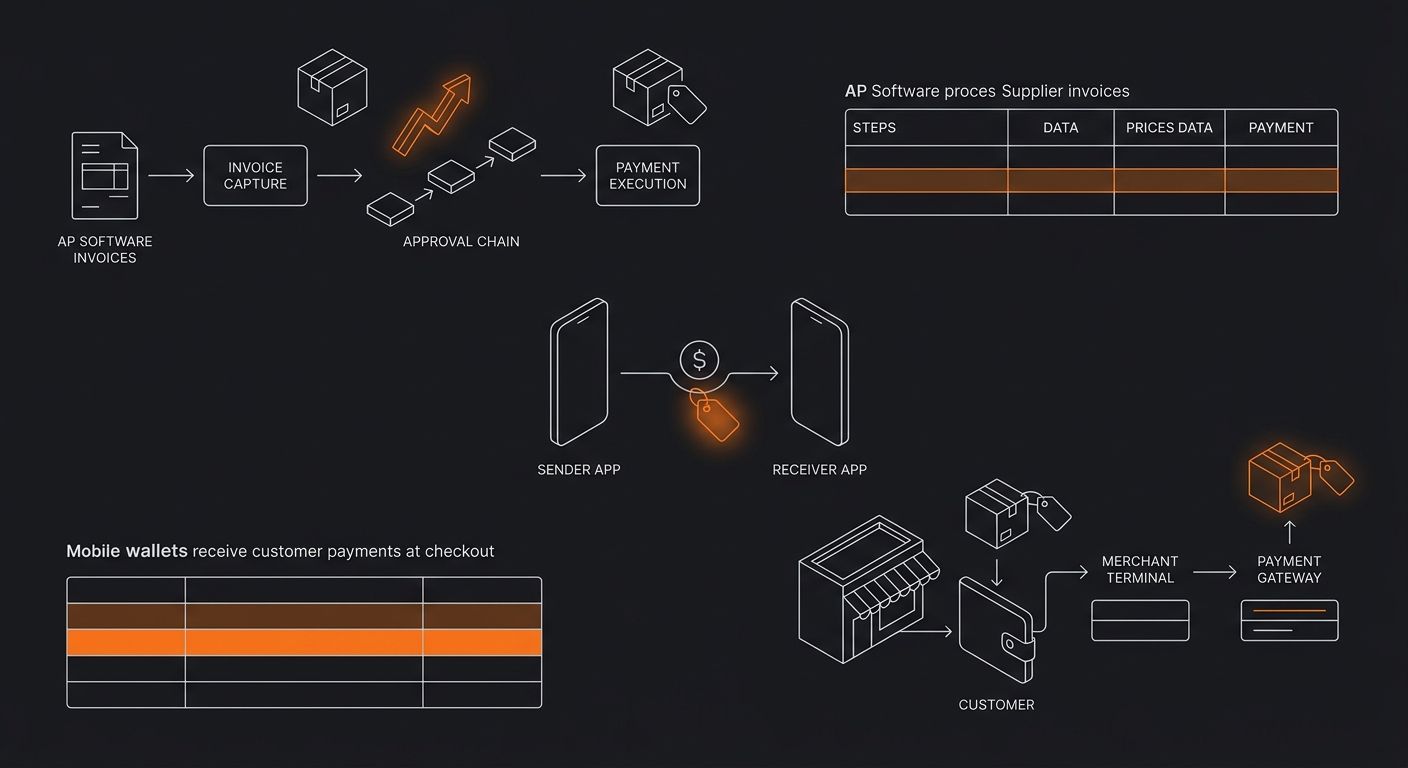
Attribute | AP Software (Bill.com / Ramp / Tipalti) | P2P Apps (PayPal / Venmo / Zelle) | Mobile Wallets (Apple Pay / Google Wallet) |
|---|---|---|---|
Primary use | Outbound supplier invoices | One-off transfers to suppliers/contractors | Inbound customer payments |
Monthly cost | $45-$1,250+/mo (subscription) | $0 base; 0%-2.99% per transaction | $0 (processor fees apply) |
Approval workflows | Yes, configurable multi-step | No | No |
Multi-currency | Yes (Tipalti, Ramp) | Limited (PayPal only) | Yes (via processor) |
Invoice matching | Automated 2-way and 3-way | Manual | N/A |
Security | Multi-factor auth, audit trails, fraud detection | Tokenization, 2FA, biometrics | NFC encryption, biometrics, tokenization |
Best for | 50+ invoices/month, $500K+ revenue | Under 20 payments/month, early-stage | Any operator wanting higher checkout conversion |
Biggest risk | Overpaying for features you don't use yet | No buyer protection on personal sends | Solves only the collection side |
Who Should Pick Which
You're doing under $10K/month and paying 1-5 suppliers: Use PayPal Business for supplier payments (eat the 2.99% fee as a cost of doing business) and enable Apple Pay/Google Wallet on your store checkout. AP software is overkill at this stage. Your profit margin math should factor the PayPal fees into landed cost, not treat them as a surprise.
You're at $20K-$50K/month with 10-20 recurring suppliers: Bill.com's $45/month Essentials plan starts making sense here. The automated invoice matching and approval routing will save you 4-6 hours per week, and 77% of AP software users say duplicate payment alerts alone justify the subscription. Keep Apple Pay enabled on the checkout side.
You're above $50K/month with international suppliers across multiple currencies: Ramp (if you qualify for underwriting) or Tipalti (if you can absorb the pricing) will pay for themselves through FX fee savings and reduced manual processing. At this volume, 75% of AP solutions deploy AI-driven invoice capture that hits 80-90% accuracy on first pass, which means your team handles exceptions instead of every single document.
The worst decision is using a P2P app like Venmo for supplier payments at scale. At $50K/month in supplier spend, Venmo's 1.9% fee eats $950/month, and you get zero automation, zero audit trail, and zero multi-step approval protection. That $950 covers two months of Bill.com for your entire team.
Pick based on transaction volume and supplier count, not feature lists. Features you don't use are overhead, and overhead kills margin.

Ryan Torres
Ryan Torres is a former Amazon FBA seller turned dropshipping consultant who has generated over $2.8M in ecommerce revenue across 14 product launches. He specializes in supplier vetting, margin optimization, and scaling DTC operations for sub-$1M brands. Ryan focuses on actionable frameworks that drive measurable results for independent operators.
Frequently Asked Questions
- What is the best payment app for ecommerce operators paying multiple suppliers each month?
- For operators processing 50+ supplier invoices per month, accounts payable software like Bill.com, Ramp, or Tipalti is best. These platforms automate invoice capture, matching, and approval workflows, saving 4-6 hours per week compared to manual processing.
- How much does Bill.com cost for small ecommerce businesses?
- Bill.com's Essentials plan starts at $45/user/month, which equals $540-$1,080 per year for a solo operator or two-person team, plus additional per-transaction fees for ACH transfers.
- What are the transaction fees for PayPal business payments to suppliers?
- PayPal charges 2.99% + $0.49 per domestic commercial transaction, which amounts to $15.44 on a $500 payment or $308.80/month across 20 payments.
- Does Zelle have buyer protection for supplier payments?
- No, Zelle offers zero buyer protection and has no dispute reversal mechanism. If a supplier sends the wrong product, Zelle won't reverse the payment, unlike PayPal's Buyer Protection program.
- Do Apple Pay and Google Wallet add extra fees to my checkout?
- Apple Pay and Google Wallet don't charge merchants directly; your existing payment processor (Stripe, Shopify Payments, Square) charges the same 2.9% + $0.30 rate whether customers use a wallet or type a card number.
- What payment app should I use if I'm doing under $10K per month?
- Use PayPal Business for supplier payments and enable Apple Pay/Google Wallet on checkout. AP software is overkill at this stage, and you should factor PayPal's 2.99% fee into your landed cost calculations.
- Why is Ramp a poor choice for new ecommerce businesses under $250K revenue?
- Ramp requires underwriting approval, and businesses under $250K in annual revenue are often declined or receive low credit limits, making it inaccessible for early-stage dropshipping operations scaling from $0 to $50K.
- What are the risks of using Venmo for supplier payments at scale?
- At $50K/month in supplier spend, Venmo's 1.9% fee costs $950/month with zero automation, audit trails, or multi-step approval protection. Using it for business payments at scale is inefficient compared to dedicated AP software.
Related Articles
How to Start Dropshipping: A Beginner's Guide
Starting a dropshipping store requires three connected layers: a storefront platform (Shopify leads), a supplier automation app (DSers, Spocket, or Zendrop), and a payment-plus-shipping configuration.
autopilot app reviews: Top Picks & Features
Autopilot, M1 Finance, and Wealthfront all automate portfolio management, but they split on one axis: how much control you keep over individual trades.
The Automation Tool Selection Trap: Why Feature Parity Doesn't Equal Profit Growth for Your Dropshipping Store
Feature parity — when two automation platforms check the same boxes on a comparison chart — tells you almost nothing about which tool will grow your store's contribution margin.
Explore more topics