Gelato Print on Demand: Full App Review
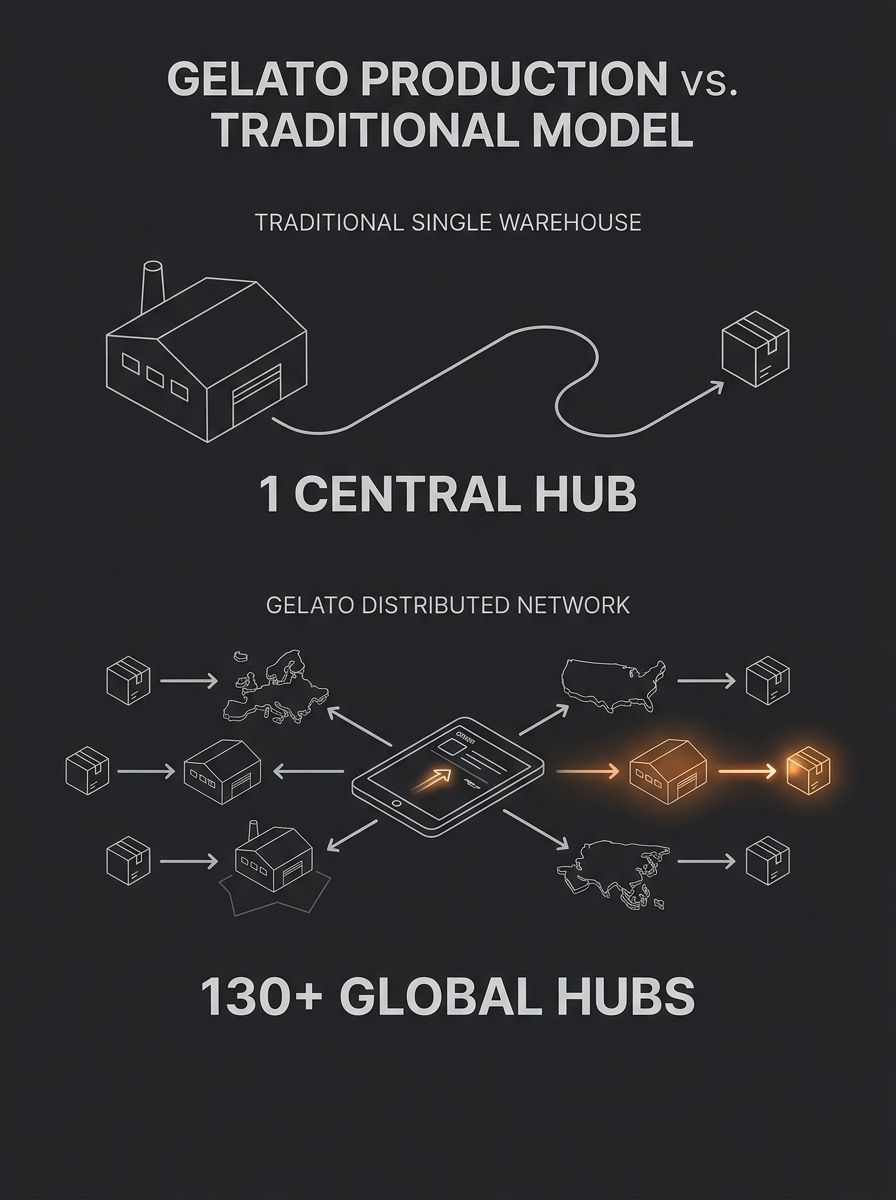
Gelato is a print-on-demand platform that routes each customer order to the nearest production facility in a network spanning 140+ hubs across 32 countries, producing goods locally instead of shipping from a central warehouse.

Gelato Print on Demand: Full App Review
Gelato is a print-on-demand platform that routes each customer order to the nearest production facility in a network spanning 140+ hubs across 32 countries, producing goods locally instead of shipping from a central warehouse. The result: 88% of orders are fulfilled inside the customer's own country, which compresses delivery windows and kills the 2-3 week wait times that plague most POD competitors.
How Gelato's Production Network Differs from Traditional POD
Most print-on-demand platforms operate from one to three central facilities. Printful runs production from locations concentrated in the US, Mexico, and Latvia. Printify aggregates third-party print providers but doesn't control routing the same way. Gelato built something architecturally different: a distributed production network where the software decides which of 140+ facilities handles each order based on the customer's shipping address.
According to Gelato's own data, 88% of orders get fulfilled in the same country as the end customer, and 99% within the same geographic region. If you're comparing this to how Printful and Printify handle fulfillment, the difference is structural. Gelato produces internationally rather than just shipping internationally.
This matters for margin math. When a POD provider ships a t-shirt from North Carolina to Munich, you're eating $12-18 in cross-border shipping. When Gelato prints that same shirt in a German facility, the shipping cost drops to domestic rates. Your customer gets the product in 3-5 days instead of 12-18.
Order Routing and the Automation Layer
When a customer places an order on your Shopify, WooCommerce, or Etsy store, Gelato's integration captures the order data and runs it through an automated routing algorithm. The system evaluates the customer's delivery address, checks which nearby facilities can produce the required product, and assigns the job. The entire handoff from storefront to production floor happens without manual intervention.
A BusinessWire comparison of POD platforms noted that "the fully automated process sends orders straight to production, and Gelato is the only platform providing this service" at this scale of geographic distribution. If you're running a Shopify-based dropshipping operation, the Gelato app installs from the Shopify marketplace and walks you through connecting your store step-by-step.
Gelato also offers a mobile app for monitoring orders, tracking production status, and managing your catalog from your phone. For operators running multiple stores or managing POD alongside other fulfillment channels, this is useful, but it's a monitoring tool, not a design tool. You'll still do product creation and mockup work on desktop.
Pricing Architecture: Free Tier vs. Gelato+
Gelato runs a freemium model. The free tier gives you access to the full production network, all integrations, and the design editor. You pay per product at base cost plus shipping, and you set your own retail prices. There's no monthly fee and no minimum order volume.
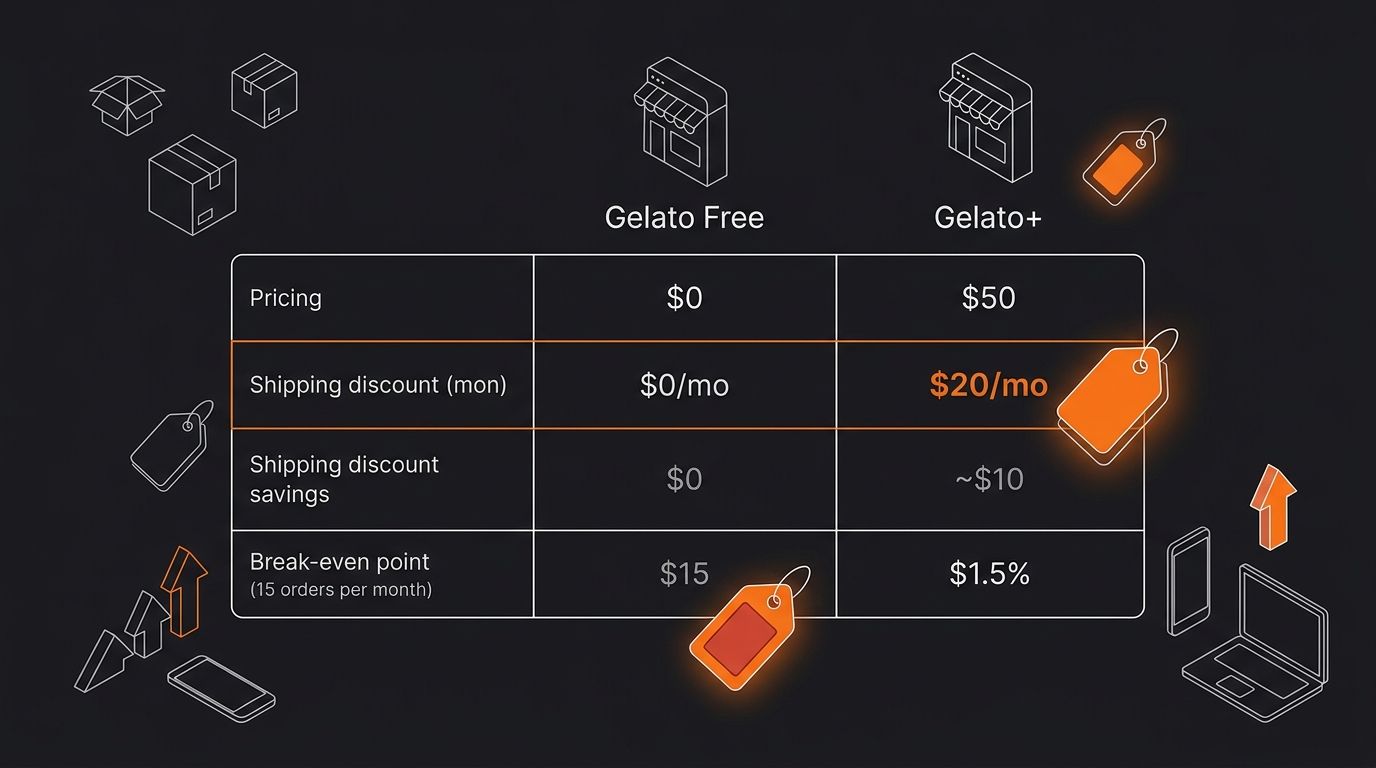
The paid tier, Gelato+, costs $24/month or $239/year and adds shipping discounts, mockup tools, premium product access, and priority support. The Merch Titans review team noted that "the Gelato+ shipping discounts make the paid plan worthwhile at moderate volume".
Here's how I think about the break-even: if you're doing 20+ orders per month and your average shipping discount saves $1.50-2.00 per order, Gelato+ pays for itself at around 15 orders. Below that, the free tier is fine. And when you're calculating your actual profit margins on POD products, the shipping discount is where Gelato+ creates the clearest ROI.
Feature | Free Tier | Gelato+ ($24/mo) |
|---|---|---|
Production network access | Full (140+ hubs) | Full (140+ hubs) |
Monthly fee | $0 | $24/mo or $239/yr |
Shipping discounts | None | Included |
Mockup generator | Basic | Premium |
Personalization tools | Limited | Expanded (paid add-on) |
Priority support | No | Yes |
Best for | Testing, <15 orders/mo | 20+ orders/mo, scaling |
Product Catalog and Quality Assessment
Gelato's catalog covers apparel (t-shirts, hoodies, activewear), wall art (posters, canvas prints, framed prints), stationery (cards, calendars, notebooks), phone cases, mugs, tote bags, and home decor items. The PrintKK review describes the selection as "curated", and that word is doing real work here. Compared to Printify's marketplace model where dozens of print providers offer overlapping product lines, Gelato's catalog is narrower but more controlled.
Wall art stands out as Gelato's strongest category. Multiple reviews single out framed prints and canvas quality as the best within the POD space. If your brand leans into home decor, art prints, or photography products, Gelato has a genuine quality advantage over competitors in this vertical.
Apparel is competent but unremarkable. The t-shirt and hoodie options cover standard blanks (Bella+Canvas, Gildan equivalents), and print quality stays consistent across regions, which is actually the harder problem to solve when you're printing in 32 countries. The color matching across facilities is where Gelato's quality control earns its keep.
Shipping Costs and Delivery Windows
Domestic shipping through Gelato's local production model typically runs $4-8 depending on product weight and destination. International orders, cases where the nearest production hub is still in a different country from the customer, range from $10-$50 based on destination and shipping method.
The key margin insight: shipping costs are not included in Gelato's base product prices. When you're setting retail prices, you need to account for both the base production cost and the shipping fee. A poster that costs $8.50 to produce might carry a $5.20 domestic shipping charge, putting your true cost at $13.70. If you're retailing at $24.99, your gross margin is $11.29, around 45%. That's workable, but only if you're tracking your profit percentages accurately.
Delivery windows break down like this:
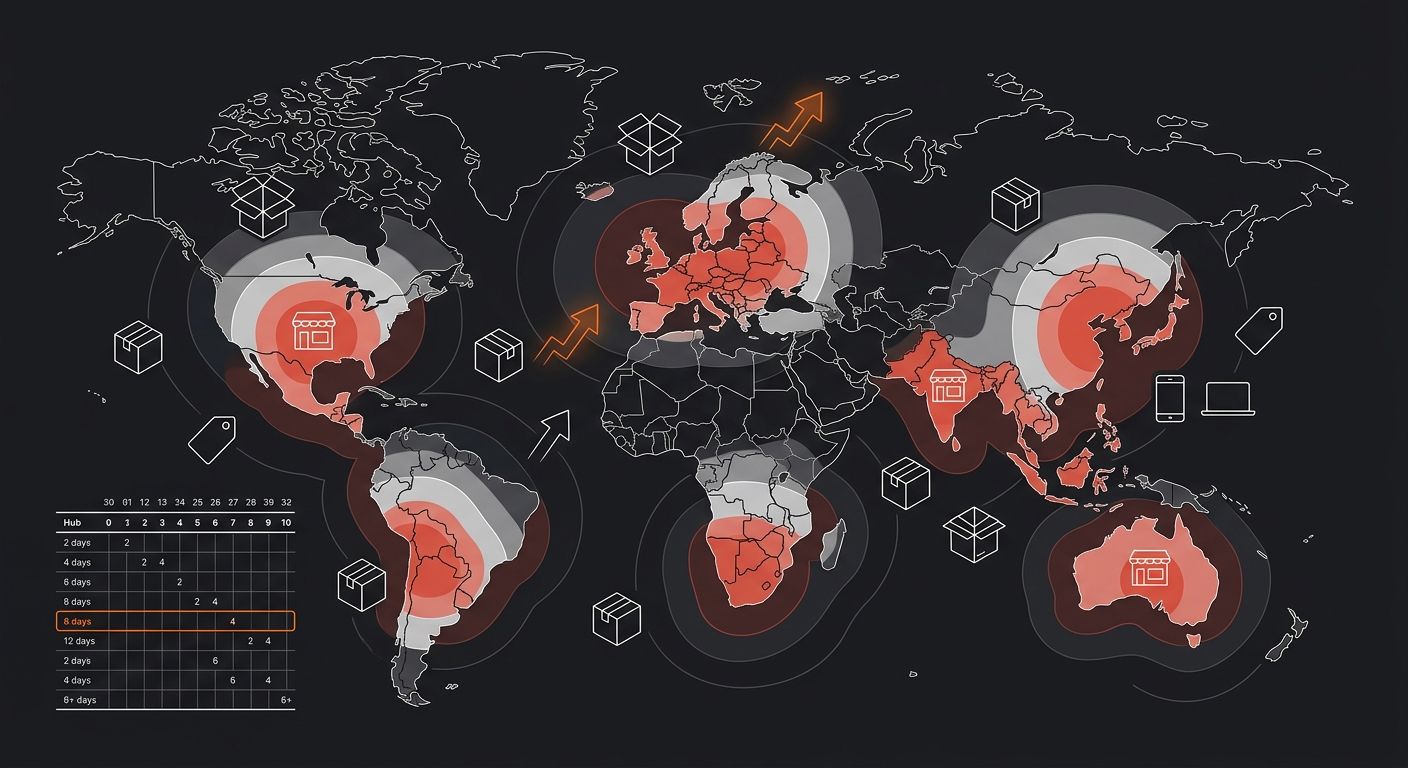
Same-country fulfillment (88% of orders): 3-5 business days typical
Same-region fulfillment (remaining 11%): 5-8 business days
Cross-region (rare, ~1% of orders): 8-15 business days
Those numbers beat most POD competitors by 3-7 days on average, and the gap widens dramatically for international orders where platforms like Printful ship from centralized facilities.
Where Gelato's Model Breaks
The local production architecture that makes Gelato fast also creates specific failure modes worth understanding before you commit.
Catalog constraints by region. Not every product is available at every facility. A customer in Brazil might trigger an order for a product that the nearest hub doesn't produce, forcing the system to route to a more distant facility. When this happens, delivery time spikes and shipping costs jump, and you won't always know in advance which products have thin geographic coverage.
Price volatility you don't control. The 15-16% price increases some users reported aren't unusual for POD platforms, but Gelato's distributed model means cost structures vary by facility. A product might cost $9.20 to produce in Germany and $10.80 in Australia. When facilities update their pricing, your margins shift without warning.
Personalization tool paywalling. Gelato moved its personalization features, the ability to let customers add names, dates, or custom text to products, behind a separate paid tier. If your business model depends on personalized gifts or custom items, this adds another recurring cost on top of Gelato+.
Limited customization for complex designs. Operators working with intricate multi-color designs, all-over prints, or specialty inks will find Gelato's design tools constraining. The platform optimizes for standard DTG and poster printing, and the quality control that makes it consistent across 140+ facilities also limits production flexibility.
No bulk order pricing. If you're running a campaign that generates 500 units of the same design, Gelato still produces each one at the per-unit POD price. There's no volume discount tier. For high-volume runs, traditional screen printing or a direct manufacturer relationship will always beat POD unit economics.
Common Questions
Does Gelato work with Etsy, Shopify, and WooCommerce?
Yes. Gelato offers direct integrations with all three platforms. The Shopify integration installs as an app from the Shopify marketplace. WooCommerce uses a plugin. Etsy connects through Gelato's dashboard. Each integration syncs orders automatically to the production network.
How does Gelato's pricing compare to Printful and Printify?
Gelato's base product prices sit between Printful (generally higher) and Printify (generally lower due to provider competition). The real comparison point is total landed cost, base price plus shipping. Because Gelato produces locally, shipping costs for same-country orders are often $3-6 lower than competitors shipping from centralized facilities. On a $25 retail product, that gap can shift your gross margin by 12-20%.
Is the Gelato+ subscription worth paying for?
At 20+ orders per month, yes. The shipping discounts alone save roughly $1.50-2.00 per order, which means the $24/month fee pays for itself at 12-16 monthly orders. Below that volume, the free tier covers everything you need to test products and validate demand.
What happens if a Gelato production facility makes an error?
Gelato handles reprints and refunds for production defects through their support team. Gelato+ subscribers get priority support with faster response times. For free-tier users, resolution typically takes 2-4 business days.
Can I order samples before selling?
Yes. Gelato lets you place sample orders at a discount so you can evaluate print quality, packaging, and delivery speed before listing products in your store. Order samples from the facility that will serve your primary customer base, not just the nearest one to you, that's the sample that tells you what your actual buyers will experience.

Ryan Torres
Ryan Torres is a former Amazon FBA seller turned dropshipping consultant who has generated over $2.8M in ecommerce revenue across 14 product launches. He specializes in supplier vetting, margin optimization, and scaling DTC operations for sub-$1M brands. Ryan focuses on actionable frameworks that drive measurable results for independent operators.
Frequently Asked Questions
- How fast does Gelato deliver orders compared to other print on demand companies?
- Gelato delivers same-country orders in 3-5 business days and same-region orders in 5-8 business days, beating most POD competitors by 3-7 days on average. This speed advantage comes from its network of 140+ production hubs across 32 countries that produce orders locally rather than shipping from centralized facilities.
- Is Gelato+ subscription worth the $24 per month cost?
- Gelato+ is worthwhile if you're doing 20+ orders per month, as the shipping discounts save approximately $1.50-2.00 per order and pay for themselves at around 12-16 monthly orders. Below that volume, the free tier provides all essential features for testing and validation.
- What products does Gelato offer and which are highest quality?
- Gelato's catalog includes apparel, wall art, stationery, phone cases, mugs, tote bags, and home decor. Wall art and framed prints are Gelato's strongest category with the best quality in the POD space, while apparel is consistent but unremarkable compared to competitors.
- How much does shipping cost on Gelato orders?
- Domestic shipping typically costs $4-8 depending on product weight and destination, while international orders range from $10-50. Shipping costs are separate from base product prices and vary by region due to Gelato's distributed production model.
- Can I use Gelato with Shopify, Etsy, and WooCommerce?
- Yes, Gelato integrates directly with Shopify (via app marketplace), WooCommerce (via plugin), and Etsy (through Gelato's dashboard). All integrations automatically sync orders to the production network without manual intervention.
- Why is Gelato faster and cheaper than Printful or Printify?
- Gelato produces orders locally in its 140+ facility network, so 88% of orders are fulfilled within the customer's own country at domestic shipping rates, reducing shipping costs by $3-6 compared to competitors that ship internationally from centralized locations.
- What are the main limitations of using Gelato?
- Gelato has catalog constraints by region (not all products available at every facility), uncontrollable price volatility across facilities, paywalled personalization features, limited design customization options, and no bulk order discounts for high-volume runs.
Related Articles

Printful print-on-demand App Review: Features & Costs
Printful's base product costs run 15–35% higher than Printify's on comparable items, while Gelato undercuts both on international fulfillment speed through local production routing. The right print-on-demand platform depends on whether you're optimizing for quality, margin, or geographic reach.

Printify: Complete App Review & Guide
Printify is a print-on-demand marketplace that routes your orders to a network of over 100 independent print providers who manufacture and ship products under your brand.

Printful vs Printify: Which Platform Wins
Printful and Printify completed a corporate merger but still operate as separate platforms with independent pricing, fulfillment networks, and dashboards. POD sellers face three real paths: Printful for brand control, Printify for margin, or a hybrid splitting the catalog across both.
Explore more topics