Terapeak eBay: Complete Seller Research Tool
EBay acquired Terapeak in 2017, spent four years rebuilding it inside Seller Hub, then made the core product research module free to every seller in April 2021.
Terapeak eBay: How a Free Research Tool Replaced $600/Year Subscriptions
EBay acquired Terapeak in 2017, spent four years rebuilding it inside Seller Hub, then made the core product research module free to every seller in April 2021. The tool now surfaces up to three years of transaction-level sales data, including actual Best Offer accepted prices, at zero cost to any eBay account holder.
The Acquisition That Rebuilt eBay Seller Research
EBay announced the Terapeak acquisition in 2017, absorbing what was then the dominant paid analytics platform for eBay marketplace data. Before the acquisition, Terapeak charged sellers roughly $600/year for access to historical sales volumes, average selling prices, and competitive benchmarking across eBay categories. According to eBay's own innovation blog, the tool was designed to let sellers "derive insights on what to sell, when to sell and how to sell a product on eBay."
The integration took years. eBay didn't flip a switch and hand the old Terapeak dashboard to Seller Hub users. The company rebuilt the product research interface inside the existing Seller Hub framework, renaming it "Product Research" while keeping the Terapeak brand recognition alive. The result is a tool that looks and feels native to eBay's seller workflow, accessible directly from your Seller Hub dashboard without a separate login or third-party redirect.
What matters for sellers running margin calculations: the tool went from a standalone $50/month subscription to a free module available to anyone with an eBay account. If you're doing product research before your first listings, you're working with the same dataset that used to cost real money.
The 2025-2026 updates added mobile access through the eBay App's Seller Tools, letting sellers scan barcodes in thrift stores or at estate sales and pull up three-year sales histories on the spot. That's a meaningful workflow change for sourcing sellers who previously had to bookmark items, drive home, and research on desktop.
Reading the Dashboard Without Getting Fooled
Terapeak eBay surfaces four data points that drive every sourcing and pricing decision: search volume, active listing count, sell-through rate (STR), and average selling price (ASP). Understanding how these interact determines whether you'll price profitably or sit on dead inventory.
The sell-through rate formula is straightforward: (Total Sold ÷ Total Active Listings) × 100. According to LitCommerce's 2026 analysis, an STR above 100% signals high demand where items sell faster than new listings appear. An STR below 20% means you're entering a saturated category where most listings expire unsold. That single metric tells you more about a product's viability than any gut feeling or competitor count.
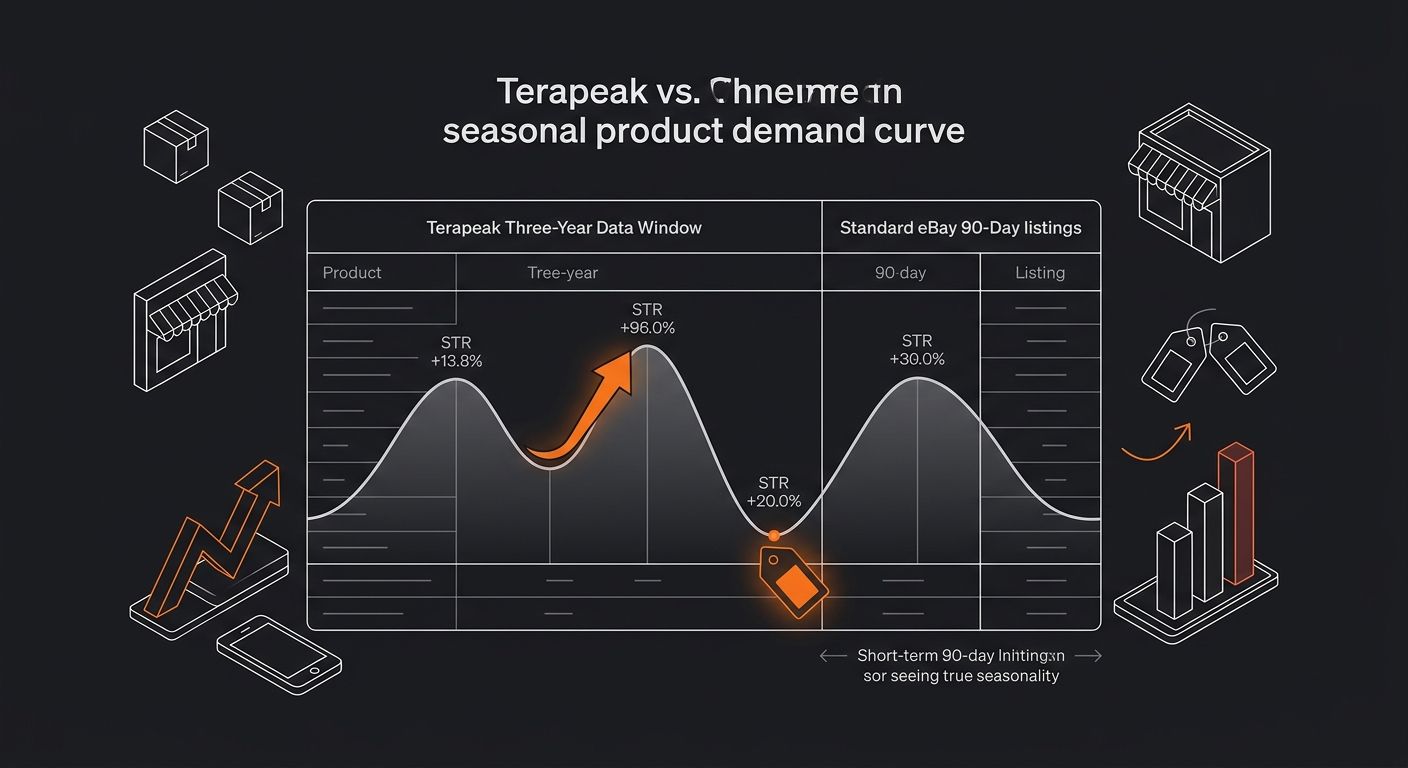
The three-year data horizon is where Terapeak eBay separates from standard eBay sold listings searches, which cap at 90 days. Seasonal products reveal their real demand cycles only across multi-year windows. A Halloween costume category might show 47% STR in October but crater to 3% by December. Without the longer lookback, you'd miss the timing entirely.
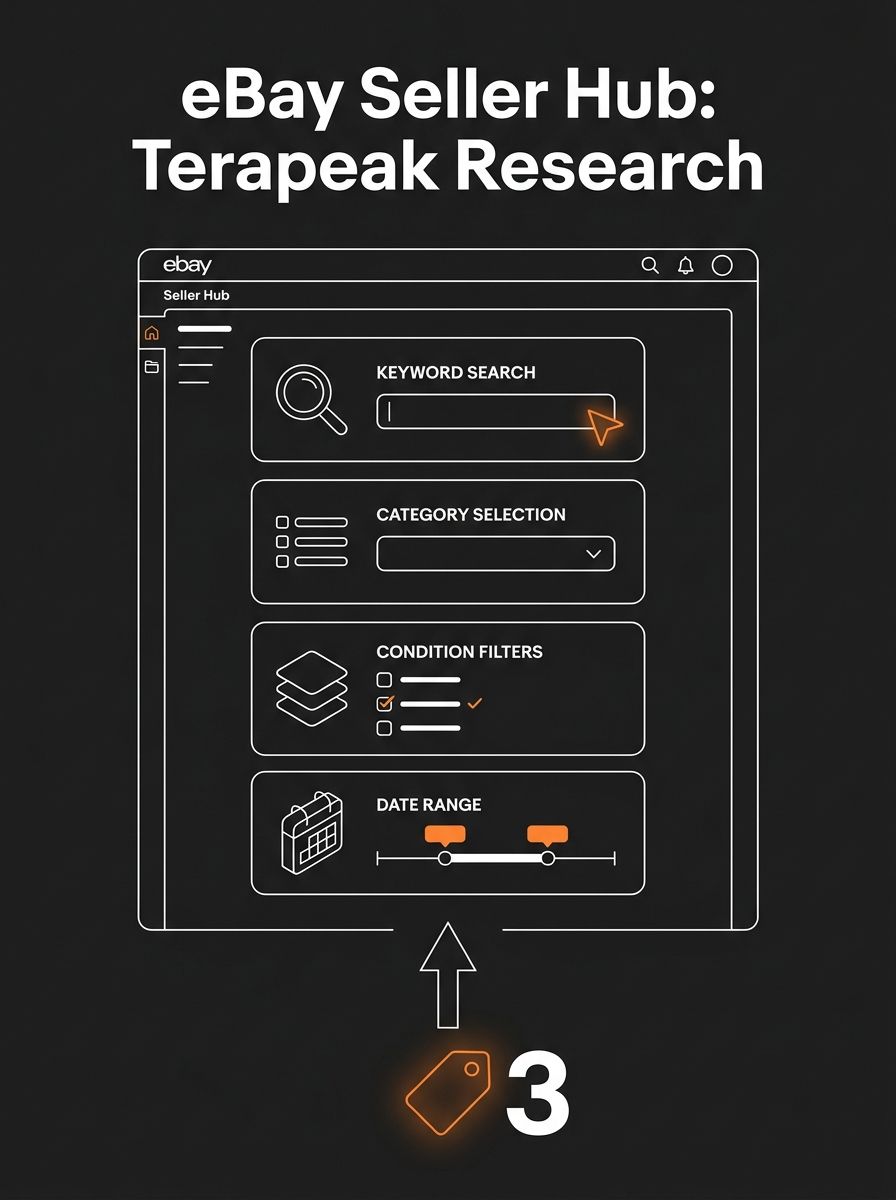
As eBay's product research documentation explains, you can filter by keyword or product and apply category, item condition, brand, color, and buyer/seller location filters. The filters matter because raw keyword searches are literal. Searching "Nike Air Max" won't automatically include "Nike Airmax" or "Air Max Nike vintage." You need to run multiple keyword variations and cross-reference the results.
One trap that catches newer sellers: ASP without condition filtering is meaningless. A sealed-in-box video game console and a "for parts only" unit of the same model show up in the same keyword search. The average of those two prices tells you nothing useful. Always filter by condition (New, Used, Refurbished, For Parts) before pulling ASP data into your margin calculations. If you're building a supplier quality evaluation process, the condition-filtered ASP from Terapeak eBay gives you the realistic ceiling price for each inventory grade.
Free Access Ends at the Sourcing Insights Paywall
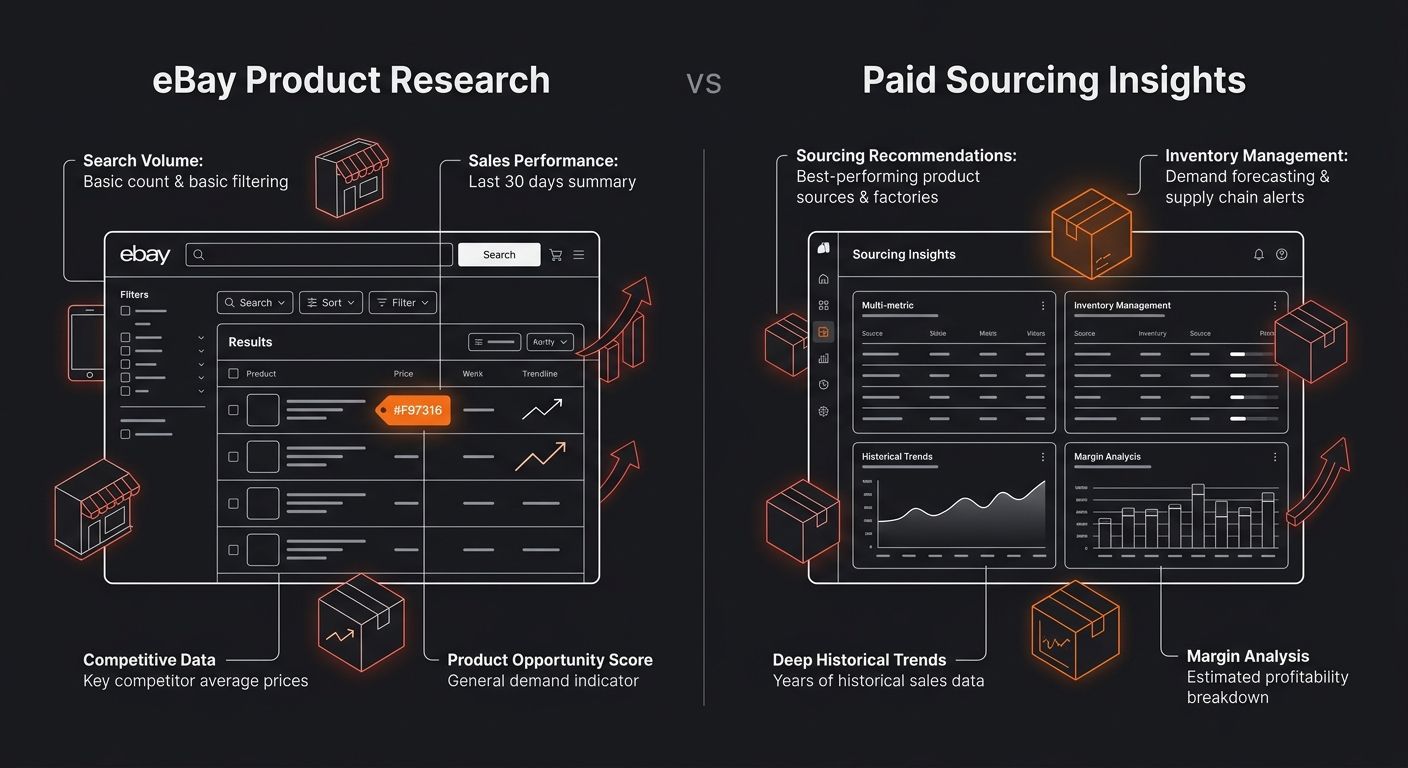
EBay's free Terapeak eBay product research covers individual item lookups, which handles about 70% of what a typical seller needs for listing optimization and competitive pricing. The other 30%, category-level trend analysis through Sourcing Insights, sits behind a store subscription paywall.
Here's the cost breakdown across eBay store tiers, per Capterra's 2026 pricing data:
Store Tier | Monthly Cost | Sourcing Insights | Product Research | Free Listings/Month |
|---|---|---|---|---|
No Store | $0 | ✗ | ✓ | ~250 |
Starter | $4.95 | ✗ | ✓ | 250 |
Basic | $21.95 | ✓ | ✓ | 1,000 |
Premium | $59.95 | ✓ | ✓ | 10,000 |
Anchor | $299.95 | ✓ | ✓ | 25,000 |
Enterprise | $2,999.95 | ✓ | ✓ | 100,000 |
The meaningful jump is from Starter ($4.95) to Basic ($21.95). That $17/month delta unlocks Sourcing Insights, which shows category-wide search volume, total active listings, and monthly sales trends across product segments. For sellers doing volume research across multiple categories, that $21.95/month pays for itself if it prevents even one bad $200 inventory purchase per month.
Sourcing Insights lets you browse categories or search by product keyword, ID, or product name. The dashboard then shows search query volume alongside active listing counts for that category, giving you a supply-demand snapshot. If a category shows 50,000 monthly searches but only 8,000 active listings, you're looking at underserved demand. If it shows 12,000 searches against 90,000 listings, walk away.
For sellers cross-listing between eBay and other platforms, Terapeak's data is eBay-only. Underpriced AI's analysis noted that "Terapeak remains free and useful for what it does," but sellers working across Amazon, Mercari, or Poshmark need supplemental tools for cross-platform sold data and pricing. If you're already running an Amazon dropshipping operation, Terapeak won't give you Amazon ASP data, so you'd need a separate research workflow for each channel.
What eBay's Terapeak Bet Reveals About Marketplace Tool Economics
EBay's decision to make Terapeak free followed a specific commercial logic: sellers who research products inside eBay's own ecosystem list more products on eBay. The tool is a retention mechanism disguised as a free resource.
That matters for how you should think about the data. Terapeak eBay gives you excellent visibility into eBay-specific demand, but it incentivizes you to stay within eBay's marketplace. The three-year data horizon, the sell-through rate calculations, the ASP by condition filtering, all of it assumes you're optimizing for eBay performance. If you're building a multi-channel ecommerce operation, Terapeak is one input, not the whole research stack.
For a deeper look at Terapeak's feature set and how it compares to third-party alternatives, we've covered the full pricing and feature breakdown separately. The short version: the free tier handles individual product validation well, and the Basic store subscription is worth the $21.95/month if you're listing more than 250 items and need category-level demand data.
The practical takeaway from eBay's Terapeak integration is that marketplace-native research tools are now table stakes. Sellers who ignore the free data available inside Seller Hub are pricing blind, and sellers who treat Terapeak as their only research input are building a business visible through one window. The STR formula, the condition-filtered ASP, and the seasonal trend data from the three-year lookback window give you a real edge on eBay listings specifically. For everything else, you're supplementing with external tools and your own margin math, which is how sound ecommerce operations work across any platform.

Ryan Torres
Ryan Torres is a former Amazon FBA seller turned dropshipping consultant who has generated over $2.8M in ecommerce revenue across 14 product launches. He specializes in supplier vetting, margin optimization, and scaling DTC operations for sub-$1M brands. Ryan focuses on actionable frameworks that drive measurable results for independent operators.
Related Articles

Terapeak Product Research: Complete Guide
EBay absorbed Terapeak into Seller Hub under the label "Product Research," giving every seller with a Seller Hub account access to up to three years of completed transaction data.

Terapeak Review: Features, Pricing & Best Uses
Three eBay product research tools dominate the seller conversation right now: Terapeak (free inside Seller Hub), ZIK Analytics ($29.99/month standalone), and Ecomli (freemium with paid tiers).

Ebay Product Research
This guide walks you through eBay product research from raw data pull to validated listing in about 90 minutes. You'll use Seller Hub's built-in Terapeak tool and ZIK Analytics to identify products with proven demand, healthy margins, and beatable competition.
Explore more topics