The Supplier Audit Flowchart: Isolating Root Cause When Your Dropshipping Margins Collapse Mid-Campaign
When a Meta campaign producing $11 contribution margin per unit on day three drops to $3.40 by day fourteen, the instinct is to blame the ad creative or the audience. The ad account gets the autopsy. The supplier rarely does.

The Supplier Audit Flowchart: Isolating Root Cause When Your Dropshipping Margins Collapse Mid-Campaign
When a Meta campaign producing $11 contribution margin per unit on day three drops to $3.40 by day fourteen, the instinct is to blame the ad creative or the audience. The ad account gets the autopsy. The supplier rarely does. And that reflexive misdiagnosis burns through more cash than the original margin collapse, because every day you spend A/B testing thumbnails while your supplier quietly raises processing fees or ships degraded product is a day your real per-unit economics keep deteriorating. Batch analysis of actual fulfilled orders, a method that compares projected contribution margin against what your bank account actually shows, routinely reveals a 5-8% gap between theoretical and real profitability. The source of that gap is almost never Facebook's algorithm. It's upstream, sitting somewhere in your fulfillment stack.
This article walks through a root cause analysis framework for mid-campaign margin erosion: how to systematically trace collapsed margins back to the specific operational failure, whether that's supplier pricing drift, shipping cost inflation, quality degradation driving returns, or some combination you haven't even considered yet.
Where the Diagnostic Goes Wrong
The typical operator response to margin compression follows a predictable sequence. First, they check ROAS. If ROAS dropped, they start tweaking audiences, swapping creatives, adjusting bids. If ROAS held steady but profit evaporated, they stare at the Shopify analytics dashboard in confusion and eventually decide the product is "played out." Both paths skip the operational audit entirely, and both paths are expensive mistakes.
The reason this happens is structural. Ad platforms give you real-time feedback loops. Your supplier doesn't. Meta will tell you within hours that your CPM jumped from $14 to $22. But nobody sends you an alert when your supplier's per-unit cost crept up by $1.80, or when their shipping partner switched from Yanwen to an untracked ePacket variant that adds six days to delivery. If you haven't built a post-sale audit process that reconciles actual costs against projections, the demand-side data will always dominate your attention because it's the only data that's fresh and visible. Your net profit margin accounts for everything: advertising costs, transaction fees, platform fees, returns, refunds, apps, and tools. But you can only manage what you measure, and the fulfillment side of that equation is where measurement usually stops.
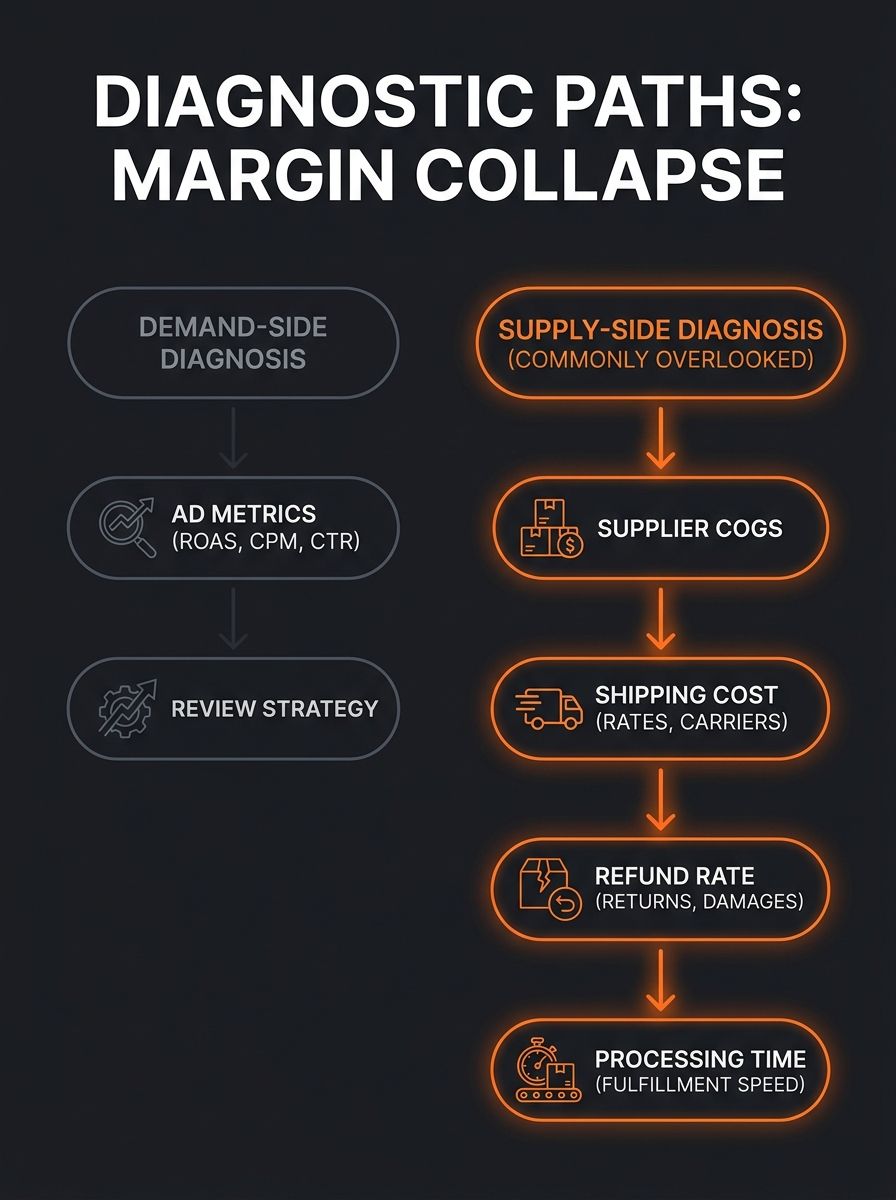
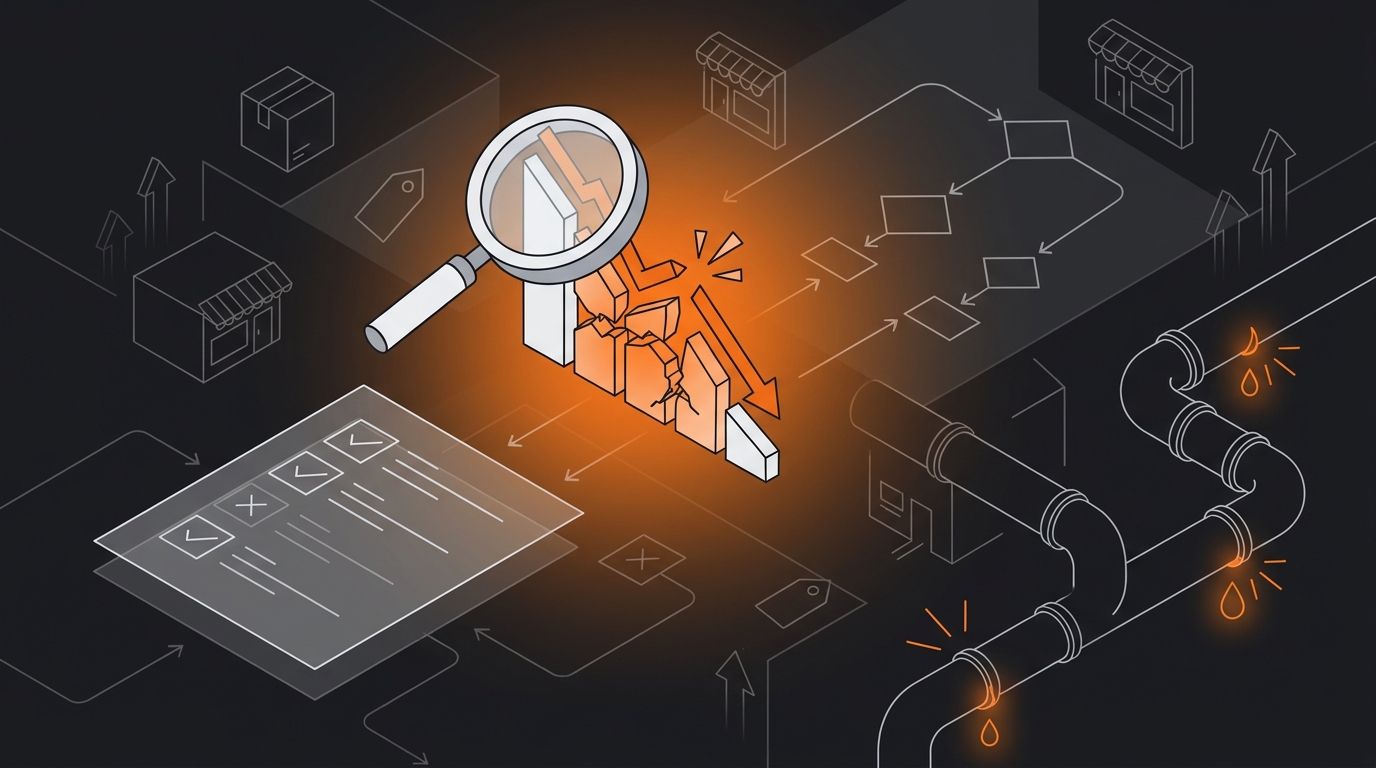
The dropshipping margin diagnosis that actually works starts on the supply side, not the demand side. Pull your last 100 fulfilled orders. Calculate actual COGS per unit including the product price your supplier charged (not the catalog price, the invoiced price), the shipping cost paid, transaction fees from your payment processor, and any refund-related costs. Compare that number to what your pre-launch spreadsheet assumed. If the gap is more than 3%, you've found your starting point, and you haven't touched an ad dashboard once.
Tracing the Leak Through Your Fulfillment Stack
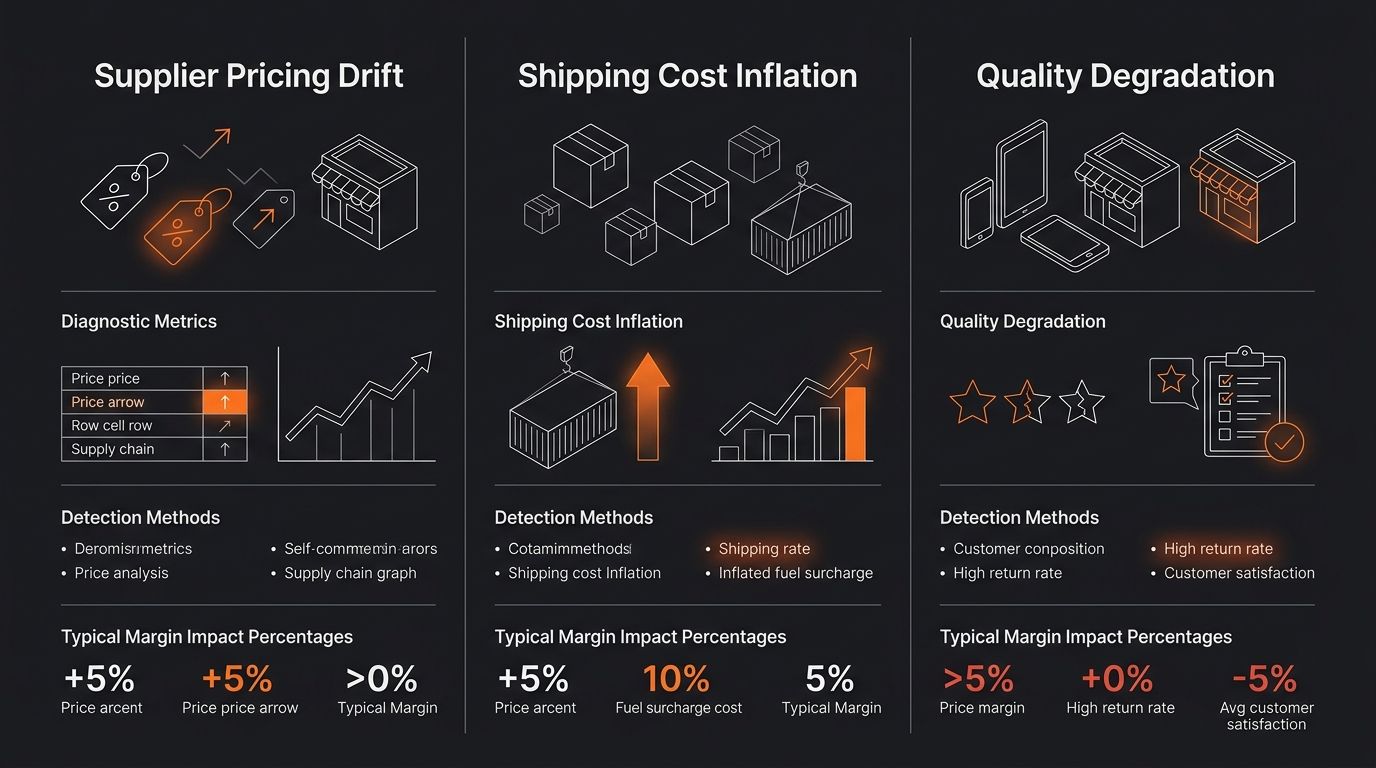
Once you've confirmed that the supply side is where margin evaporated, the next question is which specific cost moved. There are three fault lines that account for roughly 90% of mid-campaign margin collapse in dropshipping, and they interact in ways that make the root cause harder to pin down than you'd expect.
The first fault line is raw supplier pricing. Suppliers on platforms like CJ Dropshipping, Spocket, and Zendrop can adjust per-unit pricing without advance notice, especially during demand surges when they face their own upstream cost pressure. A product you locked in at $6.80 per unit during your test order phase might invoice at $8.20 by the time you're doing 40 units a day. The fix here is mechanical: compare your invoiced COGS for the first 20 orders against the most recent 20, and flag any per-unit increase above $0.50. If you've gone through the work of validating supplier pricing and quality during test orders, you'll have a documented baseline to compare against. Without that baseline, you're arguing from memory, which isn't a negotiating position.
The second fault line is shipping cost inflation, which often compounds during exactly the scaling windows when you need stable economics. Rising port costs, carrier surcharges, and route changes can add $1-3 per unit without any change in the product itself. If your supplier absorbs those costs, you're fine. If they pass them through, and many do, your per-unit margin shrinks on every order. We covered how fuel surcharges are reshaping dropshipping economics in detail, but the practical takeaway for mid-campaign troubleshooting is straightforward: isolate the shipping line item in your last 50 invoices and plot it on a simple line chart. If there's a slope, you've found at least part of your problem.
The third fault line is the one operators detect last, and it's usually the most expensive: supplier quality drift detection failures. This is where the product your customers receive in week four of a campaign is materially worse than the product they received in week one. Maybe the supplier switched materials. Maybe they subcontracted to a different factory. Maybe their quality control, never rigorous to begin with, collapsed under volume. The symptom shows up as rising refund rates, but by the time your refund rate crosses 8-10%, the damage to your margins is already severe. Each refund costs you the product, the original shipping, the return processing, and often a replacement shipment. A product with a 4% refund rate and a product with a 12% refund rate can have identical COGS and completely different profit profiles.
Building the Operational Audit Checklist Into Your Campaign Rhythm
The mistake most operators make with a root cause analysis framework is treating it as something you do after margins collapse. By that point, you've already lost weeks of profitable scaling. The better approach is embedding a lightweight operational audit checklist into your campaign cadence so that supplier quality drift, pricing changes, and shipping cost shifts surface while you still have time to react.
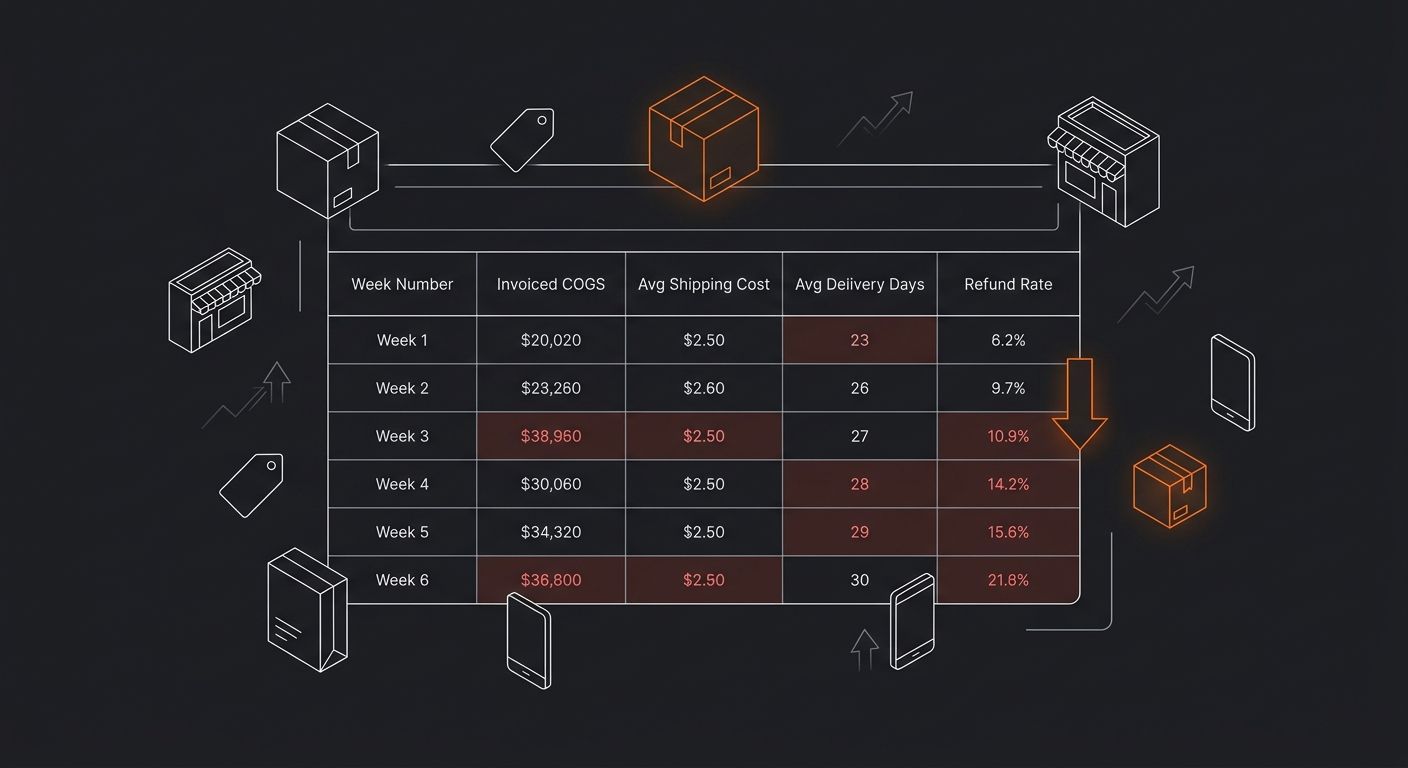
The core of this is a supplier scorecard that tracks four metrics weekly once a campaign enters scaling phase: invoiced COGS per unit, average shipping cost per order, average delivery time in calendar days, and refund rate as a percentage of fulfilled orders. You don't need software for this. A spreadsheet with four columns updated every Monday morning will catch 80% of the problems that blow up margins. The key is consistency: if you track these numbers for three consecutive weeks without a significant move, your supply side is stable and you can focus on demand-side optimization with confidence. If any metric shifts by more than 10% week-over-week, you pause scaling and investigate before spending another dollar on ads.
Communication cadence with your supplier matters as much as the numbers themselves. When you're running volume, a weekly check-in message asking about stock levels, any upcoming price adjustments, and current processing times acts as an early warning system. Suppliers who go quiet during scaling periods are the ones most likely to be dealing with problems they haven't told you about. If a supplier stops responding within 24 hours to direct questions about inventory or pricing, treat that silence as a data point equivalent to a 15% COGS increase: it's a signal to start qualifying a backup supplier immediately. Having that backup identified before you need it is what separates operators who survive mid-campaign disruptions from those who watch profitable campaigns die while scrambling to find alternatives. The work you do during initial supplier vetting should include identifying at least one secondary source for any product you plan to scale past $200/day in ad spend.
The Uncomfortable Lag Problem
Everything described above works when the audit cadence is consistent and the data is clean. The reality for most dropshipping operators is messier than that. The fundamental tension in mid-campaign troubleshooting is temporal: the data you need to diagnose a supply-side problem arrives days or weeks after the problem started. Your supplier raised prices on Tuesday. You don't see the invoiced cost until the order processes on Thursday. The customer receives a lower-quality product on day twelve but doesn't request a refund until day twenty. Meanwhile, you've been scaling ad spend the entire time based on margin projections that were already wrong.
This lag means that even a disciplined weekly audit can miss fast-moving deterioration. A supplier who quietly substitutes a cheaper material on a Monday could ship 200 units of degraded product before your Friday scorecard update catches the rising refund signal. There's no clean solution to this problem. Ordering test units to yourself every two weeks during scaling helps, but it's imperfect and adds cost. Setting up automated alerts when your refund rate crosses a threshold (say, 6% on a rolling 50-order basis) helps, but by definition those alerts fire after damage is already done.
What remains genuinely uncertain is whether the economics of dropshipping at scale can ever fully account for this diagnostic lag. The operators who do best aren't the ones with perfect audit systems. They're the ones who build enough margin cushion into their pricing that a 5-8% gap between projected and actual profitability doesn't kill the campaign. If your product can't tolerate a $2 per-unit surprise on the supply side and still produce positive contribution margin, the audit framework described here will help you die more slowly, but it won't save the campaign. The real question the framework raises is whether the product was priced correctly in the first place, and that's a question most operators don't want to answer honestly until it's too late.
365 Dropship Editorial
Editorial team writing about E-commerce, dropshipping, and product discovery — reviews of dropshipping suppliers and platforms, trending niche guides (jewelry, beauty, pets, home, fashion), supplier due diligence, ecom operations, shipping & fulfillment strategy, product research, AOV optimization, and profitable dropshipping case studies.
Related Articles
5 Supplier Communication Failures That Collapse Margins Mid-Campaign (And the SOP to Fix Each One)
Sixty percent of dropshipping stores that attempt to scale fail due to supply chain instability—inventory gaps, cost swings, quality drift—according to Spocket's analysis of DSers data.
The Post-Sale Audit Framework: How to Diagnose Which Dropshipping Mistakes Are Actually Costing You Margin
Theoretical margin on a $34.99 pet grooming kit sold through Shopify: 42%. Actual margin after pulling the last 100 fulfilled orders, tallying refund shipping labels, Facebook ad spend allocated per unit, and three chargebacks at $22 each: 19%.
Why Marketing Failures Masquerade as Supplier Problems: How to Audit Your Ad Spend Before Blaming Your Dropshipping Partner
Break-even ROAS for a typical dropshipping campaign sits around 1.95x, meaning for every dollar you spend on Facebook or TikTok ads, you need $1.95 back in revenue just to cover product cost, shipping, and platform fees.
Explore more topics