dropshipping io Review: Features & Pricing
Dropship.io, AutoDS, and SaleHoo attack the same problem from three different angles: finding products worth selling on Shopify. Dropship.io bets on competitor intelligence and sales tracking at $39–$99/month. AutoDS wraps product research inside full-store automation.
Dropship.io Review: Features, Pricing, and How It Stacks Up Against AutoDS and SaleHoo
Dropship.io, AutoDS, and SaleHoo attack the same problem from three different angles: finding products worth selling on Shopify. Dropship.io bets on competitor intelligence and sales tracking at $39–$99/month. AutoDS wraps product research inside full-store automation. SaleHoo hands you a vetted supplier directory instead.
How This Comparison Works
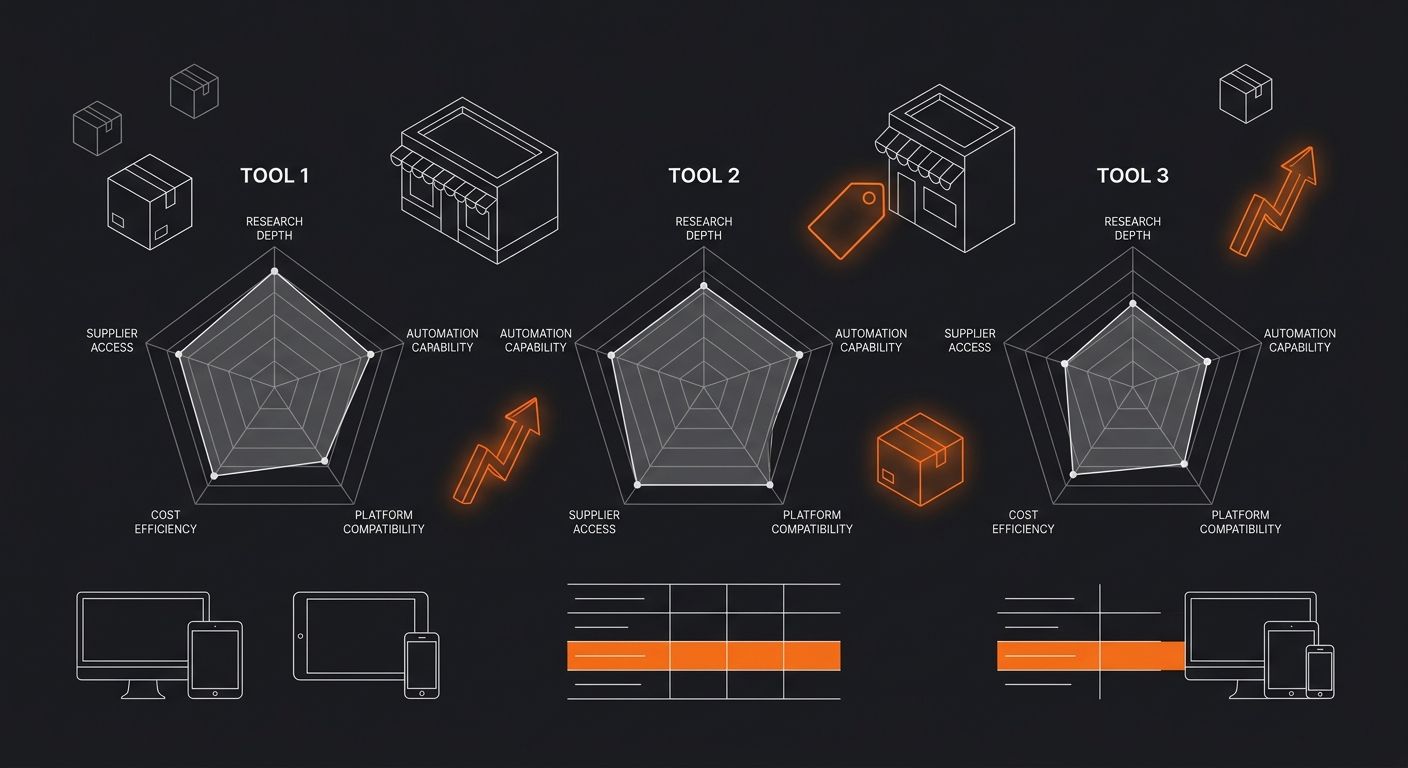
I evaluated all three tools on four criteria: product research depth, competitor tracking accuracy, platform compatibility, and cost per feature at each pricing tier. I excluded tools like Minea and Sell The Trend that focus primarily on ad creative spying since they solve a narrower problem. Every pricing figure below reflects current published rates as of mid-2026.
Dropship.io Gives You Intelligence Without the Automation
Dropship.io is a Shopify-only product research and competitor intelligence platform rated 7.8/10 in independent testing. Pick it when your main bottleneck is figuring out which products are actually selling, how fast, and through which stores. The platform charges $39/month (Basic), $59/month (Standard), or $99/month (Premium), with annual billing cutting costs by roughly 40% across all tiers.
The core toolset breaks into four modules. The Sales Tracker lets you paste any Shopify store URL and pull estimated monthly revenue, top-selling products, and traffic trends. The Product Library surfaces trending items based on order velocity. The Ad Library indexes active Facebook and Meta ads for creative validation. And the Portfolio feature lets you save and monitor specific products or stores over time.
A 2026 upgrade added TikTok Shop tracking to Standard and Premium plans, letting you monitor viral product momentum before saturation hits. The platform also introduced Magic AI Search, a reverse-image lookup that matches uploaded product photos to active stores and ads in its database. Both features are locked behind the $59/month Standard tier or higher.
Here's the critical caveat that the marketing pages won't emphasize: all revenue figures inside the Sales Tracker are algorithmic estimates based on public signals like store update frequency and review velocity. A hands-on review by WinningHunter's editorial team concluded that "the figures shown are projections, so they function as indicators rather than confirmed sales reports." Accuracy sits within 20–35% for mid-sized stores but can diverge by 50% or more for high-volume operations. If you're using dropshipping io data to size a market, treat the numbers as directional signals and cross-reference with tools like SimilarWeb before committing real ad budget.
Trustpilot reviewers consistently note that "the platform is easy to use, provides valuable product research tools, and helps me find winning products quickly." But user feedback also flags that the product database can feel repetitive after 2–3 weeks of daily use, and there's zero integration with WooCommerce, BigCommerce, or Amazon.
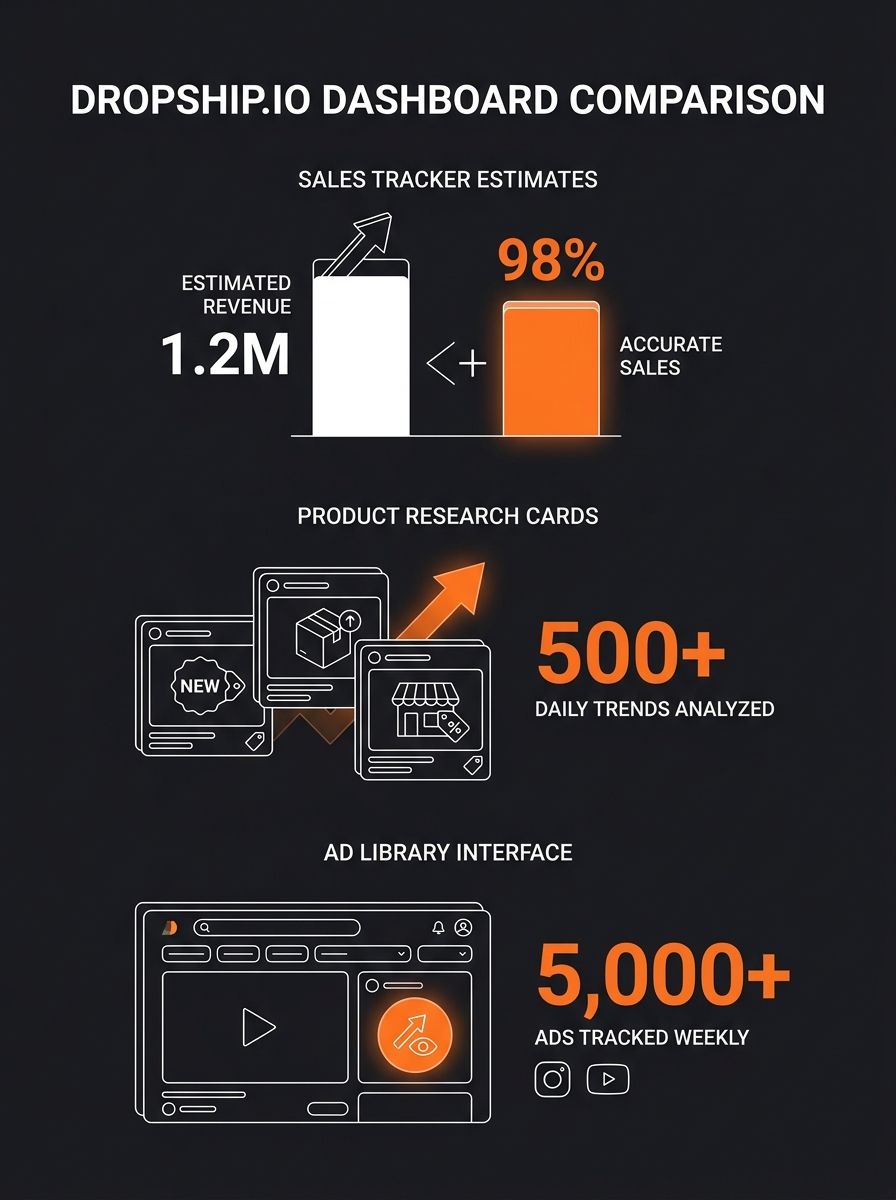
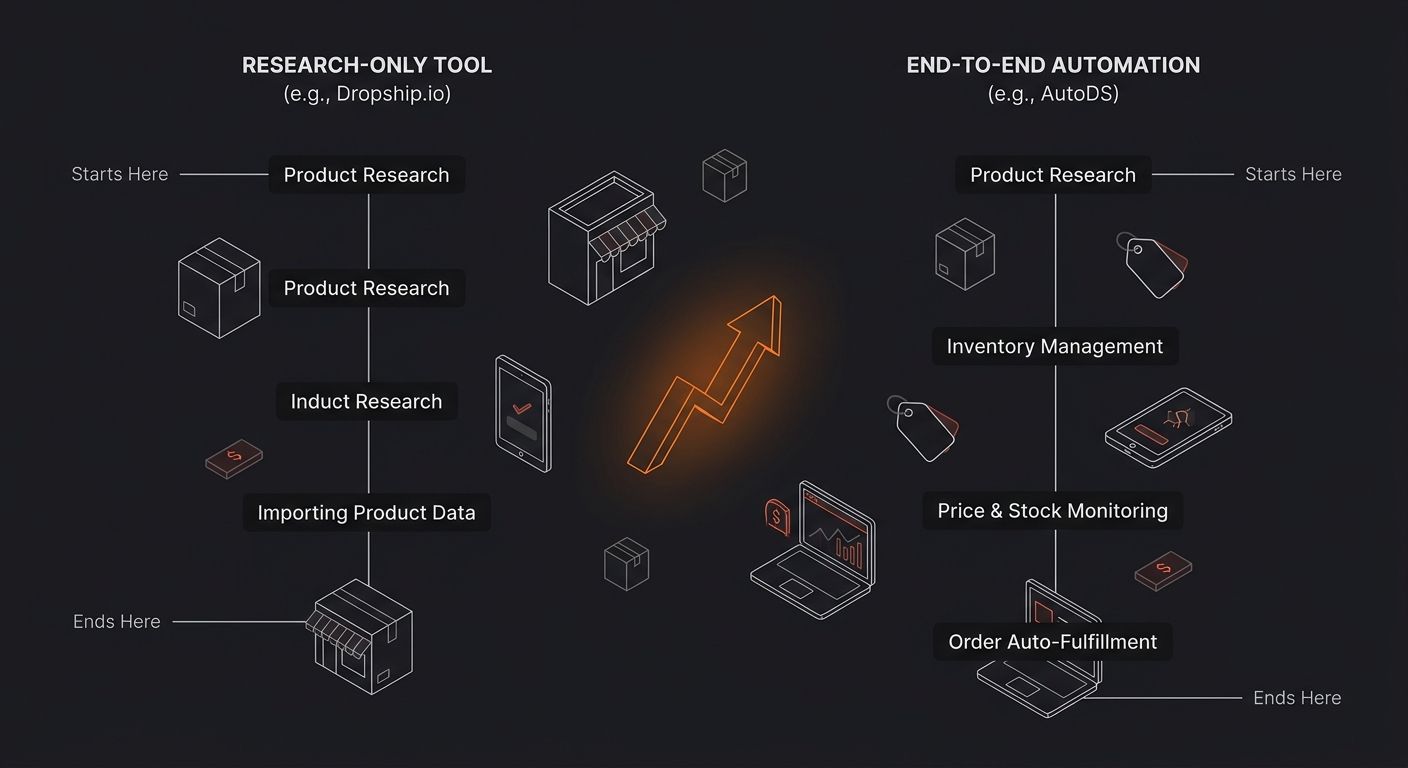
The biggest limitation is scope. Dropship.io doesn't fulfill orders, manage inventory, or build your store. It's a research layer that sits on top of your existing Shopify dropshipping setup. You still need a separate fulfillment tool, and if you're running operations on any platform other than Shopify, the entire toolset is off the table.
AutoDS Bundles Research with Full-Store Automation
AutoDS positions itself as the all-in-one alternative to dropship io, and the feature gap between them is substantial. Choose it when you want product research, automated listing, price monitoring, and order fulfillment inside a single dashboard. AutoDS explicitly markets itself as the primary Dropship.io competitor, leaning hard on the automation features that Dropship.io doesn't touch.
Where Dropship.io stops at research, AutoDS continues through the entire order lifecycle. Its product research module scrapes AliExpress, Amazon, eBay, and 25+ additional suppliers for trending items. Once you identify a product, AutoDS imports it directly to your store (Shopify, WooCommerce, eBay, or Facebook Marketplace), monitors supplier pricing, and processes orders automatically when a customer buys.
Pricing starts at $26.90/month for the Import 200 plan (200 product imports), scaling up through Import 500 ($39.90/month) and Import 1000 ($49.90/month). The automation features—auto-pricing rules, auto-order processing, stock monitoring—are included across all tiers. A 14-day free trial gives you enough runway to test the workflow end-to-end.
The tradeoff is research depth. AutoDS gives you product research, but its competitor intelligence is thin compared to Dropship.io's Sales Tracker. You won't get estimated revenue breakdowns for specific Shopify stores or the kind of granular ad-spend analysis that the Ad Library provides. AutoDS answers "what should I sell?" while giving you less data on "who's already selling this and how much are they making?"
For operators who are still learning to calculate profit margins on individual products, AutoDS's built-in margin calculator and automated repricing save hours of spreadsheet work. But experienced sellers who want to reverse-engineer a competitor's entire product strategy will find the intelligence layer shallow.
SaleHoo Approaches From the Supplier Side
SaleHoo is a supplier directory first, product research tool second. Pick it when your real constraint is finding trustworthy suppliers with verified track records rather than identifying trending products. The platform maintains a directory of 8,000+ vetted suppliers and wholesalers, each reviewed for legitimacy, shipping reliability, and minimum order requirements.
Launchpad Reviews' hands-on assessment noted that platforms like Dropship.io are "best for beginners who want a structured way to find products and for intermediate sellers who need to validate ideas quickly." SaleHoo fills a different slot in the stack—it answers "who can I trust to fulfill this product?" rather than "what product should I sell?"
SaleHoo offers two pricing models: a one-time $127 lifetime access fee for the directory, or $27/month for SaleHoo Dropship (which includes Shopify integration and one-click product imports). The lifetime option is unusual in a market dominated by monthly subscriptions, and it delivers strong long-term value if supplier sourcing is your primary pain point.
The limitation is clear. SaleHoo's product research tools are basic compared to both Dropship.io and AutoDS. There's no Sales Tracker equivalent, no ad library, and no competitor intelligence module. You're paying for supplier quality data, and if you've already got a supplier vetting process that works, the directory duplicates effort. SaleHoo currently integrates only with Shopify for automated imports—WooCommerce and BigCommerce sellers handle product transfers manually, a friction point that compounds past 50 SKUs.
All Three Plans at a Glance
Attribute | Dropship.io | AutoDS | SaleHoo |
|---|---|---|---|
Primary function | Product research + competitor intel | End-to-end automation | Supplier directory + sourcing |
Starting price | $39/month | $26.90/month | $27/month (or $127 lifetime) |
Top-tier price | $99/month | $49.90/month | $27/month |
Annual discount | ~40% | ~20% | Lifetime option eliminates recurring cost |
Free trial | 7 days, no credit card | 14 days | 60-day money-back guarantee |
Platform support | Shopify only | Shopify, WooCommerce, eBay, FB Marketplace | Shopify only (manual for others) |
Sales Tracker / competitor intel | Strong (algorithmic estimates) | Minimal | None |
Ad Library | Facebook/Meta ads indexed | None | None |
TikTok tracking | Yes (Standard+ plans) | No | No |
Order fulfillment | No | Yes, automated | Partial (Shopify import only) |
Supplier directory | No | 25+ integrated suppliers | 8,000+ vetted suppliers |
Best for | Validating product ideas + spying on competitors | Running a hands-off automated store | Finding reliable suppliers |
Who Should Pick Which
Pick Dropship.io if you're a Shopify seller spending $500–$5,000/month on ads and you need to validate product-market fit before scaling. The Sales Tracker and Ad Library save you from blind-testing products that competitors have already saturated. Start with the Standard plan at $59/month—the Basic tier locks you out of TikTok tracking and Magic AI Search, which are the two features that actually differentiate dropshipping io from free alternatives. The 7-day free trial requires no credit card, so test it against your existing research workflow before committing.
Pick AutoDS if you're running 50+ products and your bottleneck is operational overhead. The automation alone—auto-order processing, price monitoring, stock sync—pays for itself once you're handling 10+ orders daily. At $26.90–$49.90/month, it's the cheapest option and the only one that replaces manual fulfillment work. But don't expect it to replace a dedicated research tool for competitive intelligence. Once you're scaling to the point where you need supplier-level metrics across multiple vendors, AutoDS gives you the operational backbone to manage that complexity.
Pick SaleHoo if you're sourcing products from scratch and supplier reliability is your primary concern. The $127 lifetime option makes it the lowest total cost of ownership over a 12-month horizon. But if you already have a system for vetting AliExpress alternatives, the directory duplicates what you've already built.
The honest math: most operators under $30K/month in revenue get the highest ROI from Dropship.io's Standard plan for research, paired with a separate fulfillment solution. Once you cross $50K/month and operational friction starts eating margin, AutoDS earns its keep. SaleHoo lives in a different lane and solves a procurement problem that the other two tools don't address at all.

Ryan Torres
Ryan Torres is a former Amazon FBA seller turned dropshipping consultant who has generated over $2.8M in ecommerce revenue across 14 product launches. He specializes in supplier vetting, margin optimization, and scaling DTC operations for sub-$1M brands. Ryan focuses on actionable frameworks that drive measurable results for independent operators.
Frequently Asked Questions
- What is dropship.io and what does it do?
- Dropship.io is a Shopify-only product research and competitor intelligence platform that helps sellers identify which products are selling, how fast, and through which stores. It offers features like a Sales Tracker for revenue estimates, a Product Library for trending items, an Ad Library for Facebook/Meta ads, and TikTok Shop tracking on higher tiers.
- How much does dropship.io cost?
- Dropship.io charges $39/month for Basic, $59/month for Standard, or $99/month for Premium, with annual billing offering roughly 40% savings across all tiers. A 7-day free trial is available without requiring a credit card.
- How accurate are dropship.io's revenue estimates?
- Dropship.io's Sales Tracker provides algorithmic estimates based on public signals rather than confirmed sales data, with accuracy typically within 20–35% for mid-sized stores but potentially diverging by 50% or more for high-volume operations. These figures should be treated as directional indicators and cross-referenced with other tools before committing ad budget.
- What is the difference between dropship.io and AutoDS?
- Dropship.io focuses on product research and competitor intelligence without order fulfillment, while AutoDS bundles research with full-store automation including order processing, price monitoring, and inventory management. AutoDS also supports multiple platforms (Shopify, WooCommerce, eBay, Facebook Marketplace) whereas Dropship.io is Shopify-only.
- Which dropship.io plan should I choose?
- The Standard plan at $59/month is recommended as the starting point because the Basic tier locks you out of TikTok tracking and Magic AI Search, the two features that differentiate Dropship.io from free alternatives. Premium ($99/month) is best for sellers spending $5,000+ monthly on ads who need maximum competitive intelligence.
- Does dropship.io work with platforms other than Shopify?
- No, Dropship.io is exclusively available for Shopify stores and does not integrate with WooCommerce, BigCommerce, Amazon, or other e-commerce platforms, making it unavailable for sellers operating on these channels.
- What are the limitations of dropship.io?
- Dropship.io doesn't fulfill orders, manage inventory, or build stores—it's only a research layer that requires a separate fulfillment tool. The product database can feel repetitive after 2–3 weeks of daily use, and revenue estimates require verification against other data sources before making business decisions.
Related Articles
Profitable Niches for Dropshipping: Top 10
Dropship.io, SEMrush, and Meta Ad Library each claim to surface profitable dropshipping niches, but they pull from fundamentally different data pools: product sales databases, organic search volume, and paid ad spend.
Spocket vs. AutoDS in 2026: Which Dropshipping Automation Platform Actually Delivers Margin at Scale
AutoDS outperforms Spocket for margin at scale when stores cross the 200-weekly-order threshold, driven by end-to-end fulfillment automation, access to 500M+ products across 25+ global suppliers, and AI-powered repricing that Spocket's curated US/EU catalog can't match at volume.
Best AliExpress Dropshipping Suppliers 2024
Three sourcing paths dominate the AliExpress dropshipping supplier landscape: manual vetting directly on the platform, automation tools like DSers and AutoDS layered on top of AliExpress, and hybrid fulfillment services such as CJDropshipping, Spocket, and Zendrop that pull from AliExpress catalogs
Explore more topics