The Overselling Crisis: How Automation Tools Fail When Inventory Syncing Breaks
Shopify's Admin API enforces a rate limit of 40 requests per second on standard plans. For a store running 200 SKUs across two suppliers with a sync tool polling every 15 minutes, that ceiling rarely matters.
The Overselling Crisis: How Automation Tools Fail When Inventory Syncing Breaks
Shopify's Admin API enforces a rate limit of 40 requests per second on standard plans. For a store running 200 SKUs across two suppliers with a sync tool polling every 15 minutes, that ceiling rarely matters. Scale to 2,000 SKUs across five suppliers during a traffic spike, and the arithmetic changes fast. Requests queue. Inventory data goes stale. Your storefront shows "12 in stock" for a product your supplier sold out of nine minutes ago. Three customers buy it, and you've got three refunds, three angry emails, and a margin hole you didn't see coming.
This is how inventory overselling in dropshipping actually begins. Not with dramatic system crashes, but with silent timing gaps baked into the very architecture of the tools operators trust.
The Architecture Behind the Curtain
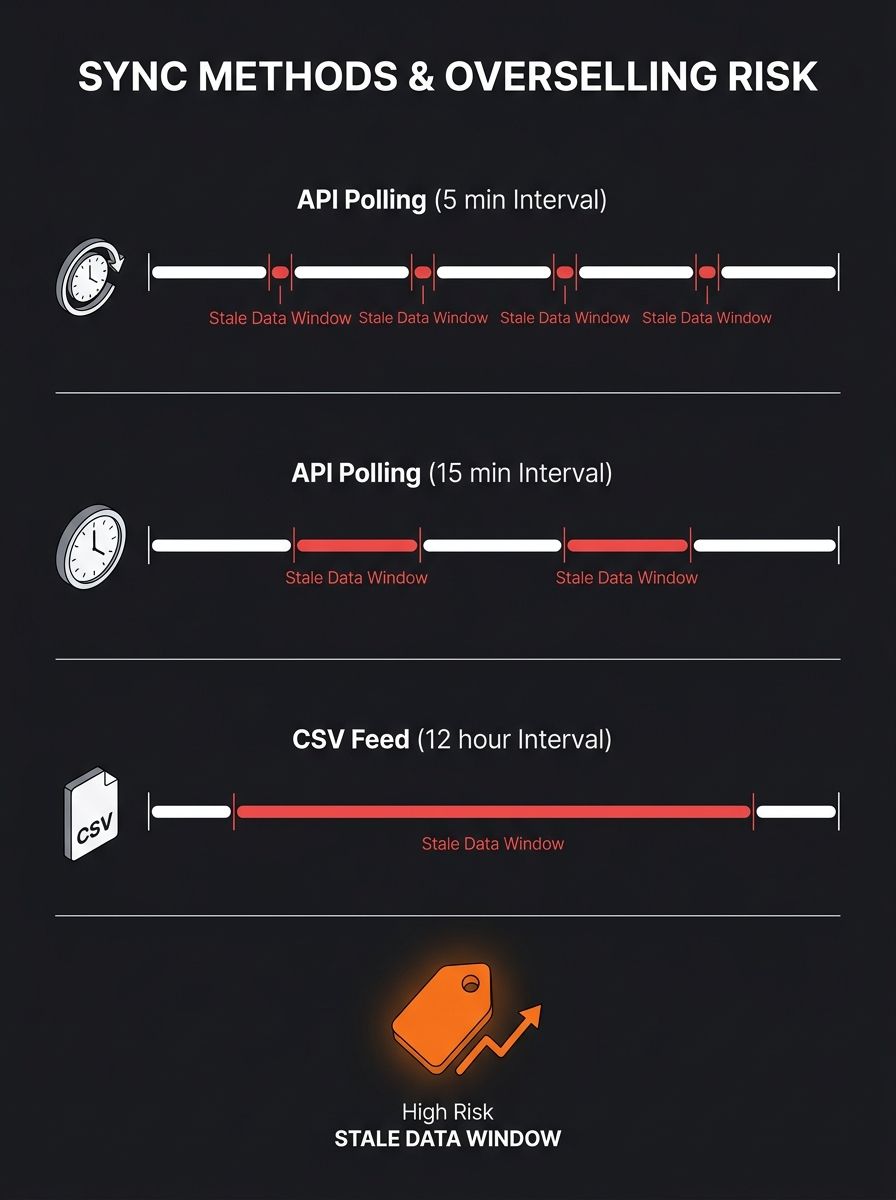
Every dropshipping inventory management tool relies on one of two sync methods: API polling or CSV feed imports. API-based tools query your supplier's system at set intervals and pull updated stock counts. CSV-based tools download flat files (usually on a schedule) and reconcile them against your store listings.
The critical detail most tool marketing pages gloss over: "real-time" almost never means real-time. As Inventory Source documents, there's always a tradeoff between real-time API updates, batch processing, and scalability. A tool might advertise "live inventory sync," but the actual polling interval could be every 5, 10, or even 30 minutes depending on your plan tier and how many SKUs you're running.
For CSV-based sync, the gap is worse. Most suppliers update their CSV feeds once or twice per day. If you're relying on a supplier who exports stock data at 6 AM and 6 PM, your store is working with data that could be 12 hours old during peak selling windows.
If you've been evaluating tools like DSers for AliExpress order automation, pay attention to the sync frequency buried in the settings panel, not the headline claim on the features page.
When the Gaps Widen Under Load
The polling interval problem compounds during high-traffic events. Here's the sequence that plays out during a sale or ad burst:
Traffic spikes 3-5x above normal baseline.
Multiple customers browse and add the same low-stock item to cart simultaneously.
Your sync tool's last poll was 8 minutes ago. At that time, the supplier had 4 units.
Between then and now, two units sold through another channel (the supplier sells to multiple retailers).
Your store still shows 4 available. Six customers place orders.
The next sync poll fires. Actual supplier stock: 0 units.
You owe refunds on 4 of those 6 orders.
This scenario isn't hypothetical. According to research from Branvas on automation tool failures, inaccurate inventory and overselling represent the most frequent point of failure across dropshipping automation software. The problem gets layered when you sell across multiple channels. If you're listing on Shopify, Amazon, and Etsy, each channel needs its own sync connection, and stock sync failures in automation multiply across every additional marketplace.
API rate limits accelerate the breakdown. When your tool hits the request ceiling during a traffic spike, additional sync requests get queued or dropped entirely. The result: your highest-traffic moments are precisely when your inventory data is least reliable.
The Damage Calculation Most Operators Skip
The direct cost of an oversold order looks straightforward: you refund the customer. But the actual margin impact runs deeper.
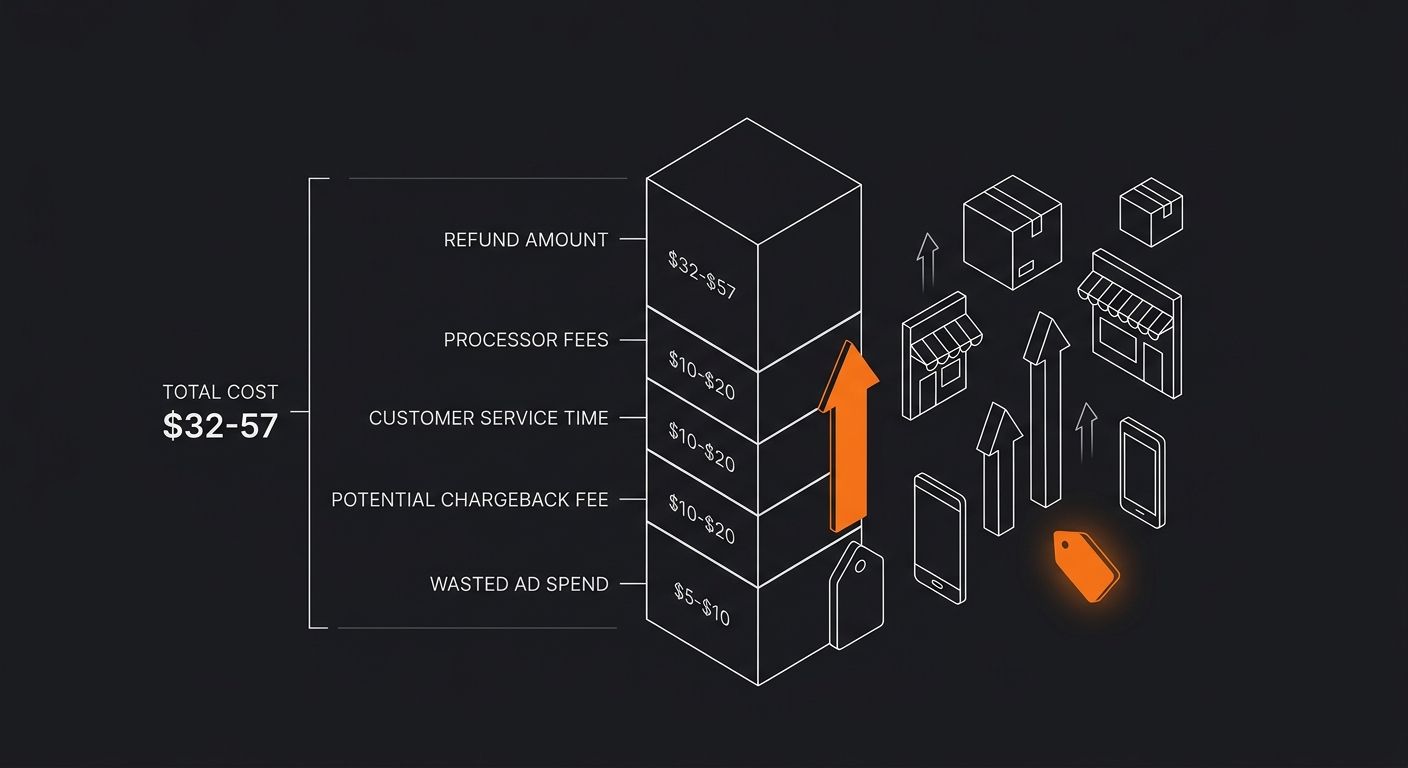
Consider a single overselling incident on a $45 AOV product with a 30% margin:
Gross profit lost on the refund: $13.50
Payment processor fee (non-refundable on most gateways): ~$1.60
Customer service time (15-20 minutes per ticket at $18/hr effective cost): ~$5.00
Potential chargeback if the customer disputes before you refund: $15-25 fee from your processor
Ad spend to acquire that customer (at a $12 CAC): $12.00
A single oversold order on a $45 item can cost you $32-57 when you account for all the downstream expenses. Run that across 20 oversold orders during a weekend sale, and you're looking at $640-1,140 in losses from a sync gap you never saw in your dashboard.
And that doesn't account for the softer costs: negative reviews, reduced customer lifetime value, and potential marketplace suspensions if your cancellation rate exceeds platform thresholds. Amazon, for instance, will flag seller accounts with cancellation rates above 2.5%.
The Recovery Scramble
Once an overselling event hits, operators typically follow a predictable recovery path. The first instinct is manual: log into the supplier portal, check actual stock, cancel unfulfillable orders, and email affected customers before they open disputes. This manual triage works for 5-10 orders. At 50+, it becomes a full-time job for days.
The second move is usually a settings adjustment. Operators dig into their sync tool's configuration and shorten the polling interval, sometimes paying for a higher plan tier to access faster sync rates. This helps, but it doesn't eliminate the gap entirely. A 5-minute polling interval still means 5 minutes of stale data.
The third, more structural response involves building in safety stock buffers. You configure your sync tool to show an item as out of stock when the supplier count drops below a threshold (say, 3 units) rather than at zero. This sacrifices some potential sales but dramatically reduces overselling incidents. Cin7's analysis of stock conflict prevention recommends this approach alongside regular stock audits and supplier performance monitoring.
For stores dealing with order fulfillment delays and recovery from overselling events, AfterShip's tracking capabilities become useful for managing customer communication on orders that do ship, keeping the non-problematic portion of your order volume from getting dragged down by the chaos of the cancelled ones.
The Tool Reliability Gap Nobody Benchmarks
Here's what's missing from most dropshipping tool reviews: nobody publishes sync uptime data. You can find ratings, feature lists, and pricing tables for every major inventory sync tool on the market. What you can't find is a straight answer to: "What percentage of sync cycles completed successfully over the last 90 days?"
Inventory Source flags this directly, noting that inventory synchronization failures occur when product stock levels aren't updated consistently across ecommerce platforms, supplier systems, and automation tools. Critical errors like complete sync failures require immediate intervention, while minor inconsistencies can sometimes be resolved through retry mechanisms.
The problem is that most operators don't know the difference between a critical sync failure and a minor delay until customers start complaining. Your tool's dashboard might show a green checkmark while the actual data it synced was 3 hours old because the supplier's API endpoint timed out and the tool silently fell back to cached data.
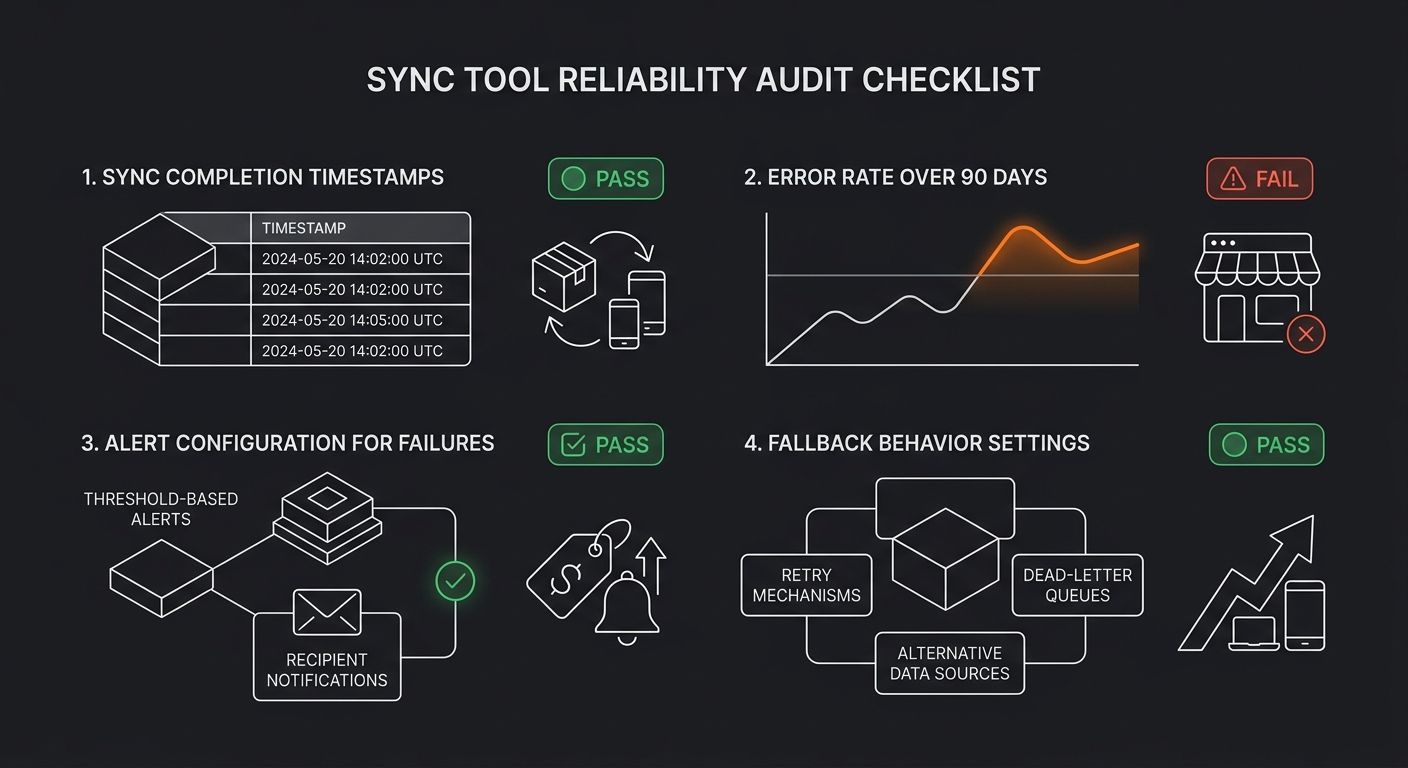
A proper tool reliability audit should check for:
Sync logs with timestamps showing when each pull actually completed (not when it was scheduled)
Error rate reporting that shows failed vs. successful sync cycles over 30/60/90 day windows
Alerting behavior when a sync cycle fails (does the tool notify you, or does it silently retry?)
Fallback behavior when the supplier API is unreachable (does it use cached data, or does it flag the product?)
If your tool can't answer these four questions from its own reporting interface, you're flying blind on the reliability of your inventory data.
Where the Supplier Relationship Enters the Picture
The automation tool is only half the equation. Your supplier's data infrastructure determines the ceiling of how accurate your sync can ever be. A supplier running a modern warehouse management system with webhook-based stock updates can push changes to your tool within seconds of a unit shipping. A supplier manually updating an Excel spreadsheet and exporting it to CSV twice a day gives you a 12-hour accuracy window at best.
This is why operator conversations about choosing suppliers who outperform basic AliExpress connectors matter so much to inventory accuracy. The supplier's technical capability directly determines whether your $99/month automation tool can actually do what it promises. And if you're evaluating platforms like Spocket for US/EU supplier access, the supplier's sync infrastructure should be a top-three evaluation criterion alongside shipping speed and product margins.
Ask your suppliers directly: How often is your inventory feed updated? Do you support webhook notifications for stock changes? What's your typical latency between a unit selling and the stock count updating in your system? Suppliers who can't answer these questions clearly are suppliers whose inventory data you should buffer aggressively.
The State of Play
The tools have gotten faster. Five years ago, 30-minute sync intervals were standard. Today, top-tier plans on major platforms offer 1-5 minute polling, and some support webhook integrations that approach genuine real-time sync. But the fundamental architecture hasn't changed: there's always a gap between what your supplier knows and what your storefront shows.
Operators who avoid chronic overselling tend to share three practices. They run safety stock buffers of 2-5 units on every synced SKU. They schedule weekly manual spot-checks where they pick 10-15 random products and compare their store's displayed stock against the supplier's actual count. And they treat their sync tool's error logs like a financial report, reviewing them on a fixed cadence rather than waiting for customer complaints to surface problems.
The overselling crisis in dropshipping isn't a tooling problem you solve once with the right subscription. It's an ongoing operational discipline that sits at the intersection of your sync tool's architecture, your supplier's data quality, and your willingness to verify what the green checkmarks on your dashboard actually mean. The stores that treat inventory accuracy as a recurring audit, rather than a set-and-forget configuration, are the ones that keep their refund rates below 2% and their marketplace accounts in good standing.
365 Dropship Editorial
Editorial team writing about E-commerce, dropshipping, and product discovery — reviews of dropshipping suppliers and platforms, trending niche guides (jewelry, beauty, pets, home, fashion), supplier due diligence, ecom operations, shipping & fulfillment strategy, product research, AOV optimization, and profitable dropshipping case studies.
Explore more topics