Why Niche Tool Bias Costs You Margin: How Free vs. Paid Research Tools Miss India's Rising Dropshipping Supplier Ecosystem
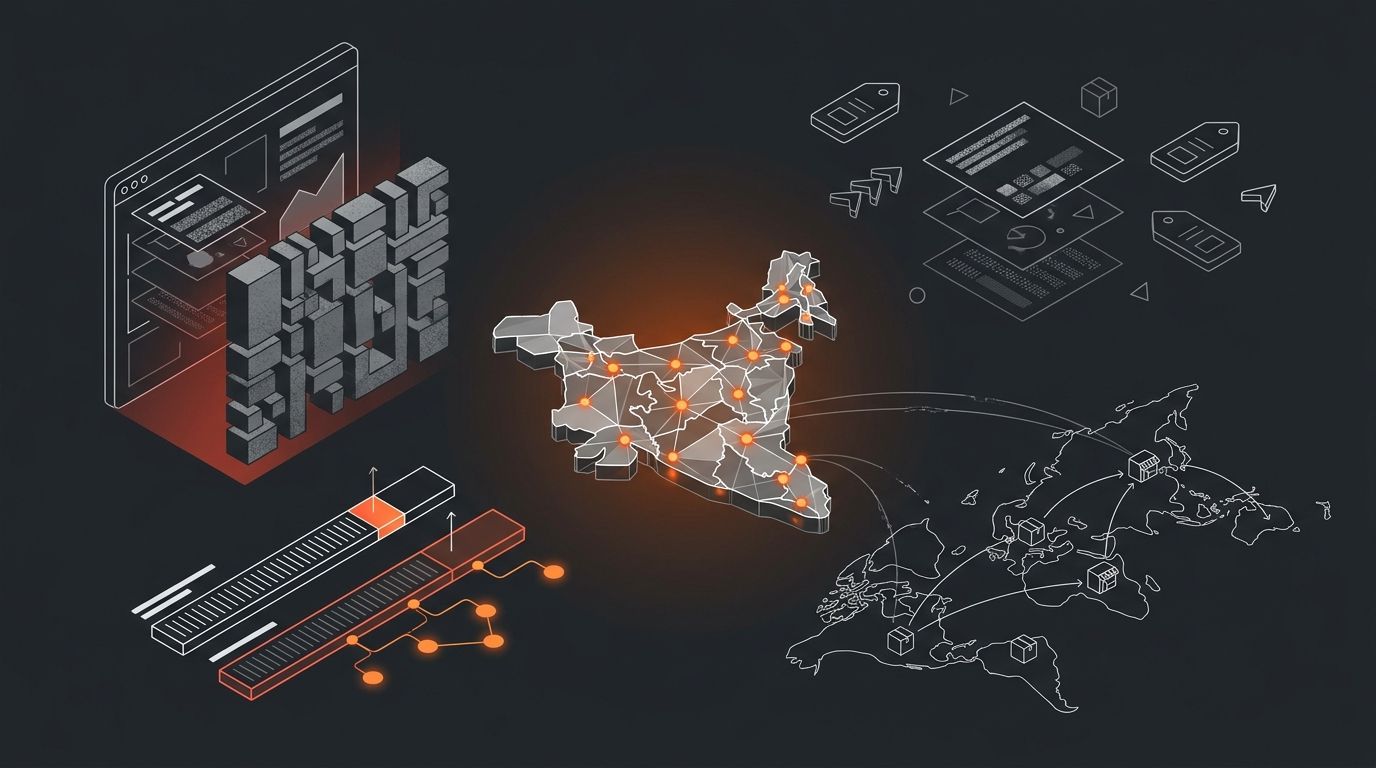
Qikink, Printrove, and Baapstore each process thousands of print-on-demand and general merchandise orders monthly out of India, and none of them appear in the supplier databases of Sell The Trend, Niche Scraper, or the AliExpress Dropshipping Center. This absence matters for your margin math.
Why Niche Tool Bias Costs You Margin: How Free vs. Paid Research Tools Miss India's Rising Dropshipping Supplier Ecosystem
Qikink, Printrove, and Baapstore each process thousands of print-on-demand and general merchandise orders monthly out of India, and none of them appear in the supplier databases of Sell The Trend, Niche Scraper, or the AliExpress Dropshipping Center. This absence matters for your margin math. Indian suppliers in categories like eco-friendly home goods, minimalist jewelry, and personalized phone cases often price 15–30% below their Chinese equivalents for comparable quality, because India's manufacturing labor costs and raw material access (especially cotton, jute, brass, and semi-precious stones) create real cost advantages in specific verticals.
Yet the tools you rely on for product research route you straight past these suppliers. Every time. Whether you're using a free browser extension or paying $49/month for a trend-tracking dashboard, the geographic market research bias baked into these platforms shapes which products you see, which suppliers you find, and ultimately what margin you keep.
This article breaks down three approaches to product and supplier research — free tools, paid tools, and a direct-sourcing hybrid — and measures each one against the same question: does this method actually surface India dropshipping suppliers in 2026, or does it funnel you toward the same AliExpress catalog as everyone else?
What Free Tools Actually Index (And What They Don't)
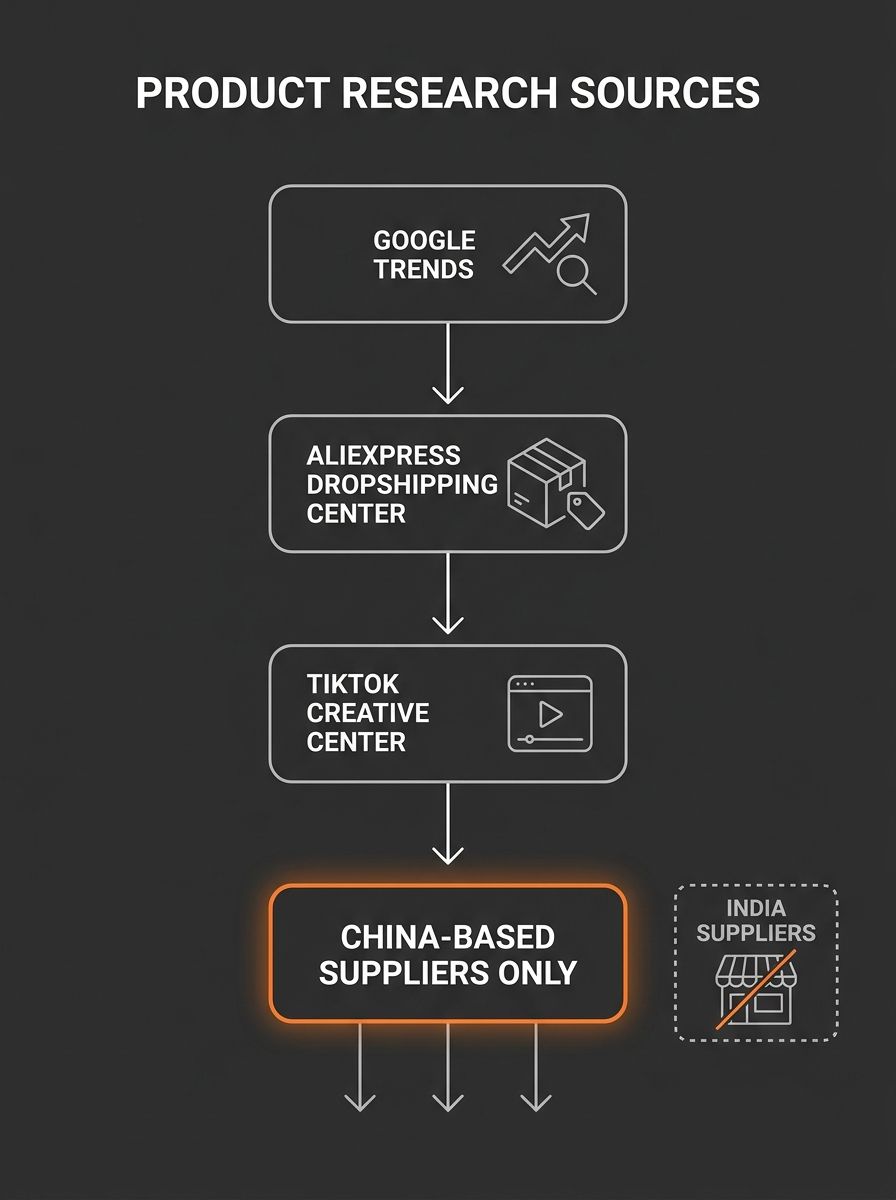
Google Trends, the AliExpress Dropshipping Center, and TikTok Creative Center are the three free research tools that dominate beginner workflows. Each one has genuine value for demand validation. And each one has a geographic blind spot wide enough to hide an entire country's supplier ecosystem.
Google Trends tells you what people search for. It's excellent at confirming whether interest in "portable solar chargers" or "smart pet feeders" is rising or falling. But it tells you nothing about where those products are manufactured or who can supply them at favorable unit economics. A trending search term in Google Trends defaults you to sourcing on AliExpress, because that's where your next tool in the workflow (usually the AliExpress Dropshipping Center) sends you.
AliExpress Dropshipping Center indexes AliExpress listings. That's it. Its product database is overwhelmingly Chinese manufacturers selling through AliExpress storefronts. Indian suppliers don't list on AliExpress in meaningful volume. When sampling bias in market research means your sample doesn't represent the full population of available suppliers, you get a skewed picture of what's possible at what cost.
TikTok Creative Center shows you what's performing well in ad creative and which products are trending in short-form video. Useful for demand signals. Useless for supplier discovery. If a product is trending on TikTok, you still need to find someone who makes it, ships it reliably, and prices it at a point where you keep margin after ad spend and fulfillment.
The result: free tools confirm demand but lock your supply chain to China by default. If you've been wondering why your niche research tool isn't surfacing profitable markets, this geographic constraint is a major contributor. The tool works fine for what it indexes. The problem is what it doesn't index.
The Margin Impact in Real Numbers
Assume you're selling minimalist jewelry. A typical AliExpress supplier prices a brass-plated minimalist ring at $2.80–$3.50 per unit. An Indian supplier like Qikink or a manufacturer found through IndiaMART prices comparable items at $1.80–$2.40, with similar or better material quality because India is a major brass and silver processing hub. On a $24.99 retail price, that $1.00–$1.10 per-unit difference across 500 monthly orders is $500–$550 in recovered margin. Per SKU.
Multiply that across a catalog of 8–12 active SKUs and the regional product research gap in your free tool stack costs you $4,000–$6,600 per month in margin you never knew existed.
Paid Platforms Sharpen the Data but Repeat the Same Map
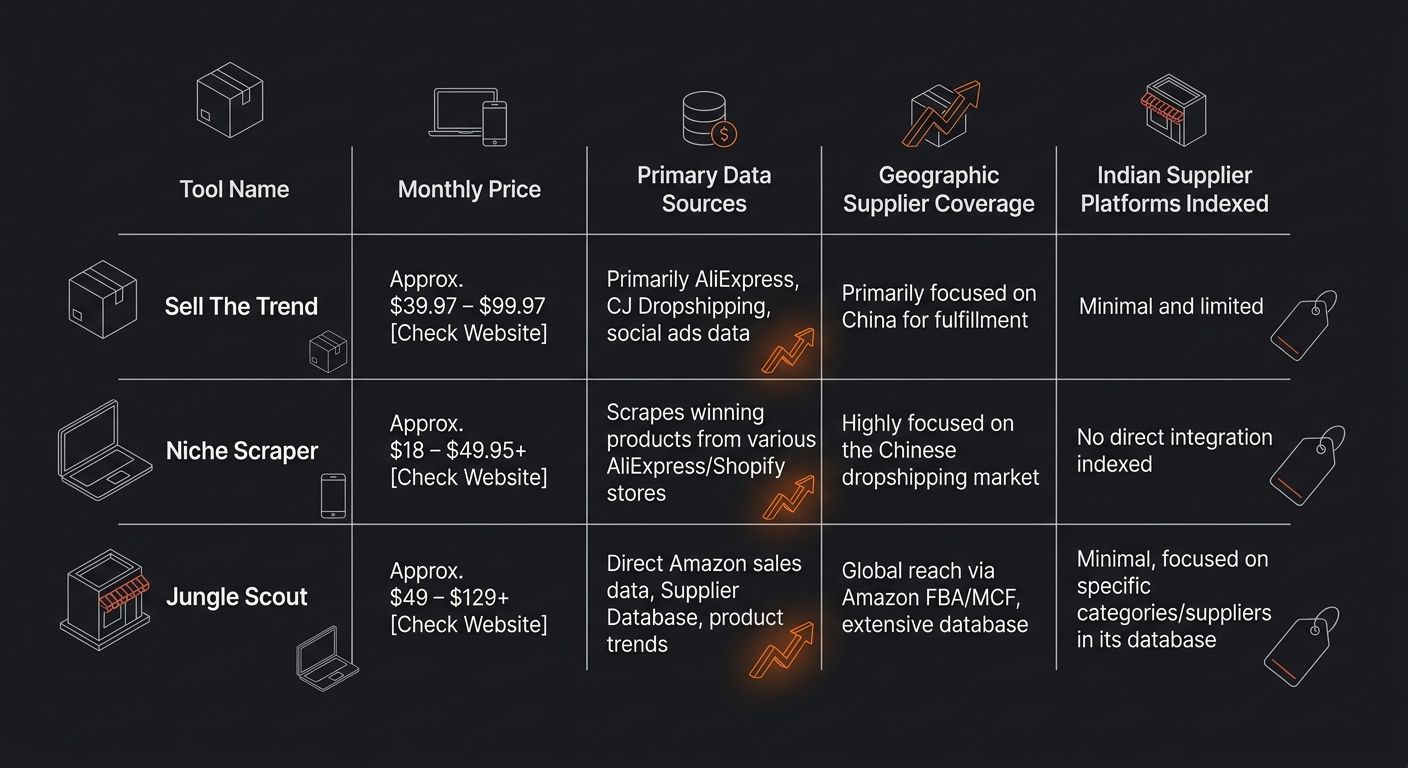
Sell The Trend ($39.97/month), Niche Scraper ($49.95/month), and Jungle Scout ($49/month) represent the next tier. They offer competitor store analysis, ad spy features, product score algorithms, and in some cases estimated revenue data for specific Shopify stores. The data quality genuinely improves over free alternatives, as we've covered in our comparison of free vs. paid niche tools and their data quality tradeoffs.
But the geographic bias persists.
Sell The Trend pulls product data primarily from AliExpress and Amazon. Its "NEXUS" product research engine scores items based on AliExpress order volume, Amazon BSR, and social media engagement. Indian suppliers on platforms like IndiaMART, TradeIndia, or standalone Shopify B2B storefronts don't feed into this scoring system at all.
Niche Scraper analyzes AliExpress hand-picked products and Shopify store product pages. Same constraint. If a product is manufactured and sold through Indian supply channels that don't touch AliExpress, Niche Scraper doesn't know it exists.
Jungle Scout is Amazon-focused. Its supplier database feature can surface some Indian manufacturers, but only those who've registered as Amazon suppliers. The large population of Indian dropshipping-ready suppliers operating through their own platforms or through Indian e-commerce aggregators sits outside Jungle Scout's index entirely.
Where Paid Tools Earn Their Subscription
Paid tools excel at competitive intelligence within the AliExpress/Amazon ecosystem. If you want to know which products are selling well on competitor Shopify stores, what Facebook ads are running longest (a proxy for profitability), and what AliExpress items have the best order-to-rating ratios, paid tools deliver real value.
They also help you avoid oversaturated products. When Sell The Trend shows you that 847 Shopify stores already carry a specific LED strip light kit from the same AliExpress supplier, that's actionable intelligence worth the subscription cost.
But they can't show you the emerging supplier networks they don't track. And India's supplier ecosystem is growing fast. According to Qikink's dropshipping statistics, the estimated dropshipping success rate in India sits between 10% and 20%, comparable to global averages and indicating a maturing market with real infrastructure behind it.
Going Direct Into India's Supplier Networks
The third approach skips tool-mediated supplier discovery and goes straight to where Indian suppliers actually operate.
IndiaMART is the largest B2B marketplace in India, with over 7 million supplier listings. It's free to browse and search. You can filter by product category, minimum order quantity, and location. The interface feels dated compared to AliExpress, but the supplier density in categories like home textiles, jewelry, leather goods, brass hardware, and personal care products is extraordinary.
Qikink and Printrove handle print-on-demand specifically. If you're selling custom t-shirts, hoodies, mugs, or phone cases, these platforms integrate with Shopify and handle production plus fulfillment from Indian facilities. Unit costs typically run 20–35% below Printful or Printify for comparable product types, because Indian textile manufacturing costs are structurally lower.
TradeIndia functions similarly to IndiaMART but with a smaller supplier base. It's worth cross-referencing against IndiaMART results to find suppliers active on both platforms, which serves as a rough signal of business legitimacy.
Unicommerce's supplier directory lists India's top dropshipping platforms with details on catalog size, integration options, and fulfillment capabilities. Trending Indian dropshipping categories include eco-friendly household items, smart home devices, portable solar chargers, minimalist jewelry, fitness bands, and pet tech products like smart feeders.
Vetting Indian Suppliers Without Familiar Guardrails
The tradeoff with direct sourcing is clear: you lose the rating systems, order-count transparency, and buyer protection that AliExpress provides. Vetting matters more here, and the process takes more effort.
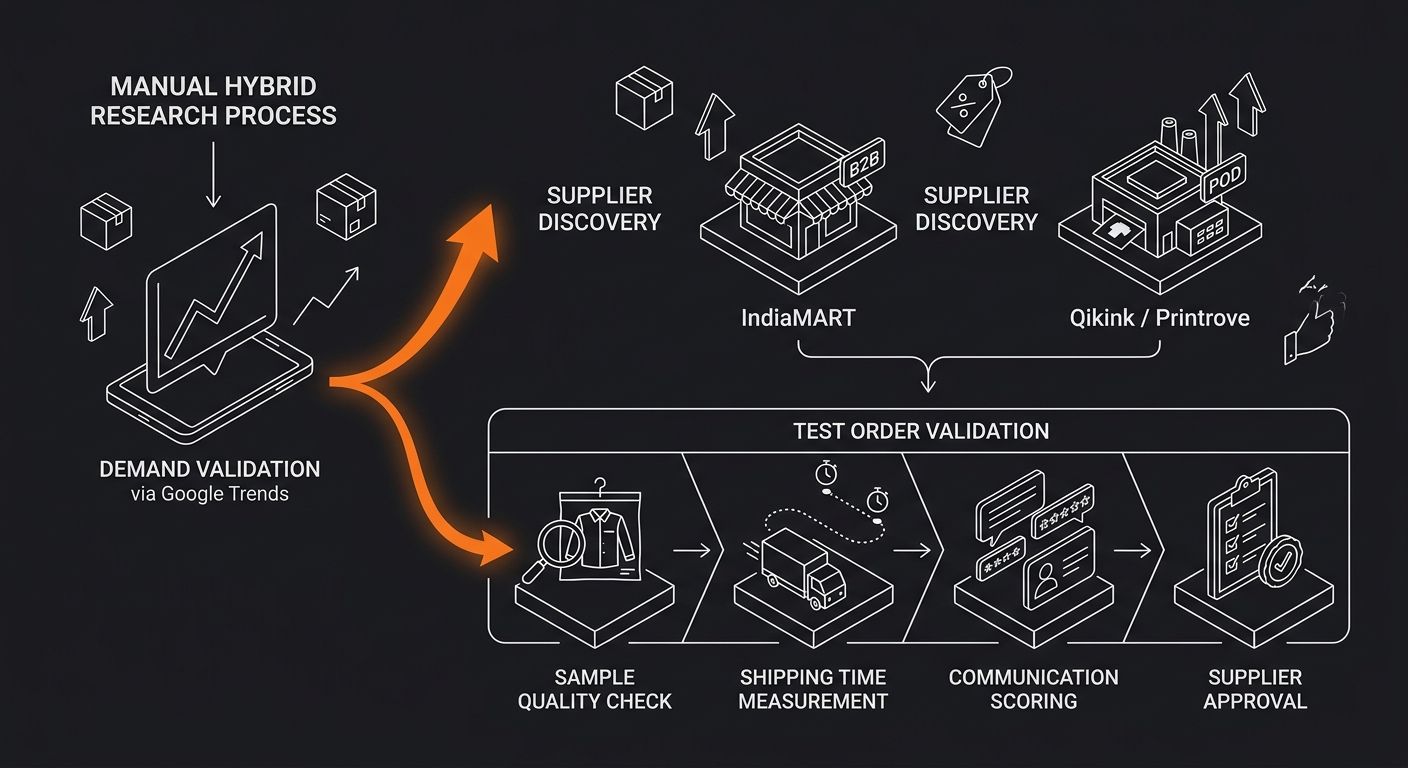
Before committing to any Indian supplier, run a structured test order process. We've detailed this in our supplier test order validation framework, and every step applies to Indian suppliers with one addition: pay attention to packaging quality and customs documentation accuracy, because cross-border shipments from India occasionally encounter classification issues that delay delivery.
Key vetting criteria for Indian suppliers:
Sample order turnaround: Request 2–3 sample units. Measure time from order to delivery. Indian suppliers shipping internationally should hit 8–14 business days to the US via ePacket equivalents or express couriers.
Communication responsiveness: IndiaMART suppliers often respond within 24 hours during Indian business hours (IST). If a supplier takes more than 48 hours to respond to an initial inquiry, that's a red flag for ongoing reliability.
MOQ flexibility: Many IndiaMART suppliers default to bulk MOQs (50–500 units). For dropshipping, you need per-unit fulfillment. Qikink and Printrove already operate on a per-order model. IndiaMART suppliers may require negotiation to reach single-unit fulfillment terms.
Payment methods: Look for suppliers accepting PayPal or Payoneer for buyer protection. Wire transfer-only suppliers add risk for small initial orders.
Building a proper supplier vetting checklist before reaching out saves you from wasting time on suppliers who can't actually fulfill dropshipping-style orders.
Shipping Realities
Indian suppliers ship internationally through a mix of India Post (cheapest, slowest), Delhivery (domestic-focused but expanding), and private couriers like DHL eCommerce and FedEx Economy. Typical delivery windows:
India to US: 10–18 business days via standard, 5–8 via express
India to UK/EU: 8–15 business days standard, 4–7 express
India to Australia: 10–16 business days standard
These windows are comparable to AliExpress standard shipping from China, which typically runs 12–20 business days to the US. Express options from India are often cheaper than express from China because Indian courier partnerships with DHL and FedEx offer more competitive rates for lightweight parcels under 500g.
How To Choose Between These Three
The honest answer depends on where you are in your business and what categories you sell.
Stick with free tools if you're validating demand for a new niche and haven't committed to a product line yet. Google Trends plus TikTok Creative Center gives you enough signal to confirm whether people want what you're considering selling. Accept that your supplier options will default to AliExpress, and your margins will reflect that default.
Pay for a research tool if you're running an active store, need competitive intelligence on what other Shopify stores carry, and want to avoid oversaturated products. The $40–$50/month is worth it for the time savings on competitor analysis alone. But supplement it with manual sourcing outside the tool's index. Don't let the tool's geographic boundaries become your geographic boundaries.
Add the India direct-sourcing hybrid if you sell in categories where India has manufacturing advantages: jewelry, textiles, leather, home décor, brass items, personal care, and print-on-demand apparel. The upfront time investment in supplier vetting is higher, but the per-unit cost savings compound every month. At 500+ orders per month per SKU, the margin difference between a $2.80 Chinese supplier and a $1.90 Indian supplier funds your entire quarterly ad spend increase.
The niche tool blind spots in your current research workflow aren't bugs in the software. They're boundaries in the data. Every product research tool indexes what it can crawl, and India's supplier ecosystem sits outside that crawl radius for every major platform right now. The dropshippers who figure out how to combine unconventional data sources with direct supplier outreach will capture the margin that tool-dependent competitors leave sitting on the table.
India's dropshipping infrastructure is maturing fast enough that ignoring it carries a real, measurable cost. The suppliers exist, the shipping lanes work, and the unit economics favor anyone willing to look beyond the default search results.
365 Dropship Editorial
Editorial team writing about E-commerce, dropshipping, and product discovery — reviews of dropshipping suppliers and platforms, trending niche guides (jewelry, beauty, pets, home, fashion), supplier due diligence, ecom operations, shipping & fulfillment strategy, product research, AOV optimization, and profitable dropshipping case studies.
Explore more topics