Automation Tool Failure Modes: The Overselling, Syncing & Supplier Risk Matrix for 2026
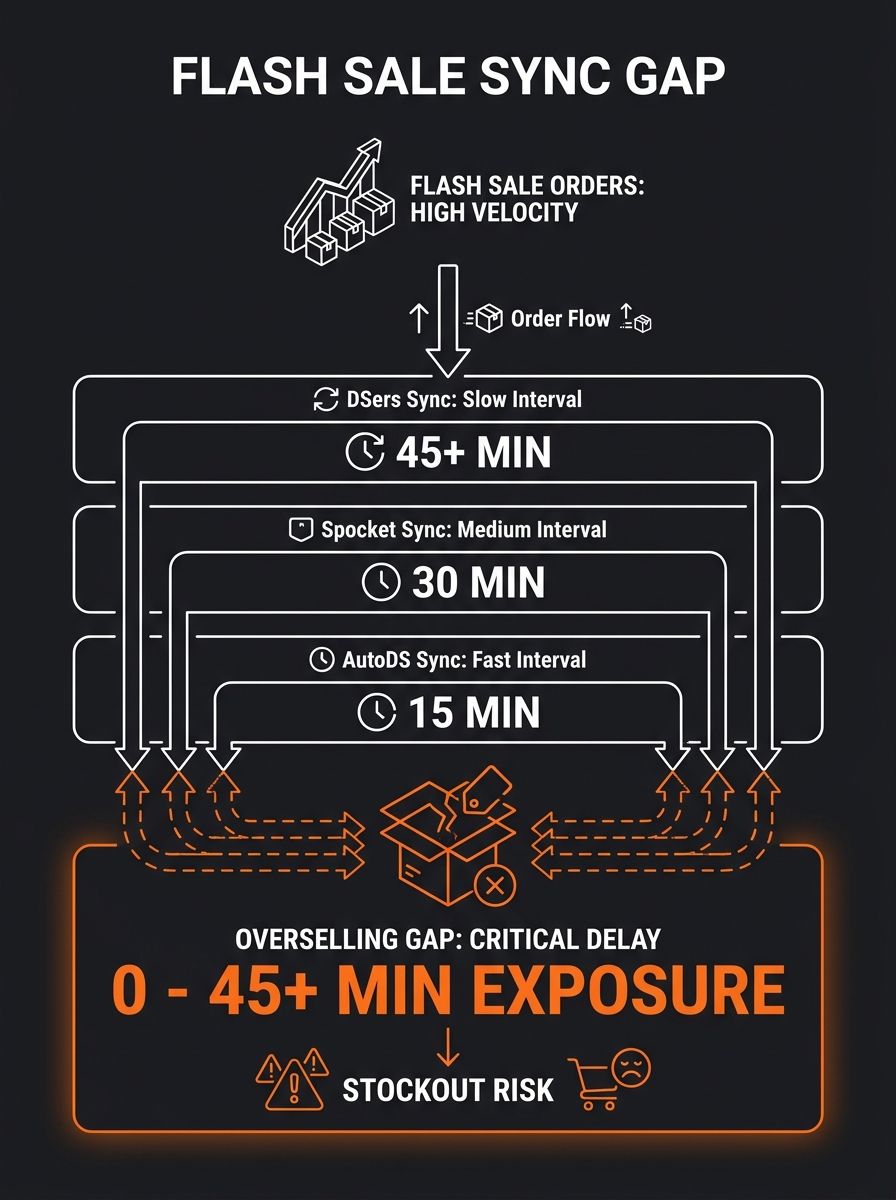
Every major dropshipping automation tool syncs inventory on a delay. DSers polls AliExpress suppliers roughly every 4–6 hours on free tiers. Spocket advertises "real-time" updates but actually pushes data in 15- to 60-minute intervals depending on SKU volume and plan level.
Automation Tool Failure Modes: The Overselling, Syncing & Supplier Risk Matrix for 2026
Every major dropshipping automation tool syncs inventory on a delay. DSers polls AliExpress suppliers roughly every 4–6 hours on free tiers. Spocket advertises "real-time" updates but actually pushes data in 15- to 60-minute intervals depending on SKU volume and plan level. AutoDS runs syncs at configurable intervals that default to once per hour. That delay is where overselling lives, and it's the most common automation tool failure mode in the space. The misunderstanding operators carry into their store build is that connecting an automation app to a supplier means inventory counts are accurate at checkout. They aren't. They're accurate as of the last sync, which could be minutes or hours old during a flash sale, a TikTok spike, or a Friday afternoon when your supplier's warehouse crew has already gone home.
What "Real-Time Sync" Actually Means at the API Level
When an automation tool says "real-time inventory sync," it almost always means webhook-triggered or short-interval polling. True real-time would mean your Shopify product page queries the supplier's warehouse management system at the exact moment a customer loads the page. Almost no dropshipping tool does this because the latency would kill page load times, and most suppliers don't expose APIs fast enough to handle that kind of request volume.
Instead, the typical architecture works in one of two ways. Polling-based tools hit the supplier's API on a schedule, pull the current stock count, and write it to your store's database. Webhook-based tools listen for a push notification from the supplier whenever stock changes. Polling is more common because it requires less technical sophistication from the supplier side. But polling creates a window of vulnerability: if a supplier sells 50 units of your product between syncs and your store still shows 50 available, you'll take orders you can't fill.
According to a 2026 survey of automation tool challenges, inaccurate inventory synchronization is the single most frequent point of failure in dropshipping automation. The failure rate climbs during high-traffic events because order velocity outpaces sync frequency. If you've read our breakdown of how inventory syncing actually breaks, you know this pattern repeats across every platform tier.
The cost math is brutal. Say you're running a product at a $45 AOV with $13 margin per order. Ten oversold units mean $130 in direct margin loss, plus $50–$80 in shipping costs for orders you need to refund, plus the customer service time, plus the hit to your store's review rating. A single sync failure during a busy weekend can wipe out a week of profit.
How SKU Mapping Errors Multiply the Damage
Sync frequency is the most visible failure mode, but SKU mapping errors are the quieter, more persistent one. Every product variant you sell needs a unique identifier that maps to the exact supplier listing. Size M in heather gray needs its own SKU that points to the supplier's corresponding record. When this mapping is wrong or incomplete, your automation tool can pull stock data for the wrong variant, show availability for a discontinued colorway, or update the wrong listing entirely.
As Spocket's inventory management guide explains, SKU mapping is one of the most overlooked parts of dropship inventory management, yet it prevents costly mistakes. Each product variant needs a consistent SKU so your store matches the correct supplier listing. Without it, you risk sending the wrong product, running into inventory syncing errors in dropshipping, or showing incorrect availability.
This compounds with multi-supplier setups. If you source the same product from two suppliers for redundancy (a smart move for overselling prevention), your automation tool needs to know which supplier's stock to decrement first, and when to fall back to the second. Most mid-market tools handle this poorly. They'll track each supplier's stock independently but won't create a unified availability number that accounts for both sources. You end up manually managing the logic that you paid for automation to handle.
Supplier Risk Sits Underneath Everything
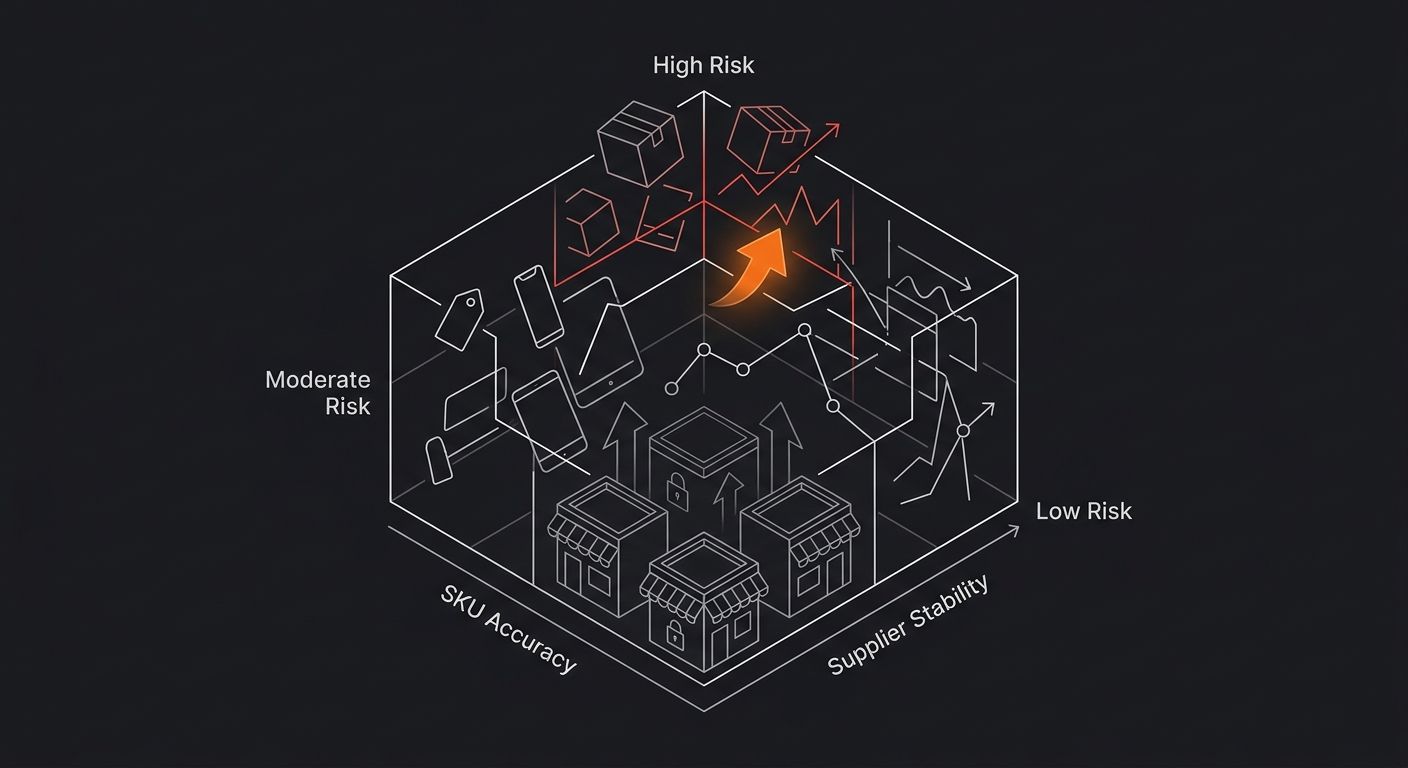
Sync speed and SKU accuracy both assume a stable supplier on the other end. Supplier risk automation is still immature in the dropshipping world, even though enterprise procurement teams have been using tools like SAP Ariba and Riskonnect to monitor supplier health for years. Those platforms centralize supplier data, track delivery punctuality, and flag financial instability. Dropshippers get none of that infrastructure by default.
Your automation tool connects to a supplier's API or scrapes their product feed. It doesn't tell you that the supplier's defect rate crept from 2% to 8% over the last quarter, or that their shipping times drifted from 7 days to 14 because they switched warehouses. It definitely doesn't tell you that the factory behind your supplier is also the factory behind six competing stores, all drawing from the same dwindling stock pool.
This is why running test orders before scaling matters so much. Your automation tool will happily keep routing orders to a supplier whose quality has collapsed. The tool doesn't have opinions. It has API connections. Building actual direct supplier relationships gives you the communication channel to catch these problems before they show up as chargebacks.
Preventing Oversold Orders: Reservation, Buffers, and Channel Isolation
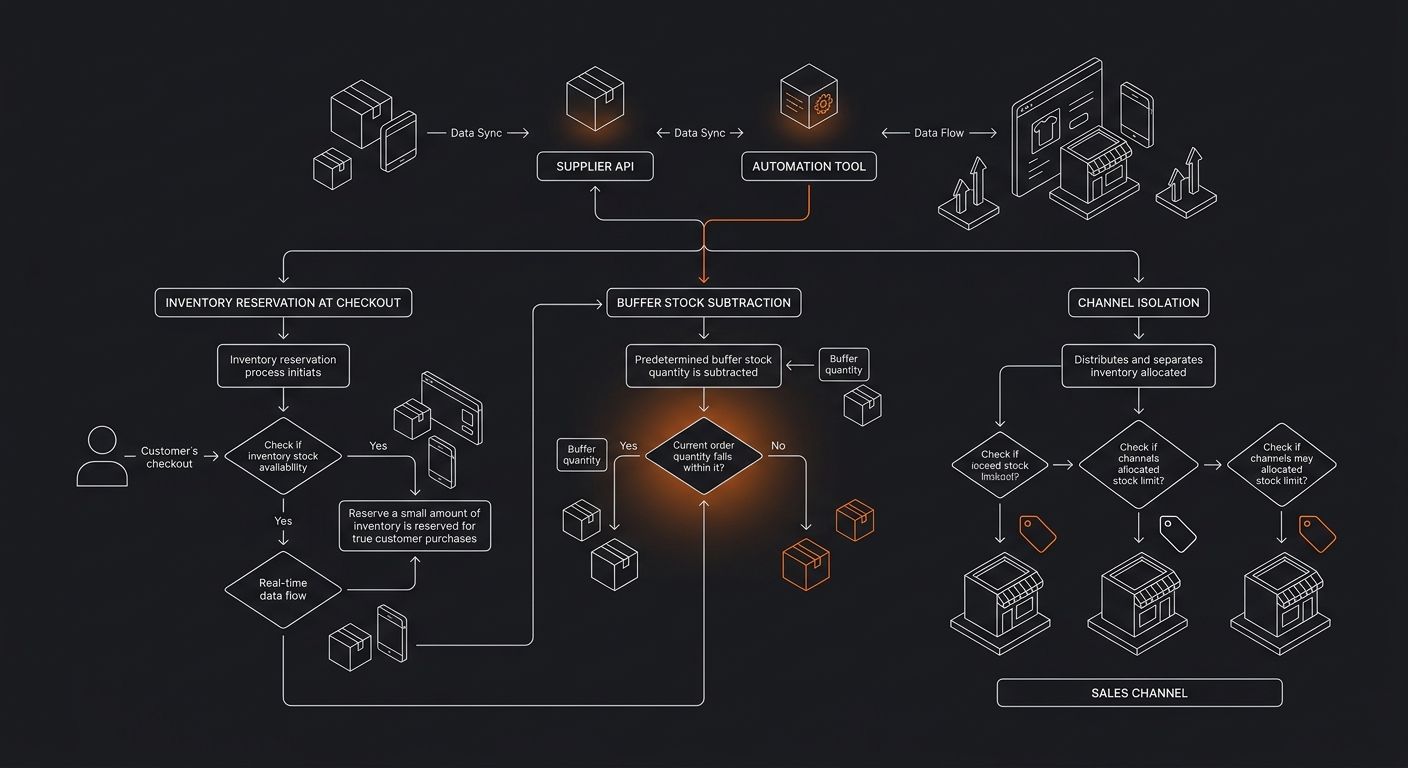
Three mechanisms exist to reduce overselling, and they work at different layers of the problem.
Inventory reservation is the most effective. As Cin7's research documents, automated systems can temporarily reserve inventory as soon as a customer starts the checkout process and confirm availability before finalizing the sale. This prevents duplicate orders during the checkout window. Shopify supports this natively for stores using their own inventory, but dropshippers relying on third-party stock don't get this protection unless their automation tool explicitly implements it. Most don't.
Buffer stock settings are simpler. You tell your automation tool to subtract a fixed number or percentage from the supplier's reported stock. If the supplier says 100 units available, your store shows 85. This absorbs sync-gap risk at the cost of potentially lost sales. The right buffer depends on your sync frequency and your product's sell-through rate. A product that moves 5 units per day with hourly syncs needs a smaller buffer than one that can spike to 50 units per hour during a promo.
Channel isolation matters if you sell on Shopify, Amazon, Etsy, or TikTok Shop simultaneously. Platforms like Celigo offer AI-powered error management that resolves integration issues automatically across Shopify, NetSuite, Shopee, Lazada, and TikTok Shop. But most dropshippers at the $10K–$50K/month revenue level don't run Celigo. They run DSers or Spocket with a Shopify-first setup, and if they add a second channel, they're manually splitting inventory allocations in a spreadsheet. That spreadsheet becomes the single point of failure. If you're evaluating tools for multi-channel, our platform comparison covers which ones handle this natively.
The Tradeoffs That Keep These Failures Alive
Every fix introduced above creates its own problem, which is why automation tool failure modes persist even among experienced operators.
Faster sync intervals reduce overselling risk but increase API call volume, which can trigger rate limiting from suppliers or bump you into a higher-cost plan tier. DSers' premium tiers offer faster sync, but you're paying $50–$100/month extra to close a gap that still isn't zero. Buffer stock eliminates overselling but leaves money on the table when stock is genuinely available. A 15% buffer on a fast-moving product during Q4 could mean hundreds of missed orders. And inventory reservation only works at the checkout layer, so it doesn't help when a supplier sells out between your last sync and the customer's add-to-cart action.
Supplier risk is the hardest to automate because the data is qualitative. Shipping times, packaging quality, and communication responsiveness don't fit neatly into API responses. Enterprise tools from CloudEagle and similar platforms integrate with compliance frameworks like ISO, NIST, and SOC 2 to automate vendor risk scoring. Dropshippers have no equivalent, which means supplier risk management stays manual: you track it in a spreadsheet, or you track it in your head, or you don't track it at all and find out the hard way.
The operators who get this right tend to run a hybrid approach. They use automation for the repetitive sync work but build manual checkpoints around the failure-prone edges. Weekly supplier audits. Buffer stock that adjusts dynamically based on the previous week's sell-through velocity. Separate inventory pools for each sales channel with explicit reallocation rules. Working with suppliers who own their own inventory rather than acting as middlemen for AliExpress factories.
None of this is glamorous. The pitch from every automation tool is that you set it up once and it runs itself. The reality is that every tool has a failure envelope, and the operators who avoid overselling, sync errors, and supplier blowups are the ones who've mapped where those envelopes are and built manual processes around them. The tool handles 90% of the volume. You handle the 10% where the tool goes blind. That ratio is the actual operating model, and accepting it early saves you the margin hits that come from pretending otherwise.
365 Dropship Editorial
Editorial team writing about E-commerce, dropshipping, and product discovery — reviews of dropshipping suppliers and platforms, trending niche guides (jewelry, beauty, pets, home, fashion), supplier due diligence, ecom operations, shipping & fulfillment strategy, product research, AOV optimization, and profitable dropshipping case studies.
Explore more topics