Direct Supplier Relationships vs. Platform Middlemen: The Hidden Cost Math for 2026 Dropshippers
Spocket's listed price on a silicone kitchen utensil set from a Yiwu supplier runs about $6.80. The same factory quotes $3.90 per unit on 1688.com for orders of 50 pieces, and $3.20 at 200 pieces. That $2.90–$3.
Direct Supplier Relationships vs. Platform Middlemen: The Hidden Cost Math for 2026 Dropshippers
Spocket's listed price on a silicone kitchen utensil set from a Yiwu supplier runs about $6.80. The same factory quotes $3.90 per unit on 1688.com for orders of 50 pieces, and $3.20 at 200 pieces. That $2.90–$3.60 gap per unit isn't a mystery—it's the platform's margin, baked into every product card you browse. Multiply it across 500 orders a month, and you're looking at $1,450–$1,800 in invisible cost that never shows up on an invoice labeled "platform fee." This article walks through the actual sequence of how that cost accumulates, how operators move toward direct supplier dropshipping, and where the math lands once you've made the switch.
The Platform Starting Point
Every dropshipping operation starts somewhere, and for most people that somewhere is a marketplace connector. DSers pulling products from AliExpress. Spocket filtering US/EU warehouse items. CJ Dropshipping offering its zero-monthly-fee model with per-order processing charges. If you're still evaluating which of these fits your budget and timeline, our ranked comparison of platforms breaks down the tradeoffs.
These platforms solve a real problem: they let you list products and fulfill orders without talking to a single factory. The per-item cost is typically higher than traditional wholesale or bulk pricing, as Shopify's own cost breakdown notes, but the convenience is genuine. You don't negotiate MOQs, you don't wire money to a Guangdong bank account, and you don't deal with Chinese New Year shutdowns.
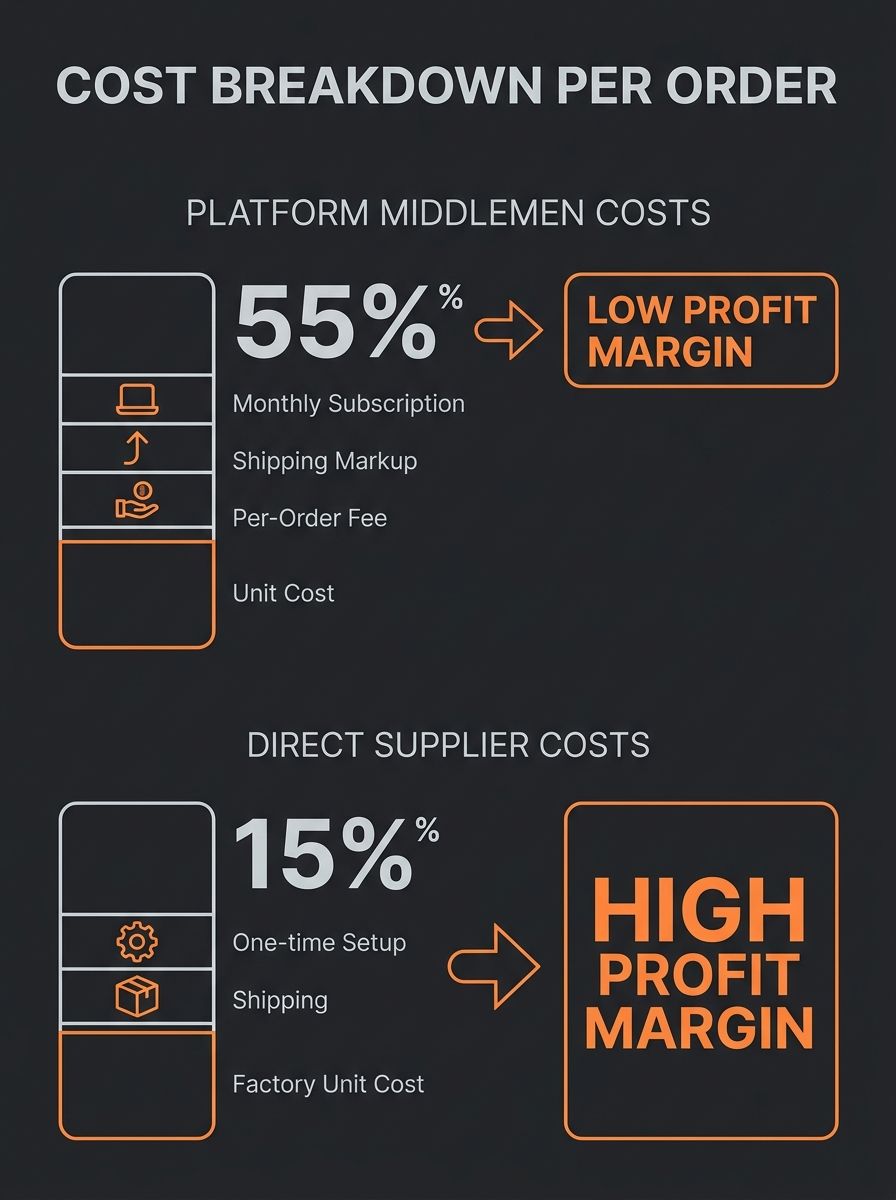
The cost structure at this stage looks something like this:
Per-order platform fee: $2–$5 (CJ Dropshipping, some Spocket tiers)
Inflated unit cost: 30–70% above factory-direct price depending on product category
Monthly subscription: $0–$99 depending on the platform
Shipping markup: platforms often negotiate bulk rates with logistics partners, then charge you retail or near-retail shipping fees
For a store doing 300 orders per month at a $35 AOV with a 40% gross margin on platform pricing, you're pulling about $4,200 in gross profit before ad spend. That sounds workable until you see what the same 300 orders look like on direct pricing.
Per-Order Fees Stack Up Faster Than the Dashboard Shows
The per-order fees across platforms range from $2 to $15 depending on product category and supplier service level. At $2 per order on 300 monthly orders, you're paying $600/month just for processing—$7,200 annually. At $5 per order (common for customized or branded packaging options), that's $18,000 a year in per-order fees alone.
And the fees aren't always transparent. Some suppliers on these platforms add what the industry calls a "dropship fee"—$1 for the first item, $0.25 for each additional item in the same order. Others fold their margin into the listed unit cost so it looks like there's no fee at all. The listed wholesale price on a middleman platform is almost never an actual wholesale price.
Here's where it gets painful. Say your real product cost from a factory is $4.50. A platform lists it at $7.20. Your retail price is $24.99. Your apparent margin looks like $17.79 minus shipping and transaction fees. Your actual margin, had you sourced directly, would be $20.49 minus shipping and transaction fees. On 300 orders, that's an $810/month difference from unit cost inflation alone—before you count per-order processing charges.
This dropshipping cost comparison becomes impossible to ignore once you cross about 200 orders per month. Below that volume, the convenience premium is arguably worth paying. Above it, the math starts screaming at you.
Making First Contact with a Factory
The shift from platform to direct typically starts with a frustrating realization: you're paying $2,000+ per month in combined platform costs, and your competitors selling similar products seem to be running tighter margins on ads. They can afford lower CPAs because their COGS are lower.
So you go to 1688.com (Alibaba's domestic Chinese marketplace), find the factory that makes your best-selling product, and send a message. This is where China supplier negotiation begins, and it's nothing like clicking "import to store" on a connector app.
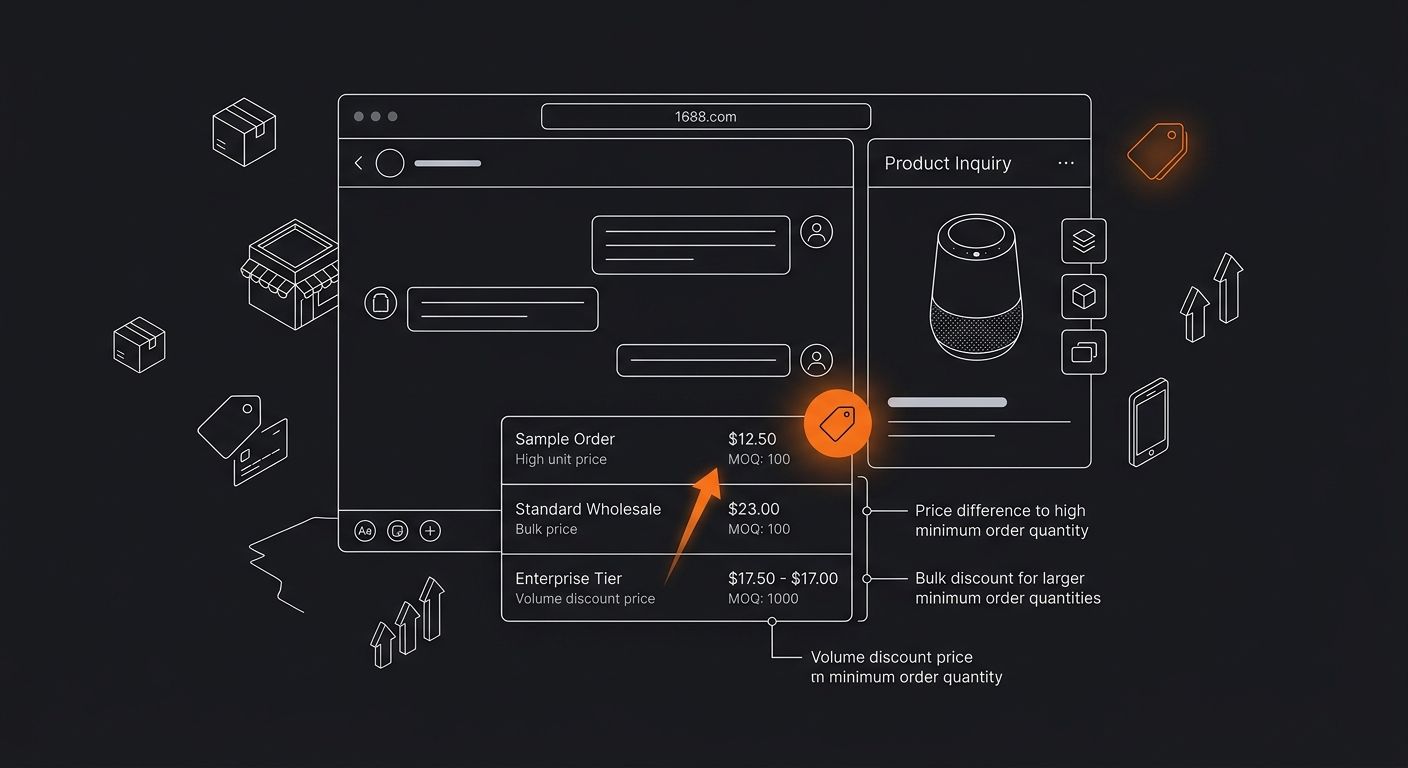
The first message usually gets a response within 24 hours if you're contacting during Chinese business hours. The factory will quote you a price based on MOQ tiers—typically 50, 100, 500, and 1,000+ units. At 50 units, the price might only be 10–15% below what the platform charged. At 200+, the savings get serious.
But here's what trips up first-timers: many factories don't want to dropship individual orders. They're set up for bulk production and container shipments. You need to find suppliers who either already offer one-piece fulfillment or are willing to set it up for a small premium. The negotiation approach matters here. As legal experts at Harris Sliwoski advise for manufacturer negotiations, walking in with walk-away power and tighter contracts protects both your margins and your supply chain.
Before you scale any relationship with a new supplier, running structured test orders is non-negotiable. We've published a detailed playbook on what to measure during supplier test orders that covers quality scoring, packaging consistency, and shipping time benchmarks.
How the Negotiation Actually Works
The negotiation phase is where wholesale vs platform dropshipping economics really diverge. Platform pricing is fixed—you pay what's listed. Direct supplier pricing is a conversation, and the conversation has rules.
ALSETTE's guide on Chinese supplier negotiation recommends using neutral language, requesting price breakdowns rather than criticizing quoted prices, and clearly stating your long-term purchasing intentions. This approach works because Chinese manufacturers operate on relationship logic. A buyer who communicates volume intent and reliability gets better pricing than one who haggles aggressively on a first order.
Here's a realistic negotiation timeline:
Week 1–2: Initial outreach via 1688.com, Alibaba, or WeChat. Request product samples (expect to pay $15–$40 including shipping for physical samples).
Week 3–4: Receive samples. Evaluate quality, packaging, and shipping speed. If you're running a branded store, this is where you discuss custom packaging and labeling. Our guide on why real suppliers outperform AliExpress connectors covers what to look for at this stage.
Week 5–6: Negotiate unit pricing, MOQs, payment terms, and fulfillment workflow. The supplier may agree to hold a small inventory buffer (50–100 units) and ship individual orders if you commit to reordering at set intervals.
Week 7–8: Place your first production order. Wire payment via Trade Assurance (Alibaba), PayPal, or T/T (bank transfer). The factory produces and ships to either you, a 3PL warehouse, or directly to customers.
The savings at this stage compound. Guided Imports documented cases where ordering at higher quantities didn't just lower the per-unit cost—it also cut freight costs dramatically by consolidating what would otherwise be multiple smaller shipments. For a product costing $4.50 direct versus $7.20 on a platform, the freight savings on consolidated shipping can add another $0.30–$0.80 per unit in margin.
The Margin Math Side by Side
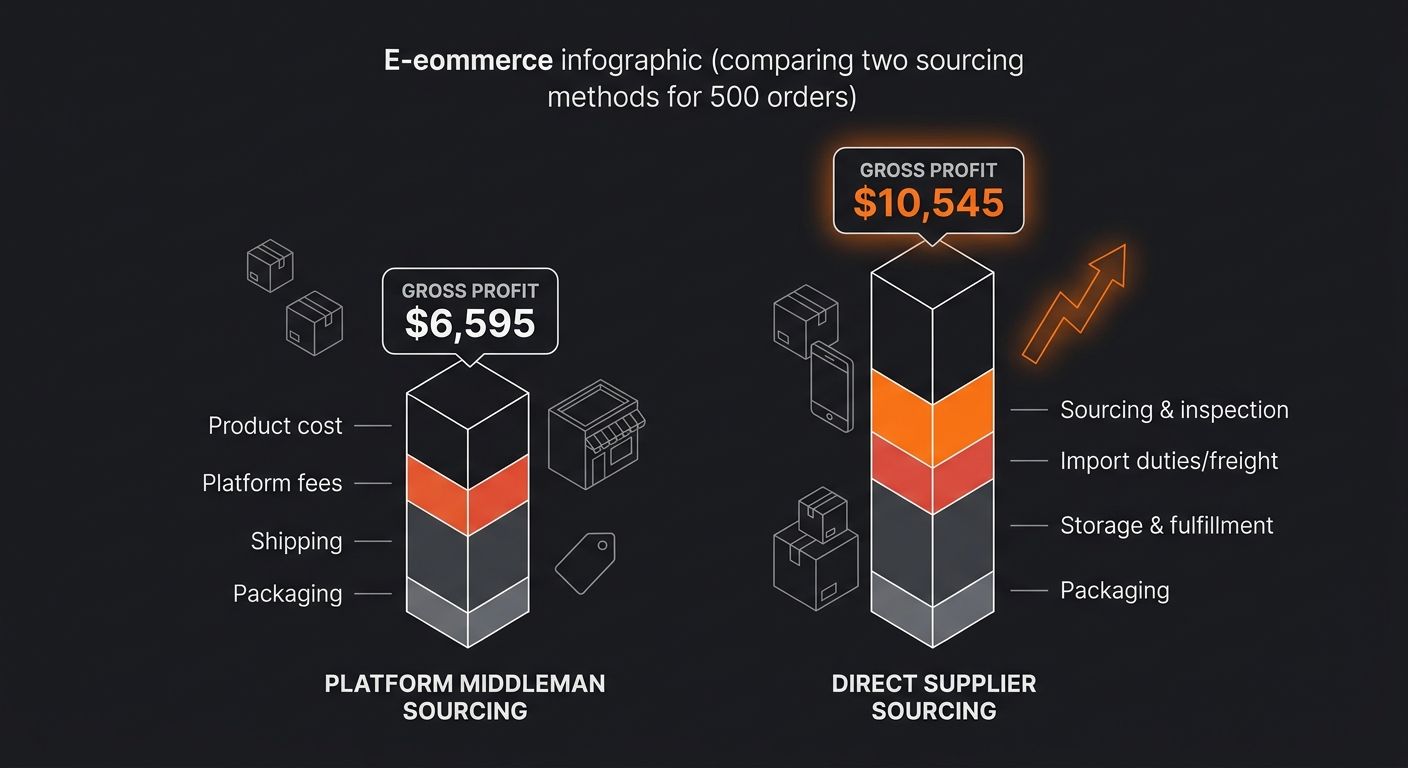
Let's run the numbers on a single SKU at 500 orders per month with a $29.99 retail price.
Platform middleman scenario:
Unit cost: $8.40 (platform-listed "wholesale" price)
Per-order fee: $3.00
Shipping to customer: $4.50 (platform rate)
Shopify transaction fee: ~$0.90
Total cost per order: $16.80
Gross profit per order: $13.19
Monthly gross profit: $6,595
Direct supplier scenario:
Unit cost: $4.80 (negotiated factory price at 500/month commitment)
Per-order fee: $0 (fulfilled from your 3PL inventory or supplier's warehouse)
Shipping to customer: $3.20 (your negotiated 3PL/ePacket rate)
Shopify transaction fee: ~$0.90
Total cost per order: $8.90
Gross profit per order: $21.09
Monthly gross profit: $10,545
That's $3,950 per month in additional gross profit on a single SKU. Over 12 months, $47,400. And this is before considering that higher margins give you more room to bid on ads—which means you can acquire customers your platform-dependent competitors literally can't afford to target.
According to Deloitte's 2025 Global Chief Procurement Officer Survey, 61% of procurement leaders said enhancing supplier collaboration and information sharing is the most effective strategy for cost reduction. That finding applies at enterprise scale, but the principle holds at $10K/month revenue too.
The Transition Costs Nobody Mentions
Switching from platform to direct isn't free, and pretending otherwise would be dishonest. There are real costs to this transition:
Time investment: Finding, vetting, and negotiating with a direct supplier takes 4–8 weeks of active work. That's time you're not spending on marketing or conversion optimization.
Sample costs: Budget $50–$150 across 3–5 suppliers to evaluate product quality before committing. If you're sourcing from multiple factories for different SKUs, this can hit $300+.
Minimum orders: Even flexible factories typically want a first order of 50–200 units. At $4–$8 per unit, you're putting $200–$1,600 into inventory upfront. That's a real cash flow difference from the zero-inventory platform model.
Communication overhead: Managing a direct supplier relationship means handling language barriers, time zone gaps, and production delays yourself. WeChat becomes a daily tool. If you're still in the early stages of learning the business, this complexity might be premature.
Quality control risk: Platforms provide a buffer. If a Spocket supplier ships garbage, you dispute it through the platform. With a direct supplier, your recourse depends entirely on the contract terms you negotiated upfront.
The breakeven point for most operators sits around 150–200 orders per month on a given SKU. Below that, the convenience and risk mitigation of a platform middleman is worth the margin hit. Above it, every month you stay on the platform is money left on the table.
Where the Numbers Land Today
The dropshipping cost landscape has shifted meaningfully since the AliExpress-connector era. Platform middlemen have gotten more expensive as they've added features, raised subscription tiers, and built their own logistics markup into pricing. Direct sourcing tools—from 1688.com translation plugins to AI-assisted supplier discovery—have gotten more accessible.
The operators pulling the best margins in mid-2026 run a hybrid model: 2–3 direct factory relationships for their core SKUs (60–80% of revenue), with platform fulfillment handling the long tail and new product tests. They treat supplier relationship management as a core business function, tracking supplier KPIs like defect rate, average fulfillment time, and communication responsiveness with the same rigor they apply to ROAS.
The hidden cost math isn't ambiguous anymore. On 500 monthly orders of a single product, the difference between platform and direct sourcing is roughly $47,000 per year in gross profit. Scale that across 3–5 SKUs and you're looking at the difference between a side hustle and a business that actually pays you. The suppliers are findable. The negotiation playbook exists. The only real question is whether your volume justifies the switch—and for most stores past the 200-order-per-month mark, it does.
365 Dropship Editorial
Editorial team writing about E-commerce, dropshipping, and product discovery — reviews of dropshipping suppliers and platforms, trending niche guides (jewelry, beauty, pets, home, fashion), supplier due diligence, ecom operations, shipping & fulfillment strategy, product research, AOV optimization, and profitable dropshipping case studies.
Explore more topics