The Supplier Exit Interview: Why Successful Dropshippers Document Their Handoff Process Before Selling
The typical dropshipping acquisition falls apart at supplier verification. Buyers audit ad accounts, Shopify analytics, and bank statements within days.
The Supplier Exit Interview: Why Successful Dropshippers Document Their Handoff Process Before Selling
The typical dropshipping acquisition falls apart at supplier verification. Buyers audit ad accounts, Shopify analytics, and bank statements within days. Supplier relationships, including contact details, payment terms, quality benchmarks, and reorder cadences, live in the operator's memory and almost never make it into the sale documentation.
The $50K Store That Couldn't Name Its Own Supply Chain
A seller on Reddit's r/SellMyBusiness posted a straightforward listing: a dropshipping store generating roughly $50,000 in annual profit, 10–20 hours of operator time per week, and a request for a "fair valuation." The community response was blunt. The business would command a higher multiple if it required 10 hours or fewer per week, and a lower one at 20 hours. But buried in the thread was a more damaging observation: no mention of supplier agreements, backup sourcing, or any written record of how products actually got from factory to customer.
This pattern repeats across virtually every dropshipping exit. And the valuation penalty is severe. Dropshipping store valuation multiples cluster between 2.0x and 3.0x monthly seller's discretionary earnings, as we've covered in our breakdown of why a $60K/month store might only sell for $130K. The difference between the bottom and top of that range often comes down to one factor: can a new owner run this business without the seller's personal relationships?
FE International, which brokers e-commerce exits, states it directly: "well-documented and detailed standard operating procedures" are what separates businesses that command premium multiples from those that don't. For dropshipping, the supplier layer is where SOPs matter most, because it's where the operator's institutional knowledge is densest and least transferable.
Five Categories of Knowledge That Vanish at Closing
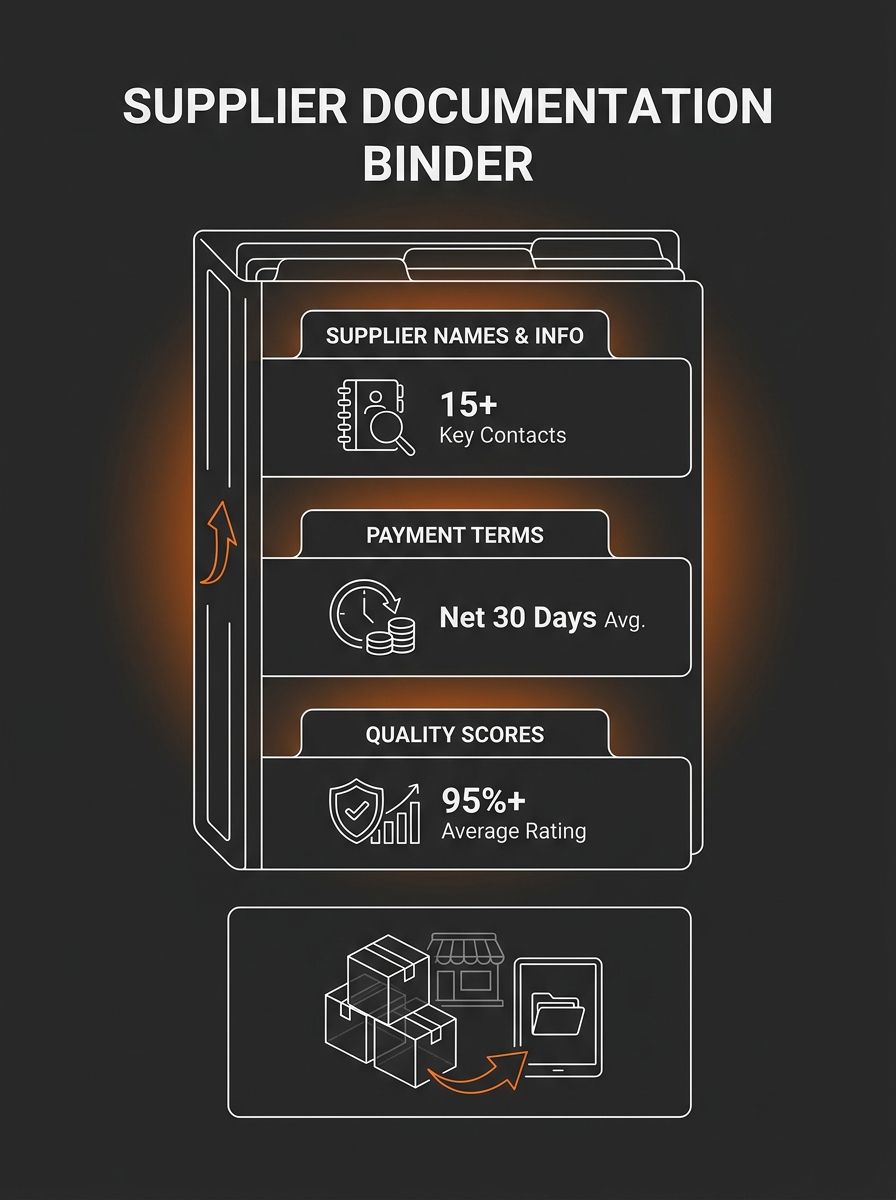
Why does supplier documentation create such a valuation gap? Because the information that matters most for day-to-day operations is the information sellers are least likely to write down. Here's what a buyer typically discovers is missing after the purchase closes:
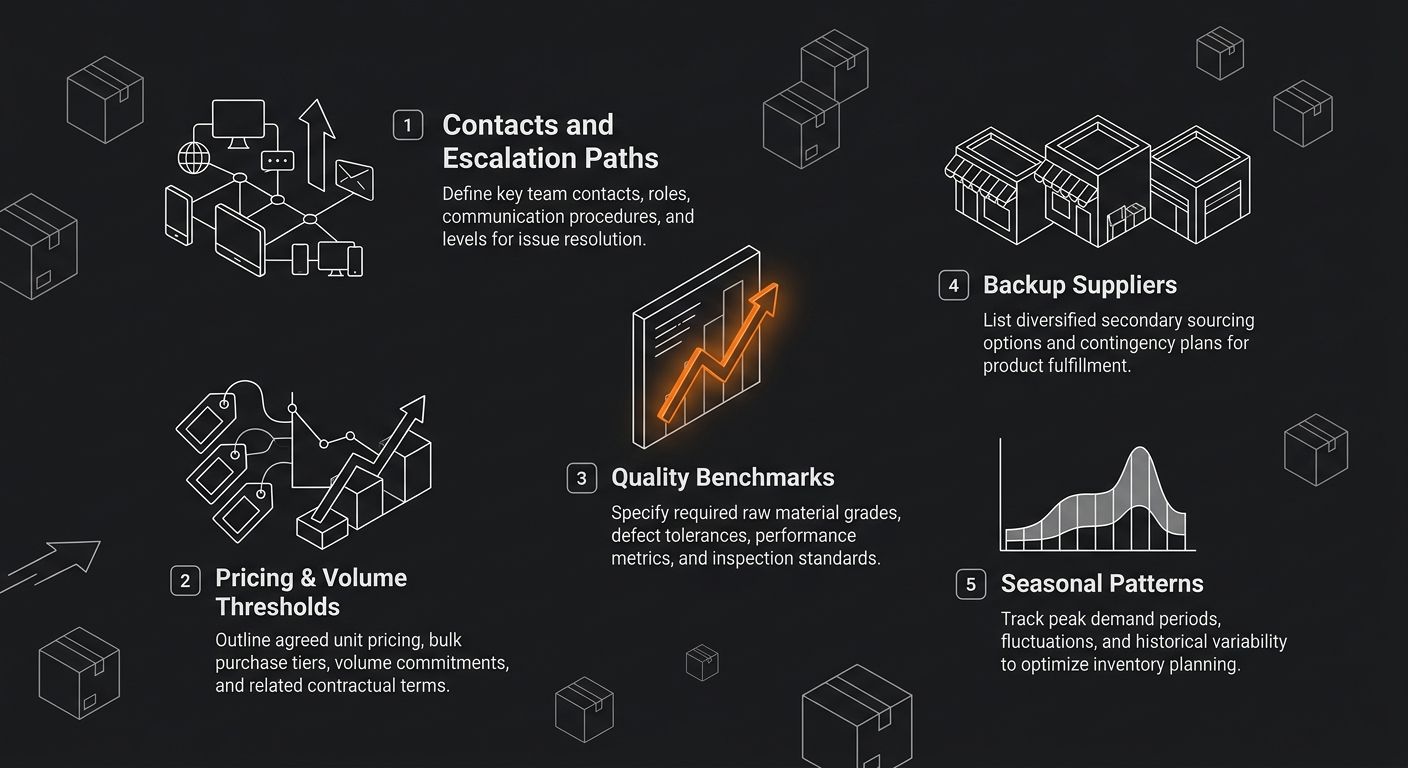
Primary contact and escalation paths. The seller messages "Amy" on WeChat when quality drops. Amy's real name, her role at the factory, and the factory's actual registered business name are nowhere in writing. If Amy leaves or the WeChat account changes, the buyer has no way to re-establish the relationship.
Negotiated pricing and volume thresholds. The seller pays $4.20 per unit because they negotiated down from $5.80 over 14 months of consistent ordering. The buyer inherits no record of this negotiation history, no written confirmation of current pricing, and no understanding of what volume keeps that price locked. According to Techspawn's 2026 supplier management playbook, supplier management inventory connects directly to stock counts and receipts. In dropshipping, "supplier stock data is the stock count." Without documented terms, a buyer can't forecast landed costs accurately.
Quality benchmarks and defect handling. The seller knows that Supplier A's defect rate runs around 3% and that they issue credits automatically for returns over $15. None of this is documented. The buyer has no baseline to measure supplier performance against and no precedent for dispute resolution. If you've already built a supplier quality matrix, you've solved this piece.
Backup supplier contacts. The seller tested two alternative suppliers and kept one as a backup. Those test results, the backup supplier's pricing, and the reasons the primary was chosen all disappear when the sale closes.
Seasonal ordering patterns. The seller knows to pre-order in September for the November rush because Supplier B's production lead time doubles during Q4. The buyer discovers this in November, when it's too late.
Every one of these gaps adds risk to the buyer's acquisition. And buyers price risk into their offers. A store requiring 20 hours per week of operator time commands a lower multiple partly because that time reflects undocumented knowledge that hasn't been systematized.
Anatomy of a Supplier Transition Playbook
A supplier transition playbook is a single document that a buyer can read in under an hour and use to manage every supplier relationship on day one. The format matters less than the coverage. Here's what it contains, per supplier:
Supplier identity block. Registered business name, country, primary contact name and role, communication channel (WeChat, WhatsApp, email), secondary contact if available, and payment method (PayPal, wire, platform escrow). If you've scored suppliers using a quality audit framework, attach the latest scores here.
Commercial terms. Current unit price, MOQ if applicable, payment terms (prepay vs. net-30), volume discount thresholds, and any written agreements or email confirmations of pricing. Include the date terms were last confirmed.
Operational cadence. Average order-to-ship time, typical shipping method, tracking number format, and the expected delivery window to your primary customer markets. If you've already analyzed shipping costs against your margins, include those numbers per supplier.
Quality and returns. Historical defect rate (even a rough estimate), the process for reporting defects, refund or credit policy, and any quality inspection steps you perform before or after shipment.
Risk notes. Any known issues: inconsistent packaging, seasonal slowdowns, communication blackout periods (Chinese New Year, for example), past disputes, or near-misses where you almost switched suppliers.
The playbook isn't a marketing document. It should include the uncomfortable details. If Supplier C has been late on 4 of the last 20 orders, write that down. If you're only keeping Supplier D because switching costs are high, say so. Buyers who discover these issues post-sale feel misled. Buyers who see them documented upfront adjust their offer accordingly but proceed with confidence.
EPROLO's exit strategy guide reinforces this: settling outstanding obligations and documenting supplier commitments before the sale ensures a cleaner transition. Rocketlane's 2026 handoff research, while focused on SaaS customer success teams, found the same dynamic: unclear handoffs lead to delays and duplicate work, and the fix is "a structured handoff document that captures the same information categories on every deal." New store owners inheriting undocumented supplier relationships repeat the seller's learning curve from scratch, burning weeks of margin in the process.
The Valuation Arithmetic of a Clean Handoff
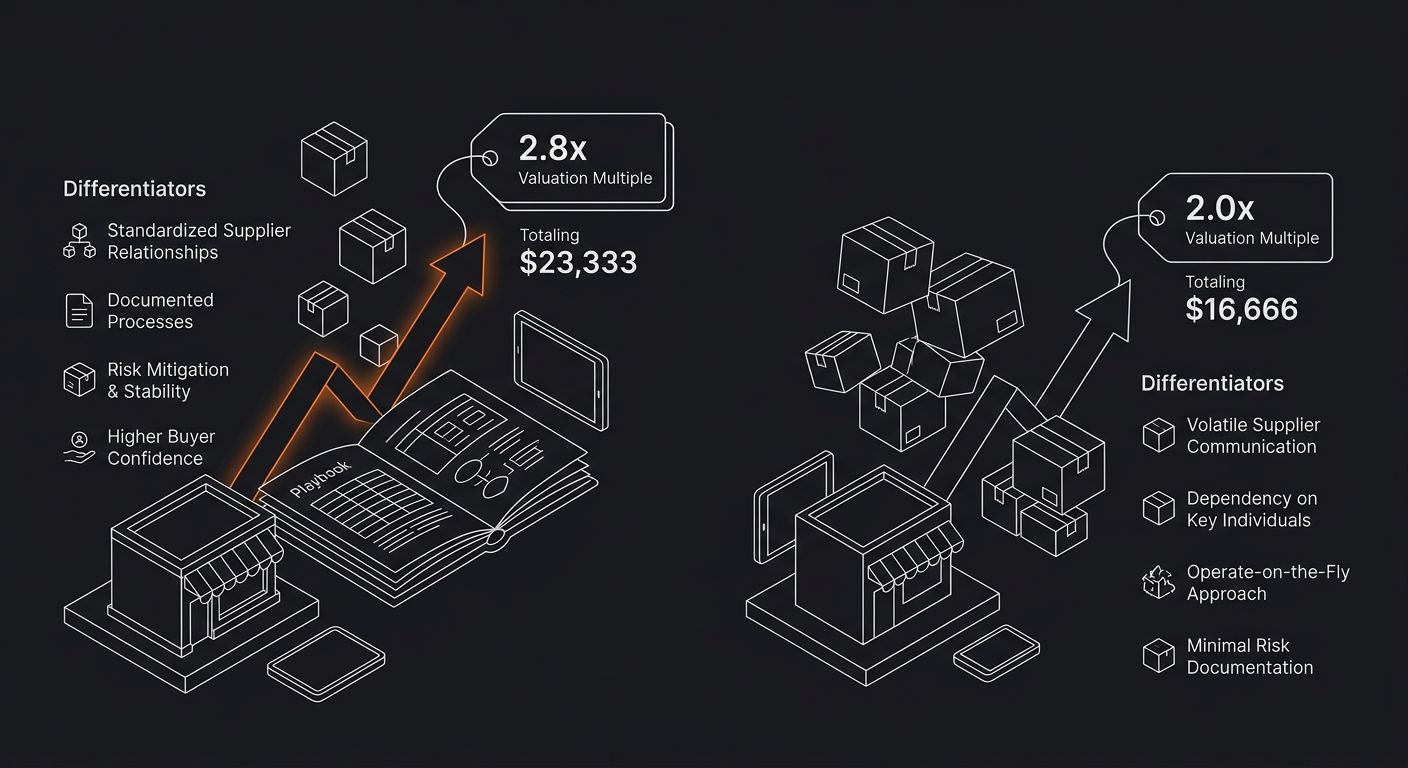
Put dollar amounts on this. A dropshipping store doing $8,000/month in SDE sits in a typical valuation range of $16,000 to $24,000 at 2.0x to 3.0x monthly earnings. The difference between a 2.0x and 2.8x multiple on that store is $6,400.
What pushes you from 2.0x toward 2.8x? Reduced operator dependency. Simpler operations with automated processes command higher multiples, as Supliful's acquisition guide notes, because businesses requiring lower management intensity "are more valuable than those requiring intensive management."
A supplier transition playbook directly reduces that dependency. When the buyer can contact the right person at each supplier, confirm pricing without renegotiating, and handle quality issues using documented procedures, the store runs without the seller's involvement. If your playbook saves the buyer 5–8 hours per week of supplier management learning, you've moved the operator time requirement from 20 hours down to 12–15. That shift alone can push a valuation from the bottom of the range toward the middle.
The reverse is also true. Transitions during peak operational stress go badly, per Techspawn's analysis. The longer the delay in documenting supplier relationships, the more painful the handoff becomes. Sellers who wait until a buyer is already in due diligence find themselves scrambling to reconstruct pricing histories, contact details, and ordering patterns from memory. The quality of that rushed documentation is predictably poor.
What the Reddit Seller Left on the Table
The $50K-profit store on r/SellMyBusiness had a viable business. Profitable operations, proven product-market fit, established supplier relationships developed over months of consistent ordering. But without buyer handoff documentation for the supplier layer, the listing forced buyers to value it as a high-risk acquisition where the new owner would need to reverse-engineer every supplier relationship from scratch, renegotiate pricing without historical context, and handle quality issues without knowing the baseline defect rates.
At 2.0x monthly SDE (approximately $4,167 per month from $50K annual profit), that store traded at roughly $8,334. At 2.8x with a clean operator exit strategy package including SOPs, a supplier transition playbook, and documented automations, it could have traded closer to $11,667. That $3,333 difference represents money the seller could have captured by spending 10–15 hours writing down what they already knew.
The operator exit strategy for dropshipping stores isn't complicated. You're documenting relationships, pricing, and processes that feel obvious because you've lived them daily. But buyers haven't lived them. And every hour you don't spend on documentation gets priced into a lower offer. The stores that sell at the top of their valuation range are the ones where the buyer's first week looks like following a manual, not conducting an investigation.
365 Dropship Editorial
Editorial team writing about E-commerce, dropshipping, and product discovery — reviews of dropshipping suppliers and platforms, trending niche guides (jewelry, beauty, pets, home, fashion), supplier due diligence, ecom operations, shipping & fulfillment strategy, product research, AOV optimization, and profitable dropshipping case studies.
Related Articles
The Exit Math: Why Your $60K/Month Store Might Only Sell for $130K (And How to Fix It Before Buyers Walk)
Dropshipping business valuation multiples cluster between 2.0x and 3.0x monthly seller's discretionary earnings (SDE), and two stores in the same niche can trade 1.0x+ apart based on risk profile and operational quality alone.
From Pandemic Pivot to Profitable Store: The Untold Operations Lessons Behind 2020-2026 Dropshipping Success Stories
COVID-era ecommerce operators who survived past 2022 share a pattern that has nothing to do with finding the right product or running the right ad. The pattern is operational: supplier onboarding speed, cash flow reinvestment discipline, and fulfillment consolidation.
5 Supplier Communication Failures That Collapse Margins Mid-Campaign (And the SOP to Fix Each One)
Sixty percent of dropshipping stores that attempt to scale fail due to supply chain instability—inventory gaps, cost swings, quality drift—according to Spocket's analysis of DSers data.
Explore more topics