Shopee App Reviews: Features & User Ratings
Shopee, Lazada, and Shopify with the Shopee Reviews integration give Southeast Asian sellers three distinct paths to collect, display, and capitalize on buyer feedback. The central tradeoff: marketplace reach versus logistics reliability versus brand ownership.
Shopee App Reviews: Features, User Ratings, and How It Stacks Up
Shopee, Lazada, and Shopify with the Shopee Reviews integration give Southeast Asian sellers three distinct paths to collect, display, and capitalize on buyer feedback. The central tradeoff: marketplace reach versus logistics reliability versus brand ownership.
How This Comparison Works
I'm evaluating these three options across five criteria that matter to operators running sub-$1M ecommerce brands in Southeast Asia: review system quality, buyer trust signals, seller control over feedback, cost structure, and logistics reliability. Platforms like Tokopedia (Indonesia-only) and TikTok Shop (different business model entirely) are excluded to keep the comparison tight and actionable.
Shopee Marketplace: Massive Buyer Pool, Messy Reputation
Shopee is the default marketplace for sellers targeting Southeast Asia's 700M+ consumer base, and shopee app reviews from both buyers and sellers reveal a platform with a sophisticated review engine sitting on top of unreliable infrastructure.
The platform's 2026 algorithm update, internally called "Veritas Core," shifted review weighting from simple star counts to semantic depth, recency, and verifiability. Review recency is now weighted 3.2× more heavily than in prior versions. Generic "good product" feedback gets suppressed in search rankings, while reviews containing specific details receive 41% higher trust scoring from the algorithm. Video reviews carry 2.3× more algorithmic weight than photo reviews and 4.1× more than text-only feedback, provided they're uploaded natively through the app.
For sellers, the operational impact is measurable. Top-performing Shopee sellers report average order value increases of 27% and return rate drops of 14% when they actively curate their review profiles. Replying only to neutral and negative reviews increases perceived authenticity by 32% compared to responding to every positive review, a counterintuitive tactic that the algorithm now rewards.
Dr. Linh Tran, Head of Platform Integrity at Shopee SEA, stated that the 2026 system "doesn't reward volume, it rewards verifiability." A single review with timestamped photos and location-tagged metadata carries more algorithmic weight than ten text-only reviews.
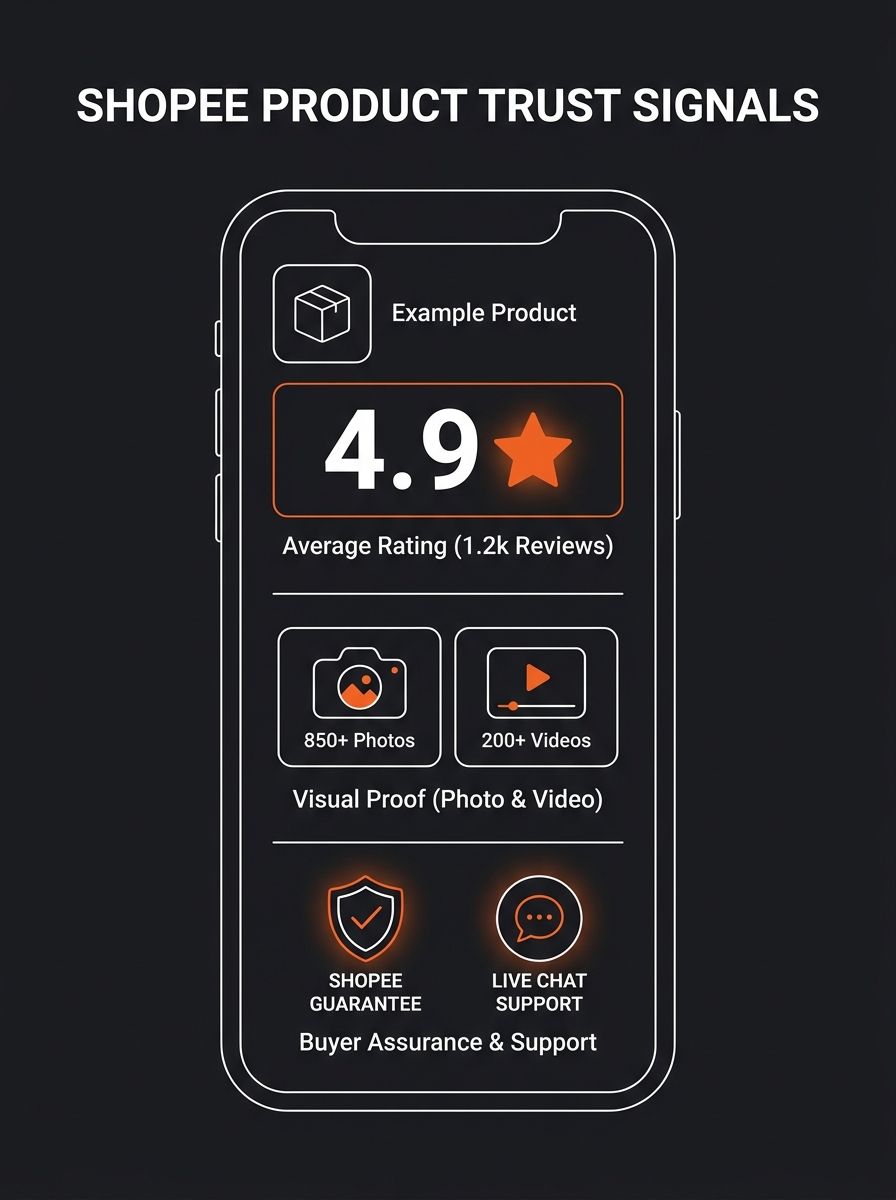
Shopee also offers a Guarantee feature that holds buyer payments in escrow until items arrive in acceptable condition, with full refunds issued for damaged goods. The platform's live chat lets buyers ask product questions, negotiate prices, and get personalized support before purchasing, which reduces return-driven negative reviews when sellers use it proactively.
But the platform-level reputation tells a different story. Shopee sits at a 1.6 out of 5 on Trustpilot, with recurring complaints about delayed deliveries, unexplained account bans, and sudden order cancellations. Users describe orders showing "delivery soon" in the morning, then receiving cancellation notices by nightfall. Other buyers report accounts banned without clear notification, with the platform citing vague policy violations during appeals.
The tradeoff: Shopee gives you access to the largest buyer pool in Southeast Asia with a sophisticated review algorithm, but you're building on a platform where the infrastructure regularly frustrates both sides of every transaction. And you own none of the review data you accumulate.
Lazada: Stronger Logistics, Simpler Review System
Lazada, backed by Alibaba, competes directly with Shopee across the same six core Southeast Asian markets. Its review system operates differently, and the fulfillment backbone gives sellers an edge that Shopee's algorithm sophistication can't offset.
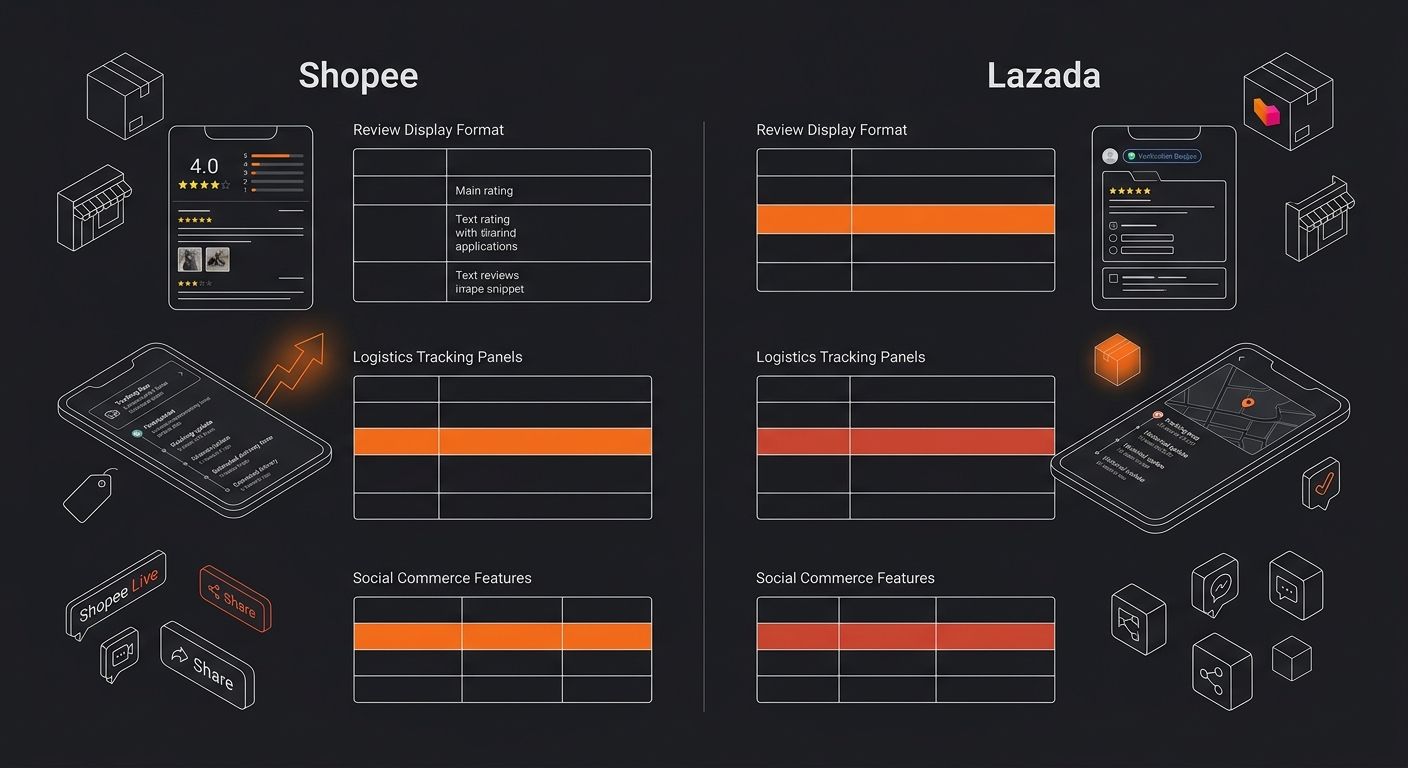
Where Shopee built growth on social commerce features, gamification, live-streaming, and social sharing of product listings, Lazada invested in warehouse networks and last-mile delivery systems. This directly reduces the "arrived damaged" and "took ages to deliver" complaints that tank seller ratings on Shopee. For operators who've dealt with verifying supplier tracking numbers across multiple platforms, Lazada's logistics transparency stands out.
Lazada's review algorithm is simpler. There's no "Veritas Core" equivalent weighting reviews by semantic depth. Ratings prioritize recency and verified purchase status, which means gaming the system is easier, but so is maintaining a clean score without sophisticated review management workflows. Both platforms are expanding rapidly across Southeast Asia while focusing on localized shopping experiences, but Shopee's in-app engagement metrics consistently outperform Lazada's.
The social commerce gap matters for specific categories. Shopee's live chat integration, social sharing tools, and in-app entertainment features drive impulse purchases in fashion, beauty, and accessories. Lazada performs better in electronics and home goods where buyers research before purchasing and delivery reliability weighs heavier than social discovery.
Cost structures run parallel: both charge commission rates between 2-5% depending on product category, with promotional placement fees layered on top. The meaningful difference shows up in dispute rates. Lazada's tighter logistics control generates fewer delivery-related disputes, which means less time managing negative reviews and fewer store score penalties.
If you're running a dropshipping operation where you don't control fulfillment speed, Shopee's review algorithm will punish you harder. Late-delivery complaints get semantically weighted against your store score under Veritas Core, while Lazada's simpler system treats them as individual incidents without compounding penalties.
Shopify + Shopee Reviews App: Own Your Social Proof
The Shopee Reviews Shopify app sidesteps the marketplace model entirely. It imports authentic buyer reviews from your Shopee listings directly onto your Shopify store, giving you social proof without marketplace dependency.
This approach solves the fundamental problem with selling exclusively on Shopee or Lazada: you don't own the customer relationship or the review data. When you build on a marketplace, every five-star review strengthens the marketplace's brand. The Shopee Reviews app flips that equation by pulling verified buyer feedback into a storefront you control, with one-click filters to curate which reviews display and a no-code design that works across all Shopee regions.
The mechanics are straightforward. The app syncs reviews from your Shopee seller account, displays them on Shopify product pages with original photos and ratings, and updates automatically as new reviews come in. You control the presentation layer, which reviews appear, how they're styled, where they sit relative to your add-to-cart button.
For operators already sourcing through AliExpress suppliers, this hybrid model makes strategic sense. You maintain a Shopee presence to tap into marketplace traffic and accumulate reviews, then funnel that credibility to your own Shopify store where you capture customer emails, control checkout, and keep margins higher without 2-5% marketplace commission on every sale.
The tradeoff: you're paying for two platforms. Shopify plans start at $39/month, and you still need active Shopee listings generating fresh reviews to keep the pipeline flowing. You also need to drive your own traffic to Shopify. The marketplace sends zero buyers your way. If you're evaluating which app tools actually move the needle for store operations, the Shopee Reviews app is lightweight (it does one thing well) but requires the surrounding Shopify ecosystem to deliver value.
Side-by-Side Breakdown
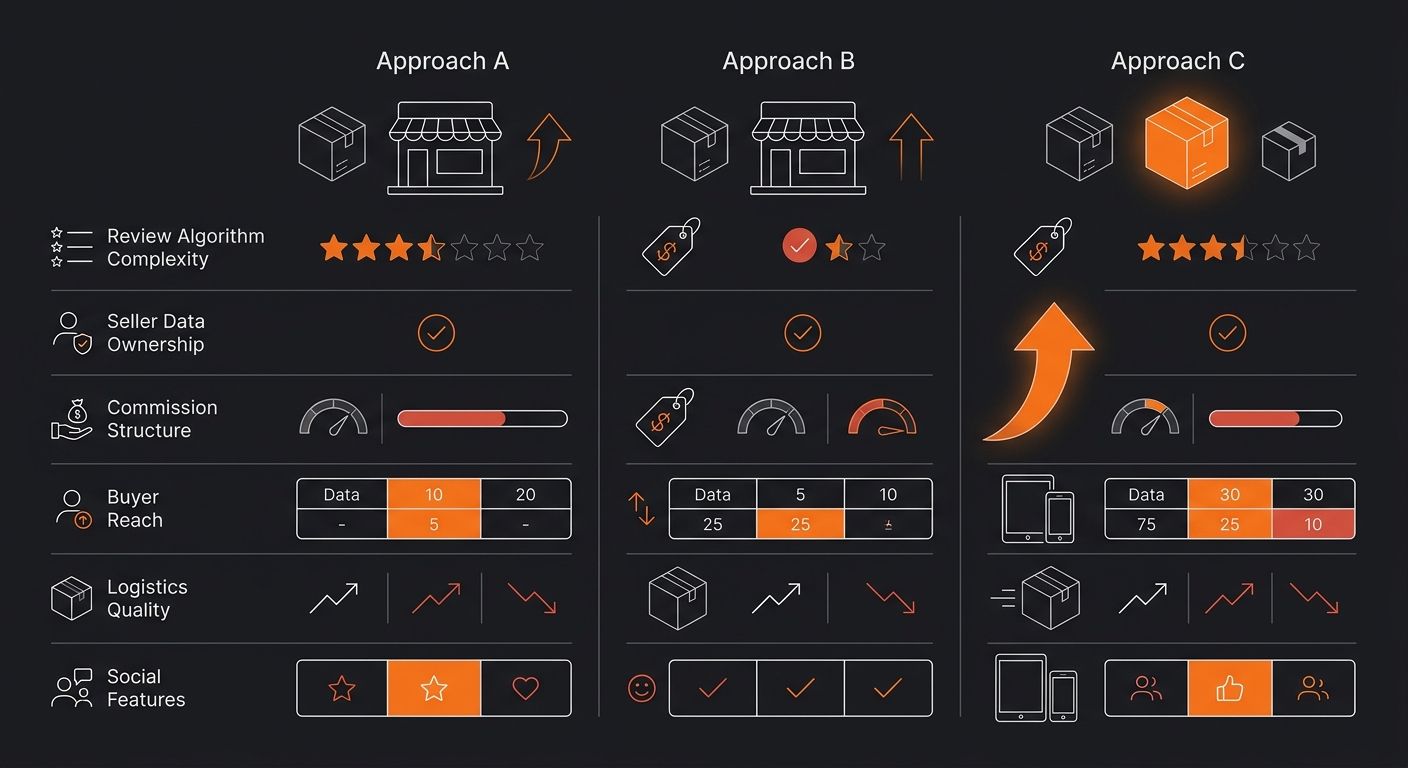
Attribute | Shopee Marketplace | Lazada | Shopify + Shopee Reviews |
|---|---|---|---|
Buyer Reach | Largest in SEA (700M+ consumer base) | Second-largest; strong in ID, TH, PH | Zero built-in traffic; you drive it |
Review Algorithm | Semantic depth, recency (3.2× weight), video priority (2.3× photo) | Recency + verified purchase; simpler weighting | Imports Shopee reviews; no independent algorithm |
Seller Control Over Reviews | Low, platform owns all data | Low, platform owns all data | High, you filter, style, and display |
Commission Fees | 2-5% + promo fees | 2-5% + promo fees | $0 marketplace commission; Shopify $39-399/mo |
Logistics Reliability | Variable; 1.6/5 Trustpilot; frequent delivery complaints | Stronger; own warehouse + last-mile network | Depends on your 3PL setup |
Social Commerce Features | Live chat, gamification, social sharing, live-streaming | Basic engagement tools | None native; add via Shopify apps |
Best For | Volume-first sellers targeting SEA marketplace traffic | Sellers prioritizing delivery reliability and lower dispute rates | DTC brands building owned audiences with imported social proof |
Who Should Pick Which
Sell on Shopee if your primary goal is volume and you're prepared to invest in review optimization under Veritas Core. You need video reviews, strategic response patterns (neutral/negative only for that 32% authenticity boost), and acceptance that you're renting your storefront. This path works best when you have reliable suppliers who can guarantee consistent quality and shipping timelines, because the algorithm compounds fulfillment failures through review sentiment analysis. Expect to spend 3-5 hours per week on review management once you're past 50 orders/day.
Sell on Lazada if logistics reliability matters more than social commerce features. Your review management burden will be lighter, your dispute rate lower, and your operational costs comparable. You sacrifice Shopee's engagement tools and a slightly smaller buyer pool, but you gain consistency in delivery performance. That consistency compounds in review scores over time, especially for categories like electronics and home goods where one "arrived damaged" review can tank conversion for weeks.
Run Shopify + Shopee Reviews if you're building a brand with actual equity, not a marketplace listing that disappears when the algorithm shifts. This is the only option where you own the customer relationship, the review display, and the email list. The cost is higher (Shopify subscription plus traffic acquisition), and you need an active Shopee presence feeding the review pipeline. But every dollar you spend protecting your margins goes further when you're not paying marketplace commission on every transaction.
The realistic path for most operators: start on Shopee to accumulate reviews and validate product-market fit in Southeast Asia, then migrate your best-performing SKUs to Shopify with imported reviews once you've proven demand. You get marketplace distribution for discovery and owned infrastructure for margin. Running both simultaneously for 60-90 days gives you enough data to know which SKUs justify the migration cost.

Ryan Torres
Ryan Torres is a former Amazon FBA seller turned dropshipping consultant who has generated over $2.8M in ecommerce revenue across 14 product launches. He specializes in supplier vetting, margin optimization, and scaling DTC operations for sub-$1M brands. Ryan focuses on actionable frameworks that drive measurable results for independent operators.
Frequently Asked Questions
- What is Shopee's 2026 review algorithm update and how does it affect seller ratings?
- Shopee's 2026 "Veritas Core" algorithm shifted review weighting from simple star counts to semantic depth, recency, and verifiability. Review recency is now weighted 3.2× more heavily, video reviews carry 2.3× more weight than photo reviews, and reviews with specific details receive 41% higher trust scoring than generic feedback.
- How does Shopee compare to Lazada for ecommerce sellers in Southeast Asia?
- Shopee offers the largest buyer pool (700M+ consumers) and a sophisticated review algorithm but has a 1.6/5 Trustpilot rating with frequent delivery complaints. Lazada has stronger logistics infrastructure and fewer delivery-related disputes, making it better for sellers prioritizing fulfillment reliability, though it has a simpler review system and smaller buyer reach.
- What is the Shopee Reviews Shopify app and how does it work?
- The Shopee Reviews app imports verified buyer reviews from your Shopee listings directly onto your Shopify store, giving you control over which reviews display and how they're styled. This lets you build an owned storefront with authentic social proof while bypassing marketplace dependency.
- Does replying to all reviews help or hurt your Shopee store rating?
- Replying only to neutral and negative reviews increases perceived authenticity by 32% compared to responding to every positive review, a tactic that Shopee's algorithm now rewards as it prioritizes verifiability over volume.
- What are the commission rates on Shopee and Lazada marketplaces?
- Both Shopee and Lazada charge commission rates between 2-5% depending on product category, with additional promotional placement fees layered on top.
- Should I use the Shopee Reviews app if I'm a new seller?
- The Shopee Reviews app works best as a secondary strategy after you've accumulated reviews on Shopee. It requires maintaining an active Shopee presence to feed the review pipeline and you must drive your own traffic to Shopify, making it more suitable for brands ready to invest in owned infrastructure rather than pure marketplace volume.
- What is Shopee's policy on incentivized reviews and review solicitation?
- Shopee's 2026 Trust Policy explicitly penalizes external review solicitation via SMS or WhatsApp, and "review for reward" language risks account suspension. Lazada enforces similar rules but with less algorithmic detection.
Related Articles
Why Your Product Reviews Are Generating Clicks But Not Sales: The Trust Gap Between Star Ratings and Purchase Intent
Products with a flawless 5.0-star average convert at lower rates than those rated between 4.0 and 4.7 stars, according to Spiegel Research Center data.

Honest Product Reviews for Dropshipping Stores: The Testing Protocol That Builds Customer Trust Without Fake Social Proof
Buying reviews will tank your store's conversion rate faster than having no reviews at all. An estimated 30% of online reviews across ecommerce are fake, and shoppers have learned to spot them. Purchased testimonials signal that your store can't earn real ones, and that inference kills sales.
The Review Generation Trap: Why Fake Social Proof Is Tanking Your Conversion Rate (And How Successful Dropshippers Build Authentic Feedback Loops)
Northwestern University's Spiegel Research Center produced a finding that should have killed the fake-review industry on the spot: products rated between 4.2 and 4.5 stars convert at higher rates than products sitting at a perfect 5.0. The implication was plain. Shoppers don't trust perfection.
Explore more topics