TrendingMediaBuzz Publishes 12-Supplier DTF Printing Comparison Highlighting No-Minimum Options and Same-Day Production Windows
TrendingMediaBuzz published a wholesale DTF printing supplier comparison on August 20 covering 12 companies serving apparel brands, with findings highlighting no-minimum ordering policies at Ninja Transfers, Upload Transfers, and DTF Transfers Wholesale, and same-day production capabilities at San A
TrendingMediaBuzz Publishes 12-Supplier DTF Printing Comparison Highlighting No-Minimum Options and Same-Day Production Windows
TrendingMediaBuzz published a wholesale DTF printing supplier comparison on August 20 covering 12 companies serving apparel brands, with findings highlighting no-minimum ordering policies at Ninja Transfers, Upload Transfers, and DTF Transfers Wholesale, and same-day production capabilities at San Antonio-based LoneStar DTF, according to the roundup. The comparison positions DTF (Direct-to-Film) transfers as a fulfillment option for clothing brands, print shops, and apparel businesses evaluating alternatives to screen printing or traditional heat transfer vinyl.
Company Differentiation Centers on Order Minimums and Production Speed
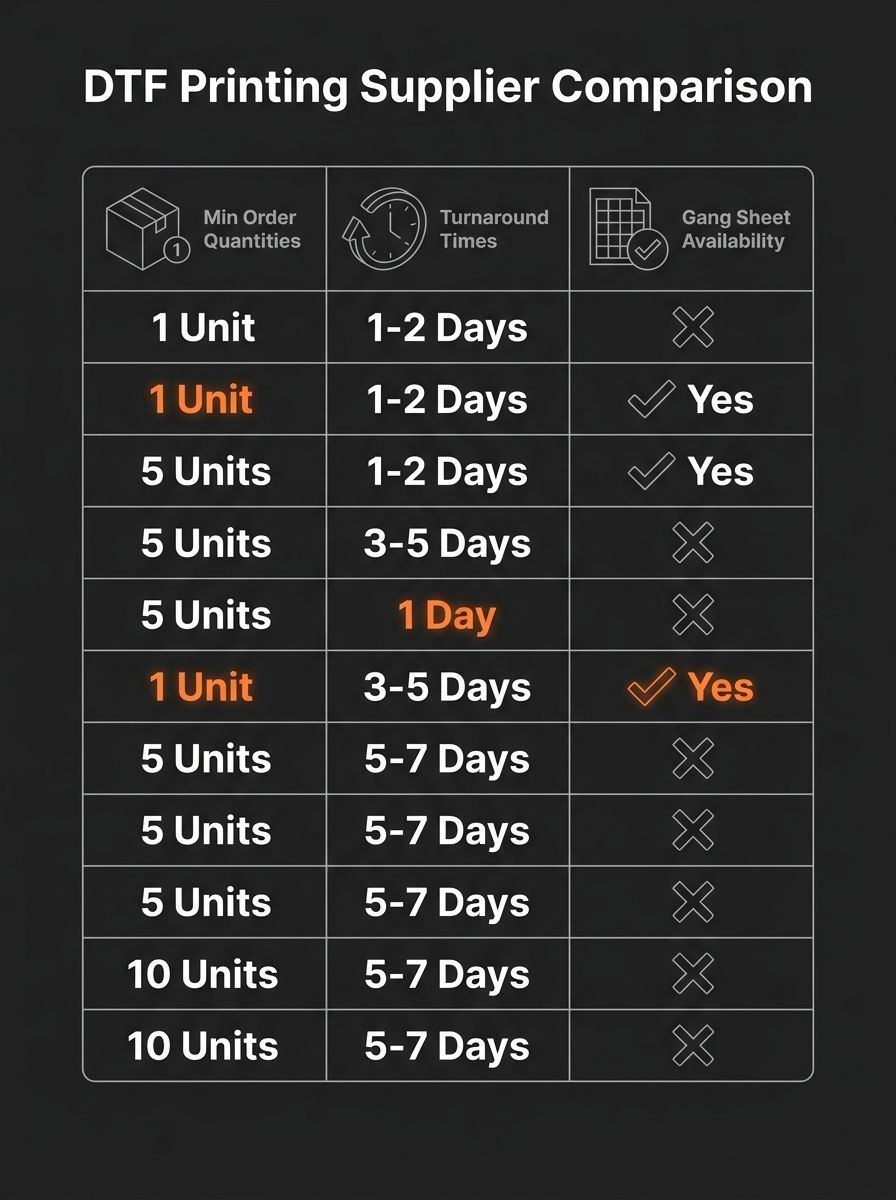
The comparison positions suppliers across four primary differentiators: minimum order quantities, turnaround windows, gang sheet pricing structures, and wholesale tier eligibility. No-minimum ordering emerged as a key filter, with Ninja Transfers, Upload Transfers, and DTF Transfers Wholesale all eliminating quantity floors. LoneStar DTF, operating from San Antonio, advertises same-day production for qualifying orders, the comparison shows. Transfer Express, in operation since 1990, anchors its offering in UltraColor Max DTF transfers supporting full-color graphics and gang sheet consolidation.
Gang sheet options—which allow multiple designs to be printed on a single transfer sheet—appeared across nine of the 12 suppliers reviewed. The roundup frames gang sheets as a cost-reduction mechanism for brands managing multiple SKUs, noting that consolidating designs maximizes material usage and lowers per-design costs. DTFS provides white-label fulfillment alongside bulk production, positioning it for brands scaling without in-house DTF equipment investment. Printful integrates DTF printing into its broader print-on-demand infrastructure, supporting cotton, polyester, and blended fabrics within an existing order-fulfillment workflow.
The roundup segments suppliers by business model: trade-only wholesale (DTF Print Co), premium garment decorator support (Supacolor), online-first ordering (Upload Transfers), and integrated POD ecosystems (Printful). FM Expressions is noted for combining decades of screen-printing experience with DTF production capacity, targeting bulk buyers. Axo Transfers focuses on resellers and apparel businesses ordering larger quantities, with bulk pricing tiers designed for volume purchasers.
Pricing Structures Vary by Volume Tier and Gang Sheet Efficiency
The comparison does not publish specific per-transfer pricing but identifies wholesale tiers, gang sheet discounts, and repeat-order pricing as primary cost levers. The roundup advises calculating total cost per finished transfer by including shipping, gang sheet efficiency, application time, and potential waste. Domestic production is flagged as a consideration for brands prioritizing faster U.S. delivery, with "American DTF companies" positioned as preferable when domestic sourcing aligns with turnaround requirements, the analysis states.
NextDayDTF and LoneStar DTF both emphasize quick production windows, the former marketing ready-to-press DTF transfers for the custom apparel market and the latter advertising same-day production. The comparison frames turnaround speed as a competitive differentiator for businesses managing tight customer deadlines or flash sales. Transfer Express's 34-year operating history is cited as an indicator of established production capabilities and transfer expertise, contrasting with newer entrants focused on speed-to-market.
For apparel-focused dropshipping operations, the roundup positions DTF transfers as a test-before-scale option. The no-minimum policies at three suppliers lower the barrier to SKU testing, while gang sheet options reduce the cost penalty of running multiple designs simultaneously. DTFS's white-label fulfillment is framed as relevant for merchants outsourcing production entirely, similar to how Gelato and Printful operate in the broader print-on-demand category.
Fabric Compatibility and Wash Durability Highlighted as Pre-Order Tests
The comparison recommends ordering samples before committing to large production runs, with specific testing criteria: color consistency, wash durability, application temperature, and turnaround time accuracy. DTF transfers are noted for compatibility across cotton, polyester, and blended fabrics, with adhesion quality varying by supplier. The roundup states that selecting a supplier based on price alone risks quality inconsistencies, particularly for brands with repeat customers sensitive to print durability.
Miami-based DTF Transfers Wholesale and DTF Print Co both emphasize trade-only wholesale models, restricting sales to print shops and apparel businesses rather than direct-to-consumer buyers. Supacolor is positioned as serving professional garment decorators with dedicated support infrastructure and wholesale pricing designed for established production workflows. The comparison frames these distinctions as relevant for businesses evaluating whether a supplier's target market aligns with their own order volume and quality expectations.
Reading Between the Lines
The DTF supplier landscape mirrors the broader print-on-demand consolidation pattern: established players with decades of transfer experience competing against speed-focused entrants offering no-minimum policies and same-day turnaround. For apparel dropshippers, the key operator question is whether DTF fits a test-before-scale model (low minimums, gang sheets for multi-SKU testing) or a scaled fulfillment model (white-label partners, wholesale tiers). Ninja Transfers, Upload Transfers, and DTF Transfers Wholesale all eliminate the minimum-order barrier, making them structurally similar to how AliExpress dropshipping allows single-unit testing before bulk orders.
The same-day production window at LoneStar DTF positions it for flash-sale or event-driven apparel campaigns where lead time compression matters more than per-unit cost. That capability sits opposite the wholesale-tier model at FM Expressions and Axo Transfers, which reward volume buyers with pricing discounts but require higher order quantities. The trade-only restriction at DTF Print Co and Supacolor signals a different customer profile—print shops purchasing transfers for resale rather than DTC brands fulfilling their own inventory.
Printful's DTF integration is the strategic wildcard: it allows existing POD merchants to add DTF-printed items without switching platforms, but the per-unit economics likely trail dedicated DTF wholesalers at higher volumes. The practical test for any apparel operator is calculating landed cost per finished transfer (including shipping, application labor, and waste) across suppliers, then stress-testing wash durability and color consistency with sample orders before scaling. No-minimum suppliers lower the cost of that testing phase; wholesale-tier suppliers reward the brands that graduate from testing into repeatable volume.

Ryan Torres
Ryan Torres is a former Amazon FBA seller turned dropshipping consultant who has generated over $2.8M in ecommerce revenue across 14 product launches. He specializes in supplier vetting, margin optimization, and scaling DTC operations for sub-$1M brands. Ryan focuses on actionable frameworks that drive measurable results for independent operators.
Related Articles

Printful's 479-Product Catalog Outweighs Tapstitch's Apparel Quality Edge in New POD Platform Comparison
Printful's 479-product catalog spanning apparel, home decor, and accessories gives it a decisive edge over Tapstitch's 400-blank apparel-only range despite Tapstitch's vertically integrated quality advantage in streetwear fulfillment, according to a platform comparison published July 8 by Ecommerce-
Printify: Complete App Review & Guide
Printify is a print-on-demand marketplace that routes your orders to a network of over 100 independent print providers who manufacture and ship products under your brand.

Printful vs Printify: Which Platform Wins
Printful and Printify completed a corporate merger but still operate as separate platforms with independent pricing, fulfillment networks, and dashboards. POD sellers face three real paths: Printful for brand control, Printify for margin, or a hybrid splitting the catalog across both.
Explore more topics