Racklify Publishes Shopify Markets Setup Guide Covering Multi-Currency Configuration and Tax Display Rules for Cross-Border Sellers
Racklify published a Shopify Markets configuration guide on September 9, 2026, documenting localization features that allow merchants to manage international storefronts, multi-currency pricing, and duty display from a single Shopify admin, according to the warehouse logistics platform's encyclopedi

Racklify Publishes Shopify Markets Setup Guide Covering Multi-Currency Configuration and Tax Display Rules for Cross-Border Sellers
Racklify published a Shopify Markets configuration guide on September 9, 2026, documenting localization features that allow merchants to manage international storefronts, multi-currency pricing, and duty display from a single Shopify admin, according to the warehouse logistics platform's encyclopedia entry. The guide addresses operational friction faced by Shopify merchants expanding beyond domestic markets without launching separate stores per country.
What Shopify Markets Controls From a Single Dashboard
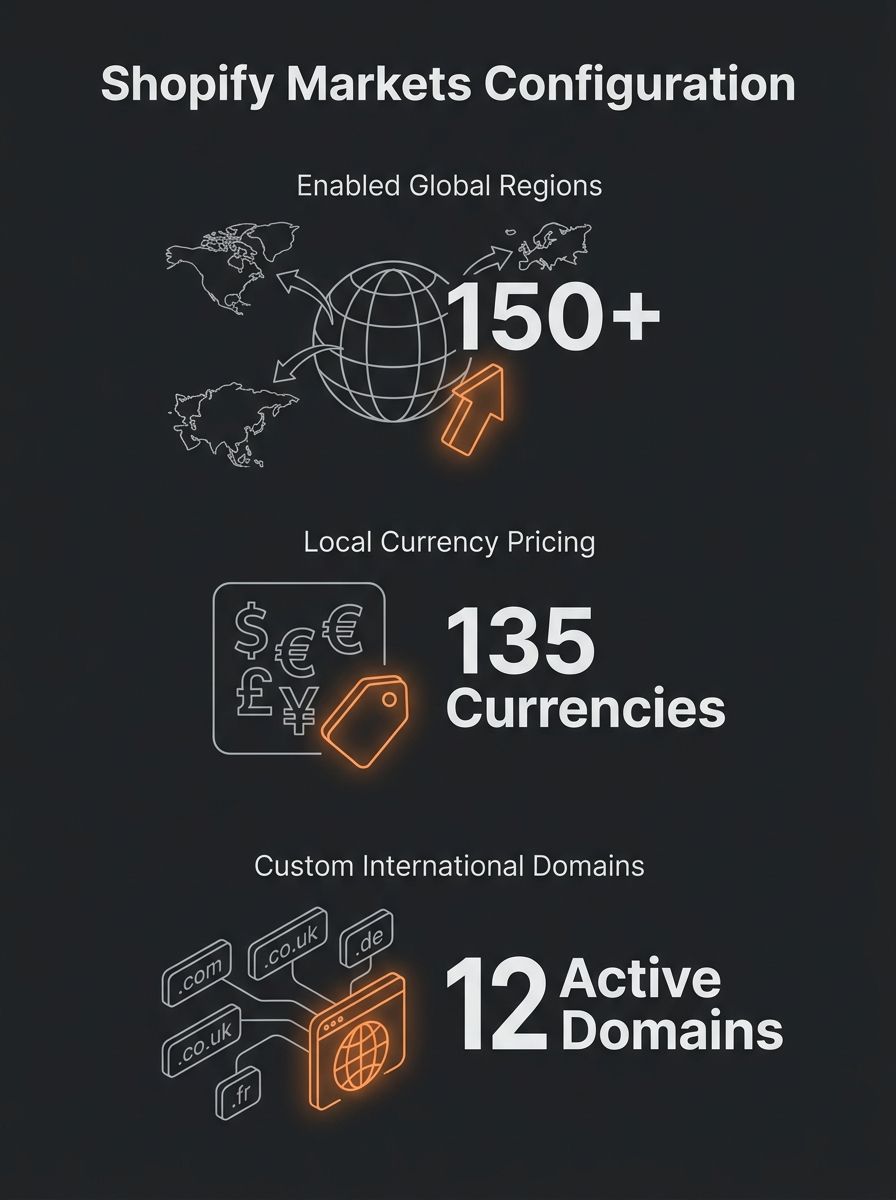
Shopify Markets functions as a centralized control panel for merchants selling to multiple countries, consolidating settings that previously required separate store instances or manual configuration per market. The feature manages seven operational layers: market-specific pricing adjustments, local domain assignment or automatic URL redirection based on buyer geolocation, currency conversion and display, region-preferred payment method support, translated product and policy content, duties and import tax collection or display, and country-specific shipping profiles with carrier rate assignment.
The guide positions the tool as a reduction layer for technical friction. "Selling internationally can unlock huge growth, but it brings friction, customers expect to see prices in their currency, read product descriptions in their language, and understand final costs including duties and taxes," the Racklify entry states. Shopify Markets addresses these expectations through market-by-market rule application within a unified admin interface.
Configuration Workflow and Margin Impact
Merchants define markets by grouping countries or regions, then apply localized rules to each group. A U.S.-based apparel brand expanding to the UK and Germany would create two market entries, set GBP and EUR currency display, configure shipping profiles reflecting local carrier rates, and upload or connect translations for product pages—all while viewing consolidated sales data in one reporting dashboard.
The guide flags cost structure shifts that accompany international expansion. "International selling often brings higher shipping, returns, and compliance costs, track margin impact per market," according to the resource. Cross-border shipments typically carry 40 to 60 percent higher fulfillment costs than domestic orders when accounting for customs processing, longer transit windows, and increased damage/loss rates. Shopify merchants using consolidated shipping methods from Chinese suppliers face additional margin pressure when splitting shipments across multiple destination countries with varying duty thresholds.
Price adjustment features allow operators to offset these costs. Merchants can set percentage-based uplifts per market (for example, +15 percent for UK pricing to cover VAT and higher return rates) or assign fixed prices in local currency to match competitive positioning. The guide recommends starting with one or two markets to establish profitability baselines before expanding to additional regions.
Payment Gateway and Compliance Constraints
Not all payment methods function across all Shopify Markets configurations. The guide notes that gateway availability varies by country—certain regions may require third-party app integrations to support local payment preferences like iDEAL in the Netherlands or Boleto in Brazil. Merchants must verify supported gateways before launching a market to avoid checkout abandonment.
Legal and compliance requirements impose additional boundaries. "Export rules, privacy laws, and product restrictions vary, consult local regulations and customs requirements," the resource states. Operators selling dropshipping inventory from AliExpress suppliers to EU markets must account for the bloc's VAT collection rules and product safety directives, which can disqualify certain categories (cosmetics, electronics, children's items) from direct cross-border sale without additional certification.
The guide positions Shopify Markets as a technical enabler but not a compliance solution. Merchants remain responsible for understanding destination-country import restrictions, tax registration thresholds, and data protection obligations before activating a market.
Duty and Tax Display Strategy
Shopify Markets offers two approaches to duties and import taxes: display-only mode, where the platform shows estimated charges at checkout but the customer pays them separately upon delivery, and collected-at-checkout mode, where Shopify calculates and collects the full landed cost upfront. The guide emphasizes that collected-at-checkout configurations significantly reduce cart abandonment—customers who see unexpected fees at delivery often refuse packages or file chargebacks.
Collected-at-checkout requires Shopify to hold an Importer of Record relationship or integration with a customs brokerage service, adding per-transaction fees. These fees typically range from 2.5 to 4 percent of order value plus a flat $5 to $8 processing charge per shipment. Merchants must model whether the conversion rate improvement offsets the added cost.
For categories with high return rates, like apparel, displaying duties separately can reduce exposure—returned items avoid duty refund processing complexity. For electronics or home goods with sub-5-percent return rates, collected-at-checkout typically delivers better unit economics.
What Happens Next
Shopify merchants entering international markets face a build-versus-buy decision: replicate store infrastructure manually or use platform-native tools like Shopify Markets to centralize configuration. The Racklify guide positions Markets as the low-friction path for operators testing geographic expansion without enterprise-level development resources. Stores already generating 15 to 25 percent of traffic from non-domestic visitors—visible in Shopify Analytics under "Sessions by location"—represent the highest-probability candidates for multi-market activation.
The guide's emphasis on cost tracking aligns with margin realities for sellers sourcing inventory from platforms like AliExpress, where product costs run $3 to $12 and international shipping adds $8 to $18 per unit. A merchant achieving 60 percent gross margin domestically may see that compress to 35 to 45 percent in European markets after accounting for longer shipping, VAT collection, and currency conversion fees. Shopify Markets reduces setup friction but does not eliminate the underlying cost structure—operators still must verify per-market profitability before scaling ad spend or inventory commitments.
Racklify's publication follows a broader pattern of logistics platforms and warehouse operators releasing educational content targeting Shopify merchants navigating fulfillment complexity. The resource joins existing documentation on carrier selection, dimensional weight calculations, and customs clearance workflows as store operators weigh whether to handle international logistics in-house or partner with third-party providers.

Ryan Torres
Ryan Torres is a former Amazon FBA seller turned dropshipping consultant who has generated over $2.8M in ecommerce revenue across 14 product launches. He specializes in supplier vetting, margin optimization, and scaling DTC operations for sub-$1M brands. Ryan focuses on actionable frameworks that drive measurable results for independent operators.
Related Articles

Warehouse Platform Releases Shopify Markets Configuration Tutorial for Cross-Border Merchants
Independent Shopify merchants exploring international sales can now access a centralized tutorial covering Shopify Markets' seven configuration layers, following a June 29 guide release by warehouse comparison platform Racklify that breaks down multi-currency setup, domain routing, and duty collecti
Logistics Platform Publishes Shopify Markets Setup Guide for Cross-Border Merchants
Racklify, a warehouse comparison and logistics platform, published a beginner-focused breakdown of Shopify Markets on June 26, detailing how independent merchants can configure multi-country storefronts, currency display, and duties handling from a single Shopify admin, according to the encyclopedia

Shopify Markets Consolidates Seven Cross-Border Configuration Layers Into Single Admin Dashboard
Seven separate market configuration layers—currency display, payment methods, domain routing, translated content, duty collection, shipping profiles, and localized pricing—can now be managed from a single Shopify admin interface, according to a June 27 beginner guide published by Racklify, a warehou
Explore more topics