Seven of 15 DTC Unicorns Maintained Valuations Through 2025 as ConversionStudio Publishes 12-Brand Case Study Series
Seven of 15 direct-to-consumer brands valued as unicorns between 2015 and 2022 maintained or grew their valuations through 2025, according to a brand case-study analysis published by ConversionStudio on September 16, 2026, citing CB Insights data that tracks category-disruption patterns among scaled

Seven of 15 DTC Unicorns Maintained Valuations Through 2025 as ConversionStudio Publishes 12-Brand Case Study Series
Seven of 15 direct-to-consumer brands valued as unicorns between 2015 and 2022 maintained or grew their valuations through 2025, according to a brand case-study analysis published by ConversionStudio on September 16, 2026, citing CB Insights data that tracks category-disruption patterns among scaled DTC operators.
The case study compilation examines brands spanning eyewear, beauty, razors, footwear, and fitness apparel, documenting the specific operational and marketing tactics that drove revenue past nine figures. The analysis arrives as direct-to-consumer ecommerce sales reached $213 billion in the United States in 2025, representing 16.2 percent of total ecommerce, according to eMarketer data cited in the report.
Survival Rate Reveals Channel Diversification Pattern
The CB Insights tracking data shows that brands maintaining valuations beyond the 2022-2025 correction period shared three characteristics: category disruption through pricing or experience innovation, demonstrated unit economics, and diversification beyond pure direct-to-consumer sales channels. Warby Parker generated $669 million in revenue in 2024 while operating 260-plus retail locations alongside its online store, according to the case study.
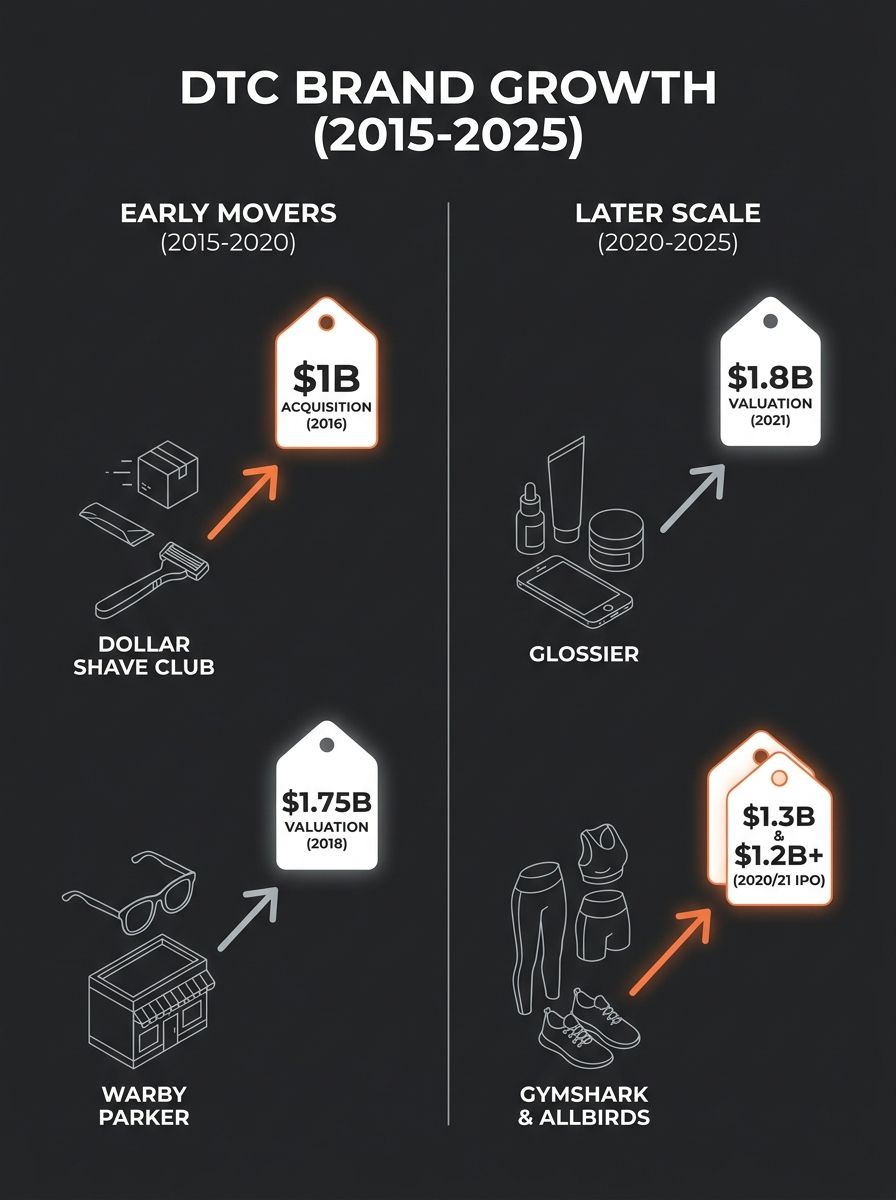
The analysis documents that home try-on programs, customer co-creation frameworks, and viral content strategies functioned as early-stage customer-acquisition levers that reduced reliance on paid acquisition. Dollar Shave Club spent $4,500 on a single YouTube video in 2012 that generated 12,000 orders in 48 hours and accumulated 28 million-plus views before Unilever acquired the company for $1 billion in 2016, the report states.
Glossier's Peer-Referral Model Cut Acquisition Costs
Glossier built products based on blog comments, Instagram direct messages, and a dedicated customer Slack group, turning product development into community co-creation. By 2019, 70 percent of Glossier's growth came from peer referrals and organic earned media, per company disclosures cited in the analysis. The brand's customer acquisition cost ran below competitors relying solely on paid social advertising.
The case study notes that Glossier founder Emily Weiss launched the brand in 2014 from beauty blog Into The Gloss, which had already built an audience of 1.5 million monthly readers. The Milky Jelly Cleanser originated from a blog post asking readers to describe their ideal face wash, according to the report.
Allbirds generated $255 million in revenue in 2024 by positioning material innovation as the differentiation vector rather than marketing sustainability through messaging alone. The brand open-sourced its carbon footprint calculator and labeled every product with its carbon score, giving environmentally conscious consumers quantifiable data points rather than vague eco-friendly claims, the analysis states.
Category Disruption Through Price Transparency
Warby Parker launched in 2010 targeting Luxottica's supply-chain control of prescription eyeglasses. By designing frames in-house and selling direct, the brand offered $95 glasses competing with $300-plus retail alternatives, according to the case study. The home try-on program, shipping five frames free for customer evaluation, solved the primary objection to buying glasses online before virtual try-on technology existed.
The program generated organic advertising as customers posted try-on selections on social media, turning every order into unpaid brand exposure. The pattern demonstrates how operational features can function as acquisition mechanisms when they remove customer friction points, the analysis notes.
Gymshark began in 2012 as a screen-printing operation in founder Ben Francis's parents' garage, building relationships with fitness influencers before influencer partnerships became a formalized marketing category. The brand's early partnerships with athletes who had small but engaged audiences created authentic endorsement that scaled as those athletes' followings grew, according to the report.
Replicable Tactics Beyond Brand Storytelling
The ConversionStudio analysis separates replicable operational tactics from founder narratives, isolating levers that solopreneurs can adapt without billion-dollar funding. The home try-on model translates to any category where fit or appearance uncertainty blocks online purchases. Customer co-creation reduces product-market-fit risk by incorporating buyer input before production. Viral content works when it communicates value propositions with enough personality that viewers voluntarily share it.
Material innovation as differentiation, Allbirds' approach, applies to categories where incumbents compete primarily on brand rather than product attributes. Sustainability becomes credible when built into the product itself rather than communicated through marketing claims, the case study states.
The analysis documents that DTC brands using lean operations models have maintained growth by automating acquisition and retention workflows, allowing smaller teams to manage customer relationships at scale. Channel diversification, adding retail locations, wholesale partnerships, or marketplace presence, emerged as a survival factor for brands that reached $50 million-plus in annual revenue.
Why This Matters Now
Independent store operators and solopreneurs researching product niches face the same customer-acquisition challenge that DTC brands solved at scale: how to earn every customer through marketing when no retail shelf space exists. The tactics documented in ConversionStudio's case study compilation, home try-on programs, customer co-creation, and content that functions as both entertainment and explanation, remain executable at small scale.
The 47 percent failure rate among DTC unicorns between 2022 and 2025 confirms that category disruption alone does not guarantee survival. Brands maintaining growth demonstrated unit economics and diversified revenue channels rather than relying solely on venture funding to subsidize customer acquisition. For operators sourcing from AliExpress or wholesale platforms, the patterns isolate which operational features reduce friction enough to drive organic word-of-mouth, cutting reliance on paid advertising.
The case studies provide margin benchmarks and tactical frameworks, Warby Parker's $95 price point against $300-plus incumbents, Dollar Shave Club's $4,500 video investment generating 12,000 orders, that translate to product research and niche evaluation decisions. Operators testing new categories can apply the same category-disruption logic: identify supply-chain inefficiencies that inflate retail pricing, then sell direct at a margin that allows profitability while undercutting incumbents.

Ryan Torres
Ryan Torres is a former Amazon FBA seller turned dropshipping consultant who has generated over $2.8M in ecommerce revenue across 14 product launches. He specializes in supplier vetting, margin optimization, and scaling DTC operations for sub-$1M brands. Ryan focuses on actionable frameworks that drive measurable results for independent operators.
Related Articles

TikTok Shop, Amazon, and Shopify Deliver Different Profit Profiles for DTC Brands, Avenue Z Analysis Finds
Avenue Z's June 10 platform analysis concludes that no single eCommerce channel delivers universal profitability for DTC brands, positioning TikTok Shop for low-acquisition trendy products, Amazon for high-intent search volume, and Shopify for margin control and customer data ownership, according to

The Niche Community Flywheel Is Overrated: Why Most Dropshippers Can't Execute the Brand-Building Playbook They Keep Reading About
Solo Brands filed its S-1 with four outdoor DTC brands and margins that, per Drivepoint's financial analysis, "blow away all other DTC brands." Content marketers cite Solo's trajectory as proof that the niche community flywheel works.

DTC Brands Using AI Revenue Agents Report 30-50% First-Time Revenue Lift as Lean Operations Model Gains Traction
Direct-to-consumer brands using AI revenue agents to automate acquisition, conversion, and retention workflows reported 30 to 50 percent higher first-time customer revenue and two- to four-times higher repeat purchase revenue compared to baseline performance, according to Ground's September 4 analys
Explore more topics