Printful's 479-Product Catalog Outweighs Tapstitch's Apparel Quality Edge in New POD Platform Comparison
Printful's 479-product catalog spanning apparel, home decor, and accessories gives it a decisive edge over Tapstitch's 400-blank apparel-only range despite Tapstitch's vertically integrated quality advantage in streetwear fulfillment, according to a platform comparison published July 8 by Ecommerce-

Printful's 479-Product Catalog Outweighs Tapstitch's Apparel Quality Edge in New POD Platform Comparison
Printful's 479-product catalog spanning apparel, home decor, and accessories gives it a decisive edge over Tapstitch's 400-blank apparel-only range despite Tapstitch's vertically integrated quality advantage in streetwear fulfillment, according to a platform comparison published July 8 by Ecommerce-Platforms.com.
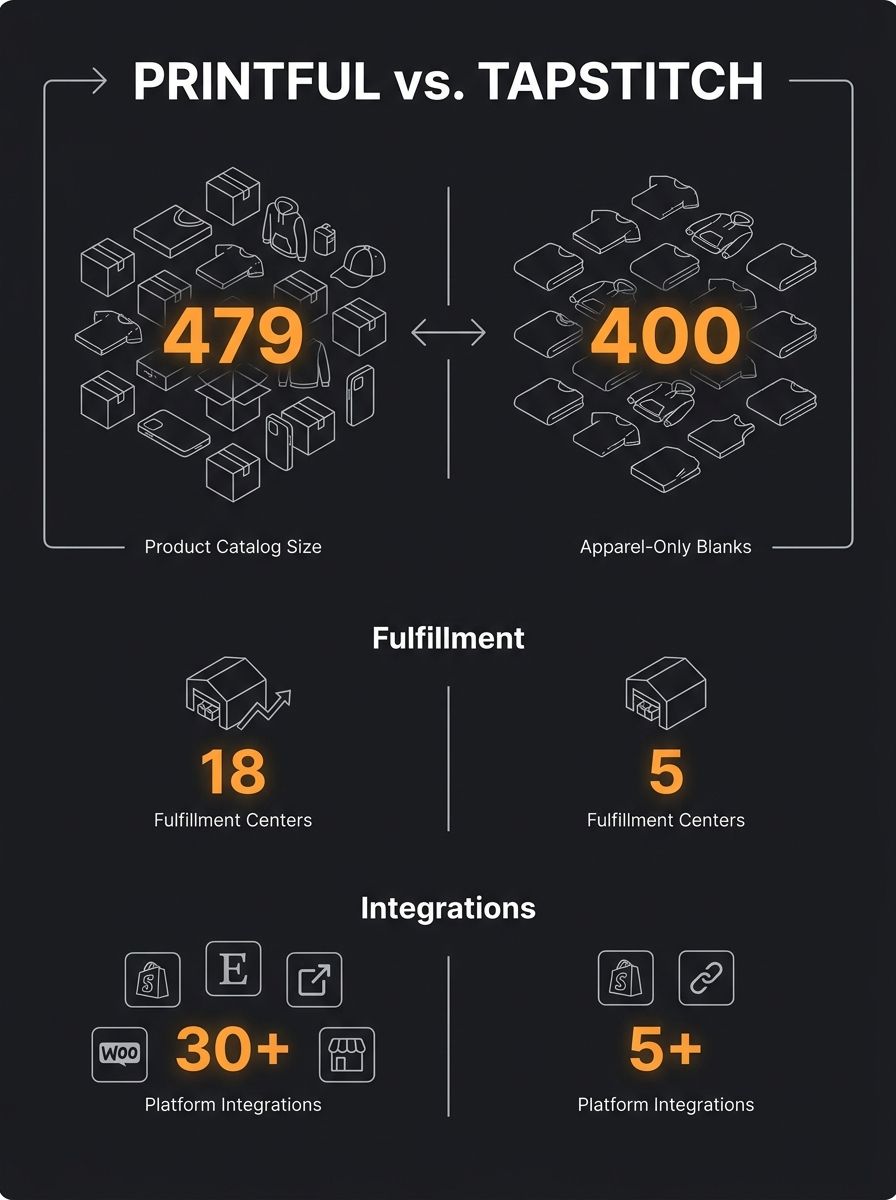
The head-to-head evaluation compared the two print-on-demand platforms across product range, print quality, integrations, pricing, and fulfillment infrastructure. Printful supports 21 platform integrations including Amazon and TikTok Shop, compared to Tapstitch's three-platform roster of Shopify, Etsy, and Wix. Printful operates 12 global fulfillment centers; Tapstitch runs facilities in the U.S. and China only, the analysis found.
The comparison arrives as dropshippers navigate tightening margins and rising customer expectations for both product variety and premium quality, trade-offs that force platform selection earlier in the business-planning cycle than supplier decisions for sourced inventory.
Product Range and Print Method Gap
Tapstitch's catalog focuses exclusively on fashion apparel with approximately 400 clothing blanks built around heavyweight tees, 400-GSM hoodies, oversized cuts, and large print zones, the review shows. The platform supports DTG and DTF print methods for apparel only.
Printful offers 479 SKUs across apparel, home goods, accessories, and wall art, with print methods including DTG, embroidery, all-over sublimation, cut-and-sew, and UV printing. For sellers testing product categories beyond clothing or diversifying catalog mix, that breadth represents a structural advantage, according to the analysis.
Tapstitch includes oversized back prints in its base per-order fee, a feature aimed at streetwear brands that prioritize large graphic placements. Printful charges separately for specialty print placements and premium blank upgrades.
Integration and Fulfillment Infrastructure
Printful's 21-platform integration roster includes Shopify, WooCommerce, Etsy, Amazon, TikTok Shop, and API access for custom implementations. Tapstitch integrates with Shopify, Etsy, and Wix, limiting multichannel operators who run storefronts across marketplaces or social commerce platforms.
The review documented Printful's 12 global fulfillment centers against Tapstitch's two-facility network in the U.S. and China. For sellers targeting European or Asia-Pacific customers, Printful's regional nodes reduce cross-border transit time and landed-cost variability, the analysis noted. Tapstitch ships all international orders from its two facilities, adding 5-to-12 business days to delivery windows outside North America.
Platform integration strategy affects catalog management and inventory sync architecture, particularly for sellers operating across three or more sales channels.
Per-Unit Pricing and Volume Discounts
Neither platform charges a mandatory monthly subscription for basic access. Tapstitch operates on a pay-per-order model with no tiered plans. Printful offers a free-to-start option and a Growth plan priced at approximately $24.99 per month that unlocks product discounts up to 33 percent, according to the comparison.
A branded tee with U.S. shipping costs approximately $22.95 through Tapstitch and $21.73 through Printful at base pricing, the review found. The $1.22 per-unit gap widens at higher order volumes once Printful's Growth plan discounts apply. For sellers processing fewer than 100 orders monthly, the pricing difference remains negligible; above 300 monthly orders, Printful's subscription-gated discounts reduce per-unit cost by $3 to $7 depending on product type, the analysis shows.
Operators evaluating supplier economics across multiple POD platforms can cross-reference supplier scorecard frameworks that weight cost against quality and fulfillment speed.
Quality Control and Placement Variance
Tapstitch runs vertically integrated production facilities rather than aggregating third-party printers, using DTG machines and DTF printing for dark fabrics. Independent reviews cited in the analysis describe garment quality as noticeably ahead of mass-market POD for streetwear applications, with strong white-ink coverage, good wash durability, and fabric weights classified as premium.
Printful's quality earned a "consistent and reliable at scale" assessment, though the review noted recurring user complaints about print placement variance of 0.5 to 1 inch, particularly on larger graphic designs. For fashion brands where placement precision affects brand perception, that variance represents a quality-control gap, according to the analysis.
The review acknowledged limited third-party feedback volume for Tapstitch due to its shorter market tenure compared to Printful, but existing assessments favor Tapstitch for apparel-first sellers prioritizing garment hand-feel and construction over catalog breadth.
Reading Between the Lines
The platform-selection framework here mirrors the storefront-versus-sourcing trade-off documented in earlier dropshipping platform analyses: breadth and integration depth win for generalist stores, while category depth wins for niche brands willing to sacrifice SKU count for product differentiation.
Tapstitch's apparel-only constraint becomes a feature rather than a bug if your entire business model is premium streetwear or fashion merch, 400 clothing blanks is more than sufficient catalog for a focused brand, and the quality delta funds higher retail pricing that improves gross margin despite slightly higher COGs. Printful's integration roster and global fulfillment unlock multichannel scale and faster international delivery, advantages that matter more as order volume crosses 500 units monthly or as you expand into non-apparel categories.
The $1.22 base-pricing gap is rounding-error territory at low volumes, but the Growth plan discount structure makes Printful materially cheaper past 300 monthly orders, a threshold most serious operators hit within six to nine months if the business model works. The real cost isn't the per-tee delta; it's whether placement variance or limited garment-weight options force you to re-source your hero SKUs after your first 1,000 orders ship.

Ryan Torres
Ryan Torres is a former Amazon FBA seller turned dropshipping consultant who has generated over $2.8M in ecommerce revenue across 14 product launches. He specializes in supplier vetting, margin optimization, and scaling DTC operations for sub-$1M brands. Ryan focuses on actionable frameworks that drive measurable results for independent operators.
Related Articles

Printful vs Printify: Which Platform Wins
Printful and Printify completed a corporate merger but still operate as separate platforms with independent pricing, fulfillment networks, and dashboards. POD sellers face three real paths: Printful for brand control, Printify for margin, or a hybrid splitting the catalog across both.
Printify: Complete App Review & Guide
Printify is a print-on-demand marketplace that routes your orders to a network of over 100 independent print providers who manufacture and ship products under your brand.
Printful print-on-demand App Review: Features & Costs
Printful's base product costs run 15–35% higher than Printify's on comparable items, while Gelato undercuts both on international fulfillment speed through local production routing. The right print-on-demand platform depends on whether you're optimizing for quality, margin, or geographic reach.
Explore more topics