AliExpress Shipping Timeframes Range From 7 Days to 50 Days Across Six Service Tiers, New Logistics Guide Documents
Delivery windows for AliExpress orders span 7 to 50 days depending on service tier selection, according to a logistics breakdown published July 10 by SendFromChina, a fulfillment platform that manages cross-border ecommerce shipments.

AliExpress Shipping Timeframes Range From 7 Days to 50 Days Across Six Service Tiers, New Logistics Guide Documents
Delivery windows for AliExpress orders span 7 to 50 days depending on service tier selection, according to a logistics breakdown published July 10 by SendFromChina, a fulfillment platform that manages cross-border ecommerce shipments. The guide segments six shipping options by transit time and carrier type, providing dropshippers with transit benchmarks for sourcing decisions that directly affect customer delivery promises and refund exposure.
The guide, available at SendFromChina's news center, breaks down transit variability across AliExpress Standard Shipping (10-45 days), Premium Shipping (7-15 days), ePacket (7-30 days), Cainiao Super Economy (30-50 days), national postal services (7-30 days), and express couriers (1-10 days). For operators who price shipping into landed cost calculations, these ranges determine whether a product's total acquisition time fits within the 14-21 day delivery window many US customers now expect for non-Amazon purchases.
Six-Tier Service Structure Reflects Cost-Speed Trade-offs
AliExpress Standard Shipping—managed by Cainiao, Alibaba's logistics affiliate—serves as the platform's default option, delivering in 15-45 days to most countries with end-to-end tracking, the guide states. The service is free or low-cost on many listings, making it the baseline for operators calculating blended fulfillment expense across SKU portfolios. Recent data cited in the guide shows actual US delivery averaging 10-20 days, faster than the advertised 15-45 day window but still outside the one- to two-week threshold many DTC brands advertise.
Premium Shipping cuts transit time to 7-15 days using private carriers like DHL and FedEx, the document shows. The upgrade carries higher per-unit fees but reduces refund risk on items where customers abandon orders after three weeks. For product categories where margin supports it—electronics, apparel with seasonal windows—operators treat Premium Shipping as mandatory rather than optional.
EPacket, arranged through China Post-EMS partnerships, delivers light packages in 7-30 days with tracking, according to the guide. The method balances speed and cost for sub-2kg shipments, a weight class that includes accessories, phone cases, and small home goods. Many AliExpress sellers default to ePacket for its tracking reliability and 10-20 day typical delivery to North America and Europe.
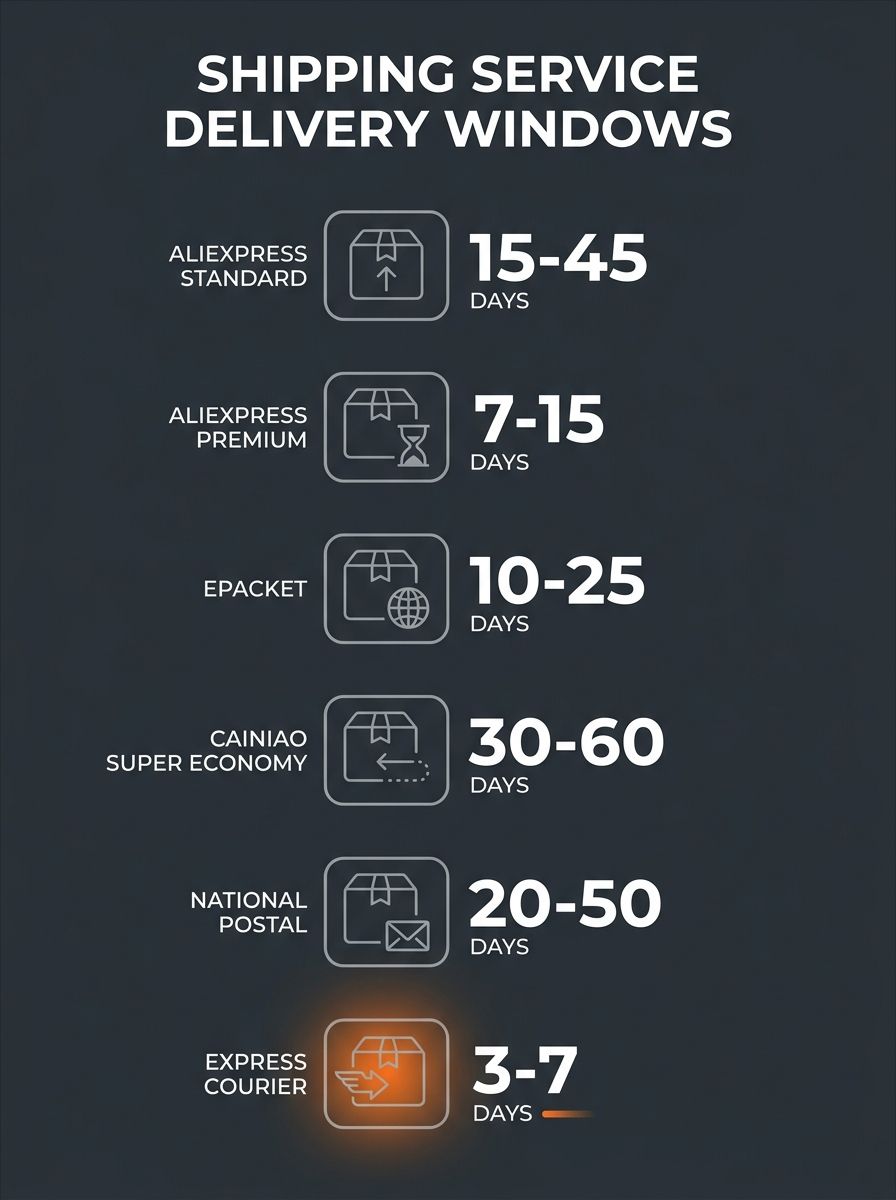
Cainiao Super Economy, positioned for ultra-low-value items, extends delivery to 30-50 days with limited tracking beyond China's borders, the guide notes. The service handles orders where free shipping is the only viable margin structure—under-$5 impulse purchases where customers tolerate extended wait times. Operators using Cainiao Super Economy typically cluster these SKUs in dedicated "long ship" collections and set 6-8 week delivery expectations upfront.
Express couriers—DHL, UPS, FedEx, EMS—compress global transit to 1-10 days but add $15-$40 per shipment depending on weight and zone, according to the breakdown. High-value orders and time-sensitive replacements justify the premium; routine fulfillment does not. The guide positions express as a customer-paid upgrade or a fallback for orders where standard shipping missed delivery promises.
China Origin Dominates Despite Multi-Warehouse Claims
Most AliExpress shipments originate in China despite the platform's "Ship from" filter offering US, European, and other regional warehouse options, the document states. Operators relying on domestic warehouse selections to cut delivery time should verify seller reviews confirming local dispatch, as misleading "Ship from United States" tags sometimes mask China-origin products routed through intermediary handlers.
The guide references a case study showing the majority of AliExpress sellers maintain China-based operations. For dropshippers building supplier stacks, this geography directly affects shipping strategy timing calculations and whether AliExpress can compete with domestic fulfillment options on delivery speed. Items genuinely stocked in US warehouses typically deliver in 3-7 days, but their availability remains narrow relative to the platform's 100-million-plus product catalog.
National postal services—China Post Air Parcel, Singapore Post, Yanwen, SunYou—occupy the 7-30 day range with tracking, according to the guide. China Post specifically appears across AliExpress listings as a mid-speed alternative to Cainiao Standard, offering air parcel service that mirrors ePacket's timeframe without the formal ePacket branding.
The Takeaway
Operators sourcing from AliExpress face a six-tier decision tree where shipping method determines both landed cost and delivery reliability. The 7-30 day middle band—ePacket, Standard Shipping, national post—anchors most dropshipping models because it balances per-unit cost against acceptable wait times for non-Prime-conditioned customers. Premium and express tiers exist but compress margin unless passed to the customer or reserved for high-AOV orders where refund risk justifies the spend.
The guide's transit windows confirm what Cainiao's prior logistics coordination efforts documented: even optimized routing leaves AliExpress 7-20 days behind domestic fulfillment on typical orders. For 2026 operators competing against TikTok Shop's warehouse-forward model and Amazon's two-day baseline, AliExpress shipping works when products carry enough margin to absorb slower delivery or when the customer segment tolerates extended timelines for price advantages. The Cainiao Super Economy tier—30-50 days, limited tracking—remains viable only for sub-$5 impulse SKUs where free shipping is non-negotiable and customers pre-accept the wait.
SendFromChina positions the guide as a decision framework for ecommerce operators evaluating whether AliExpress fits their fulfillment mix. For stores already committed to the platform, the six-tier breakdown offers concrete delivery benchmarks for setting customer expectations and structuring shipping policies that reduce refund exposure across product lines with different margin profiles.

Ryan Torres
Ryan Torres is a former Amazon FBA seller turned dropshipping consultant who has generated over $2.8M in ecommerce revenue across 14 product launches. He specializes in supplier vetting, margin optimization, and scaling DTC operations for sub-$1M brands. Ryan focuses on actionable frameworks that drive measurable results for independent operators.
Related Articles
SendFromChina Documents Six AliExpress Shipping Methods With Delivery Windows Spanning 7 to 50 Days in New Logistics Guide
AliExpress shipping timeframes range from 7 days via premium express carriers to 50 days through Cainiao's economy service, according to a logistics guide published July 31, 2026, by SendFromChina that segments six shipping methods by speed, tracking capability, and cost structure for dropshipping o

AliExpress and Dropshipping: Complete Guide
AliExpress dropshipping is a retail fulfillment method where your online store forwards each customer order to an AliExpress supplier who ships directly to the buyer. You hold zero inventory.

SendFromChina Publishes Category-Based AliExpress Alternative Guide Segmenting Suppliers by Product Type and Minimum Order Quantities
SendFromChina released a supplier sourcing guide on July 18 breaking down AliExpress alternatives across six product categories—clothing, electronics, home textiles, and smallware—with platform-specific data on minimum order quantities, shipping speeds, and pricing tiers, according to the company's
Explore more topics