Yiwu Market Sourcing Guide Segments Product Categories by Factory Access and Compliance Risk for Volume Buyers
A sourcing guide published July 8 by Maple Sourcing segments Yiwu Market's product catalog into buy-recommended and avoid categories based on factory access, quality control limitations, and compliance risk for volume importers, according to the company's market breakdown. The guide identifies toys,

Yiwu Market Sourcing Guide Segments Product Categories by Factory Access and Compliance Risk for Volume Buyers
A sourcing guide published July 8 by Maple Sourcing segments Yiwu Market's product catalog into buy-recommended and avoid categories based on factory access, quality control limitations, and compliance risk for volume importers, according to the company's market breakdown. The guide identifies toys, party supplies, fashion jewelry, stationery, seasonal décor, and kitchen gadgets as margin-viable categories while flagging electronics, branded goods, and safety-certified products as high-risk buys from the wholesale complex.
The breakdown addresses a structural challenge for ecommerce operators sourcing from Yiwu: most market vendors operate as traders rather than manufacturers, which limits customization options, quality oversight, and supplier recourse when defects surface post-shipment. The guide quantifies the market's scale at "tens of thousands of shops" organized by product district, enabling side-by-side supplier comparison within single afternoons but creating verification complexity when buyers need to trace actual manufacturing origin.
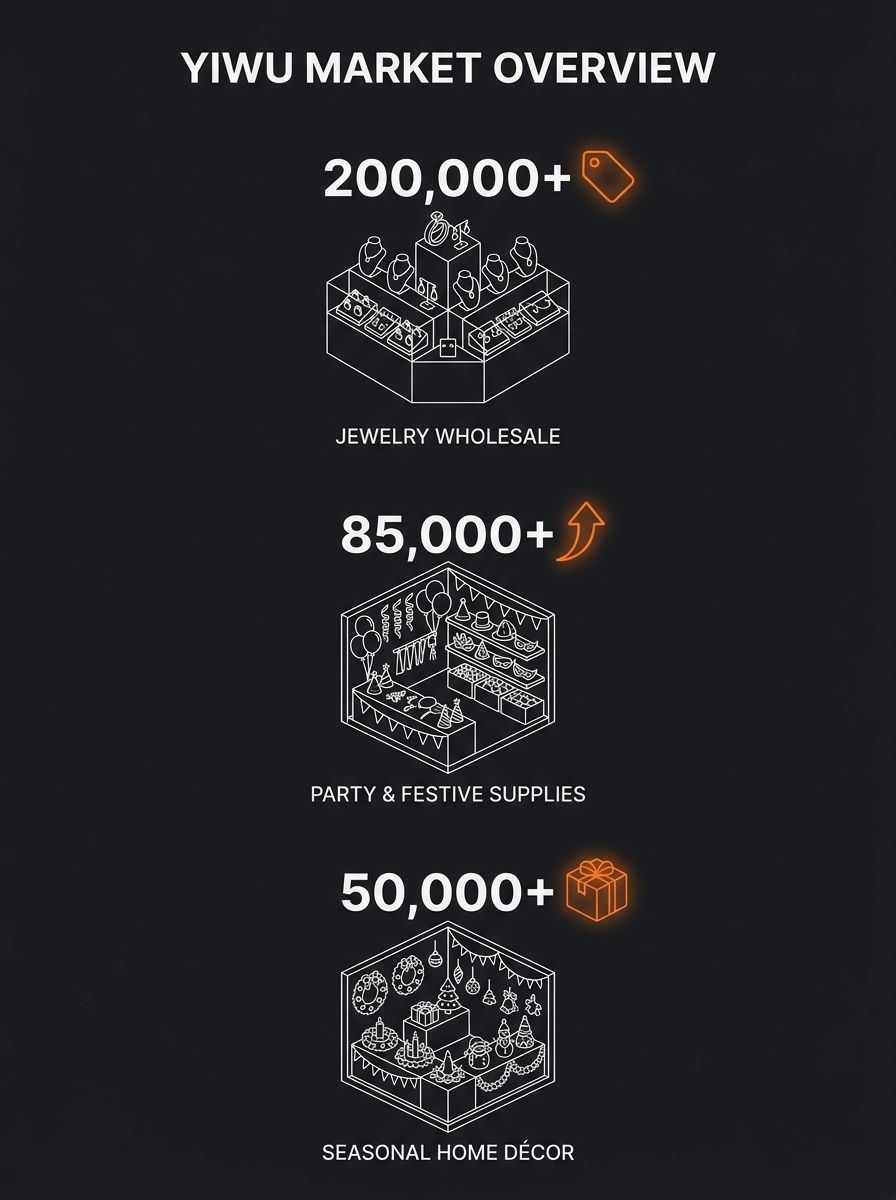
Buy-Recommended Categories and Margin Profiles
Maple Sourcing's framework designates six product verticals as structurally suited to Yiwu's trader-network model. Toys and party goods deliver "huge variety, very low cost" for gift shops and ecommerce sellers. Fashion jewelry supports "high markup, high volume" for boutiques and online storefronts. Stationery and craft supplies offer cheap per-unit costs and lightweight shipping profiles for dollar stores and dropship operations. Holiday décor provides "deep specialty selection" for seasonal retailers, though the guide notes inventory must ship months ahead of calendar demand.
Kitchen gadgets and home tools round out the recommended set, targeting "everyday demand" for general merchants. Bags, scarves, and small textiles appear in the guide's comparative table as additional margin-viable categories. The connecting thread across all six verticals: design differentiation matters more than precision engineering, and unit prices stay low enough to absorb the quality variance inherent in trader-sourced inventory.
A case study in the guide describes a gift-shop owner who consolidated holiday ornaments, gift bags, and seasonal décor from nearby Yiwu stalls during a single visit, filling an entire season's inventory pipeline. The alternative—sourcing the same range online—would have fragmented orders across a dozen suppliers with no pre-purchase quality verification.
Avoid Categories and Risk Vectors
Electronics top the avoid list due to "inconsistent quality, weak support" from traders who lack direct factory relationships. The guide steers buyers toward verified factories for gadgets requiring technical specifications or post-sale service. Branded or licensed goods carry legal seizure risk at customs, classified as "often counterfeit" in market context. Safety-certified products—baby items, electrical components, anything requiring regulatory documentation—belong with audited factories that can supply compliance paperwork, not market traders.
Fragile or high-value items create "damage and return risk" boosted by the distance between point of sale and manufacturing origin. A documented case involved a first-time buyer who purchased wireless earbuds from a Yiwu stall; nearly one-third arrived faulty, and trader relationships offered "no real recourse" for refunds or replacements. Savings evaporated into return freight and customer chargebacks.
The guide frames the electronics trap as a category mismatch: products needing consistent quality control require direct factory access, inspection protocols, and vendor accountability mechanisms that market-based supplier relationships structurally cannot deliver.
Verification and Inspection Protocols
Maple Sourcing outlines a four-step procurement discipline for buyers operating in Yiwu's trader environment. Sample the actual product before committing to volume orders—display units often differ from bulk shipments. Verify who manufactures the product, not just who sells it at the stall; this step requires asking traders for factory names and, in higher-stakes orders, visiting production sites. Negotiate prices as starting points rather than fixed quotes; the guide positions first-quoted figures as expected negotiation anchors. Conduct pre-shipment inspections before freight leaves China to catch defects while recourse remains possible.
The sampling discipline directly addresses the most common failure mode: buyers who order volume based on a single display sample later discover that bulk inventory quality deviates from the original touchpoint. The guide positions inspection as the last checkpoint before a cheap-looking deal transforms into "a container of unsellable stock."
For operators who cannot travel to Yiwu in person, the guide acknowledges remote buying through agents who walk market districts on behalf of importers. The in-person trip pays off when sourcing across multiple categories or when hands-on quality judgment outweighs the travel cost.
The Takeaway
The July 8 guide provides category-level triage for dropshippers and small-volume importers evaluating Yiwu as a sourcing channel, explicitly segmenting the market's structural advantages—variety, low minimums, same-day comparison shopping—from its verification gaps. Operators sourcing toys, jewelry, stationery, or seasonal goods can use trader networks; those buying electronics, branded items, or compliance-sensitive products face quality and legal exposure that market relationships cannot mitigate.
The practical filter: if your product category requires factory documentation, consistent technical specs, or post-sale recourse beyond a refund, Yiwu's trader model introduces risk that outweighs its cost savings. The margin math flips when defect rates climb past 10-15% or when customs holds delay seasonal inventory past peak demand windows. Small-goods categories with design-driven differentiation remain the market's defensible use case for ecommerce operators in 2026.

Ryan Torres
Ryan Torres is a former Amazon FBA seller turned dropshipping consultant who has generated over $2.8M in ecommerce revenue across 14 product launches. He specializes in supplier vetting, margin optimization, and scaling DTC operations for sub-$1M brands. Ryan focuses on actionable frameworks that drive measurable results for independent operators.
Related Articles
Eighteen Percent of AliExpress Dropshipping Suppliers Exited Platform in First Five Months of 2026 as China's Factory Base Consolidates
An estimated 18% of active AliExpress dropshipping suppliers exited the platform between January and May 2026, folding into larger factory collectives in Guangdong, Foshan, and Yiwu, according to sourcing intelligence firm Syncee's internal supplier index cited in a LooperBuy guide published August

SendFromChina Publishes Category-Based AliExpress Alternative Guide Segmenting Suppliers by Product Type and Minimum Order Quantities
SendFromChina released a supplier sourcing guide on July 18 breaking down AliExpress alternatives across six product categories—clothing, electronics, home textiles, and smallware—with platform-specific data on minimum order quantities, shipping speeds, and pricing tiers, according to the company's

LooperBuy Publishes Etsy Sourcing Framework Detailing 1688.com Access and Five-Criteria Supplier Vetting for Production Partner Model
Etsy sellers using China-based production partners can now access 1688.com's 10 million product catalog through LooperBuy's B2B platform, according to a sourcing guide published July 30, 2026, that details five supplier vetting criteria and factory-direct pricing 25-40% below Western alternatives.
Explore more topics