Contribution Margin Framework Shows Equal-Revenue Products Can Deliver 4x Profit Gaps
A product selling for $100 with $60 in variable costs generates $40 in contribution margin, while an identical-revenue SKU with $90 in variable costs contributes just $10 toward fixed costs and profit, according to a contribution margin analysis framework published May 3 by Supply Chain Today. The p

Contribution Margin Framework Shows Equal-Revenue Products Can Deliver 4x Profit Gaps
A product selling for $100 with $60 in variable costs generates $40 in contribution margin, while an identical-revenue SKU with $90 in variable costs contributes just $10 toward fixed costs and profit, according to a contribution margin analysis framework published May 3 by Supply Chain Today. The publication outlines how revenue metrics mask profitability disparities across products, channels, and customer segments.
The framework addresses a measurement gap that affects dropshippers operating on thin margins. Gross margin calculations typically exclude channel-specific fulfillment costs, promotional expenses, and customer service overhead — variable costs that determine whether revenue converts to profit or simply covers operational burn.
Supply Chain Today's analysis demonstrates that equal revenue does not equal equal value when variable cost structures differ. The publication presents contribution margin as revenue minus all variable costs, isolating how much each transaction contributes toward covering fixed overhead and generating profit.
Product-Level Disparities Drive Portfolio Decisions
The framework's product-level analysis reveals profitability splits within seemingly uniform catalogs. A consumer goods company case study cited in the publication found 20 percent of SKUs generated 80 percent of contribution margin, while 30 percent of the portfolio contributed negligible or negative margin after accounting for procurement, packaging, and logistics costs.
The company responded by prioritizing marketing spend toward high-margin SKUs, rationalizing low-margin products, and adjusting pricing strategy. The result: higher profitability, simplified operations, and better inventory efficiency, according to the report.
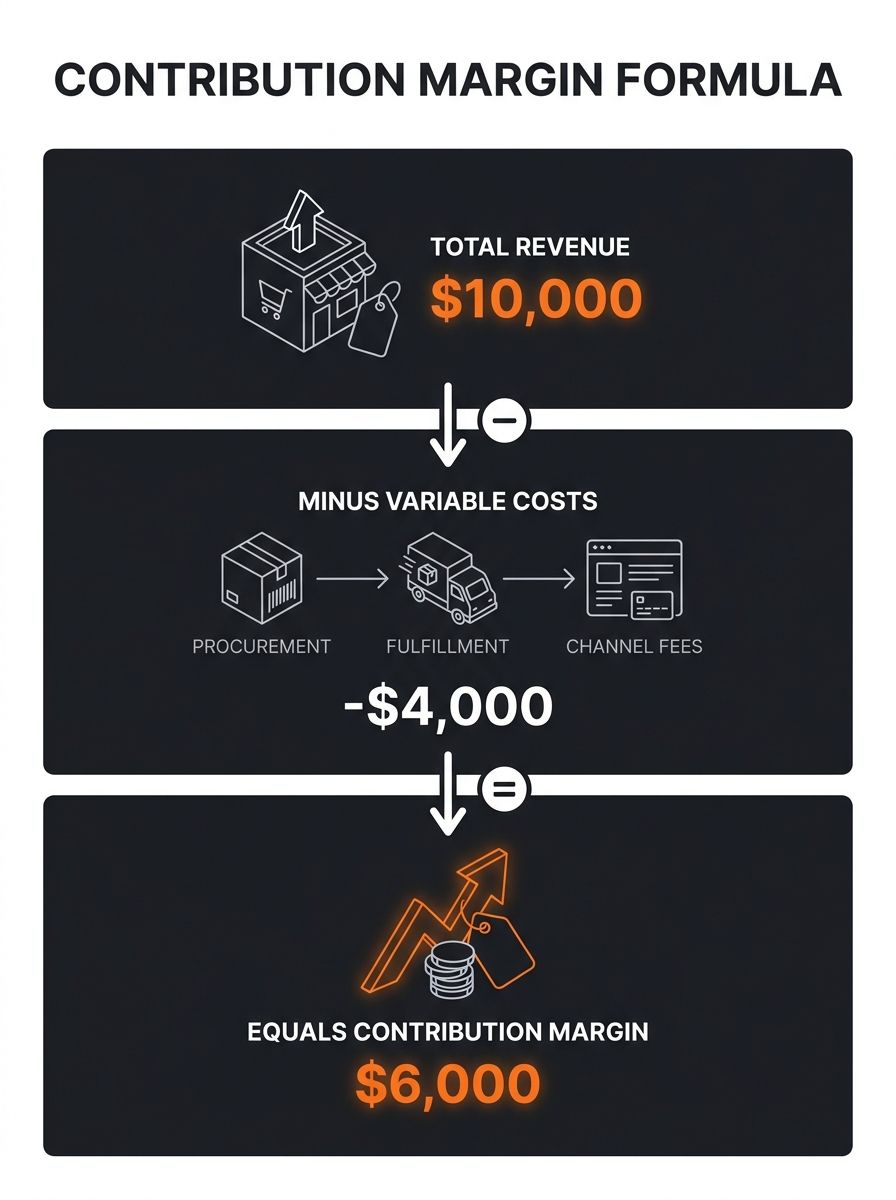
For dropshippers sourcing from platforms like AliExpress or Spocket, variable costs extend beyond product cost to include payment processing fees, platform commissions, and per-order fulfillment charges. A product with $15 landed cost selling for $49.99 might show 70 percent gross margin but deliver only $18 contribution margin after accounting for $12 in Shopify transaction fees, app costs, and shipping — a distinction that changes inventory allocation and advertising budget decisions.
Channel Economics Separate Growth from Profit
Different sales channels carry different cost structures, the analysis shows. Retail channels benefit from bulk shipments, lower per-unit fulfillment costs, and fewer returns. E-commerce orders incur single-unit picking and packing, expensive last-mile delivery, and higher return rates.
The framework warns that growth channels are not automatically profitable channels. A dropshipper running TikTok Shop campaigns might drive order volume but face 8 percent platform fees, higher return rates on impulse purchases, and expedited shipping expectations that compress contribution margin below Shopify direct sales.
Supply Chain Today's cost-to-serve analysis combines product margin with channel and customer fulfillment costs. A high-margin product sold through a high-cost-to-serve channel delivers moderate profitability, while a low-margin product through a low-cost channel may perform similarly. The publication identifies high-margin products with low cost-to-serve as the ideal combination for inventory prioritization and capacity allocation.
The framework's customer segmentation reveals that the largest buyers are not always the most profitable. Customer A ordering in bulk with predictable demand and minimal returns contributes more per dollar of revenue than Customer B placing small, frequent orders with high service expectations and frequent returns — even when total annual revenue matches.
Pricing and Promotion Erosion
Promotions drive volume but often destroy margin, the analysis shows. A product with $40 contribution margin receiving a $30 discount drops to $10 contribution margin. Sales increase while profit per unit collapses.
The framework applies to dropshipping discount strategies common on platforms like Shopify. A 30 percent off promotion on a $50 product with $28 in variable costs reduces contribution margin from $22 to $7 — requiring triple the unit volume to maintain the same total contribution toward fixed costs.
The publication recommends tracking contribution margin at SKU, customer, and channel levels; integrating margin data into planning and execution; aligning pricing with profitability; and prioritizing high-margin products and customers in inventory and fulfillment decisions. The framework also flags common pitfalls: focusing only on revenue, not including all variable costs in calculations, using static analysis when margins change over time, and ignoring channel and customer differences.
For operators managing direct supplier relationships versus platform middlemen, the framework highlights how commission structures and minimum order quantities affect variable cost calculations. A direct supplier with $18 landed cost but no platform fees may deliver higher contribution margin than a $16 AliExpress SKU carrying 2.9% payment processing, app subscription allocation, and per-order dropshipping fees.
What Happens Next
Dropshippers applying the framework will need to separate fixed costs like Shopify subscriptions and salaried labor from variable costs that scale with order volume. Contribution margin analysis shifts inventory decisions away from best-sellers toward highest-contributors, potentially reducing SKU count while increasing profitability per transaction.
The framework's application to paid acquisition changes how operators evaluate customer acquisition cost against lifetime value. A $40 CAC against a customer delivering $60 contribution margin on first purchase looks profitable until high return rates and low repeat purchase rates surface in cohort data.
Stores running multiple sales channels — Shopify, Amazon FBA, TikTok Shop, wholesale — will need channel-specific contribution margin tracking to identify where revenue growth translates to profit and where volume masks drain. The analysis suggests monthly SKU-level reviews to catch margin compression from rising supplier costs, promotional creep, or channel fee increases before they compound across catalogs.

Ryan Torres
Ryan Torres is a former Amazon FBA seller turned dropshipping consultant who has generated over $2.8M in ecommerce revenue across 14 product launches. He specializes in supplier vetting, margin optimization, and scaling DTC operations for sub-$1M brands. Ryan focuses on actionable frameworks that drive measurable results for independent operators.
Explore more topics