Why Supply Chain Disputes Will Hit Your Margins in 2026—And How Dropshippers Should Respond Now
Effective tariff rates on Chinese goods now sit between 22% and 34%. Supply chain concerns have doubled year-over-year according to the Thomson Reuters 2026 global trade report.

Supply Chain Disputes Will Hit Your Margins in 2026: 7 Rules for Dropshippers Who Should Respond Now
Effective tariff rates on Chinese goods now sit between 22% and 34%. Supply chain concerns have doubled year-over-year according to the Thomson Reuters 2026 global trade report. And as of this week, the National Law Review confirmed that courts are narrowing the legal defenses available when delivery commitments fall apart, turning supply chain performance into an active litigation risk for fashion and beauty companies. For dropshippers, who sit at the end of every supply chain and control none of the production, these overlapping pressures compress margins from multiple directions at once. Generic product margins have already fallen to 3–7%, down from 15–20% two years ago. CAC has climbed to $68–$84. The math gets worse every quarter you ignore it.
These seven rules won't eliminate supply chain disputes in 2026, but they'll keep your store profitable while competitors bleed out on chargebacks and tariff surprises.
Know the legal landscape before it finds you
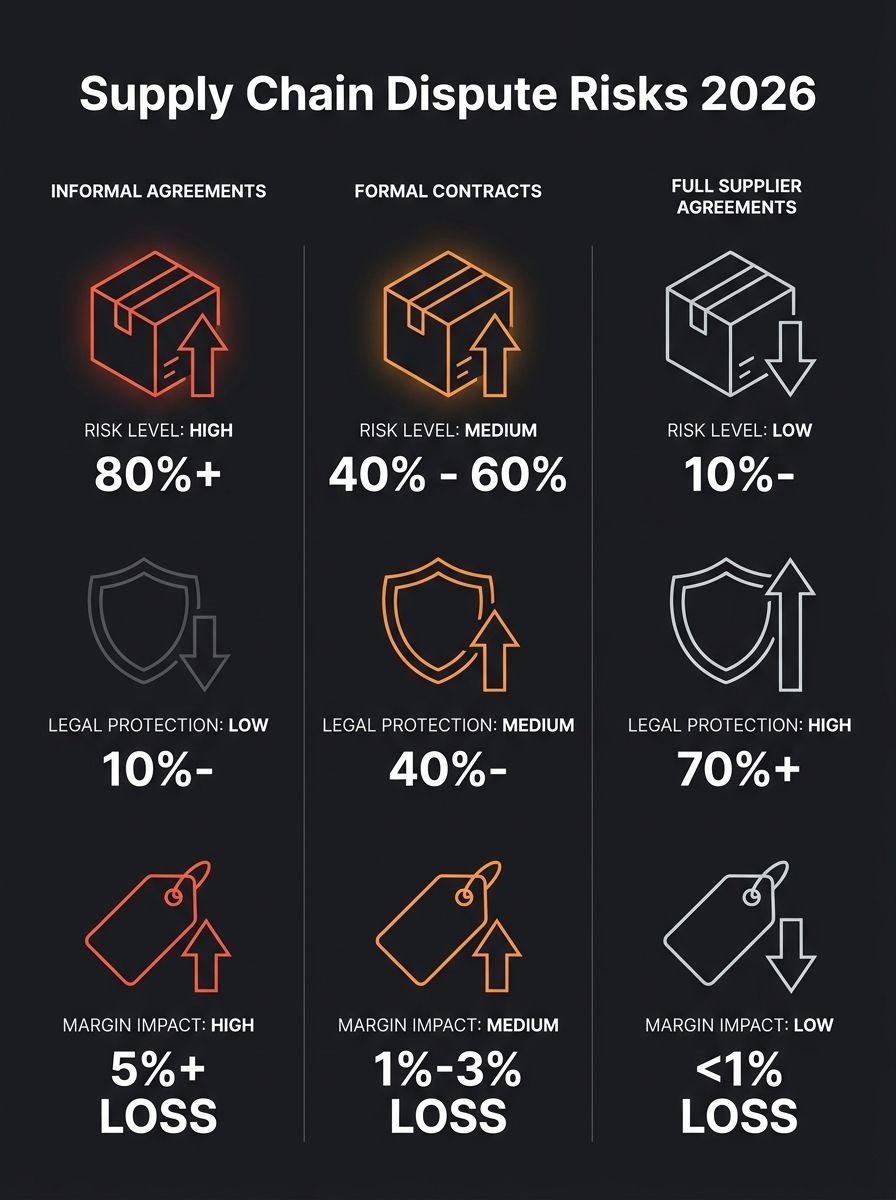
Supply chain disputes used to stay invisible to small operators. A manufacturer missed a window, a wholesaler ate the loss, and life went on. That era ended. The Azer Scientific LLC v. Quidel Corp. case (2025 U.S. App. LEXIS 20387) set a precedent that should worry anyone relying on informal supplier agreements: a diagnostics supplier lost $290,000 after acting on a buyer's email confirmation that was never formalized into a binding contract. The buyer walked when demand softened, and the court refused to enforce the commitment.
What does this mean for your dropshipping operation? If your supplier relationship lives in WhatsApp messages and loosely worded Alibaba chat logs, you have zero legal recourse when they raise prices mid-order, substitute materials, or miss delivery windows. The National Law Review's May 2026 analysis emphasizes that brands and suppliers must now explicitly define binding commitments and tighten force majeure clauses in writing.
You don't need a corporate legal team. You need a one-page supplier agreement that specifies: unit price and how far in advance it can change, delivery windows with penalties for misses, quality benchmarks tied to sample approval, and how disputes get resolved. Any supplier who refuses to sign something this basic is telling you exactly how much dropshipping supplier risk you're carrying.
Price every SKU with tariff exposure baked in
A temporary 10% ad valorem import duty took effect on February 24, 2026, stacking on top of existing Section 301 and Section 232 duties. If you're sourcing from China, your effective tariff rate is somewhere between 22% and 34% depending on the product category. The fashion beauty supply chain gets hit especially hard here because cosmetics, apparel, and accessories sit in HS code ranges that carry some of the steepest combined rates.
Here's the margin math most operators get wrong. Say your supplier quotes $8.00 per unit on a beauty tool. You assume your landed cost is $8.00 plus $3.50 shipping. But with a 28% effective tariff, that $8.00 becomes $10.24 before freight. Your actual landed cost is $13.74. If you priced that product at $29.99 expecting a $18.49 margin, you actually have $16.25. And that's before ad spend, platform fees, and payment processing eat another $10–$14.
The fix: build a landed cost calculator that adds tariff percentage as a line item for every SKU. Recalculate monthly, because tariff rates shift. The U.S. trade court ordered refunds on approximately $130 billion in previously collected tariffs, but CBP reported a 45-day delay in processing those claims, so don't count on retroactive relief for cash flow planning. Understanding the real cost math between direct supplier relationships and platform middlemen becomes critical when tariff rates make every percentage point of markup matter.
Run test orders quarterly, not just at onboarding
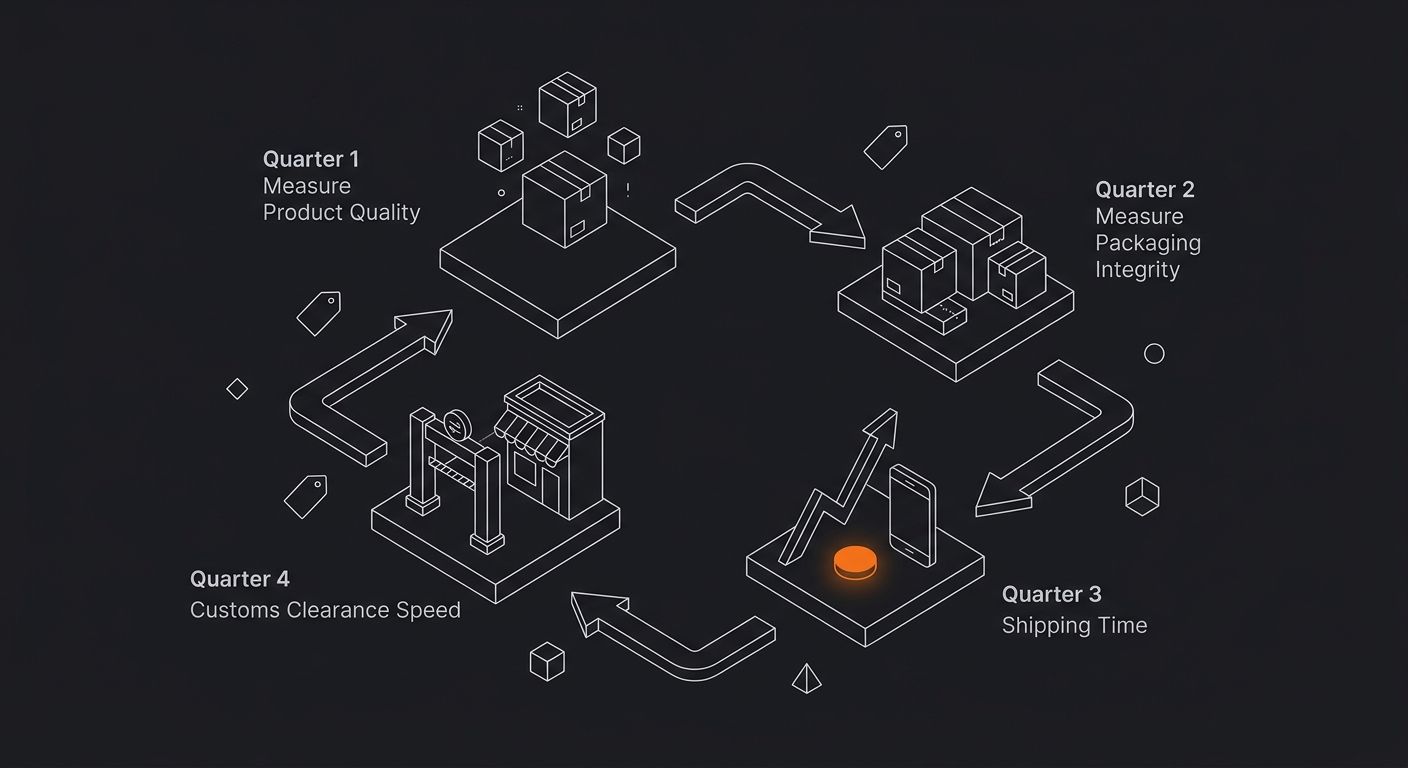
Most dropshippers place a single test order before launch, check that the product arrives intact, and never test again. Supplier quality drifts. Packaging changes. Shipping routes get rerouted through different customs checkpoints. A product that cleared customs smoothly in January might trigger inspection delays in April because your supplier switched to a different freight forwarder.
Quarterly test orders catch three things that your customer reviews will eventually catch for you (at much higher cost): material or formula substitutions, packaging downgrades that increase damage rates, and shipping time increases that spike your chargeback rate. Dropshipping stores face higher chargeback rates than traditional ecommerce because the gap between customer expectation and delivered reality tends to widen over time. Running a structured test order with measurable benchmarks closes that gap before it eats your margins.
The supplier test order playbook covers what to actually measure, but the principle here is simple: treat supplier quality as a depreciating asset. It degrades unless you actively verify it.
Negotiate around your supplier's calendar, not yours
Most operators negotiate price when they need to place an order. The supplier knows you need product, you know they know, and you get whatever price they offer minus 3–5% if you push. This is backwards.
Suppliers have their own inventory cycles, capacity utilization dips, and revenue targets. European paper mill capacity utilization fell to 77% in 2025, the lowest in a decade. When capacity is underutilized, suppliers are far more willing to lock in volume at favorable rates. The same principle applies to your Yiwu jewelry supplier in February (post-Chinese New Year slowdown) or your cosmetics manufacturer in September (between summer peaks and holiday production ramps).
This is where margin protection during supply disruption actually starts: before the disruption happens, in the contract terms you negotiated when your supplier had incentive to be generous.
Spread fulfillment across at least two geographies
The Iran conflict has disrupted printed circuit board supply chains. Hormuz Strait closures are affecting semiconductor raw materials. A single military strike targeted a complex supplying 70% of global PCB base materials. These aren't theoretical risks. They're this week's headlines. And while PCBs may seem distant from your beauty or fashion store, the shipping infrastructure that moves those components moves your products too. Container rates, port congestion, and customs processing times all correlate.
Operators who shifted to U.S.-based or nearshore fulfillment are quoting 2–5 day delivery instead of 20–40 days. That speed difference alone reduces chargeback rates and improves repeat purchase behavior. You don't need to abandon overseas sourcing entirely, but you need a second fulfillment node. Even understanding how cold chain and specialty fulfillment partnerships work can give you a template for setting up domestic backup capacity. The model is the same whether you're shipping peptides or skincare serums: identify a U.S. warehouse partner, pre-position your highest-velocity SKUs, and route orders based on geography.
Track margin drift weekly, not monthly
Suppliers change prices overnight. Tariff rates get amended by executive order. Ad platforms adjust auction dynamics. If you're reviewing margins monthly, you're discovering problems 3–4 weeks after they started costing you money. On a store doing $30K/month with a 15% net margin, a 3-point margin compression that goes undetected for 30 days costs you $900 in profit you'll never get back.
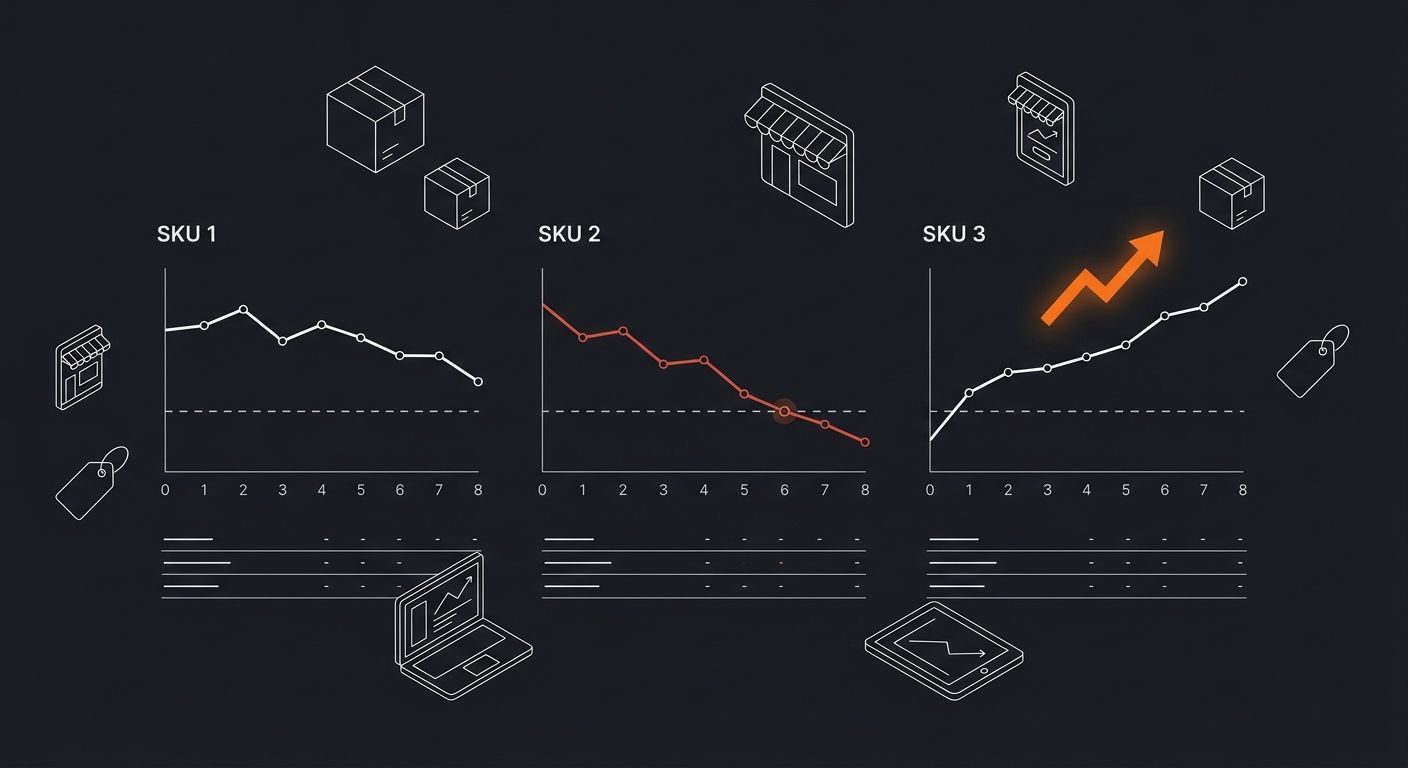
Set up a weekly margin review that takes 20 minutes. Pull your actual COGS (not your assumed COGS from three months ago), subtract current ad spend per unit, platform fees, and payment processing. Compare the result to your target margin per SKU. Any SKU drifting below your floor gets flagged for repricing or replacement. Automation tools can help, but they also have their own failure modes around inventory syncing and supplier data accuracy that you should understand before trusting them blindly.
The breakeven orders per customer have risen from 1–2 in 2024 to 8–15 in 2026, which means one-time sale models are economically dead. You need each customer to come back, and that only works if your margins survive long enough to fund the retention marketing that brings them back.
When These Rules Break Down
These rules assume you have enough volume and enough capital to negotiate terms, maintain multiple fulfillment nodes, and absorb the overhead of quarterly testing. If you're doing under $5K/month in revenue, some of this is aspirational. You probably can't split fulfillment across two geographies or get a supplier to sign a formal agreement for 50-unit orders.
The rule that still applies at every scale: track your real landed cost per SKU, including tariffs, every single week. That costs you nothing but time, and it's the difference between discovering you're selling at a loss after 200 orders versus after 20. If you're still building your first store, the beginner's operating guide covers the foundational pieces, but bring the margin discipline from day one. The operators exiting the market in 2026 are the ones who treated margin tracking as something they'd get to later. Later arrived, and they weren't ready.
365 Dropship Editorial
Editorial team writing about E-commerce, dropshipping, and product discovery — reviews of dropshipping suppliers and platforms, trending niche guides (jewelry, beauty, pets, home, fashion), supplier due diligence, ecom operations, shipping & fulfillment strategy, product research, AOV optimization, and profitable dropshipping case studies.
Explore more topics