Beyond Automation: Why Real Suppliers Like Tradelle Beat AliExpress Connectors for Serious Dropshippers
Every AliExpress connector works the same way under the hood: your customer clicks "Buy," the app fires an API call to a marketplace listing, and a factory worker you've never spoken to decides whether your customer gets what they ordered. The automation is real. The supplier relationship is not.
Beyond Automation: Why Real Suppliers Like Tradelle Beat AliExpress Connectors for Serious Dropshippers
Every AliExpress connector works the same way under the hood: your customer clicks "Buy," the app fires an API call to a marketplace listing, and a factory worker you've never spoken to decides whether your customer gets what they ordered. The automation is real. The supplier relationship is not. And that gap between automated order routing and actual supplier accountability is where most dropshipping stores bleed margin, eat chargebacks, and eventually stall out at $10K-$15K/month wondering what went wrong.
Tools like DSers, CJDropshipping, and AutoDS solve a real problem. They remove the manual labor of placing individual orders on AliExpress. But the mechanism they automate is fundamentally different from what platforms like Tradelle, Spocket, or SaleHoo offer. Understanding that difference at the infrastructure level, not the marketing level, is what separates stores that scale past six figures from stores that plateau.
How AliExpress Connectors Actually Route Your Orders
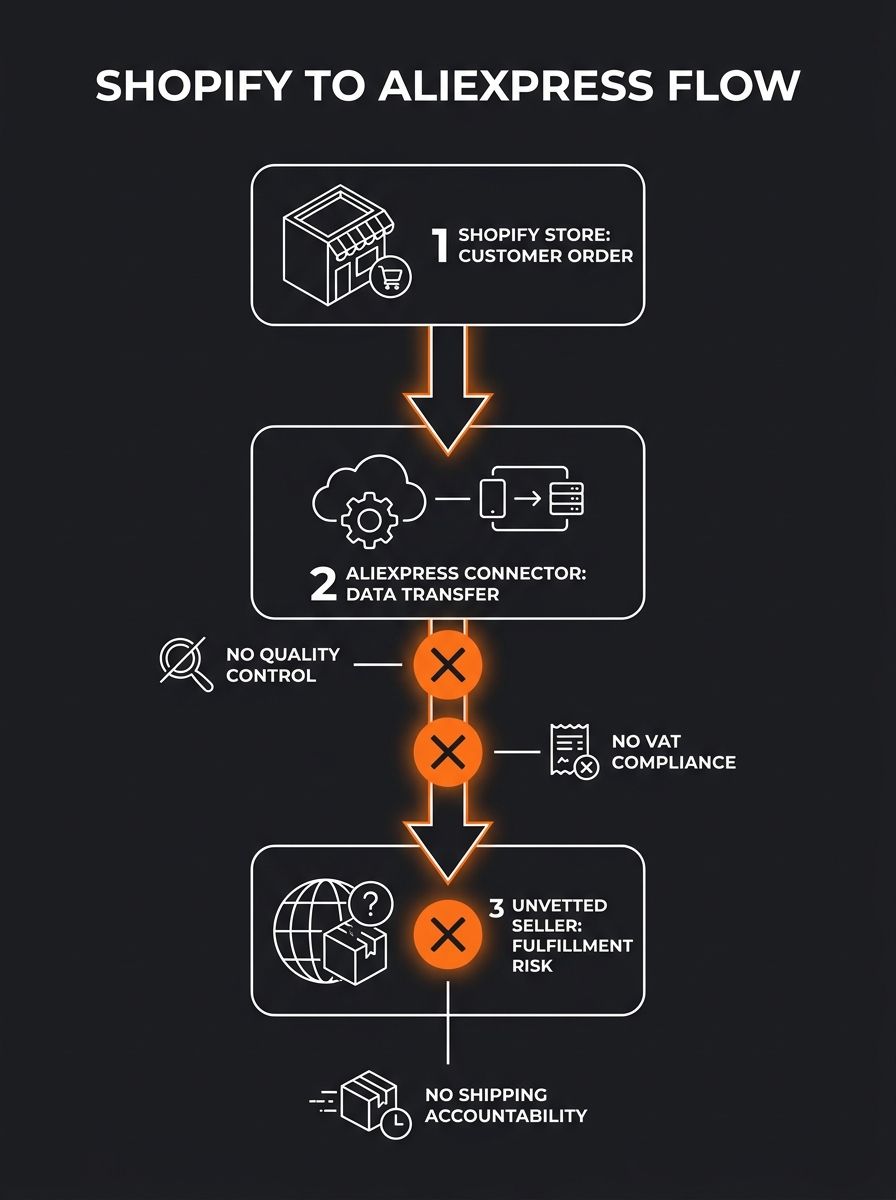
When you install an AliExpress connector on Shopify, the tool creates a bridge between your storefront and AliExpress product listings. A customer places an order. The connector reads that order, maps the SKU to an AliExpress listing, and either auto-places or queues the purchase on your behalf.
Here's what the connector does NOT do:
It doesn't verify the AliExpress seller's current inventory levels in real time (most sync every 6-24 hours)
It doesn't inspect the product before it ships
It doesn't guarantee the seller will use the same factory batch they photographed in the listing
It doesn't handle VAT registration, customs declarations, or import duty calculations
It doesn't give you recourse if the seller swaps materials, changes packaging, or simply ghosts
The connector automates the transaction. Everything surrounding that transaction—supplier reliability, product consistency, shipping accountability, tax compliance—is still on you. If you've used DSers to manage AliExpress fulfillment, you've seen this firsthand: the tool is excellent at bulk order placement, but it can't force a seller to ship on time or match your listing photos.
This is the core automation tool supplier risk that operators underestimate. The automation makes the workflow feel professional and controlled. The underlying supply chain is neither of those things.
The Supplier Vetting Layer That Connectors Skip
Dropshipping supplier vetting on AliExpress is almost entirely manual. You check seller ratings, read reviews, order samples, and hope the quality holds when you scale from 5 orders/week to 50. There's no SLA. No contractual shipping guarantee. No penalty if the seller decides to source from a cheaper factory next month.
Curated platforms flip this. Tradelle, for example, pre-negotiates with suppliers and maintains ongoing relationships with factories that produce branded products across categories like fashion, accessories, and home goods. The platform acts as an intermediary with actual commercial pull: if a supplier drops quality or misses shipping windows, Tradelle can cut them from the catalog. That kind of enforcement doesn't exist on AliExpress, where any seller with a ¥1,000 deposit can list products.
According to analysis of top automation platforms, the critical question operators should ask is whether their tool connects to a curated, vetted network of suppliers or simply provides access to a massive, unvetted marketplace. An integrated supplier network where the platform and suppliers work in close partnership is almost always superior to a loose aggregation of independent sellers.
SaleHoo takes a directory approach, screening suppliers before adding them and reducing scam risk. Spocket curates US and EU suppliers with faster shipping windows. Tradelle focuses specifically on branded and private-label products with factory-level quality agreements. The mechanisms differ, but the principle is the same: someone with commercial power sits between you and the supplier, and that someone has a financial incentive to keep quality high.
Branded Dropshipping vs. AliExpress: The Margin Math
The branded dropshipping vs AliExpress debate usually gets framed around customer perception. But the numbers tell a more specific story.
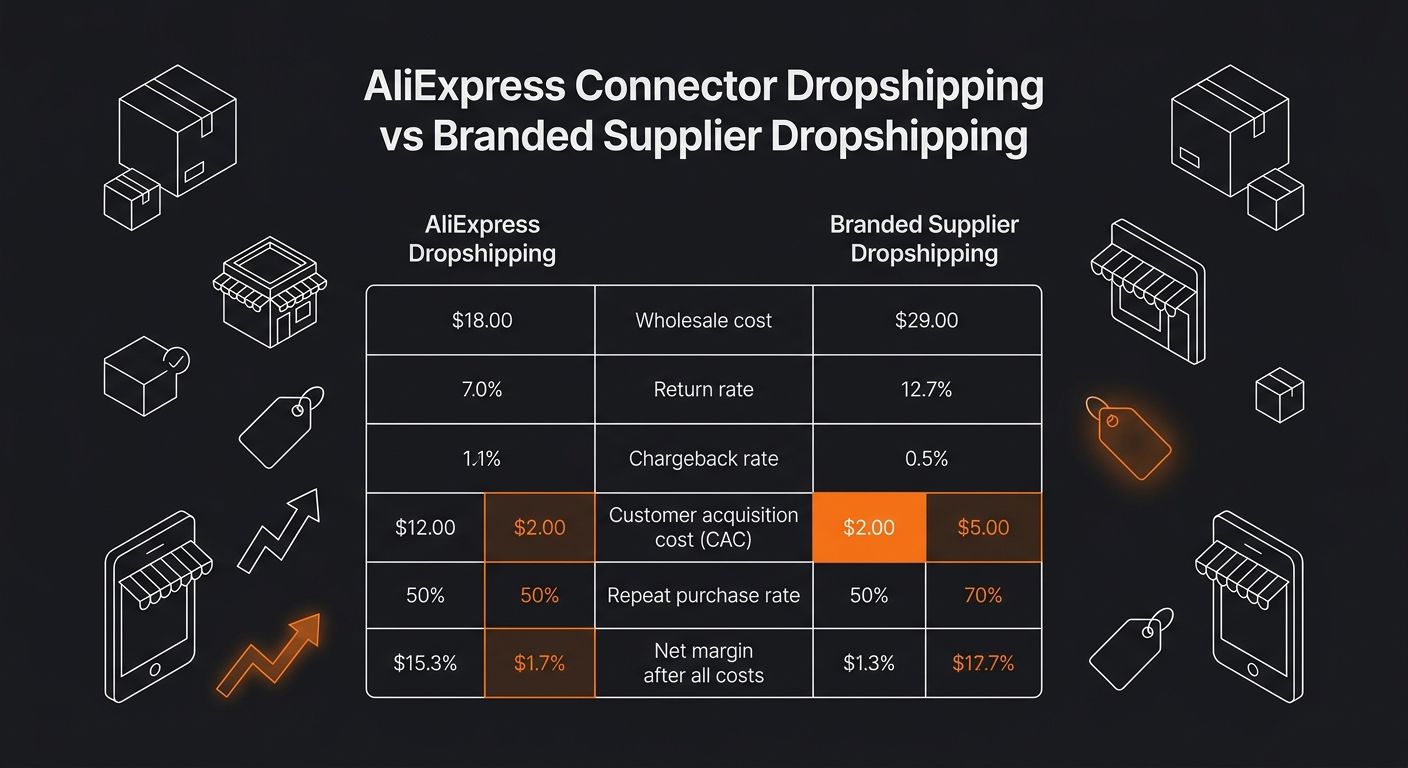
A typical AliExpress product costs $8-15 wholesale, sells for $25-45 retail, and carries a 55-65% gross margin before ad spend. Sounds great on paper. Now factor in the real costs:
Return rate: 8-15% on AliExpress-sourced products (quality variance plus slow shipping leading to "where is my order" refunds)
Chargeback rate: 1.5-3% when shipping takes 15-30 days and customers dispute
Customer acquisition cost: $12-25 on Meta/TikTok for generic products with no brand differentiation
Repeat purchase rate: Under 10% because there's no brand loyalty to a white-label product with a different logo every shipment
A Tradelle or similar branded-supplier product might cost $12-20 wholesale with a retail of $35-70. The gross margin percentage looks similar or slightly lower. But the return rate drops to 3-6% (consistent quality), chargebacks fall below 1% (faster shipping, better tracking), and repeat purchase rates climb to 15-25% because the product arrives in branded packaging that builds recognition.
Run those numbers through your actual margin tracking setup and the branded supplier route wins on net margin by 8-15 percentage points once you account for returns, chargebacks, and customer lifetime value. The cheaper wholesale cost on AliExpress is a mirage when your effective COGS includes all the downstream costs of inconsistency. As Dropified's pricing analysis frames it, when a customer buys a $60 jacket from your store that costs $20 on AliExpress, the $40 markup is the fee they pay to avoid navigating a confusing foreign marketplace, waiting four weeks without tracking, and risking credit card security on an unknown vendor. Your job is to justify that fee with a consistent experience. AliExpress connectors make that justification harder with every quality inconsistency.
VAT, Customs, and the Compliance Blind Spot
Here's where automation tools create genuine legal exposure. If you're selling into the UK or EU from overseas suppliers, VAT compliance dropshipping rules apply regardless of whether you hold inventory. In the UK, if your rolling annual turnover exceeds the current threshold of £90,000, you're legally required to register for VAT. For goods shipped to UK customers valued under £135, the VAT obligation falls on the seller at point of sale, not at customs.
AliExpress connectors don't handle any of this. DSers won't calculate your VAT liability. CJDropshipping won't file your customs declarations. AutoDS won't tell you when you've crossed a registration threshold in Germany, France, or the Netherlands.
Curated supplier platforms handle this differently depending on their structure. Some, like Spocket, work with US and EU-based suppliers where the goods already sit inside the destination market, eliminating the import duty question entirely. Others provide compliance documentation as part of supplier onboarding, giving you the paperwork you need for your accountant without chasing a seller in Yiwu for an HS code.
If you're selling cross-border, you should already be modeling your tariff exposure before picking a supplier. The right platform makes this easier by providing consistent product origin data. AliExpress sellers frequently misclassify goods or omit origin details, which means your customs declarations can be wrong without you knowing it.
Supplier Quality Control Without Being in the Factory
The question every scaling dropshipper eventually hits: how do you maintain supplier quality control when you never touch the product?
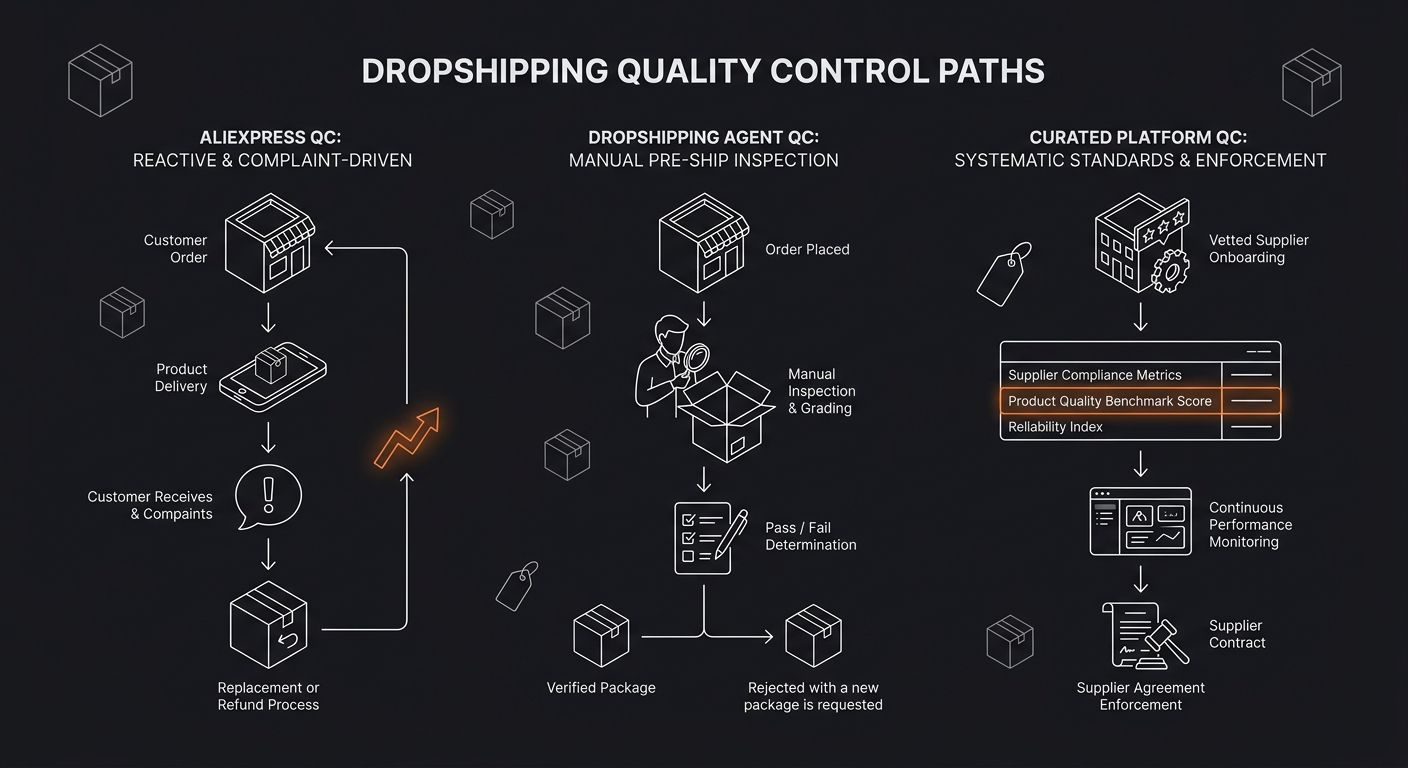
On AliExpress, you don't. You order samples before launch, hope for consistency, and react when customers complain. Your quality control is your refund rate. By the time you notice a supplier has switched materials or cut corners on stitching, you've already shipped 200 units of a product that doesn't match your listing photos.
Branded supplier platforms build inspection into the process. According to research on private-label quality control, a proper QC layer ensures that branded items match your specifications, packaging and logo placement are accurate, and product quality remains consistent across every batch. Tradelle and similar platforms either perform these checks themselves or require their suppliers to meet documented standards before products enter the catalog.
Dropshipping agents offer a middle path. They check products before they ship, negotiate prices, and oversee inventory. But agents add another margin layer and require you to manage the agent relationship on top of everything else. A platform that bakes QC into its supplier agreements removes that management burden.
The mechanism is straightforward: commercial power comes from aggregation. When a platform like Tradelle sends a supplier 500 orders/month across dozens of stores, that supplier has a powerful reason to maintain standards. When you're one store sending 15 orders/week to an AliExpress seller who fills 10,000 orders/month from anonymous buyers, you have zero pull.
Where This Model Still Has Tradeoffs
Curated supplier platforms aren't a free upgrade. The tradeoffs are real, and pretending otherwise would be dishonest.
Catalog size drops dramatically. AliExpress has millions of products. Tradelle has hundreds to low thousands. If your strategy depends on testing 50 products a week to find winners, a curated platform will feel suffocating. The AliExpress connector approach is still the fastest way to validate product-market fit at volume, even with all its downsides.
Per-unit costs are higher. You're paying for the vetting, the QC, and the platform's margin on top of the supplier's price. On low-AOV products ($15-25 retail), this can eat your margin entirely. Branded supplier platforms work best when your retail price is $40+, where the quality premium converts into repeat purchases and lower return rates that justify the higher COGS.
You're dependent on the platform's curation judgment. If Tradelle picks bad suppliers, or Spocket onboards a fulfillment partner that can't handle holiday volume, you eat the consequences. You've traded one dependency (random AliExpress sellers) for another (the platform's vetting team). The second dependency is usually more reliable, but it's still a single point of failure.
Switching costs increase. Once you've built a brand around a curated supplier's products with custom packaging and consistent quality, moving to a different supplier or platform means rebuilding that consistency from scratch. AliExpress stores, for all their flaws, are supplier-agnostic by nature.
The honest assessment: AliExpress connectors are the right tool for testing and early-stage validation. Curated supplier platforms are the right infrastructure for stores that have found winning products and need to build a repeatable, defensible business around them. The mechanism that makes one approach fast also makes it fragile at scale, and the mechanism that makes the other approach slower also makes it durable. Choosing between them depends entirely on what stage you're actually at, and whether you're honest with yourself about the answer.
365 Dropship Editorial
Editorial team writing about E-commerce, dropshipping, and product discovery — reviews of dropshipping suppliers and platforms, trending niche guides (jewelry, beauty, pets, home, fashion), supplier due diligence, ecom operations, shipping & fulfillment strategy, product research, AOV optimization, and profitable dropshipping case studies.
Explore more topics