Amazon Blocks Meta's Muse AI Agent While Shopify Announces Shop Pay Integration
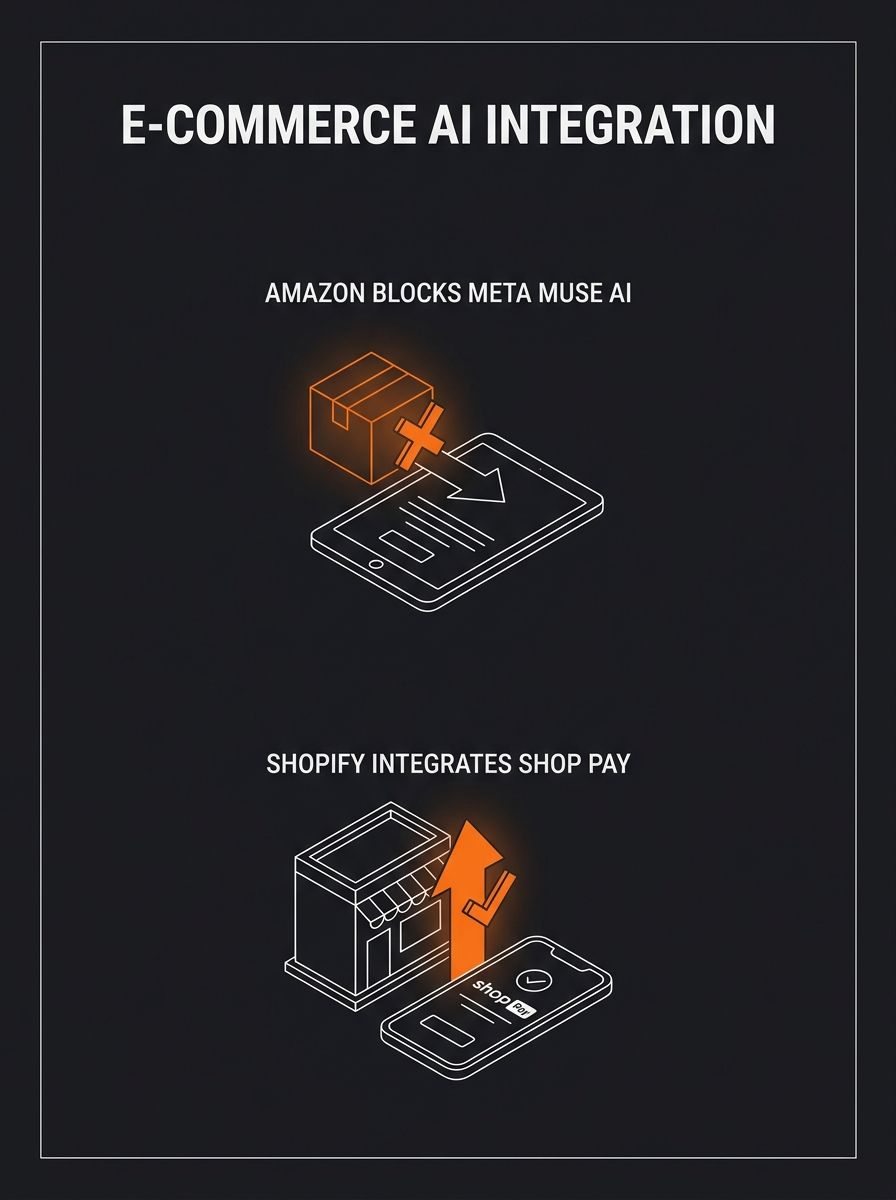
Amazon blocked Meta's Muse AI agent from searching for products and completing purchases on Amazon.com on September 22, 2026, citing unauthorized activity, while Shopify simultaneously announced Shop Pay integration across all Shopify merchant stores, according to a report published by BlockBeats.

Amazon Blocks Meta's Muse AI Agent While Shopify Announces Shop Pay Integration
Amazon blocked Meta's Muse AI agent from searching for products and completing purchases on Amazon.com on September 22, 2026, citing unauthorized activity, while Shopify simultaneously announced Shop Pay integration across all Shopify merchant stores, according to a report published by BlockBeats.
The dual development marks the first major platform split on AI shopping agents, with e-commerce infrastructure providers and marketplace operators taking divergent positions on automated purchase tools that bypass traditional storefront interfaces.
Amazon's Block and Terms Violation Claims
Amazon displayed an "unauthorized AI agent" message to Muse users attempting to browse or purchase products on the platform, stating the tool violated the site's terms of service. The company said Meta did not obtain prior permission to deploy the AI agent on Amazon.com, according to the BlockBeats report.
Amazon further claimed Muse does not disclose itself as an AI agent when browsing the site, creating what the platform characterized as a terms-of-service violation. The block prevents Muse from executing product searches, price comparisons, or checkout flows on Amazon's marketplace.
The restriction arrives as AI agents increasingly target e-commerce platforms for automated shopping assistance. Amazon's position reflects concern over external tools that could redirect the customer journey away from the platform's native search and recommendation systems.
Shopify Integration Details
Shopify announced deep integration with Muse that embeds Shop Pay checkout across all Shopify stores, enabling customers to complete purchases through the AI agent without re-entering shipping or payment details on individual merchant sites. Shop Pay functions as Shopify's one-click checkout system, storing customer payment and address data for simplified transactions.
The integration allows Muse users to select products and execute checkout directly through the AI agent interface, with Shop Pay handling payment processing and order confirmation. Shopify merchants gain access to Muse traffic without implementing custom API connections or agent-specific configurations, according to the announcement.
Shopify characterized the partnership as an additional sales channel for independent merchants operating on its platform. The company does not control the storefront gateway in the same manner as Amazon—merchants sell through their own branded sites, with Shopify providing backend infrastructure for listings, order management, and checkout processing.
The integration positions Shopify's platform infrastructure to capture transaction volume from AI-mediated shopping regardless of the traffic source. Merchants using Shop Pay already benefit from faster checkout flows and stored customer credentials; the Muse integration extends that convenience to conversational AI shopping interfaces.
Business Model Divide Explains Platform Responses
The contrasting positions stem from fundamentally different e-commerce business models, the BlockBeats report noted. Amazon operates as a shopping gateway where customers typically search, compare products, and browse algorithmic recommendations before placing orders. An external AI agent bypassing that flow represents direct competition for the platform's core customer-acquisition and retention mechanisms.
Shopify, by contrast, provides infrastructure for product listings, order management, and checkout to independent merchants. The platform generates revenue from transaction fees and subscription payments tied to merchant activity, not from controlling the initial customer browsing experience. Traffic originating from Muse, ChatGPT, or traditional search engines produces equivalent value as long as transactions complete on Shopify-hosted stores.
For Amazon, Muse competes for gateway control. For Shopify, Muse acts as a traffic driver that increases gross merchandise volume across the merchant base without threatening the platform's infrastructure role.
The distinction mirrors earlier platform splits on price-comparison tools and affiliate networks. Marketplaces that monetize customer attention during the browse-and-search phase historically restrict external tools that shortcut the discovery process. Infrastructure providers capturing value at the transaction layer face fewer incentives to block inbound traffic sources.
The rise of AI-powered revenue agents in direct-to-consumer operations suggests merchants will increasingly adopt automated tools for customer acquisition and conversion optimization. Shopify's integration positions the platform to capture that shift, while Amazon's block signals resistance to AI agents that disintermediate the marketplace's customer relationship.
What Happens Next
Shopify merchants operating Shop Pay checkout will gain access to Muse-driven traffic without additional configuration, creating a potential conversion-rate advantage for stores already using Shopify's one-click payment system. Operators testing AI agent channels may prioritize Shopify infrastructure over Amazon listings to maintain access to emerging conversational-commerce flows.
Amazon sellers face continued restrictions on AI agent access unless Meta and Amazon reach a licensing agreement allowing Muse to disclose its automated nature while browsing the platform. The terms-of-service dispute leaves Amazon-dependent dropshippers and private-label sellers unable to capture traffic from Meta's AI shopping tool.
The platform split forces merchants with multi-channel strategies to evaluate whether AI agent compatibility justifies shifting inventory emphasis toward Shopify storefronts and away from Amazon FBA or Seller Central operations. Conversion data from Muse-driven Shop Pay transactions in the coming quarter will determine whether the traffic channel delivers sufficient volume to alter platform allocation decisions for operators managing both Shopify and Amazon presences.

Ryan Torres
Ryan Torres is a former Amazon FBA seller turned dropshipping consultant who has generated over $2.8M in ecommerce revenue across 14 product launches. He specializes in supplier vetting, margin optimization, and scaling DTC operations for sub-$1M brands. Ryan focuses on actionable frameworks that drive measurable results for independent operators.
Related Articles

Shopify Spring 2026 Updates Push AI Shopping Integration and Checkout Automation for Independent Stores
Shopify rolled out its Spring 2026 platform updates with AI shopping tools, checkout workflow improvements, and product discovery automation that independent store operators can deploy without developer resources, according to creator-commerce analysis published June 17 by Jack Righteous. The releas

TikTok Shop, Amazon, and Shopify Deliver Different Profit Profiles for DTC Brands, Avenue Z Analysis Finds
Avenue Z's June 10 platform analysis concludes that no single eCommerce channel delivers universal profitability for DTC brands, positioning TikTok Shop for low-acquisition trendy products, Amazon for high-intent search volume, and Shopify for margin control and customer data ownership, according to
AI Store Builders vs. Manual Shopify Setup: The 2026 Speed-to-Profit Tradeoff for Dropshippers
Atlas AI Store Builder generates a fully functional Shopify store in under two minutes, according to a Dropmagic comparison of seven AI tools. Manual Shopify configuration typically requires 15 to 40 hours of theme work, copywriting, image editing, and SEO.
Explore more topics