DTC Brands Using AI Revenue Agents Report 30-50% First-Time Revenue Lift as Lean Operations Model Gains Traction
Direct-to-consumer brands using AI revenue agents to automate acquisition, conversion, and retention workflows reported 30 to 50 percent higher first-time customer revenue and two- to four-times higher repeat purchase revenue compared to baseline performance, according to Ground's September 4 analys
DTC Brands Using AI Revenue Agents Report 30-50% First-Time Revenue Lift as Lean Operations Model Gains Traction
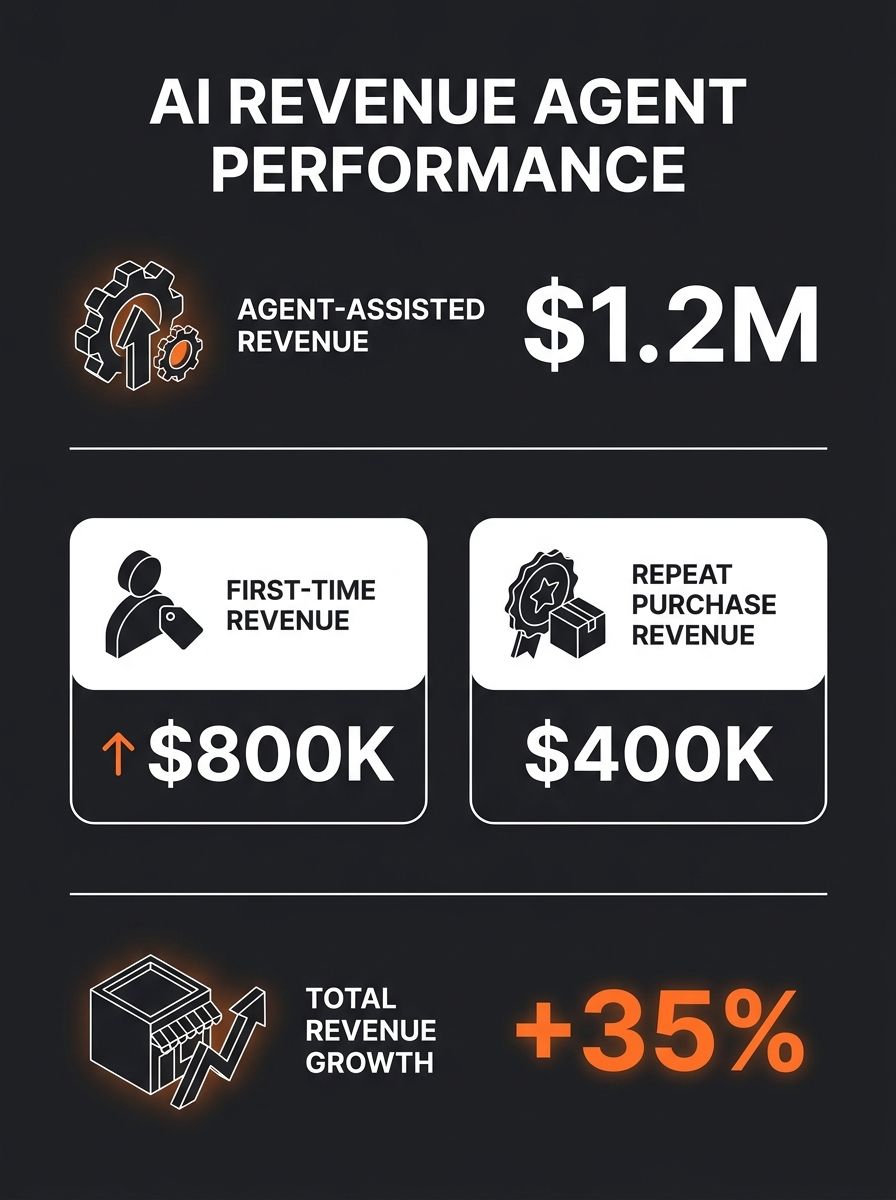
Direct-to-consumer brands using AI revenue agents to automate acquisition, conversion, and retention workflows reported 30 to 50 percent higher first-time customer revenue and two- to four-times higher repeat purchase revenue compared to baseline performance, according to Ground's September 4 analysis of partner brand data, marking a shift toward lean operational models as customer acquisition costs climbed 222 percent over eight years.
The operational model represents a departure from the traditional scaling playbook that relied on hiring lifecycle marketers, retaining agencies, and building internal infrastructure over multi-quarter timelines. Ground, a Shopify and Klaviyo-integrated platform, reported that its AI agents now drive approximately 10 percent of total DTC revenue for partner brands, with setup requiring 15 minutes and no data science team.
"The brands quietly printing profit in 2026 run small, focused teams - not because they cut corners, but because AI now does revenue-generating work that used to take whole departments," Sheida Mirjahani, who leads growth at Ground, wrote in the company's Common Ground newsletter.
Customer Acquisition Cost Pressure Drives Retention Focus
The 222 percent increase in customer acquisition costs since 2018 has forced DTC operators to prioritize retention economics over volume-based growth strategies. Ground's analysis positioned AI-driven retention as the mechanism allowing brands to "earn more from every customer they acquire" rather than reducing acquisition spend.
The platform's three-agent system handles visitor identification, on-site conversion, and post-purchase lifecycle automation. Partner brands using the system see every acquisition dollar generate higher lifetime value through retention compounding, according to the company's September 4 report.
Traditional scaling required hiring a lifecycle marketer, standing up email and SMS infrastructure, coordinating across agencies, and waiting two quarters for payback on the investment. The AI agent model collapses that timeline to a same-day deployment inside existing ecommerce stacks, the analysis noted.
AI Shopping Adoption Outpaces Retailer Readiness Ahead of Q4
Sixty-five percent of consumers plan to use artificial intelligence tools for holiday shopping in 2026, while only 8 percent of retailers report feeling "very confident" in their agentic commerce capabilities, according to a BCG consumer study cited in Ground's report. The readiness gap arrives nine weeks before the fourth-quarter selling period, when the operational efficiency differential between lean AI-powered teams and traditional structures becomes most expensive.
AI-assisted shopping journeys introduce consumers to new brands in 63 percent of interactions, the BCG study of 13,000-plus consumers across 12 markets found. Ground framed the statistic as evidence that commerce distribution is shifting toward large language model-driven discovery, research, and purchasing faster than most retailers have prepared for.
Walmart reported 70 percent year-over-year growth in usage of its AI shopping assistant Sparky, with Sparky users spending 40 percent more per order than baseline shoppers, according to data cited by Ground from Retailgentic. Williams-Sonoma's AI assistant Olive drove a 620 percent surge in associated revenue in 2026, with Olive users converting at three times the rate of other site visitors, the same Retailgentic data showed.
First-Party Data Positioning for LLM-Driven Commerce
Ground positioned first-party data accumulation as the long-term strategic advantage for brands adopting AI agents early, arguing that every interaction trains the models driving future revenue. The company suggested lean brands hold an agility advantage over legacy retailers constrained by existing infrastructure when building for LLM-driven commerce channels.
The platform's revenue contribution to partner brands grows as its models improve, creating what the company described as a compounding effect for early adopters. Brands that integrated AI agents in 2025 or early 2026 are "compounding" their advantage over competitors still operating traditional lifecycle marketing structures, according to the September 4 analysis.
Ground announced its team will attend Klaviyo's Boston conference September 9-10, 2026, positioning the event as an opportunity to share "what's actually moving topline revenue" for partner brands. The company offers calendar bookings with co-founder Kat and head of sales Aman for in-person meetings at the Hynes Convention Center.
Reading Between the Lines
Independent ecom operators and dropshipping solopreneurs face the same CAC inflation documented in Ground's analysis, but most lack the budget to hire lifecycle agencies or build multi-person retention teams. The AI agent model Ground describes—automated visitor identification, conversion optimization, and email/SMS lifecycle loops inside existing Shopify and Klaviyo setups—maps directly to the operational constraints of single-person stores that can't afford traditional scaling paths.
The 30-50 percent first-time revenue lift and 2-4x repeat purchase multiplier translate to meaningful margin improvements for stores operating on thin dropshipping economics. A solopreneur running 15 percent net margin on $10,000 monthly revenue who captures an additional 30 percent first-time revenue and doubles repeat purchases shifts from $1,500 to roughly $3,000 monthly profit without adding headcount. The question for operators evaluating platforms like Ground is whether the software cost consumes the margin gain—pricing wasn't disclosed in the September 4 piece.
The 65-percent-plan-to-use-AI versus 8-percent-retailer-readiness gap signals that lean stores willing to test AI shopping assistants, recommendation engines, or lifecycle agents in September 2026 may capture holiday traffic that larger retailers aren't yet equipped to serve. For dropshippers testing product niches, adding an AI layer to acquisition and retention while competitors run manual email sequences could be the operational edge that makes a mediocre product test profitable.

Ryan Torres
Ryan Torres is a former Amazon FBA seller turned dropshipping consultant who has generated over $2.8M in ecommerce revenue across 14 product launches. He specializes in supplier vetting, margin optimization, and scaling DTC operations for sub-$1M brands. Ryan focuses on actionable frameworks that drive measurable results for independent operators.
Related Articles
Shopify Spring 2026 Updates Push AI Shopping Integration and Checkout Automation for Independent Stores
Shopify rolled out its Spring 2026 platform updates with AI shopping tools, checkout workflow improvements, and product discovery automation that independent store operators can deploy without developer resources, according to creator-commerce analysis published June 17 by Jack Righteous. The releas
AI-Powered Dropshipping: Automate Your Store
Artificial intelligence dropshipping tools can save operators 8 to 20 hours per week on inventory sync, customer support, and pricing adjustments. But the operators who profit from AI follow specific rules about where automation belongs and where it destroys value.
AI Store Builders vs. Manual Shopify Setup: The 2026 Speed-to-Profit Tradeoff for Dropshippers
Atlas AI Store Builder generates a fully functional Shopify store in under two minutes, according to a Dropmagic comparison of seven AI tools. Manual Shopify configuration typically requires 15 to 40 hours of theme work, copywriting, image editing, and SEO.
Explore more topics