Dropshipping For Beginners: The 2026 Operator's Guide
If you can put $1,500 to $3,000 behind paid testing and accept that the first profitable store usually arrives in month four to six, dropshipping is still a viable side-business in 2026 — especially in jewelry, beauty, pets, and home niches with 50%+ gross margins. Skip it if …
Dropshipping For Beginners: The 2026 Operator's Guide
TL;DR
If you can put $1,500 to $3,000 behind paid testing and accept that the first profitable store usually arrives in month four to six, dropshipping is still a viable side-business in 2026 — especially in jewelry, beauty, pets, and home niches with 50%+ gross margins. Skip it if you have under $500, can't run ads, or want passive income — the post-tariff economics punish thin-margin AliExpress arbitrage. A realistic timeline is $0 in months 1-2, $1K-$3K/month by month six for the majority who get profitable, and replacement-of-day-job income at month twelve to eighteen for a smaller cohort that scales hard.
Dropshipping in 2026 looks nothing like the 2018 Oberlo era. Three things shifted in the last twelve months that change the math for new operators. First, the August 2025 suspension of Section 321 de minimis — extended globally by executive order in February 2026 — killed the tax-free $800-and-under loophole that propped up cheap China-direct stores. Section 122 surcharges plus existing duties now stack to 50%+ of customs value on a lot of low-value Chinese goods, so the $1.50 phone-case-to-$24.99 model from five years ago no longer pencils out. Second, Meta CPMs sit at $20-$23 in the US in early 2026 — meaningfully higher than the $8-$12 of 2020 — which means undercapitalised testing is more brutal than ever; you cannot get statistical signal on a $50/day budget anymore. Third, AI-overview traffic has cannibalised a chunk of organic search, so 'rank in Google for {product} review' is a slower and less reliable acquisition channel. None of this means dropshipping is dead. It means the winners look different: better niches, US-warehoused suppliers, healthier margins, and operators who treat their first $1,500 as tuition rather than seed capital.
What dropshipping actually is in 2026 (and what it's not)
Mechanically: a customer orders from your storefront at retail price, you forward the order and your wholesale payment to a supplier, and the supplier ships directly to the customer with your branding (or generic packaging). You never touch the inventory. Margin is the gap between what the customer paid and what you paid the supplier plus shipping plus payment fees plus your ad cost. That part hasn't changed. What HAS changed: this is no longer 'free money'. It's not 'hands-off' — running a real store is roughly 30 hours a week of customer service, ad management, creative iteration, and supplier coordination. It's not the AliExpress-arbitrage of 2018 — Section 321 ended global duty-free entry on low-value parcels in February 2026, so a $5 product from China now lands with formal customs entry plus tariff. And it's not 'start with $0' — anyone selling that pitch is selling a course. The 2024-2025 platform shakeout (Oberlo officially gone, AliExpress integrating with DSers as the default tool, several smaller suppliers folding under tariff pressure) consolidated the market around a smaller set of credible providers. Dropshipping in 2026 is closer to running a real direct-to-consumer brand than to flipping items: you build a niche-focused store, cultivate one or two supplier relationships, run paid traffic, and treat the business like a 12-month project rather than a 12-week stunt.
Why most beginners fail (and how to avoid it)
Five failure modes account for almost every blown-out beginner store. First, picking saturated niches — generic phone accessories, knockoff posture-correctors, copy-paste 'gadget' stores. The fix: pick one of the six durable categories where margin discipline still works (jewelry, beauty, pets, fashion, home, cosmetics), then go narrower — not 'pet store' but 'enrichment toys for senior dogs'. Second, undercapitalised ad budgets. The biggest reason new dropshippers fail is testing with $5-$10/day; you cannot collect statistical signal at that volume when US Meta CPMs are $20+. The fix: don't start running ads until you can commit $50-$100/day for fourteen consecutive days against a single creative-and-audience combo. Third, wrong supplier choice. Picking the cheapest AliExpress listing without ordering a sample, without checking lead times, without confirming the supplier handles RTO (return-to-origin) gracefully — that ends in chargebacks. The fix: order three samples from any supplier you plan to use, time the actual delivery, and inspect packaging quality before publishing the product. Fourth, no margin discipline. Selling a $9 product for $19 in 2026 means after CAC, payment fees, and refunds you net negative. The fix: 3x markup minimum on the landed cost, or move to a higher-AOV niche. Fifth, emotional product picks — selling what you personally like rather than what data says is selling. The fix: validate every product against the Meta Ads Library, TikTok Shop best-sellers, and Amazon Movers & Shakers before you commit a dollar of inventory or ad spend.
The 6-step beginner roadmap
Shopify is the default storefront for new dropshippers in 2026.
Step 1 — Pick a niche. Use three filters: gross margin potential of 50%+ at retail (jewelry, beauty, pet accessories, home decor all clear this), an average order value above $35 (sub-$50 AOV niches die under 2026 CPMs unless you have a freakishly high repeat rate), and a topic you can plausibly write 100 emails about in a year. If you can't, you'll burn out before you reach profitability. Step 2 — Validate demand. Search the Meta Ads Library by competitor name and look for ads that have been live 30+ days — that's the demand signal that matters. Cross-check on TikTok Shop best-sellers and Amazon Movers & Shakers. If three or more competitors are running the same product variant for over a month, the demand is real. Step 3 — Find a supplier. Order samples from at least two suppliers, even if it costs you $80. Time the delivery, photograph the packaging, and test their support response time. For US targeting in 2026, prefer suppliers with US warehousing (Spocket, Zendrop's US 3PL, CJ's US warehouses, 365dropship's vetted US-and-EU network) — the post-tariff math punishes ship-from-China unless your AOV exceeds $80. Step 4 — Build the store. Shopify Basic at $29/month, one premium theme ($150-$350 one-time), and three apps to start: a reviews app (Loox or Judge.me), an email tool (Klaviyo free tier up to 250 contacts), and one upsell app (ReConvert or Bold Upsell). Skip everything else until you're profitable. Step 5 — Drive traffic. Paid first, organic later. Start with $50-$100/day on Meta against one cold audience and one warm-retargeting set; expect $20-$23 US CPMs and $25-$35 CPA in your first thirty days. TikTok ads run cheaper ($5-$10 CPM, $0.50-$1.50 CPC) but convert at lower rates — they're better for awareness than direct response in most niches. Step 6 — Fulfill and iterate. Track three numbers obsessively: time-to-fulfill (under 72 hours from order to tracking number is the bar), RTO rate (under 5% is healthy; over 10% means a product or shipping problem), and CAC payback period (you want first-purchase profitability or under 90-day payback). If any of those slips, fix it before you scale spend.
Realistic earnings, timeline, and capital needed
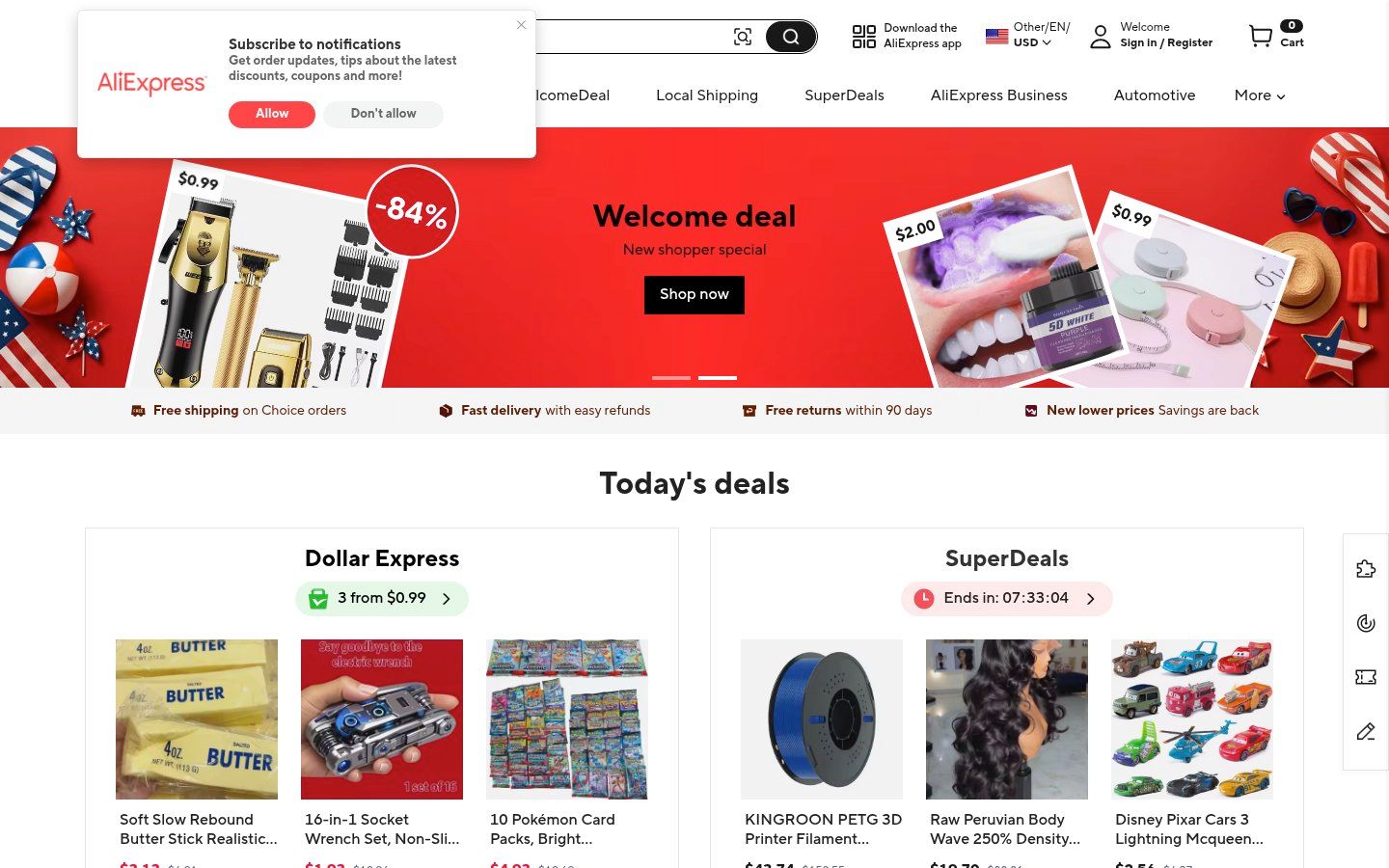
AliExpress remains the largest catalog, though tariff math has shifted.
Honest numbers, the kind no course-seller will give you. Capital. $1,000 is the real minimum for a serious test in 2026 — $30 for the domain and Shopify trial extension, $150-$350 for a theme if you want a credible look, $80 for samples, and $400-$500 for the first ad-test cycle. $3,000 is the budget that gives you two product tests instead of one and a meaningful buffer for payment-processor holds. $5,000-$8,000 is the realistic three-month operating budget if you're going to commit. Timeline. Months 1-2: Setup, sample testing, first ad test. Most stores lose money or break even in this window — that's expected. Roughly 60-70% of stores that survive this phase do so because the operator made data-driven kills, not because they got lucky on product one. Month 3-4: First profitable creative-product-audience combination, often in the $1,500-$5,000 monthly revenue range. Month 6: For the cohort that's still active and learning, $3,000-$8,000 monthly revenue is the typical band, with $1,000-$3,000 in net profit after ads. Month 12: A meaningful split — about half of survivors stagnate in the $5K-$15K MRR range and become a part-time supplemental income; the other half either scale into a real business ($30K+ MRR with hired help) or quit. Replacement of a $60K-$80K day-job income takes most successful operators 12-18 months from first sale — sooner if they reinvest aggressively, slower if they pull profit out. Profit margins of 15-40% net are typical, and the upper range comes from higher-AOV niches with strong email-list reactivation. The headline 'I made $40K my first month' stories you see on YouTube are almost always either gross revenue (not profit), unrepeatable launch-window flukes, or fabricated.
The 2026 tool stack — what you actually need
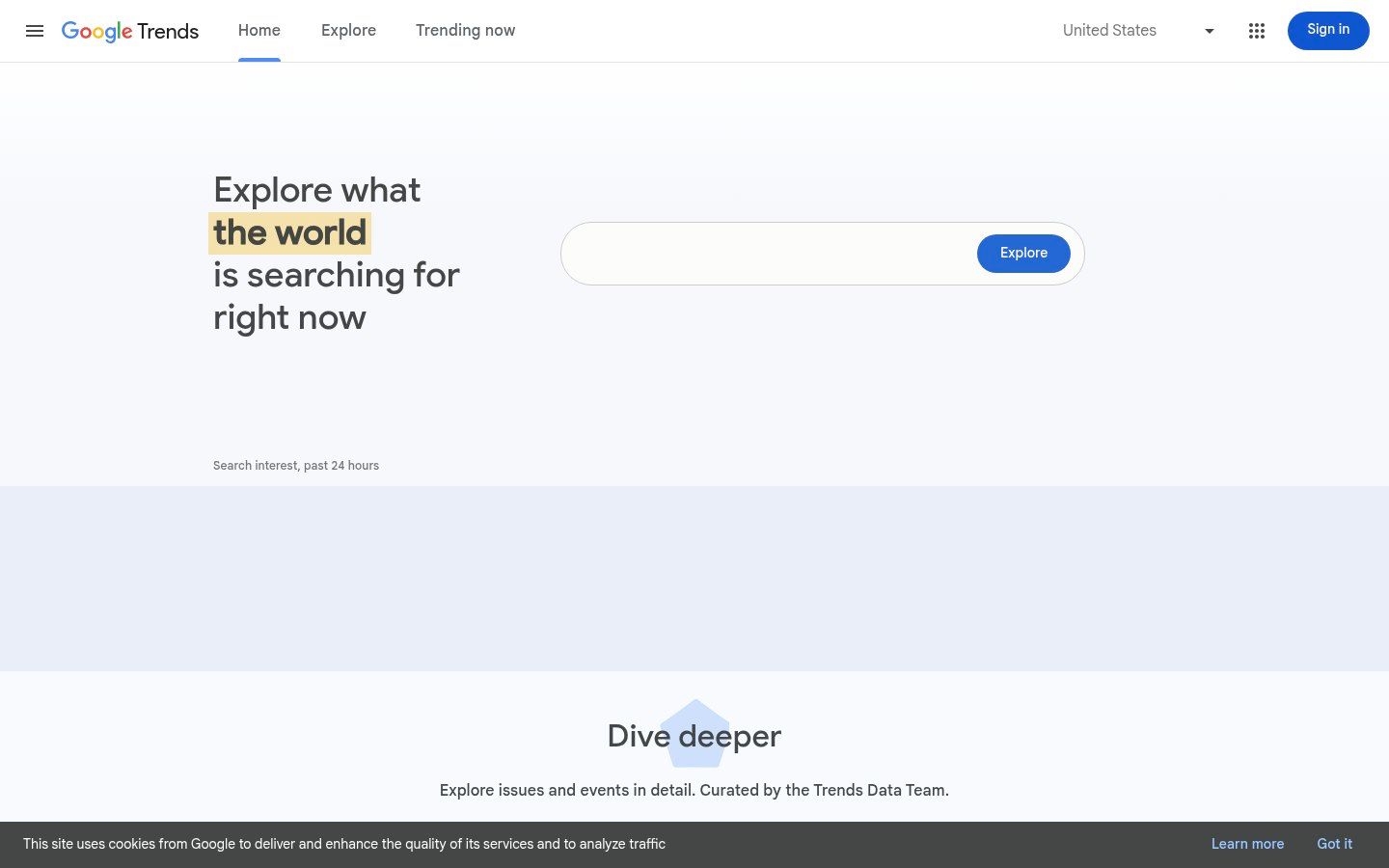
Google Trends is the cheapest way to validate niche demand before you invest a dollar in ads.
Run lean, add tools when they pay for themselves, not before. Storefront — Shopify Basic, $29/month annual billing. Don't waste time on WooCommerce or BigCommerce as a beginner; the integration depth and app ecosystem on Shopify is worth the platform fee. Reviews — Loox or Judge.me. Judge.me has a genuinely usable free tier and is the right starting point under 200 monthly orders. Loox is worth the $9.99-$34.99 monthly spend once your Meta or TikTok creative budget crosses $5K/month — its photo-review submission rate is roughly 3x Judge.me's, and that becomes ad creative you'd otherwise pay for. (We have a full review of Loox if you want depth.) Email and SMS — Klaviyo. Free up to 250 contacts; $20/month at 500; $59/month at 2,500. The marginal flow you build (welcome, browse-abandon, cart-abandon, post-purchase) typically pays for itself at any list size above 500. Omnisend is a credible cheaper alternative under 1,000 contacts; Privy is the budget pick under 500 contacts. Upsell and post-purchase — ReConvert or Bold Upsell. $4.99-$29/month depending on plan. AOV lift of 8-15% is typical and pays for the app on day one. Supplier integration — your platform of choice. AliExpress only via DSers (free Basic plan; $19.90/month Advanced). Spocket Pro at $59.99/month for US/EU SKUs. CJ Dropshipping is free with pay-per-order. 365dropship runs $39 Growth or $99 Scale for vetted-supplier access across six niches. Zendrop's $49 Pro tier covers US 3PL access. Ad analytics — Triple Whale or Shopify-native. Triple Whale (~$129/month) becomes worth it past $30K MRR; below that, Shopify's native analytics plus a Meta Pixel is fine. Customer support — Gorgias or Tidio. Tidio has a free plan that works under 50 conversations a month; Gorgias starts at $10/month and is the right tool once you're doing 200+ tickets a week. The whole stack runs $80-$150/month in the first three months if you're disciplined. Spending more than that before you're profitable is theatre.
Common questions
Is dropshipping legal? Yes, in the US and almost every developed market — it's a legitimate retail model used by Wayfair, Overstock, and large parts of Amazon. The legality questions show up around what you sell (counterfeit goods, IP-violating mockups, restricted health claims) and how you handle tax, not around the business model itself. Do I need a business license? Almost certainly yes for operating beyond hobby revenue. Most US states require a sales tax permit and a resale certificate; some cities require a general business license on top. The post-Wayfair economic-nexus rules typically kick in at $100,000 in sales OR 200 transactions per state — meaning you can rack up sales-tax obligations in states you've never visited. Check your home state and city before you cross $1,000 in monthly revenue, and revisit the multi-state question once any single out-of-state customer base approaches the nexus thresholds. What's the best country to start in? The US, UK, Canada, and Australia are the four large markets with the cleanest payment-processor support and predictable customs. The US has the highest CPMs but the highest AOVs; the UK has cleaner consumer-protection rules; Canada and Australia are smaller markets with less competition. Best niche for 2026? Jewelry (50-70% gross margins, gift-driven demand peaks), pet accessories (recession-resistant, smart-pet-device subcategory growing 20% YoY), beauty and skincare devices (high AOV, repeat-purchase potential), and home decor (handles tariff pressure better because heavier items had less de-minimis exposure). How much can I make? Realistic median for active operators in year one is $500-$3,000/month in profit. Top decile is $8,000-$40,000/month. The skewed-tail $100K+ months are real but rare and usually concentrated in high-AOV niches like furniture, premium beauty devices, or fitness equipment. The numbers shouted on YouTube are almost always gross revenue or fluke launch windows, not sustainable take-home profit. Should I dropship from China? Only if your AOV is $80+ and you've factored in the post-de-minimis tariff stack. For lower-AOV stores, US-warehoused inventory through Spocket, Zendrop, CJ's US warehouses, or 365dropship's US/EU supplier network is now the default — the math doesn't work the other way. Do I need to incorporate as an LLC? Not on day one. A sole proprietorship works for your first $5K-$10K in revenue. Form an LLC once you're consistently profitable, planning to hire, or want personal-asset protection from product-liability exposure. Can I dropship part-time while keeping a job? Yes — most successful first-year operators do exactly this. Block 8-12 hours per week (mornings, evenings, weekends) and treat the time discipline like a second job, not a hobby. Quitting your day job before month nine is almost always premature.
Next steps for a brand-new operator
Three concrete actions for the next seven days. Day 1-2: Pick the niche. Spend two hours on the Meta Ads Library, TikTok Shop, and Amazon Movers & Shakers. Make a list of fifteen products that show 30+ day ad activity, decent reviews, and an AOV above $35. Group them into three tight niches and pick the one you can stomach reading about for twelve months. Day 3-5: Order samples. Pick two products from your top niche, order from two different suppliers, and start a spreadsheet tracking lead time, packaging quality, and unit cost. This is the single highest-leverage thing you can do in your first week — most failed dropshippers skip it, and that's why their stores die. Day 6-7: Set the budget you can actually lose. Not 'invest' — lose. If $1,500 disappearing tomorrow would put your rent at risk, you don't have enough capital to start ads in 2026 yet. Save another month, or start with a lower-capital approach (organic TikTok content, Etsy storefront, free-tier email list-building) that lets you learn the customer side without burning ad money. There is no version of this where you build a successful store on $200 of starting capital in 2026. The honest pitch is: this is a real business that takes real money and 12-18 months to replace a salary. Skip the people promising otherwise.
Reviewed by 365 Dropship Editorial. Last verified 2026-04-30. Methodology: figures reflect 2025-2026 operator data from Shopify Plus, Klaviyo benchmarks, Meta's reported CPM disclosures, and the Section 321 / May 2025 tariff regime currently in effect. Email the editorial desk to flag a correction.
365 Dropship Editorial
Editorial team writing about E-commerce, dropshipping, and product discovery — reviews of dropshipping suppliers and platforms, trending niche guides (jewelry, beauty, pets, home, fashion), supplier due diligence, ecom operations, shipping & fulfillment strategy, product research, AOV optimization, and profitable dropshipping case studies.
Explore more topics