The Post-Order Problem: Why Dropshippers Lose Money After the Sale (And How to Fix It)
Dropshipping margin leaks don't cluster at the point of sale. They accumulate afterward, in the gap between order confirmation and customer satisfaction, where returns, chargebacks, and support tickets quietly eat into the 10-15% net margins most stores operate on.
The Post-Order Problem: Why Dropshippers Lose Money After the Sale (And How to Fix It)
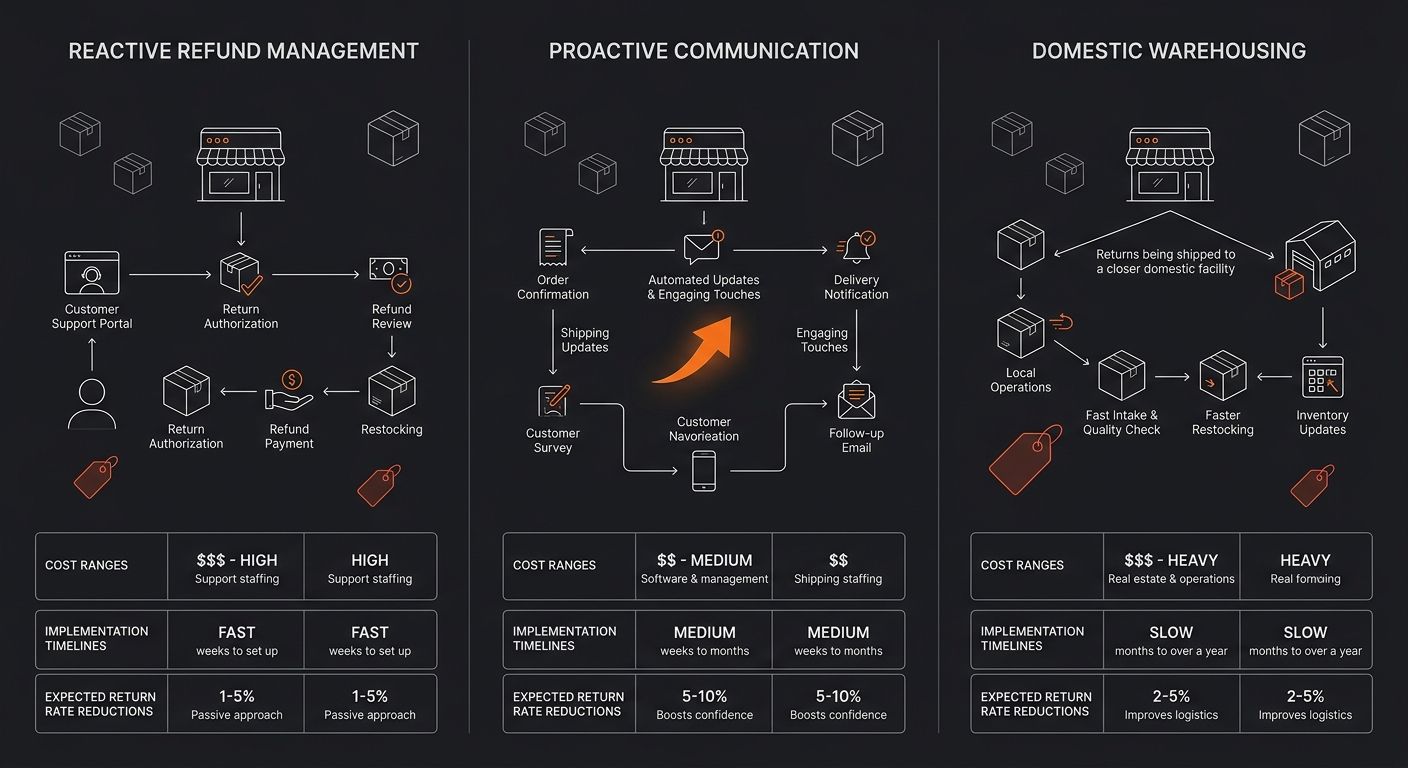
Dropshipping margin leaks don't cluster at the point of sale. They accumulate afterward, in the gap between order confirmation and customer satisfaction, where returns, chargebacks, and support tickets quietly eat into the 10-15% net margins most stores operate on. Three competing strategies have emerged for plugging these leaks: reactive damage control through store credit and partial refunds, proactive prevention through communication and expectation management, and structural fixes through domestic fulfillment and supplier diversification. Each strategy carries different costs, different timelines, and different ceilings on what it can actually save you.
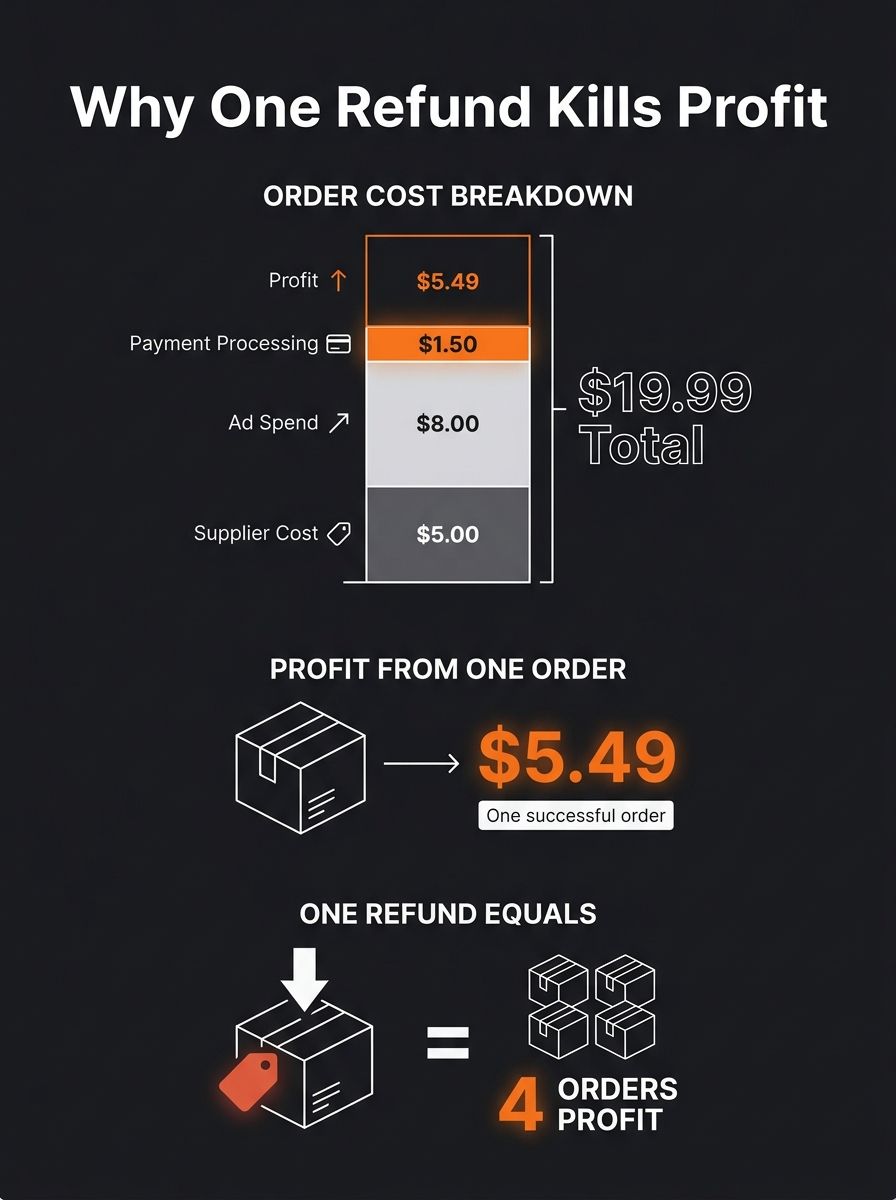
The store selling a $19.99 product at $12 cost with $6 in ad spend has $1.99 left before returns, payment processing fees, and customer service time. One refund on a non-resellable item doesn't just erase profit on that order. It erases profit on the next four orders that went perfectly. Understanding which post-purchase dropshipping operations strategy fits your store's current revenue, margin structure, and product category is the difference between scaling profitably and scaling into a wall.
Containing the Bleed with Store Credit and Partial Refunds
The fastest fix. When a customer complains, you skip the full cash refund and offer store credit, a replacement, or a partial refund that lets you keep some margin intact. This is pure damage control, and it works for stores that need to stop hemorrhaging money this week.
The math is straightforward. A full refund on a $39.99 order where the product cost you $12 and the ad spend was $15 means you've lost $27, because you can't resell the returned item and you've already paid for the acquisition. Offer a 50% partial refund ($20) and you've cut your loss to $7. Offer store credit for the full amount and your cash loss is zero until they redeem it, and RetailDive data shows that a meaningful percentage of store credit goes unredeemed.
When This Works
Stores with high AOV and repeat purchase potential benefit most. If your average customer buys twice a year and your store credit keeps them in the ecosystem, the LTV math can justify absorbing the initial cost. Clothing and accessories stores, where sizing issues drive 52% of returns according to RetailDive research, often default here because the alternative is processing expensive reverse logistics on low-margin items.
The Tradeoff
You're treating symptoms. Every store credit issued is a band-aid on a problem that will recur with the next customer, and the next. And if your customer refund management process depends on manual responses, the support time alone adds $3-8 per ticket depending on whether you're handling it yourself or paying a VA. At 50+ tickets per week, that's a second employee's worth of cost.
Requiring photo proof of damage or defects before issuing any refund is table stakes here. Spocket's return policy framework recommends defining "unused" explicitly on every product page, specifying whether original packaging matters, and making photo submission mandatory. This alone can cut fraudulent or gray-area return requests by 30-40%.
If you're running a contribution margin analysis across your catalog, as we covered in our framework on how equal-revenue products can deliver wildly different profit gaps, you'll find that the SKUs generating the most returns are often the ones with the thinnest margins to begin with. Cutting those products is sometimes a better move than managing their returns.
Preventing the Complaint Before It Happens
The second approach shifts the intervention point earlier. Instead of managing complaints when they arrive, you invest in systems that stop them from being filed. This is where proactive communication, accurate product listings, and transparent shipping timelines live.
The data supports this approach aggressively. Up to 60% of customer complaints fall into predictable categories: "Where is my order?", "This doesn't look like the photo," and "This doesn't fit." Each one is preventable with information the store already has but isn't sharing.
Shipping Transparency
If your supplier ships from China, say 12-20 business days on the product page and in the order confirmation email. Then send automated updates at dispatch, customs clearance, and out-for-delivery. AfterShip and similar tracking tools can automate this entire flow. The cost is $11-99/month depending on order volume. Compare that to the chargeback fees ($15-25 per dispute) and the payment processor risk that come from customers who never got a shipping update and assumed they were scammed.
Product Listing Accuracy
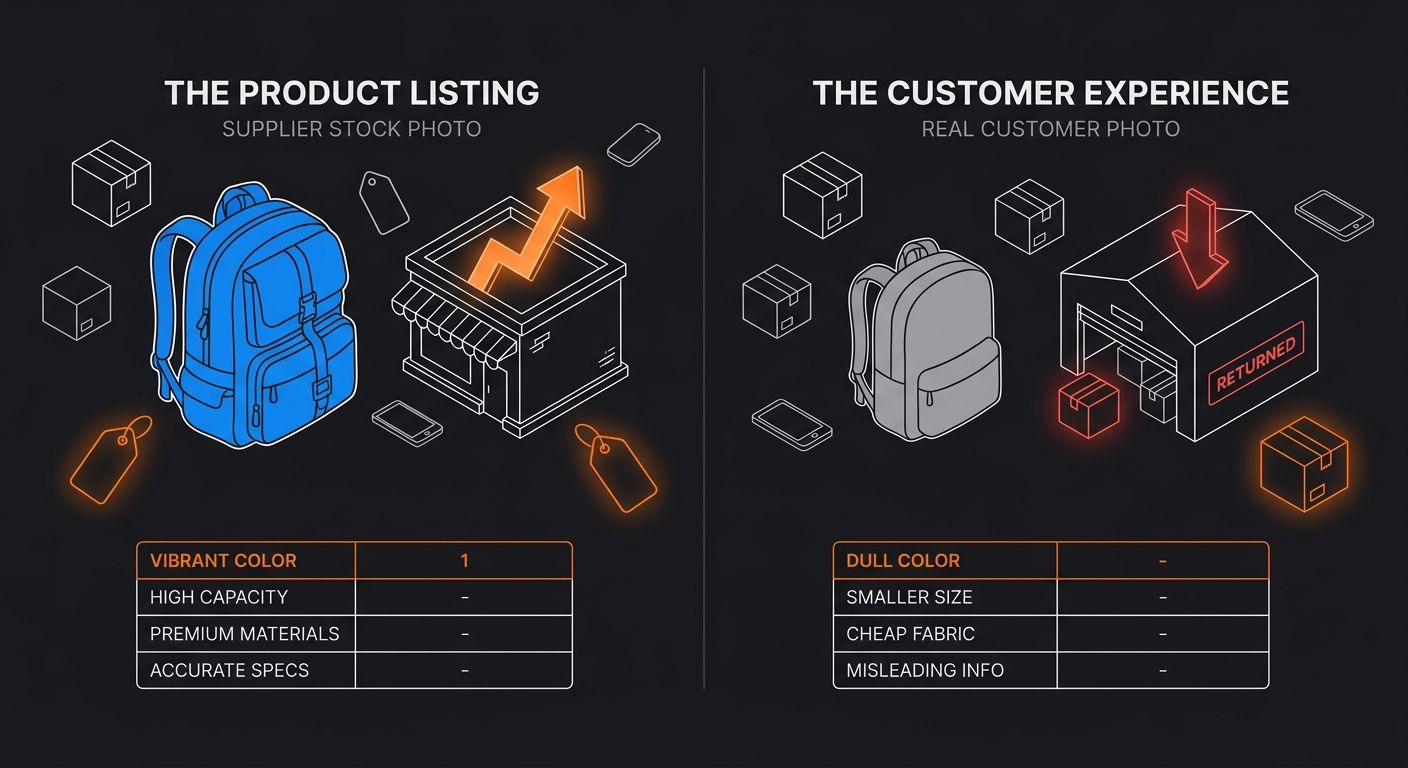
Real product photos kill returns. Supplier stock images from AliExpress are shot with studio lighting, often on models who don't represent your customer base, and frequently show colors that don't match the physical item. Ordering samples and shooting your own photos costs $50-200 per product. That investment pays for itself if it prevents even 5-10 returns per month on a mid-volume SKU.
For clothing specifically, sizing charts on every single product page are non-negotiable. USAdrop's policy guide puts it bluntly: if you're dropshipping clothing without a sizing chart, you're choosing to process more returns. Your supplier test orders should include measuring the actual product dimensions against what the supplier claims.
The Tradeoff
Prevention requires upfront investment in time and tooling before you see returns. You need automated email sequences, tracking integrations, real product photography, and accurate listings for every SKU. For a store with 200+ products, that's weeks of work. And prevention doesn't eliminate returns entirely. Some customers will always be unhappy, some products will arrive damaged, and some suppliers will ship the wrong item regardless of how well you've communicated.
The ceiling on this approach is roughly a 50-70% reduction in support tickets and return requests. That's significant, but for stores with structurally problematic fulfillment (3+ week shipping times, inconsistent supplier quality), communication can only do so much.
Rebuilding Fulfillment Around Domestic Warehousing
The third strategy is the most expensive, the slowest to implement, and the most effective at eliminating post-order dropshipping margin leaks at their source. Instead of shipping from China with 14-25 day delivery windows, you move inventory to U.S.-based (or regional) warehouses and ship within 2-5 business days.
This changes the entire complaint landscape. Fast delivery eliminates "where is my order?" tickets. Warehouse-based fulfillment allows quality inspection before shipping, which eliminates most "wrong item" and "damaged product" complaints. And shorter shipping distances mean cheaper return logistics when returns do happen.
The Cost Structure
Domestic warehousing means holding inventory. That means purchasing stock upfront, paying warehousing fees ($5-25 per pallet/month or per-unit storage fees), and eating the risk of unsold inventory. For a dropshipper used to zero inventory risk, this is a fundamental business model shift.
Setup fees with fulfillment partners typically range from $15 to $50, and per-order pick-and-pack fees run $2-5 depending on the provider and item complexity. But the per-order savings on customer service, reduced chargebacks, and lower refund rates often offset these costs at scale. One tested approach showed refund rates dropping from 25% to under 5% when switching from overseas shipping to domestic fulfillment with quality-controlled inventory.
This is also where supplier dispute resolution becomes more manageable. When you're buying inventory in bulk, you can inspect shipments before they reach customers and negotiate replacements with suppliers before the damage reaches your customer's doorstep. The dynamic shifts from "customer complains, you scramble to mediate with a supplier 12 time zones away" to "you catch quality issues in the warehouse and handle them on your own timeline." Our breakdown of how supply chain disputes affect margins covers the specifics of this negotiation process.
The Tradeoff
Capital requirements jump dramatically. You need to fund inventory purchases 30-60 days before sales, which means cash flow planning that most early-stage dropshippers haven't built. And if a product doesn't sell, you're stuck with unsold stock rather than simply delisting a product page.
Platform fees, app integrations, analytics tools, and warehouse management systems all contribute to a layer of operational cost that accumulates faster than most new operators expect. Individually modest, these recurring fees stack up. You'll want your automation tools handling inventory sync and supplier price monitoring before you commit real capital to stocking products.
Who Should Pick Which
The honest answer depends on where your store sits right now.
Under $5K/month in revenue: Reactive damage control is your only realistic option. You don't have the volume to justify warehouse fees or the product range to invest in custom photography for every SKU. Focus on a clear return policy with mandatory photo proof, offer store credit over cash refunds, and track your refund rate by product. If any SKU crosses a 15% refund rate, cut it.
$5K-$25K/month in revenue: Proactive prevention delivers the best ROI at this stage. Automated shipping updates, real product photos for your top 20 SKUs, sizing charts, and templated customer service responses through a tool like Gorgias or Tidio can cut support volume in half. You're still not at the scale where domestic warehousing pencils out, but you're generating enough data to identify which products cause the most post-order pain.
$25K+/month in revenue: Domestic fulfillment becomes viable and, for many niches, necessary. Your chargeback rate at this volume starts attracting payment processor attention, your support costs are a real line item, and the margin math on holding some inventory starts working in your favor. You don't need to warehouse everything. Start with your top 5 SKUs by volume, validate the improvement in delivery times and refund rates, and expand from there.
Most stores will end up running all three strategies simultaneously as they grow. The reactive layer handles edge cases. The proactive layer reduces volume. The structural layer solves the root cause for high-volume products. The mistake is trying to jump straight to the expensive fix at a stage where the simpler approaches would have solved 80% of the problem, or staying stuck on damage control when the store has long outgrown it.
365 Dropship Editorial
Editorial team writing about E-commerce, dropshipping, and product discovery — reviews of dropshipping suppliers and platforms, trending niche guides (jewelry, beauty, pets, home, fashion), supplier due diligence, ecom operations, shipping & fulfillment strategy, product research, AOV optimization, and profitable dropshipping case studies.
Explore more topics