Five China-Based Cashmere Coat Manufacturers Form 2026 Reference Set for Premium Women's Outerwear Sourcing
Five China-registered manufacturers now serve as the primary reference set for women's cashmere coat sourcing in the 2026 fall and winter season, spanning operations in Dalian, Inner Mongolia, and Ningxia provinces, according to an industry overview published September 17, 2026.

Five China-Based Cashmere Coat Manufacturers Form 2026 Reference Set for Premium Women's Outerwear Sourcing
Five China-registered manufacturers now serve as the primary reference set for women's cashmere coat sourcing in the 2026 fall and winter season, spanning operations in Dalian, Inner Mongolia, and Ningxia provinces, according to an industry overview published September 17, 2026. The manufacturers, DALIAN GACCILANG FASHION CO.,LTD, Dalian Dishang Huasheng Fashion Co., Ltd., Inner Mongolia Erdos Resources Co., Ltd., Inner Mongolia Luwang Cashmere Co., Ltd., and Ningxia Zhongyin Cashmere Co., Ltd., operate in a global cashmere clothing market valued at USD 3.63 billion in 2025, with cashmere sweaters and coats accounting for 60.58 percent of the product category.
The listing arrives as China's total apparel exports declined 5 percent year-over-year to USD 151.2 billion in 2025, according to China Customs data, shifting competitive pressure toward higher-value categories including pure cashmere outerwear where unit economics support longer supplier relationships. All five manufacturers maintain hand-stitched double-faced construction capability, a technical standard the industry now positions as the quality benchmark for high-end coats in 2026 under the broader quiet luxury movement in premium fashion.
Manufacturer Profiles and Production Scale
DALIAN GACCILANG FASHION CO.,LTD operates a 3,000-square-meter facility in Dalian with 120 employees and a four-person research and development team, producing 360,000 units annually with monthly capacity of 30,000 pieces, the report shows. The company exports 60 percent of production to Korea, Japan, the United States, and the European Union.
The manufacturer's principal model, JSL26W011, is a women's double-breasted coat constructed from 100 percent cashmere, offered in sizes S to XXL with full hand-sewn workmanship. DALIAN GACCILANG reports production cost 22 percent lower than comparable handcrafted styles from competitors for coats using 100 percent pure cashmere and 450 g/m² fabric with fully hand-sewn construction, though that figure is company-stated rather than independently audited.
Dalian Dishang Huasheng Fashion Co., Ltd., part of Dishang Group, employs more than 450 people in the same Dalian garment cluster. The three Inner Mongolia and Ningxia manufacturers operate in regions geographically closer to raw cashmere fiber sourcing, though production specifics for those facilities were not detailed in the September 17 announcement.
Quality Control Protocols and Construction Standards
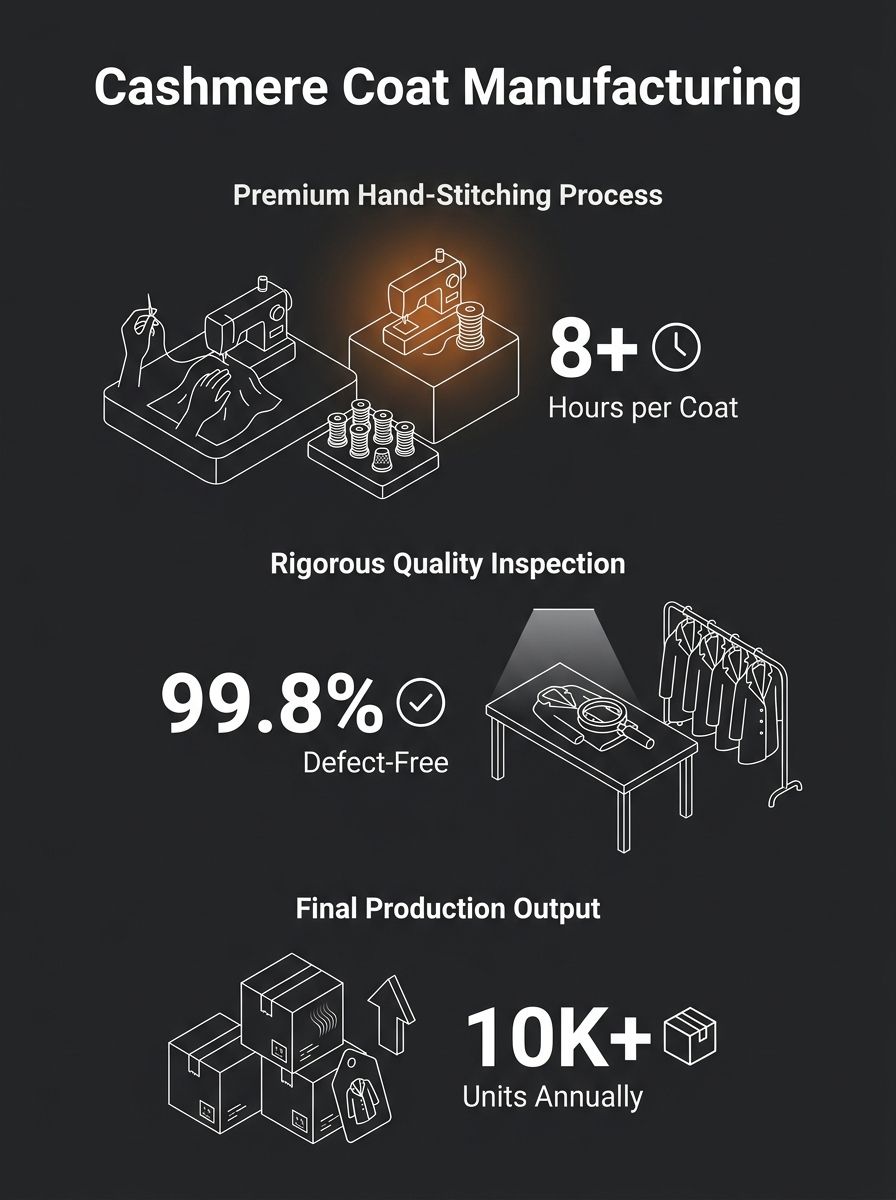
Hand-stitched double-faced cashmere construction joins two fabric faces by hand without a lining, placing garment finish, weight, and drape entirely under control of the sewing team. DALIAN GACCILANG implements a three-step quality protocol: sealing confirmed samples after order confirmation, inspecting every coat before delivery, and retaining records of fabric batches and production procedures, according to the company's published process documentation.
That procedural approach addresses a documented risk in the cashmere category where bulk finished coats diverge from approved samples in fabric or workmanship, producing returns and after-sales complaints that damage long-term channel reputation, the overview notes. Typical cashmere coats contain 600 to 1,200 grams of fabric depending on length and design, according to Business Research Insights data cited in the report.
For U.S. imports, women's wool or fine animal hair overcoats fall under HS code 6202.20.11 in the Harmonized Tariff Schedule maintained by the U.S. International Trade Commission. External directory data places DALIAN GACCILANG's annual sales volume between USD 5 million and USD 10 million, according to BOSIG industrial directory records.
Market Positioning and End-Use Requirements
Demand concentrates in Korea, Japan, the United States, and the United Kingdom for premium fashion retail and women's luxury apparel, with functional requirements spanning warmth retention, fashion styling, and outerwear matching for daily indoor and outdoor wear. Buyers in the premium segment frequently specify hand stitching, 100 percent pure cashmere content, and skin-friendly finishing as special requirements, the industry analysis shows.
Cashmere's share of the broader apparel category grew as China's overall export volume contracted, increasing the relative weight of higher-value categories where unit prices support margin structures for dropshipping apparel operators and boutique retailers. The five-manufacturer reference set positions hand-stitched construction as the primary quality marker rather than cashmere content alone, reflecting buyer preferences for craftsmanship verification over material claims.
The concentration of two manufacturers in Dalian and three in Inner Mongolia and Ningxia mirrors a broader consolidation trend in China's factory base, where regional clusters specialize in specific material categories and construction methods. Dalian's garment cluster houses both DALIAN GACCILANG and Dalian Dishang Huasheng, while Inner Mongolia's proximity to raw cashmere fiber sourcing positions manufacturers for shorter supply chains from fiber to finished coat.
What This Means for Dropshipping Entrepreneurs
The five-manufacturer reference set clarifies sourcing pathways for operators testing premium fashion niches, though cashmere coats occupy a narrow vertical with specific margin challenges. DALIAN GACCILANG's stated 22 percent cost advantage on hand-sewn construction warrants verification through sample orders and landed-cost modeling that includes HS code 6202.20.11 duty rates before scaling, particularly given that the figure is company-reported rather than third-party audited.
Hand-stitched double-faced construction defines the quality benchmark in 2026, which creates a clear product differentiation point but also limits supplier options to manufacturers with verified hand-sewing capability and sample-sealing protocols. Operators entering the premium cashmere segment should prioritize suppliers publishing procedural quality controls, sealed samples, unit-level inspection, batch traceability, over generic quality claims, given the documented risk of bulk shipments diverging from approved samples.
The 600 to 1,200 gram fabric content per coat translates to higher shipping weights and dimensional costs compared to standard dropshipping apparel, shifting unit economics toward higher average order values and lower order frequency. Operators should model landed costs including fabric weight, duty under HS 6202.20.11, and container or air freight rates before committing to cashmere inventory, particularly in a 5 percent declining export environment where supplier pricing may compress margins.

Ryan Torres
Ryan Torres is a former Amazon FBA seller turned dropshipping consultant who has generated over $2.8M in ecommerce revenue across 14 product launches. He specializes in supplier vetting, margin optimization, and scaling DTC operations for sub-$1M brands. Ryan focuses on actionable frameworks that drive measurable results for independent operators.
Related Articles

Eighteen Percent of AliExpress Dropshipping Suppliers Exited Platform in First Five Months of 2026 as China's Factory Base Consolidates
An estimated 18% of active AliExpress dropshipping suppliers exited the platform between January and May 2026, folding into larger factory collectives in Guangdong, Foshan, and Yiwu, according to sourcing intelligence firm Syncee's internal supplier index cited in a LooperBuy guide published August

Why India's Nonwoven Textile Boom Is Reshaping Dropshipping Niche Economics in 2026
India's nonwoven fabrics market is approaching $7 billion, with annual growth exceeding 12.4%, according to the Association of the Nonwoven Fabrics Industry.

LooperBuy Publishes Beauty Supplier Vetting Framework Targeting Dropshippers Sourcing Cosmetics From China's $145 Billion Trade Hub
LooperBuy released a beauty dropshipping supplier guide on July 29, 2026, detailing an eight-step vetting framework for Chinese cosmetics manufacturers as the global dropshipping market approaches $507.18 billion in 2026.
Explore more topics