Amazon's Supply Chain Network and Dropshipping Economics: Why This Changes the 3PL Equation in 2026
80,000+ trailers, 24,000+ intermodal containers, and more than 100 aircraft — that's the fleet Amazon opened to every business on May 4, 2026, when it officially launched Amazon Supply Chain Services (ASCS).
Amazon's Supply Chain Network and Dropshipping Economics: Why This Changes the 3PL Equation in 2026
80,000+ trailers, 24,000+ intermodal containers, and more than 100 aircraft — that's the fleet Amazon opened to every business on May 4, 2026, when it officially launched Amazon Supply Chain Services (ASCS). The announcement extends Amazon's full logistics stack — freight, distribution, fulfillment, and parcel shipping — to companies that don't sell a single product on Amazon.com. If you're running a Shopify store, a DTC brand, or a dropshipping operation and you're currently paying a traditional 3PL, this launch rewrites your cost comparison spreadsheet.
What ASCS Actually Includes
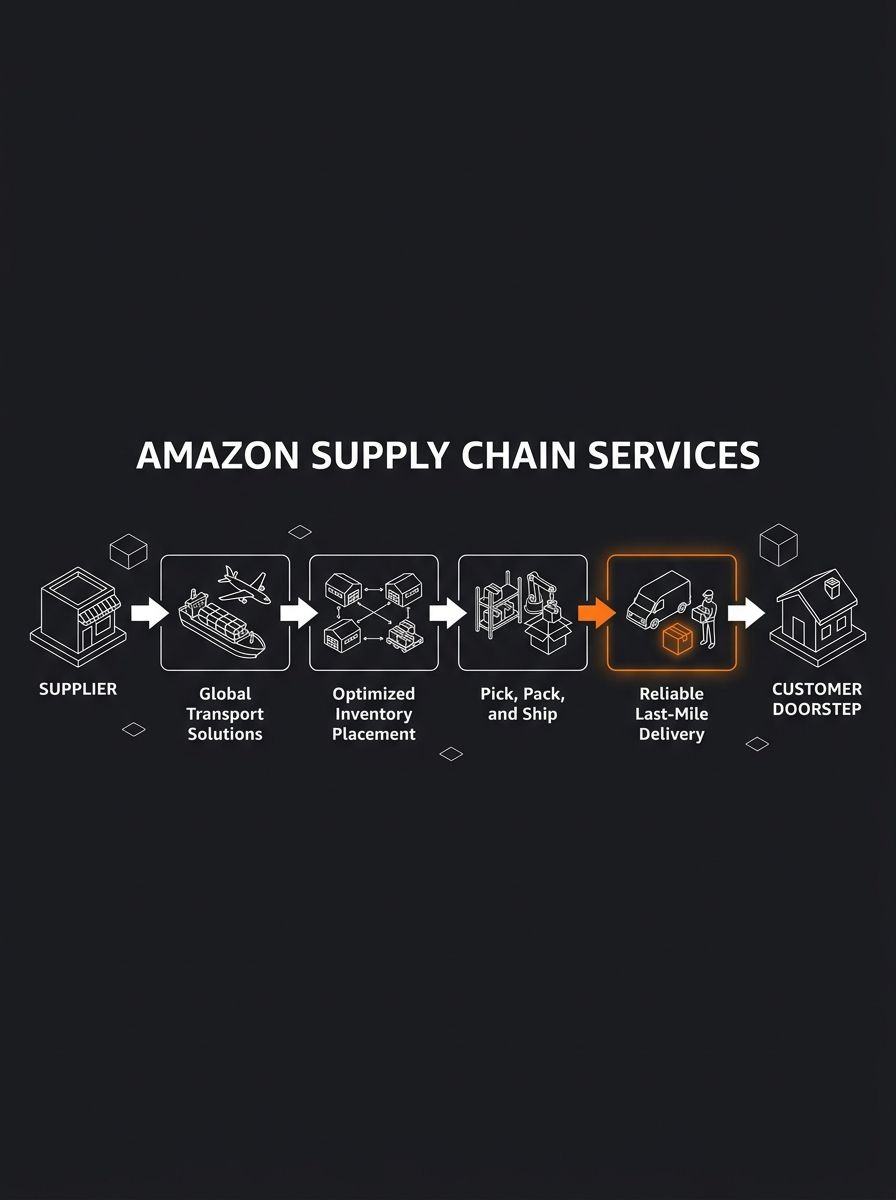
Amazon's press release describes ASCS as end-to-end supply chain access. That sounds vague until you break it into the four components businesses can now buy separately or bundle together:
Freight: Ocean, air, ground, and rail transportation using Amazon's multimodal network. This replaces the freight forwarding step most dropshippers and small brands currently handle through brokers or integrated 3PLs.
Distribution: Warehousing and inventory management within Amazon's fulfillment center network. Amazon's AI-driven demand forecasting covers over 400 million SKUs daily, which means inventory placement decisions are informed by purchase pattern data no independent 3PL can replicate.
Fulfillment: Pick, pack, and ship for orders from any sales channel. This is the FBA model extended beyond Amazon's own marketplace.
Parcel shipping: Two-to-five-day delivery speeds with seven-day-a-week service across all sales channels. Amazon provides flexible pickup from your own warehouses or theirs.
Early adopters include Lands' End, American Eagle Outfitters, and Procter & Gamble. These aren't small test accounts. They signal that ASCS pricing is competitive enough for enterprise operations with existing 3PL relationships.
How Traditional 3PL Pricing Compares
Traditional 3PL costs are layered and often opaque. A typical 3PL pricing breakdown includes receiving fees ($25–$45 per pallet), storage fees ($8–$40 per pallet per month), pick-and-pack fees ($2–$5 per order plus $0.50–$1.00 per additional item), and shipping markups that vary by carrier contract. Then there are the hidden charges: account management fees, integration fees, minimum volume commitments, and peak surcharges during Q4.
For a dropshipping operation doing 500 orders per month with an average order value (AOV) of $45 and a product cost of $18, here's what the fulfillment math looks like with a mid-tier 3PL:
Pick and pack: $3.00 per order × 500 = $1,500
Storage (assuming 2 pallets): $60/month
Shipping (average $6.50 per parcel): $3,250
Monthly platform/account fee: $150
Total monthly fulfillment cost: ~$4,960
Per-order fulfillment cost: $9.92
That $9.92 eats into a gross margin that's already thin. On a $45 AOV with $18 COGS, your contribution margin before fulfillment is $27. After fulfillment, it drops to $17.08. And that's before ad spend, returns, chargebacks, and customer support — all the post-order costs that quietly erode profitability.
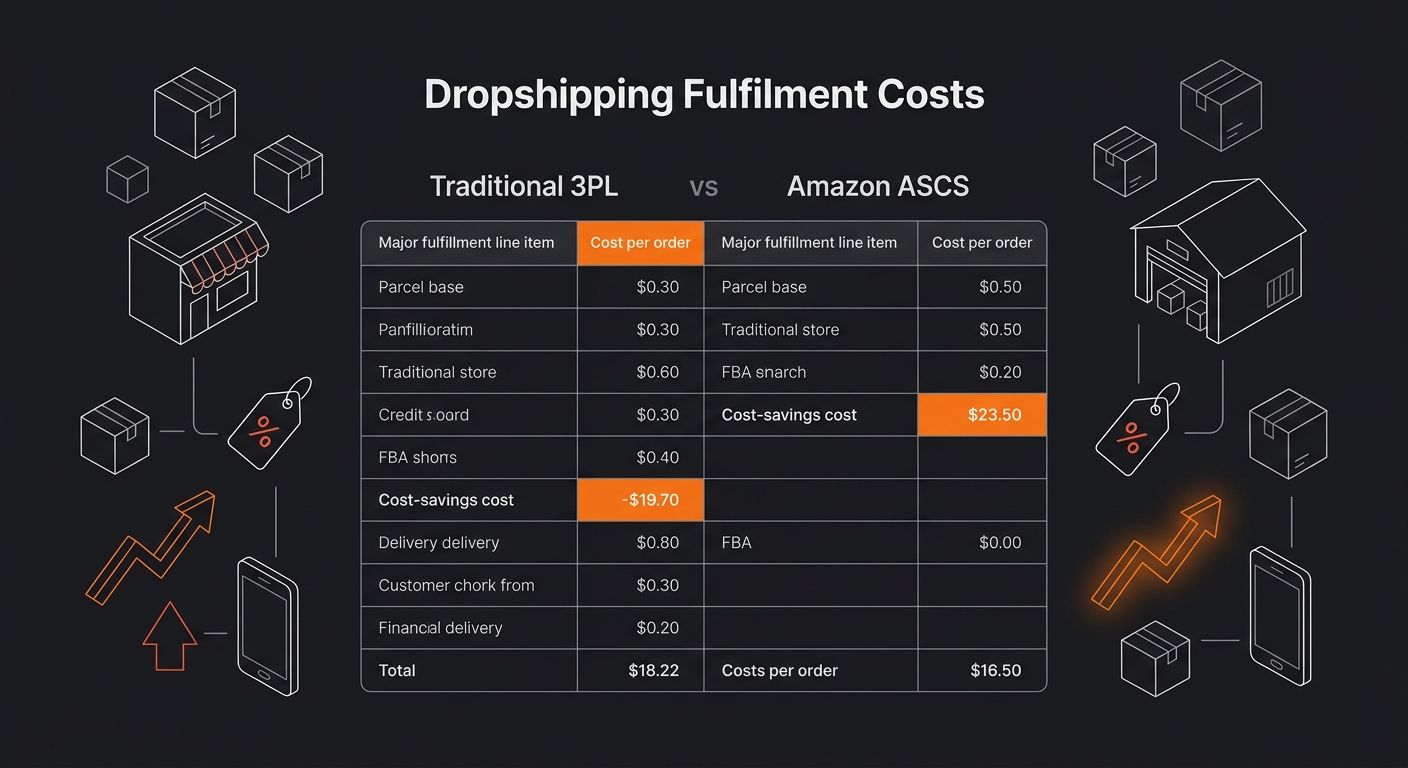
Amazon hasn't published a public rate card for ASCS yet. But we can infer from FBA economics. Amazon's per-unit fulfillment fees for standard-size items through FBA run $3.22–$6.75 depending on weight and dimensions. If ASCS pricing follows a similar structure with competitive parcel rates (Amazon's delivery network already handles more U.S. packages than UPS), the per-order cost for a comparable 500-order operation could land 15–25% below most mid-tier 3PLs.
Why Dropshipping Margin Pressure Makes This Urgent
The fulfillment cost squeeze isn't new, but it's accelerating. As Supply & Demand Chain Executive reported, CPI may look stable, but the cost to fulfill each order keeps rising while pricing power has hit a ceiling. Customers push back on price increases. Promotions face scrutiny. The strategy of passing costs to consumers has reached its limit.
For dropshippers specifically, the margin pressure compounds. Amazon's own seller documentation acknowledges the economics plainly: intense competition and slim margins are structural features of the model, driven by low barriers to entry. Tariff volatility, higher landed costs, and parcel rate increases add further pressure, as Flowspace's fulfillment analysis documents.
If you're evaluating whether equal-revenue products actually deliver equal profits, fulfillment cost is often the variable that separates a profitable SKU from a money loser. Two products at the same $45 price point with identical COGS can generate wildly different contribution margins depending on package dimensions, weight, and which fulfillment network handles them.
The Data Advantage Amazon Brings to Inventory Placement
Cost is one dimension. Speed and accuracy of inventory positioning is another, and it may matter more for dropshipping economics than raw per-unit pricing.
Amazon's demand forecasting system processes data for over 400 million SKUs daily. For new products, it applies historical demand patterns from similar items to solve the "cold start" problem — predicting where to position inventory before real sales data exists. No independent 3PL has anything close to this signal volume.
Why does this matter for dropshippers? Because fulfillment speed directly affects conversion rate and return rate. Two-day delivery converts better than five-day delivery. Orders that arrive faster generate fewer "where's my package?" support tickets, fewer chargebacks, and fewer returns initiated out of buyer impatience. If you're tracking how supplier quality and speed affect your bottom line, the fulfillment leg of the chain deserves equal scrutiny.
Amazon's ASCS offers predictable two-to-five-day delivery with seven-day service, which sits comfortably within the window most DTC customers now expect. Traditional 3PLs in the mid-tier range typically promise three-to-seven business days, with weekend service available only at premium pricing.
Where This Gets Complicated for Dropshippers
Amazon competing directly with UPS and FedEx, as TechCrunch reported, creates opportunities. It also creates dependencies worth thinking about carefully.
Data ownership: When your inventory sits in Amazon's network and your orders flow through Amazon's systems, Amazon accumulates granular data about your product velocity, seasonal patterns, and customer geography. For marketplace sellers, this has always been the trade-off. For independent Shopify store operators, it's a newer consideration. You're feeding operational data to the same company that could, theoretically, identify your best-performing categories and compete in them.
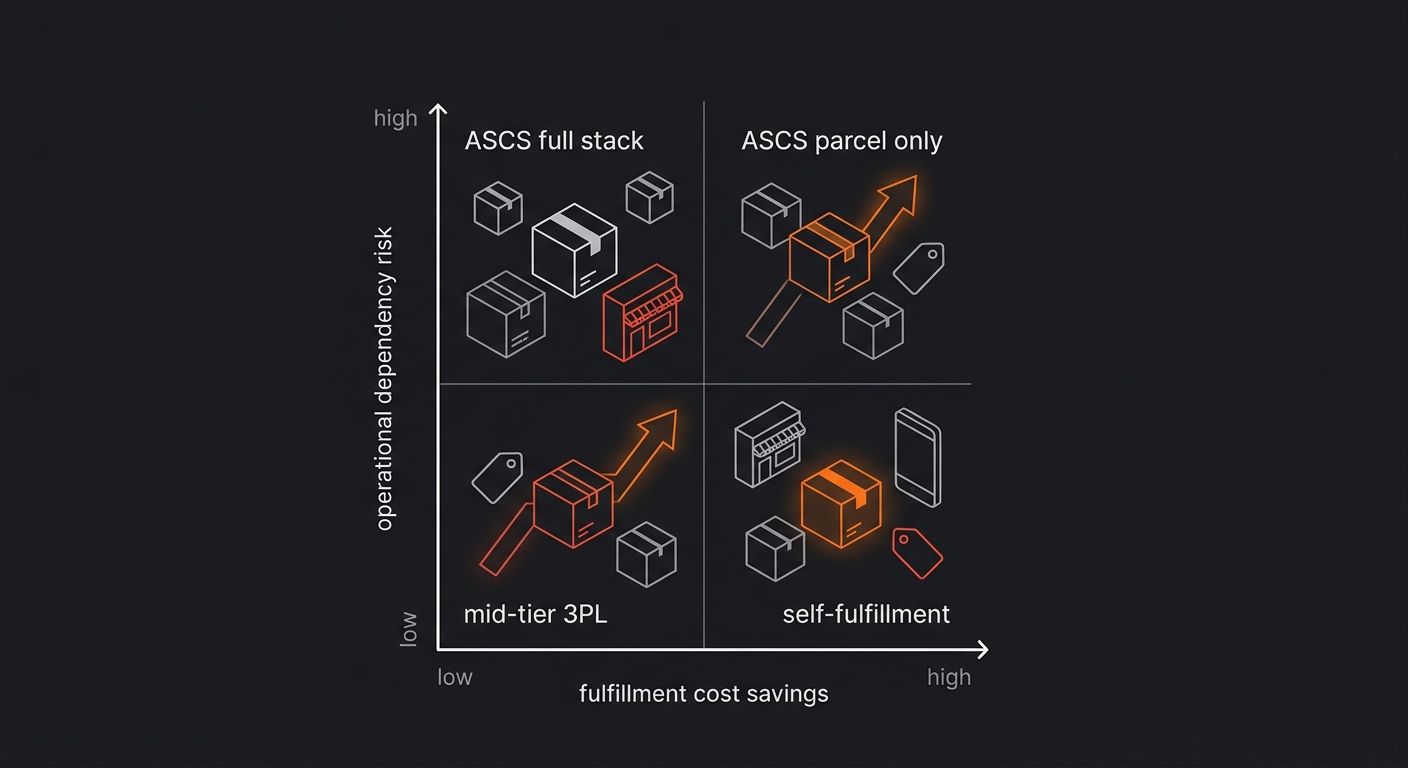
Lock-in risk: Migrating away from a 3PL is painful. Migrating away from Amazon's integrated freight-to-doorstep system would be even more painful. Every layer of the stack you hand over increases switching costs. If you use ASCS for parcel shipping only, the exit is manageable. If you use it for freight, warehousing, fulfillment, and shipping, you've essentially outsourced your entire supply chain to a single provider.
Brand control: Amazon's delivery experience is standardized. Branded packaging, custom inserts, handwritten thank-you cards — the DTC touches that build repeat purchase rates — may be limited or unavailable through ASCS fulfillment. This matters if your strategy depends on direct supplier relationships and branded experiences to justify premium pricing.
Running the 3PL Cost Comparison for Your Operation
Before switching anything, model the economics for your specific SKU mix. The comparison framework looks like this:
Pull your last 90 days of fulfillment invoices and calculate your true per-order cost (include every fee, not the headline rate)
Map your average package dimensions and weights — ASCS pricing will be dimension-dependent
Factor in your return rate and the cost of reverse logistics with your current provider versus what ASCS offers
Calculate the delivery speed differential and estimate its impact on conversion rate (even a 0.5% lift on a 2% baseline is meaningful at scale)
Price out partial adoption — use ASCS for shipping only while keeping your current 3PL for warehousing, or vice versa
The operators who'll benefit most from ASCS are those shipping 300+ orders per month with standard-size, non-fragile products and an AOV above $35. Below that volume, the integration effort may not justify the per-unit savings. Above $35 AOV, the fulfillment cost as a percentage of revenue sits in a range where even a 15% reduction meaningfully improves contribution margin.
And if you're still figuring out which automation tools and fulfillment integrations to trust with your order flow, adding Amazon's infrastructure to the mix makes the evaluation more complex — but the potential payoff is larger.
Questions the Numbers Still Can't Answer
Amazon's ASCS launch injects a massive variable into the 3PL cost comparison for 2026. The fleet size is real. The delivery speed commitments are documented. The enterprise early adopters suggest pricing that undercuts incumbents.
But several unknowns remain. Amazon hasn't published transparent per-unit pricing for non-marketplace sellers, so every cost estimate is extrapolated from FBA economics rather than confirmed ASCS rates. We don't know how Amazon will handle branded packaging requirements for DTC operators. And the long-term competitive dynamics — whether Amazon uses ASCS operational data to inform its own retail decisions — won't be visible for years.
The dropshipping margin pressure documented across the industry makes cheaper, faster fulfillment attractive regardless of who provides it. Whether Amazon is the right provider depends on how much operational control you're willing to trade for lower per-order costs. That trade-off varies by business model, SKU type, and how much your brand identity depends on controlling the unboxing experience. The data says ASCS will save money for most mid-volume operators. What the data can't tell you is whether the strategic cost of dependency will eventually exceed those savings.
365 Dropship Editorial
Editorial team writing about E-commerce, dropshipping, and product discovery — reviews of dropshipping suppliers and platforms, trending niche guides (jewelry, beauty, pets, home, fashion), supplier due diligence, ecom operations, shipping & fulfillment strategy, product research, AOV optimization, and profitable dropshipping case studies.
Explore more topics