Supplier Credibility Red Flags You're Missing: A Verification Checklist Beyond Response Time
Searching a supplier's registered business name on Google alongside "scam" or "fake goods" returns results that no AliExpress feedback score will ever surface.
Supplier Credibility Red Flags You're Missing: A Verification Checklist Beyond Response Time
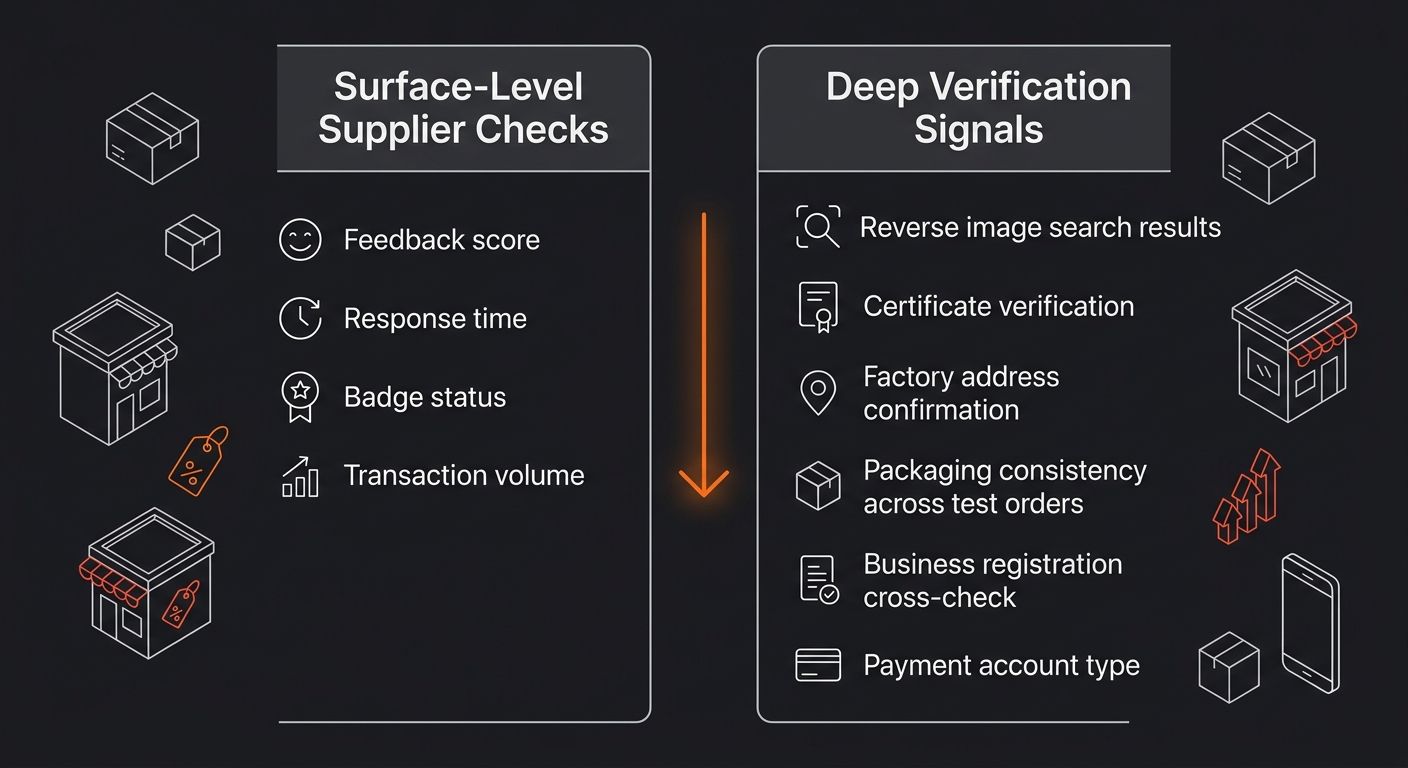
Searching a supplier's registered business name on Google alongside "scam" or "fake goods" returns results that no AliExpress feedback score will ever surface. TRADLINX's verification guide confirms this directly: online trade forums flag problem suppliers before regulators do, and often months before platform badges get revoked. Yet the standard dropshipping supplier vetting process that most operators follow still starts and ends with three data points: response time, feedback percentage, and transaction volume. We ran through this exact pattern with a CJ-listed supplier earlier this year, and the gap between what the dashboard said and what the test orders revealed was wide enough to cost a four-figure ad budget before we caught it.
This is a dissection of that gap. One supplier, one vetting cycle, every red flag we missed because we were checking the wrong things.
The Supplier That Aced Every Dashboard Metric
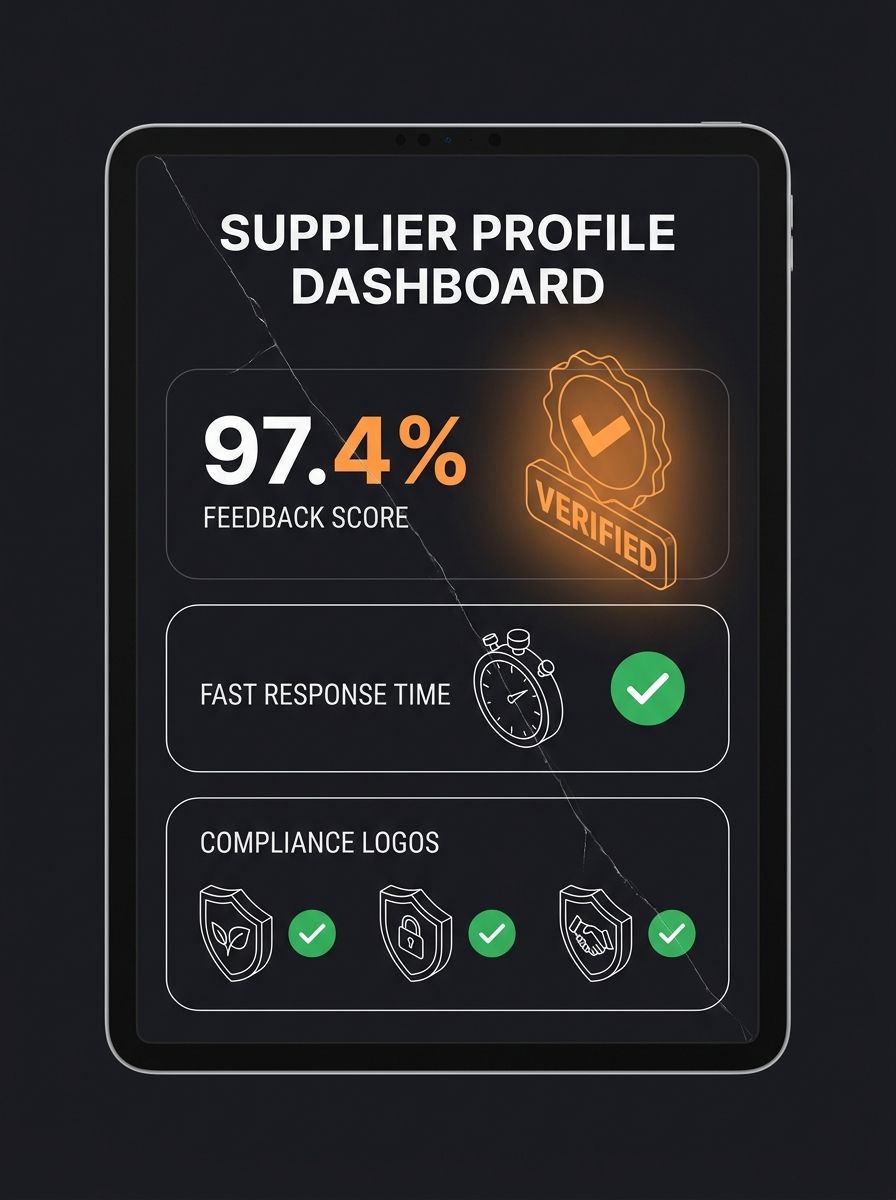
The listing looked bulletproof. A 97.4% positive feedback score across 11,000+ transactions. "Verified Supplier Pro" badge active. Average response time to inquiries clocked under two hours. Product page showed CE and FCC compliance logos. Pricing landed at $4.80 per unit on a product with a $19.99 target selling price, giving us roughly 55% gross margin before ad spend and platform fees.
If you've built a supplier reliability scorecard before, you know these surface numbers check every box. AliExpress's own supplier rating guide emphasizes feedback scores above 95% as the threshold for reliable sellers, and this one cleared that by a comfortable margin. Order volume was high. Communication was prompt. The product photos looked clean, well-lit, and professional.
We placed an initial test order of three units and moved into ad creative development while waiting for delivery. That's where the timeline starts to fracture.
Stock Photography, Borrowed Compliance Marks, and a Middleman Nobody Disclosed
The first test unit arrived on day 11. Packaging didn't match the product listing photos. The compliance marks printed on the box referenced a different company name entirely. The second unit arrived on day 14 from a different warehouse, with noticeably different material texture on the product itself. Unit three showed up on day 18, packaged in yet another style of box.
Three units, three different packaging standards, two different product feels, and a compliance certificate that belonged to someone else.
What we'd missed during the initial supplier verification checklist pass was a pattern that QCADVISOR's facility audit guide calls one of the clearest red flags in sourcing: the supplier was a trading company posing as a manufacturer. They didn't make the product. They brokered it from at least two different factories, depending on which had stock that week. The "CE/FCC" logos on their listing were copied from a legitimate manufacturer's documentation and pasted onto their product page as trust signals. They'd never held those certifications themselves.
The feedback score of 97.4%? Built over years of low-ticket, high-volume transactions where buyers didn't inspect packaging consistency or verify compliance marks. When the product is a $3 phone case, nobody files a dispute over mismatched box labels. But when you're running paid traffic to a $19.99 product and your brand reputation depends on consistency, that same supplier becomes a liability.
Here's what we should have caught beforehand: the product listing used stock photography that appeared on at least four other AliExpress stores. A reverse image search (Google Lens, TinEye) took 30 seconds and would have flagged this immediately. The compliance logos were flat image files embedded in the product description, not linked to any verifiable certificate number. And the supplier's "About" page listed no factory address, no production capacity, and no employee count.
Financial Breadcrumbs We Walked Right Past
The pricing should have been our second warning. At $4.80 per unit, this supplier undercut every verified manufacturer we'd sourced quotes from by 15-22%. Safecoze's supplier red flags checklist notes explicitly that unrealistically low pricing correlates with compromised quality or hidden costs, and trading companies can often undercut manufacturers temporarily by sourcing from whoever has excess inventory that month.
When we requested a bulk pricing quote for 500 units, the supplier asked for payment via a method that routed to what appeared to be a personal account rather than a registered business account. We flagged this and asked for a business invoice. The response took four days. The previous average response time had been under two hours. When the invoice arrived, the company name on it didn't match the store name, and the registered address traced to a residential building in Yiwu.
None of this showed up in the platform's supplier trust scoring metrics. AliExpress doesn't surface payment account types, business registration details, or invoice consistency to buyers. You have to ask for these documents directly, and then you have to verify them independently.
The unit economics tell the real story. That $4.80 cost looked great against a $19.99 selling price. But once we factored in the inconsistent quality requiring a 12% return rate (versus our target of 3-4%), the cost of reshipping replacements, and the refund processing fees, our actual margin math dropped the effective gross margin from 55% to somewhere around 28%. And that's before ad spend.
The Five Verification Layers That Would Have Caught This
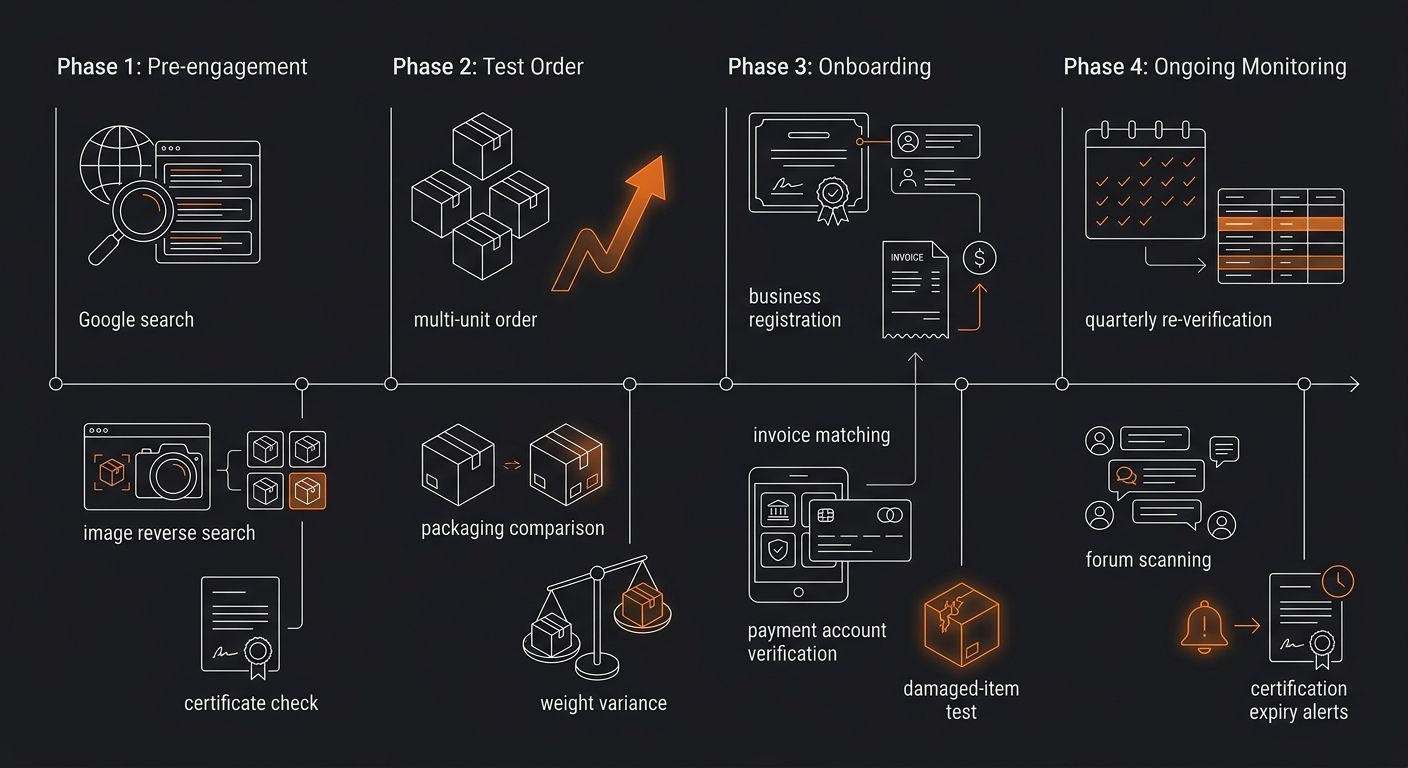
Running through what we now use as our standard dropshipping supplier vetting protocol, here's what would have surfaced the problems before any ad dollar was spent:
Reverse Image Search on Every Product Photo
Takes 30 seconds per listing. If the same images appear across multiple unrelated stores, the supplier is reselling, not manufacturing. Trading companies almost always use manufacturer-provided stock photos because they don't have their own production line to photograph.
Certificate Number Verification
Every legitimate CE, FCC, ISO, or RoHS certification has a traceable certificate number tied to a specific legal entity. Ask for the number. Verify it against the issuing body's public database. If the supplier can't provide a certificate number, or if the number traces to a different company, walk away. Third-party verification services like SGS, Bureau Veritas, and TUV can confirm facility-level compliance when the stakes justify the cost.
Business Registration Cross-Reference
Request the supplier's registered business name and license number. Cross-check it against the relevant national business registry. For Chinese suppliers, this means checking the National Enterprise Credit Information Publicity System. The company name on the business license should match the store, the invoice, and the payment account. Any mismatch is a signal worth investigating.
The Damaged-Item Customer Test
StorefrontAdvisor's vetting guide recommends pretending to be a customer with a damaged item to test the supplier's return and complaint handling process. This is one of the highest-signal tests you can run. A supplier committed to transparency will have a documented escalation path, clear timelines, and consistent communication. A trading company intermediary will stall, deflect, or ghost, because they're coordinating between you and a factory they don't control.
This pairs well with the broader test order methodology we've covered in our supplier test order playbook, where measuring packaging consistency, label accuracy, and product weight variance across multiple units reveals problems that a single-unit sample never will.
Continuous Monitoring vs. One-Time Checks
Your supplier verification doesn't end after onboarding. The research from Safecoze recommends re-verification at minimum every three months. Set calendar reminders to re-run the Google "scam" search, check for new forum complaints, and verify that certifications haven't expired. Suppliers who pass initial vetting can degrade over time, especially trading companies who switch factory sources based on price. If you're tracking inventory availability claims alongside quality metrics, you'll catch sourcing changes faster.
Why the Badge Economy Keeps Rewarding the Wrong Signals
The platform incentive structure explains why this keeps happening. AliExpress, and most supplier directories, weight their trust signals toward transaction volume and dispute resolution rate. A trading company that processes thousands of low-ticket orders per month with a sub-3% dispute rate earns the same badges and scores as a vertically integrated manufacturer with genuine quality control. The metrics that matter for dropshipping logistics quality aren't measured at the platform level at all: packaging consistency, certificate authenticity, factory-direct production control, and financial transparency.
Pre-vetted supplier directories like SaleHoo, Spocket, and Wholesale2B add a screening layer that raw AliExpress browsing doesn't provide, and for operators who are still building their vetting muscle, that layer has real value. But even directory-vetted suppliers warrant your own independent checks. No directory verifies every certificate number, tests return handling under stress, or monitors factory-source changes quarterly.
The supplier we profiled here is still active on AliExpress. The feedback score has actually ticked up to 97.6% since our test orders. The compliance logos are still on the listing. The stock photos are still shared across multiple stores. And operators who check response time, feedback score, and badge status will continue to mark this supplier as safe, because by every metric the platform chooses to surface, it is. The verification work that actually predicts failure happens entirely off-platform, in registration databases and reverse image searches and invoice cross-checks that take maybe 45 minutes total. Forty-five minutes that would have saved us the $1,200 in wasted ad spend and the two-week delay that came from scrambling to find a replacement supplier mid-campaign.
365 Dropship Editorial
Editorial team writing about E-commerce, dropshipping, and product discovery — reviews of dropshipping suppliers and platforms, trending niche guides (jewelry, beauty, pets, home, fashion), supplier due diligence, ecom operations, shipping & fulfillment strategy, product research, AOV optimization, and profitable dropshipping case studies.
Explore more topics