The Supplier Inventory Trap: Why Product Availability Claims Don't Match Reality (And How to Verify Before Launch)
AliExpress shows 4,832 units in stock. Your CJ Dropshipping dashboard confirms availability across three warehouses. You launch the Facebook ad, spend $200 in the first six hours, and three of your first eight orders come back with a "temporarily unavailable" notice.
The Supplier Inventory Trap: Why Product Availability Claims Don't Match Reality (And How to Verify Before Launch)
AliExpress shows 4,832 units in stock. Your CJ Dropshipping dashboard confirms availability across three warehouses. You launch the Facebook ad, spend $200 in the first six hours, and three of your first eight orders come back with a "temporarily unavailable" notice. The supplier's inventory number hasn't changed on the listing page. It still says 4,832. This scenario destroys more first-month dropshipping margins than bad creatives or weak product-market fit, because the money is already spent on traffic by the time you discover the stock was never real. Understanding supplier inventory verification before you commit ad dollars is the difference between a profitable launch week and a refund nightmare.
The root of the problem is straightforward: many supplier platforms display aggregated or projected inventory numbers, not verified counts of what's physically sitting on a shelf in a specific warehouse. Some suppliers share stock across dozens of resellers. Others display manufacturing capacity as if it were available inventory. And a meaningful number simply don't update their systems in real time, so you're looking at a snapshot from three days ago while the actual stock depleted yesterday. As Dropship.io's guide on supplier scams warns, inconsistent stock availability is one of the clearest red flags that a supplier can't deliver what they promise.
The Gap Between Dashboard Numbers and Physical Shelves
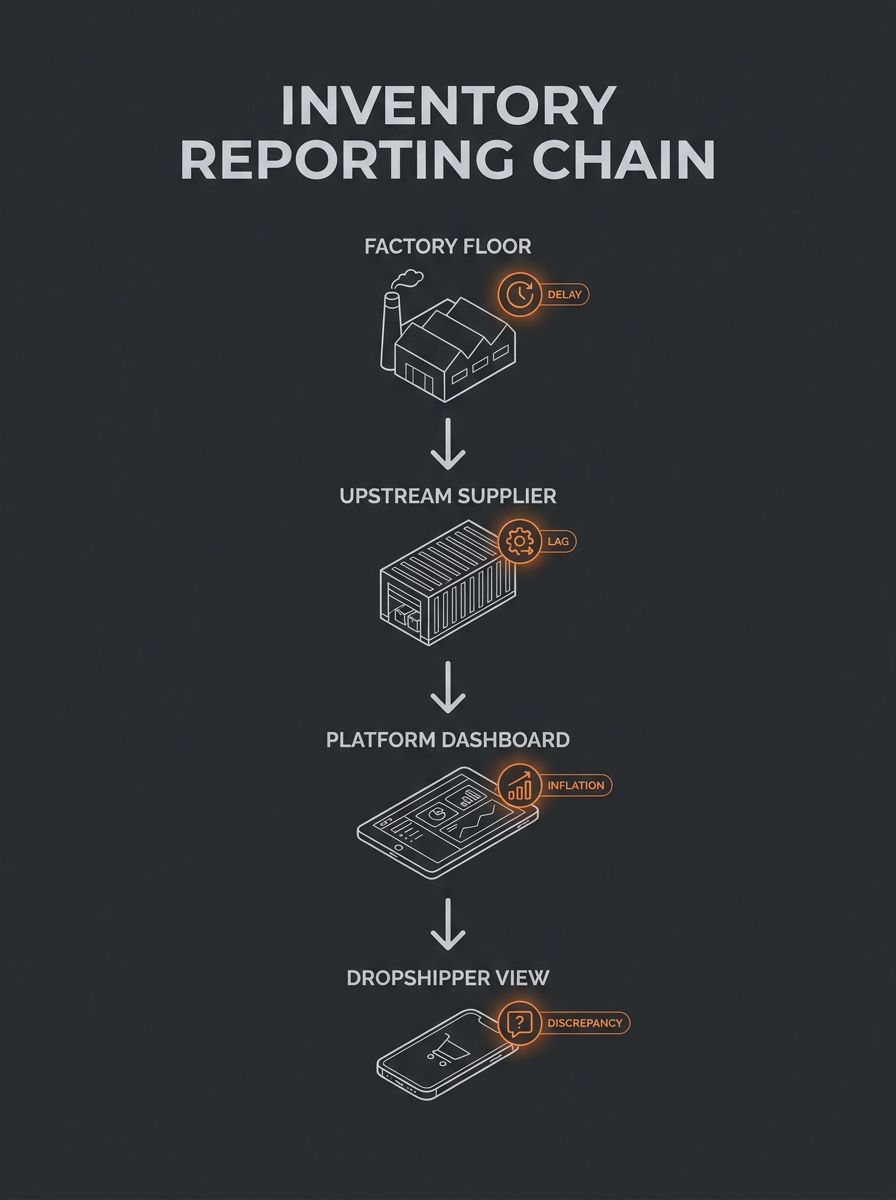
The inventory number you see on a supplier platform is almost never a direct reflection of what's available for your orders. On AliExpress, the "units available" figure often represents total production run capacity or the combined stock across multiple fulfillment partners, some of whom may be located in countries that add 15-20 days to your shipping window. Spocket and Zendrop are somewhat better about showing warehouse-specific stock, but even those numbers can lag behind real-time sales velocity by 12-48 hours. When a product goes semi-viral on TikTok and three other stores are also running it, 48 hours of lag means the stock evaporated before your second batch of orders hits the supplier's queue.
This mismatch exists because suppliers optimize their listings for conversion, not for operational accuracy. A supplier showing "12 units left" gets fewer new resellers than one showing "5,000+ available." The incentive structure rewards inflated numbers. And on platforms like CJ Dropshipping, where the supplier acts as a sourcing intermediary rather than holding its own warehouse stock, the listed quantity might reflect what their upstream factory claims to have on hand. That's two layers of unverified reporting between you and the actual product.
The financial damage compounds quickly. If you're running paid traffic at a $15 CPM and converting at 2%, each $100 in ad spend generates roughly 13 clicks and maybe 1-2 orders. When half your orders get cancelled because inventory was phantom, your effective customer acquisition cost doubles overnight. You're also eating refund processing time, potential chargebacks, and the reputational hit of cancelled orders on your store. For a store targeting $50 AOV, even five phantom-stock cancellations in a launch week can wipe out $250 in revenue and leave you with $150+ in wasted ad spend that generated zero fulfilled orders. Proper inventory risk management prevents this math from ever reaching your P&L.
What a Stock Reliability Audit Actually Looks Like
Professional inventory auditing follows specific protocols that dropshippers can adapt at a smaller scale. According to AccountingTools' breakdown of inventory audit procedures, formal audits require halting all inventory movement during the count, reviewing transfer documentation for goods in transit, and testing inventory layers to verify they're valid. You're obviously not going to fly to a warehouse in Yiwu and count units on a shelf, but the underlying principle applies: you need to verify claimed stock through independent evidence, not through the supplier's own dashboard.
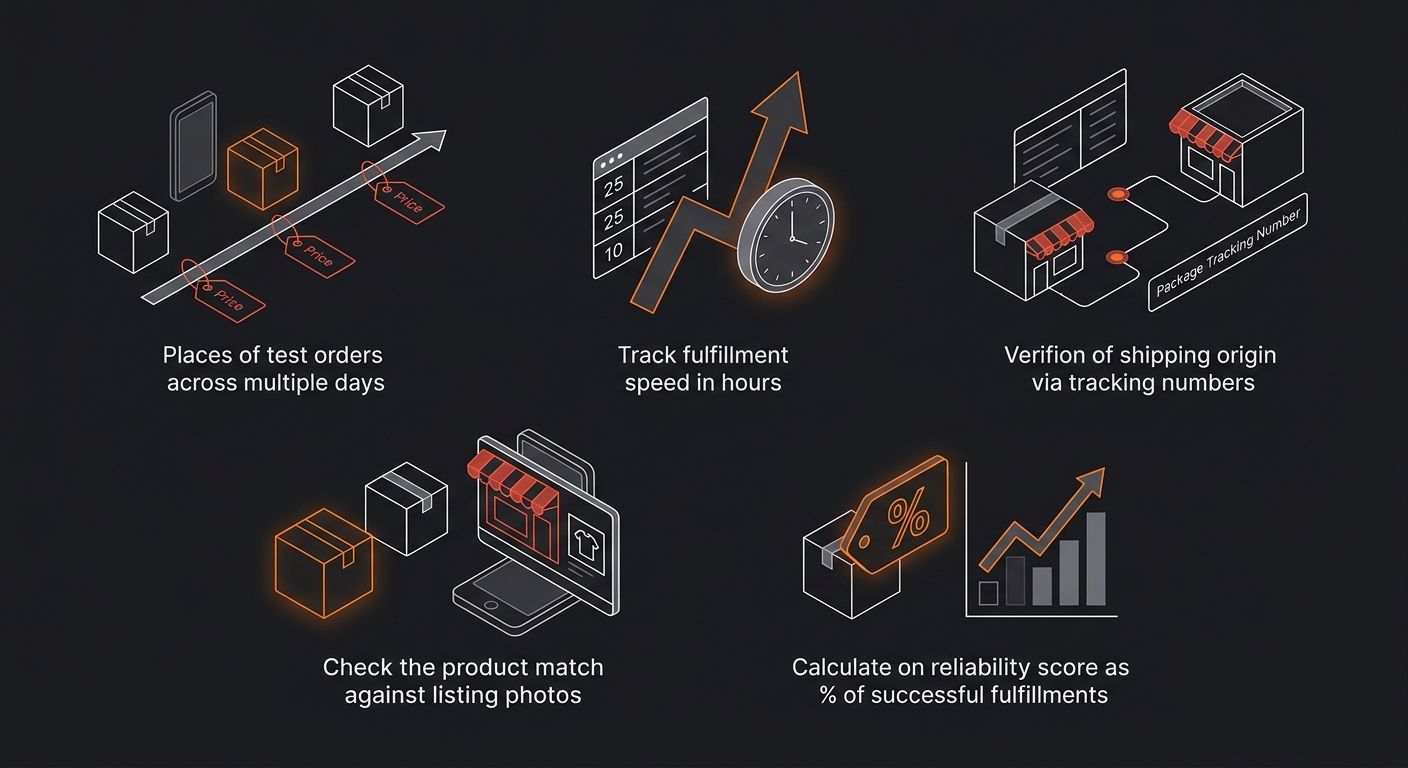
A practical stock reliability audit for a dropshipping operation means testing the supplier's claims against observable behavior over a defined window. The approach that consistently works involves placing small test orders across multiple days and tracking fulfillment speed, actual shipping origin, and whether the product that arrives matches the listing. If you place three orders on Monday, Wednesday, and Friday of the same week and all three ship within the supplier's stated processing time from the stated warehouse location, that's a positive signal. If the Wednesday order takes four extra days or ships from a different country than advertised, you've caught a stock reliability problem before scaling.
The IBTimes' guide on finding dropshipping products in 2026 makes this point directly: check your supplier before you invest in the product, not after. For European and US markets specifically, local warehousing should be your starting point. A supplier claiming US warehouse fulfillment should be able to prove it through tracking numbers that originate domestically, with delivery windows of 3-5 business days rather than the 12-18 day patterns typical of direct-from-China shipping.
Running Your Own Supplier Inventory Verification
Building a supplier vetting checklist specific to dropshipping product availability requires testing across four dimensions: stock accuracy, fulfillment consistency, communication responsiveness, and return handling. Stock accuracy is the most visible and the easiest to game, which is why it can't be your only signal.
For stock accuracy, the test-order method described above is your baseline. But you should also monitor the supplier's listing over 10-14 days without placing orders. Screenshot the inventory count daily at the same time. A supplier with genuine stock in a single warehouse will show inventory decreasing in rough proportion to their sales velocity. A supplier displaying a static number day after day either isn't selling anything (bad sign for product demand) or isn't connecting their listing to real inventory systems (bad sign for fulfillment reliability). If the number fluctuates wildly, jumping from 200 to 5,000 overnight, that usually indicates the supplier is manually updating based on upstream factory commitments rather than tracking physical units.
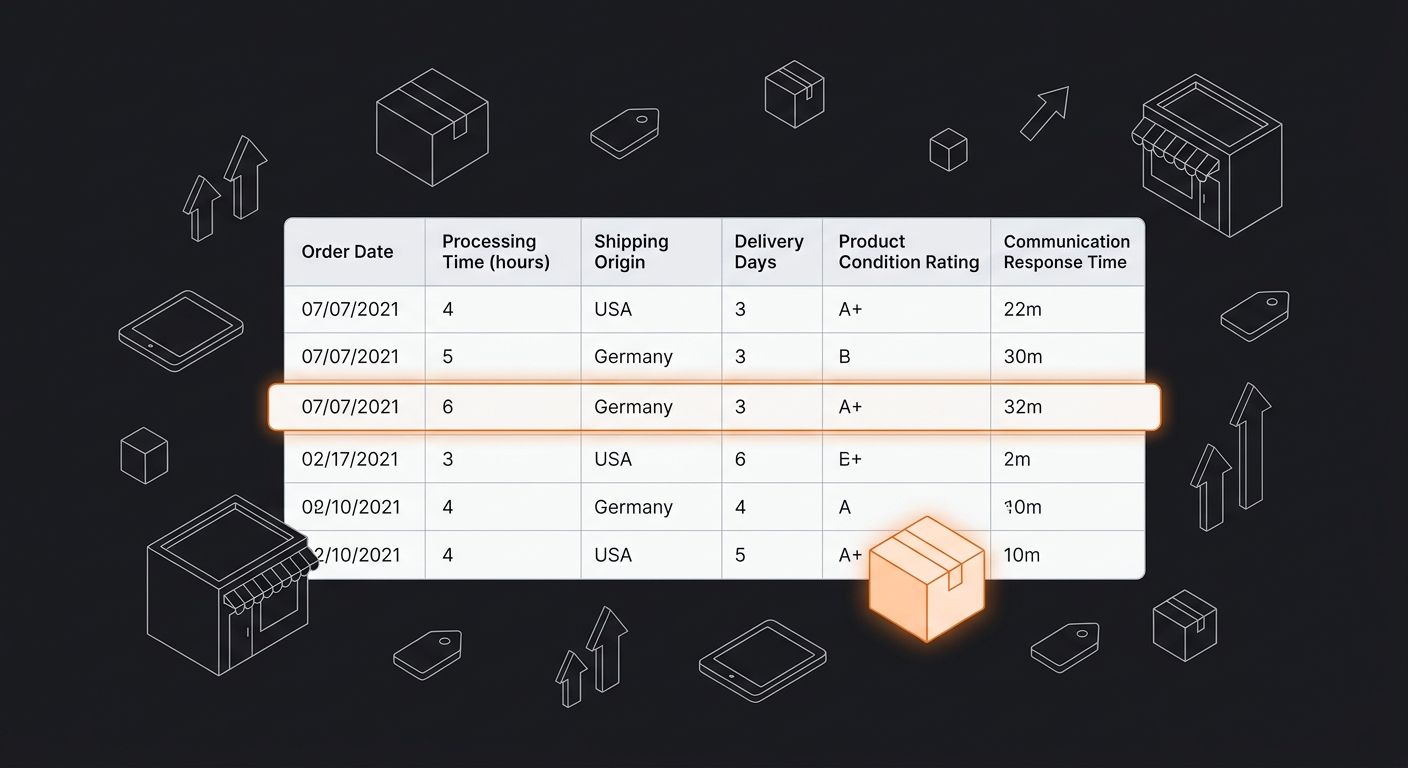
Fulfillment consistency requires at least three test orders, ideally placed under different account names or through different storefronts if possible. You're looking for processing time variance. A supplier that ships order one in 18 hours, order two in 72 hours, and order three in 120 hours has an operational problem, even if all three eventually arrive. That variance means your customers will have wildly different experiences, your support ticket volume will spike, and your refund rate will climb. Consistent 48-hour processing across all test orders is more valuable than one fast shipment and two slow ones.
Communication responsiveness matters because you need to know how a supplier handles the inevitable stockout. Message the supplier's support channel with a specific question about current stock levels for the exact SKU you plan to sell. Ask what happens if a variant goes out of stock mid-order. A supplier who responds within 4 hours with a specific answer ("We have 340 units of the blue variant in our NJ warehouse, expected restock on the 15th") is dramatically more reliable than one who replies in 48 hours with "yes, in stock." Building a proper supplier reliability scorecard around these data points turns gut feelings into measurable criteria you can compare across multiple potential partners.
Return handling is where weak suppliers fall apart entirely. Place a test order, receive it, then initiate a return or exchange. Time the response, document the process, and note whether the supplier absorbs return shipping or pushes it to you. As noted in research on testing dropshipping products, checking how other dropshippers experience a supplier's return process through their reviews can reveal problems you'd otherwise discover only after scaling.
The cost of this entire verification process is typically $80-$150 in test orders plus 2-3 weeks of calendar time. Compare that against a failed launch where you spend $500-$1,000 in ads driving traffic to products that can't be fulfilled. The ROI on pre-launch supplier testing is among the highest in the entire store-building process. When you reverse-engineer successful stores in your niche, pay attention to which suppliers the winning stores appear to use, because those sellers have already absorbed the verification cost for you. Match their suppliers, then run your own confirmation tests.
Where Trust and Verification Still Collide
There's an uncomfortable tension built into every supplier relationship in dropshipping. You need to trust a partner you've never met, whose warehouse you'll never visit, with the experience of customers whose loyalty you're trying to earn. Every supplier inventory verification protocol I've described reduces that trust gap, but it doesn't eliminate it. A supplier who passes all your tests in March can change fulfillment partners in April without telling you. A warehouse that held reliable stock for six months can get cleaned out during a seasonal demand spike.
The honest answer is that verification is ongoing, not a one-time gate. The best operators treat their supplier vetting checklist as a living document, re-running test orders quarterly, monitoring tracking data for shipping origin drift, and keeping a secondary supplier warm for every hero product. Redundancy costs margin in the short term because you're maintaining two supplier relationships instead of one. But the first time your primary supplier goes dark during a $200/day ad campaign, that backup supplier is worth every dollar of the margin you sacrificed to keep them active.
Stock is the single most fragile link in the dropshipping model. Every other part of the business (your ads, your store design, your pricing) is within your direct control. Inventory is the one variable where you're entirely dependent on someone else's truthfulness and operational competence. Building a system that pressure-tests that variable before you scale is the closest thing to insurance this business model offers, and the operators who treat it as optional tend to learn the lesson at exactly the worst possible time.
365 Dropship Editorial
Editorial team writing about E-commerce, dropshipping, and product discovery — reviews of dropshipping suppliers and platforms, trending niche guides (jewelry, beauty, pets, home, fashion), supplier due diligence, ecom operations, shipping & fulfillment strategy, product research, AOV optimization, and profitable dropshipping case studies.
Explore more topics