The Supplier Reliability Scorecard: Building Your Own Due Diligence Framework for Dropshipping Partners
Gartner's procurement research found that 83% of companies discover third-party risks only after onboarding a vendor, and 31% of those risks cause material financial damage.
The Supplier Reliability Scorecard: Building Your Own Due Diligence Framework for Dropshipping Partners
Gartner's procurement research found that 83% of companies discover third-party risks only after onboarding a vendor, and 31% of those risks cause material financial damage. Translate that into dropshipping math: if you're running five suppliers and roughly a third of your risk events hit your P&L, you're almost guaranteed to eat a margin-killing surprise within your first two quarters of operation. The Inventory Source supplier scorecard framework offers one of the more structured approaches to catching these problems before they compound. Here's how it plays out when you pressure-test it against real fulfillment partners on AliExpress, CJ Dropshipping, and Spocket.
The Framework Before the First Order
The scorecard model operates on a simple premise: supplier scorecards provide a framework for ongoing performance dialogue, pushing you toward continuous measurement instead of one-time gut checks. But the structure only works if you define weighted fulfillment quality metrics before you place your first real order.
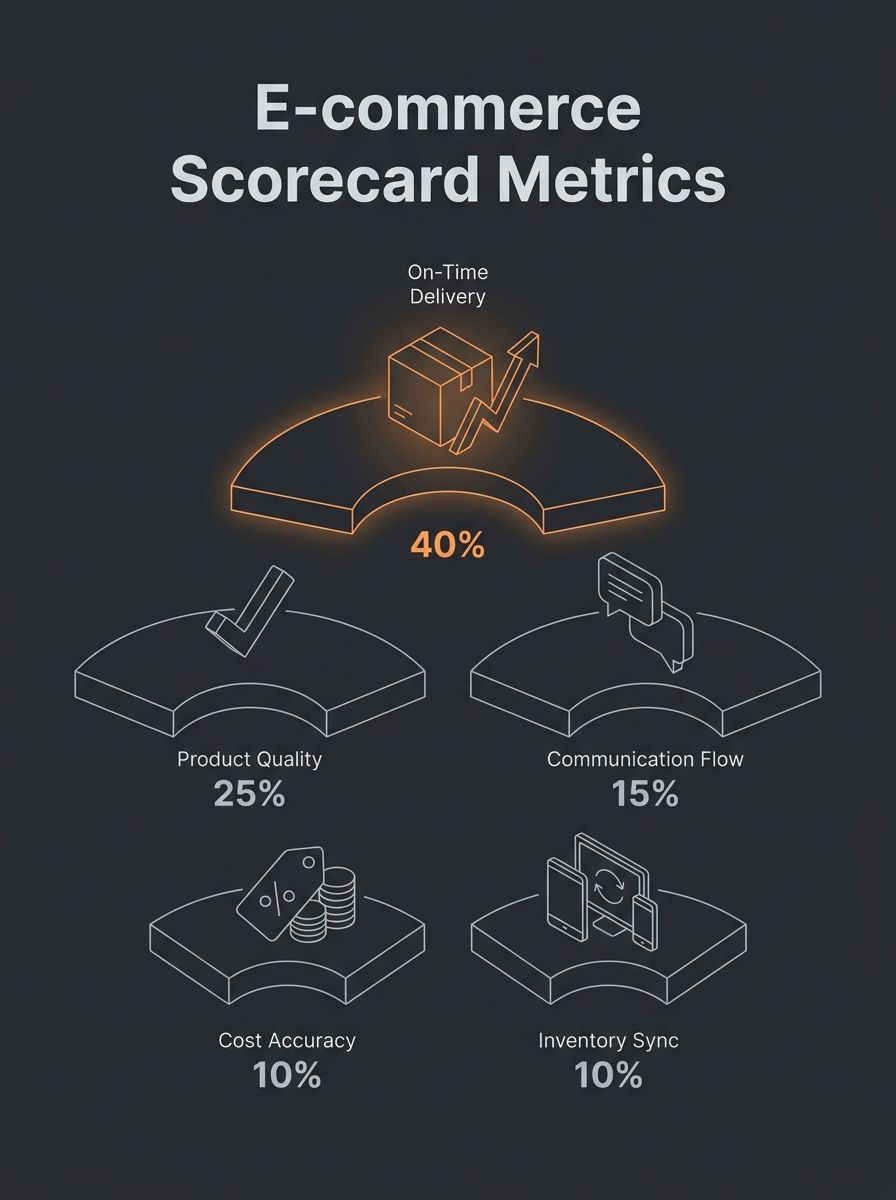
Here's the weight distribution that makes sense for most dropshipping operations with an AOV between $30 and $80:
On-time delivery: 40% weight
Product quality / defect-free rate: 25% weight
Communication responsiveness: 15% weight
Cost accuracy (invoiced vs. quoted): 10% weight
Inventory accuracy / stock sync reliability: 10% weight
That 40% weighting on delivery isn't arbitrary. In dropshipping, delivery time is the single largest driver of chargebacks, negative reviews, and customer service tickets. A supplier who ships quality products three days late will hurt your store's economics more than one who ships average products on time.
When you're studying what makes high-performing stores tick, one of the patterns that shows up repeatedly is that profitable operators have already defined these weights before they even begin supplier outreach. The vendor performance scorecard isn't something they build after problems surface. It's the filter they use during sourcing.
The Sample Order Phase: Where the Real Dropshipping Supplier Evaluation Happens
The most reliable method for pre-launch quality assessment is to order sample products, then evaluate fabric, stitching, packaging, and delivery experience end-to-end. This sounds obvious. In practice, almost nobody does it properly.
Here's what a rigorous sample evaluation looks like for a single supplier on CJ Dropshipping or Zendrop:
Order 1: Baseline test (Day 1)
Place a standard order for 2-3 SKUs you plan to list. Note the exact timestamp of order placement. Track processing time (order placed to tracking number generated), ship time (tracking generated to first carrier scan), transit time (first scan to delivered), packaging condition on arrival, and product match to listing photos including color accuracy, sizing, and materials.
Order 2: Stress test (Day 14)
Place a second order for the same SKUs plus 1-2 you don't plan to sell. This tests whether the supplier's fulfillment consistency holds across a wider catalog. If Order 2 arrives with worse packaging or slower processing, you've identified a capacity or attention problem early enough to pivot.
Order 3: Communication test (Day 21)
Before placing this order, send three messages to the supplier through their platform's messaging system. Ask a question about a product specification, request a custom shipping note or branded packing slip, and ask about their return/defect policy. Score response time in hours. If any response takes longer than 24 hours on a business day, that's a red flag. If the answers are copy-pasted templates that don't address your specific question, that's a bigger one.
The total cost of this three-order evaluation runs $50-$150 depending on your product category. Compare that against the cost of a single bad supplier relationship: one cluster of 1-star reviews can tank your conversion rate by 15-25% on a product page, and clawing back organic ranking after a review hit takes weeks.
The Scoring Math Against Three Real Supplier Types
Let's say you're evaluating three potential suppliers for a home décor niche. Your sample orders are complete. Here's how the scorecard actually generates a usable number.
Each metric gets scored 1-5:
5 = Exceeds expectation (delivery 2+ days early, zero defects, sub-4hr response time)
4 = Meets expectation
3 = Acceptable with minor issues
2 = Below standard, requires correction
1 = Unacceptable
Multiply each score by its weight, sum the results. Maximum possible score: 5.00.
Supplier A (AliExpress, Guangdong-based)
On-time delivery: 4 × 0.40 = 1.60
Quality: 3 × 0.25 = 0.75
Communication: 2 × 0.15 = 0.30
Cost accuracy: 5 × 0.10 = 0.50
Inventory sync: 3 × 0.10 = 0.30
Total: 3.45
Supplier B (CJ Dropshipping, US warehouse)
On-time delivery: 5 × 0.40 = 2.00
Quality: 4 × 0.25 = 1.00
Communication: 4 × 0.15 = 0.60
Cost accuracy: 4 × 0.10 = 0.40
Inventory sync: 4 × 0.10 = 0.40
Total: 4.40
Supplier C (Spocket, EU-based)
On-time delivery: 4 × 0.40 = 1.60
Quality: 5 × 0.25 = 1.25
Communication: 3 × 0.15 = 0.45
Cost accuracy: 3 × 0.10 = 0.30
Inventory sync: 5 × 0.10 = 0.50
Total: 4.10
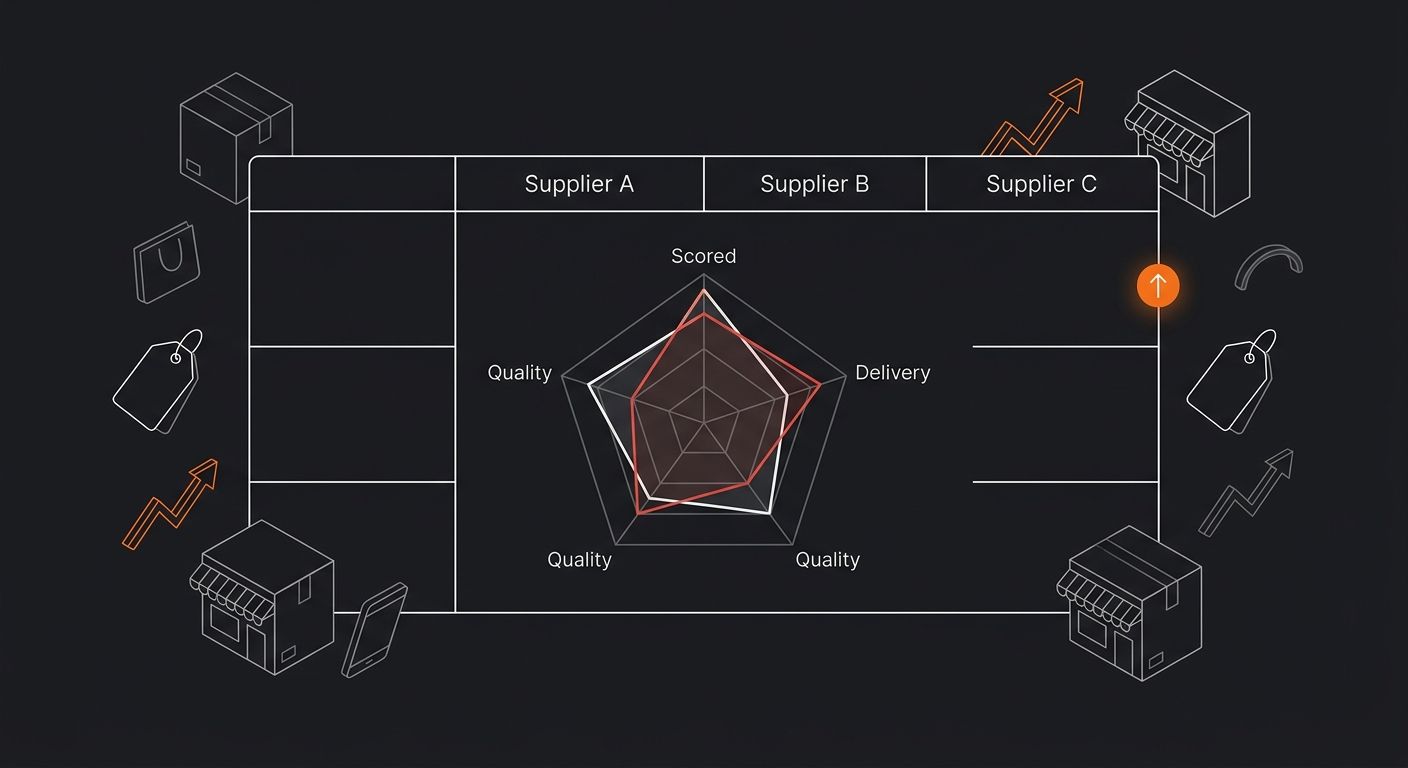
Supplier B wins on the scorecard. But look at the detail: Supplier C scores highest on quality and inventory sync, which might matter more if your niche has high return sensitivity (fashion, electronics accessories). The weights aren't permanent. They're your starting assumptions, and you should adjust them as your store's data teaches you which problems actually cost the most money.
This kind of data-driven approach to supplier selection separates operators who scale from operators who churn through suppliers every eight weeks hoping to stumble onto a good one.
The Quarterly Review Cycle That Catches Drift
The initial scorecard gets you started. The quarterly review is what keeps you profitable. Industry best practice, as documented in Inventory Source's ongoing performance monitoring framework, involves a structured evaluation of supplier deliverables focusing on on-time delivery, quality, and cost at regular intervals.
Here's what a quarterly review looks like in practice:
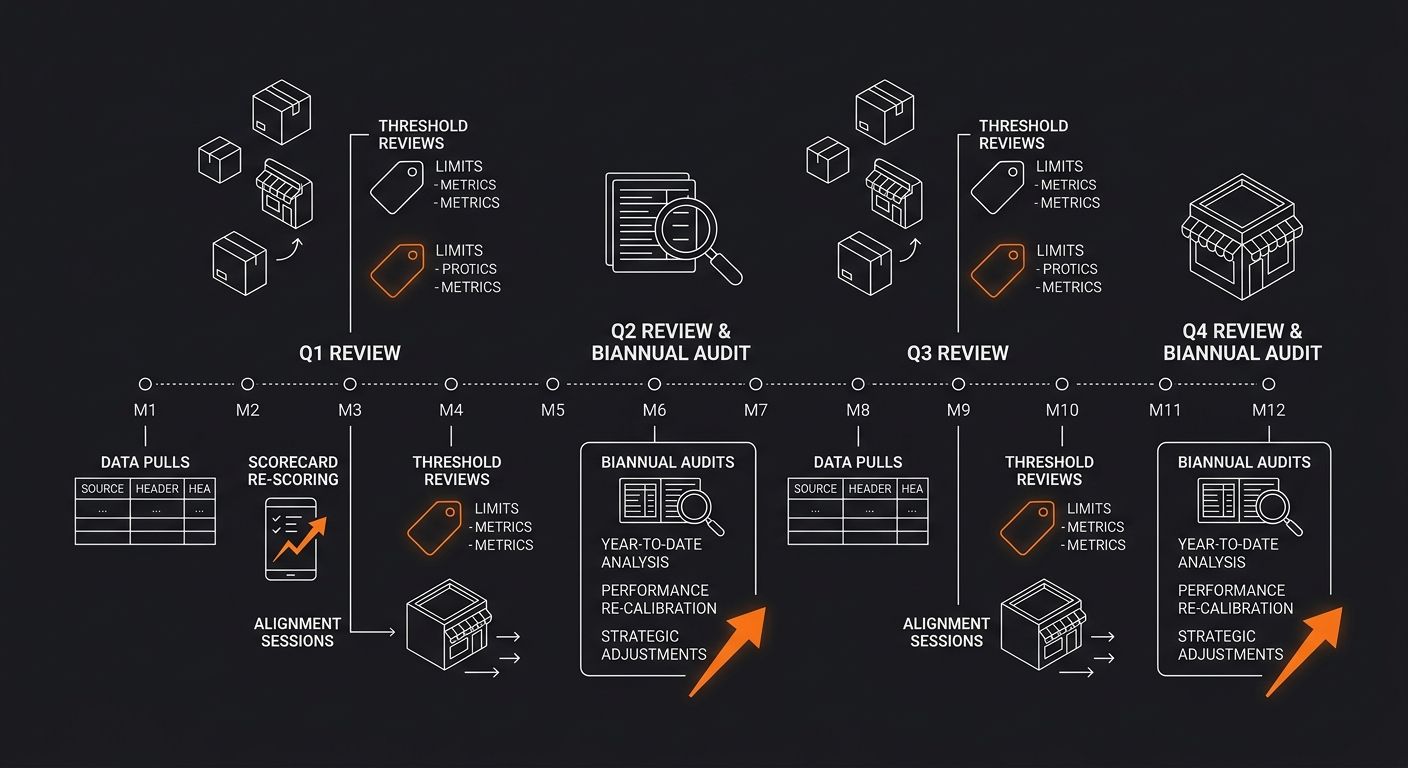
Pull your data. You need total orders placed with each supplier, percentage delivered within the promised window, customer complaint rate per supplier (sort your support tickets by product/supplier), refund/return rate per supplier, and any out-of-stock incidents that caused order cancellations.
Re-score each supplier using the same 1-5 scale and weights from your original scorecard. Compare against the previous quarter's score.
Set thresholds. Any supplier scoring below 3.0 gets a formal improvement notice with specific metrics that need to move. Any supplier below 2.5 gets replaced. Any supplier whose score drops more than 0.5 points quarter-over-quarter gets flagged for investigation regardless of their absolute score, because that rate of decline usually signals an operational problem (warehouse move, staffing changes, financial stress) that will keep getting worse.
Biannual audits add another layer. Quality control research recommends scheduling these with detailed checklists assessing product quality, compliance, and ethical standards. For most dropshipping operations under $500K annual revenue, a virtual audit (video call walkthrough of the supplier's warehouse or production facility) is sufficient. Above that threshold, consider on-site visits or third-party inspection services.
The suppliers who score consistently above 4.0 across multiple quarters deserve preferential treatment: higher order volume, priority access to new product launches, and collaborative planning on seasonal inventory. This partnership dynamic, where the scorecard drives ongoing performance dialogue, creates alignment between your growth goals and the supplier's capacity planning.
Why Supplier B's Score Dropped to 3.1 by Q3
The scoring math above is clean. Real operations are messy. Supplier B, the CJ Dropshipping US warehouse vendor who scored a 4.40 on initial evaluation, is exactly the kind of partner who looks bulletproof on paper and starts slipping once your volume grows.
The pattern is predictable: US warehouse stock runs thin during peak months, orders get rerouted to the China warehouse without notification, and your 3-5 day delivery window suddenly stretches to 12-18 days. Your on-time delivery score for that supplier drops from a 5 to a 2. Even with all other metrics holding steady, that 40% weighting drags the total score from 4.40 down to the low 3s.
If you don't have the quarterly review cycle catching this, you won't notice until your Shopify reviews page fills up with "where is my order?" complaints and your chargeback rate crosses the 1% threshold that payment processors use as a warning trigger.
The fix isn't to drop Supplier B immediately. It's to use the scorecard data in a direct conversation: "Your on-time delivery rate dropped from 96% to 71% between Q1 and Q3. Here's the order-level data. What changed in your fulfillment operation, and what's your plan to get back above 90% within 45 days?"
Some suppliers will respond with a concrete plan and hit the targets. Others will give you vague assurances and nothing changes. The scorecard gives you documentation to make that distinction based on performance trends instead of gut feelings, and it gives you a defensible basis for the decision when you do need to cut a partner loose. When you're analyzing what differentiates profitable stores from struggling ones, supplier accountability systems like this consistently show up as a dividing line between stores that plateau at $10K/month and stores that push past $50K.
Your supplier due diligence checklist and your ongoing vendor performance scorecard are the same document at different points in time. The initial version tells you who to work with. The maintained version, updated every 90 days with real fulfillment data, tells you who's still earning that partnership and who has quietly become your most expensive liability.
365 Dropship Editorial
Editorial team writing about E-commerce, dropshipping, and product discovery — reviews of dropshipping suppliers and platforms, trending niche guides (jewelry, beauty, pets, home, fashion), supplier due diligence, ecom operations, shipping & fulfillment strategy, product research, AOV optimization, and profitable dropshipping case studies.
Explore more topics