Margin Math Gone Wrong: Why Your 40% Product Markup Doesn't Equal 40% Profit (Real Numbers from Winning Stores)
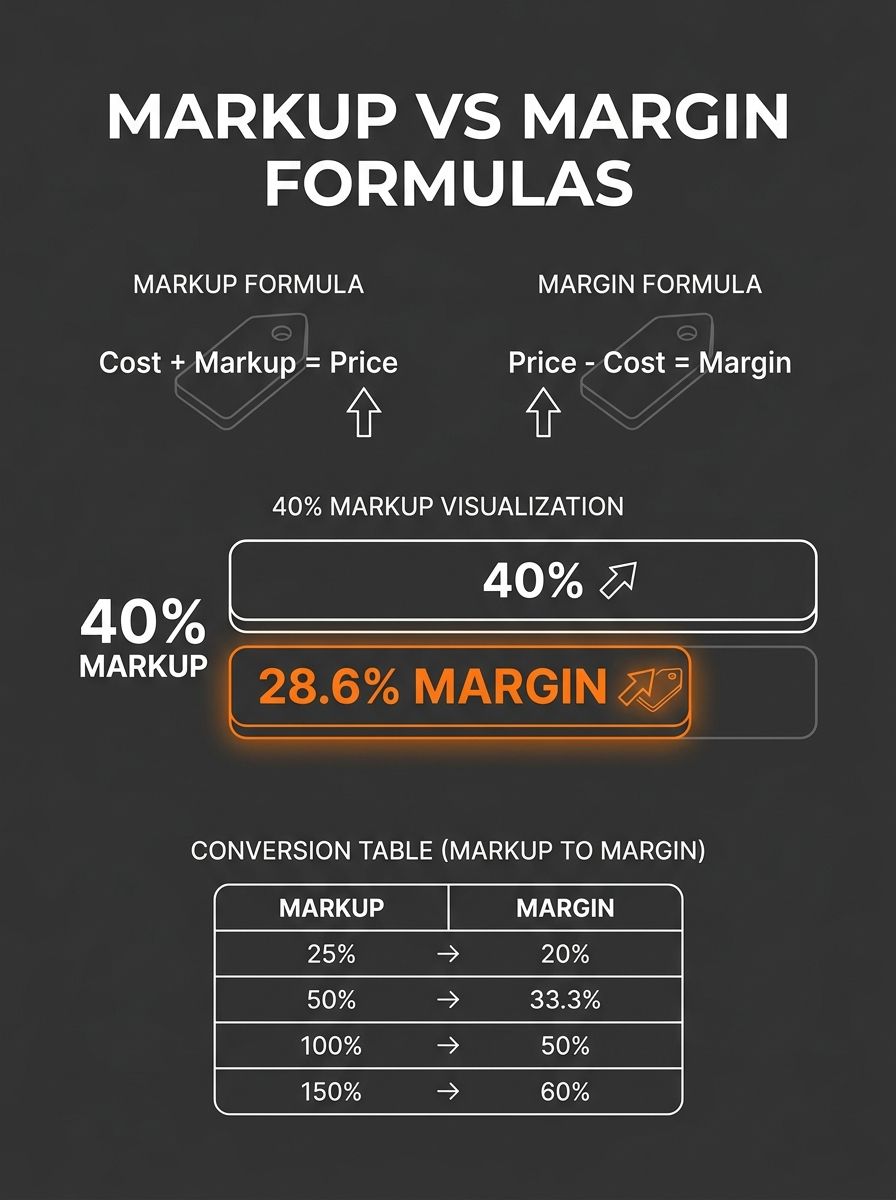
A 40% markup on a $15 product gives you a $21 selling price and $6 in gross profit. Divide that $6 by the $21 sale price and you get 28.6%, which is your actual gross margin. The 11.
Margin Math Gone Wrong: Why Your 40% Product Markup Doesn't Equal 40% Profit
A 40% markup on a $15 product gives you a $21 selling price and $6 in gross profit. Divide that $6 by the $21 sale price and you get 28.6%, which is your actual gross margin. The 11.4-percentage-point gap between the markup number you chose and the margin number that shows up in your bank account is the single most expensive math error in dropshipping. It compounds on every order, every day, across every SKU. And it gets worse from there, because gross margin isn't net margin, and net margin is the only number that matters when you're deciding whether this business is worth running.
This article breaks down the margin calculation formula that actually governs your profitability, explains each layer of cost that sits between your selling price and real take-home profit, and shows you where winning stores' numbers diverge from what newcomers expect.
The Core Confusion: Markup Operates on Cost, Margin Operates on Revenue
The formulas look similar, which is why they get mixed up. But they answer different questions.
Markup asks: how much did I add on top of what I paid? The formula is (Selling Price - Cost) / Cost × 100. A $15 cost sold at $21 gives you ($21 - $15) / $15 × 100 = 40% markup.
Margin asks: what percentage of my revenue is profit? The formula is (Selling Price - Cost) / Selling Price × 100. That same sale: ($21 - $15) / $21 × 100 = 28.6% margin.
The denominator changes everything. As Orisha's breakdown of margin and markup rates confirms, a higher markup rate signifies greater profit in absolute terms, but the margin rate is what tells you how efficiently each revenue dollar converts.
Here's the conversion table that should be taped to every store operator's monitor:
Markup % | Actual Gross Margin % |
|---|---|
25% | 20.0% |
40% | 28.6% |
50% | 33.3% |
66.7% | 40.0% |
100% | 50.0% |
150% | 60.0% |
To hit a 40% gross margin, you need a 66.7% markup. To hit 50% gross margin, you need to double your cost. If you've been running your store at a 40% markup thinking you had 40% margin, you've been overestimating your gross profitability by nearly a third.
What Gross Margin Doesn't Capture
Even after you fix the markup-to-margin confusion, you're looking at gross margin, which only accounts for cost of goods sold (COGS). In dropshipping, COGS is the supplier's product price plus shipping to the customer. Gross margin ignores every other expense required to operate the store.
According to NetSuite's retail margin data, grocery retail averages a 25.5% gross margin but only a 1.2% net margin. That's a 24.3-percentage-point gap consumed entirely by operating costs. Dropshipping stores face a similar structure, just with different cost categories.
Let's walk through each layer.
Payment Processing Fees
Shopify Payments charges 2.9% + $0.30 per transaction on the Basic plan. On a $21 order, that's $0.91. On a $50 order, it's $1.75. PayPal takes a similar cut. These fees come directly off your gross margin, and they're non-negotiable until you're processing serious volume.
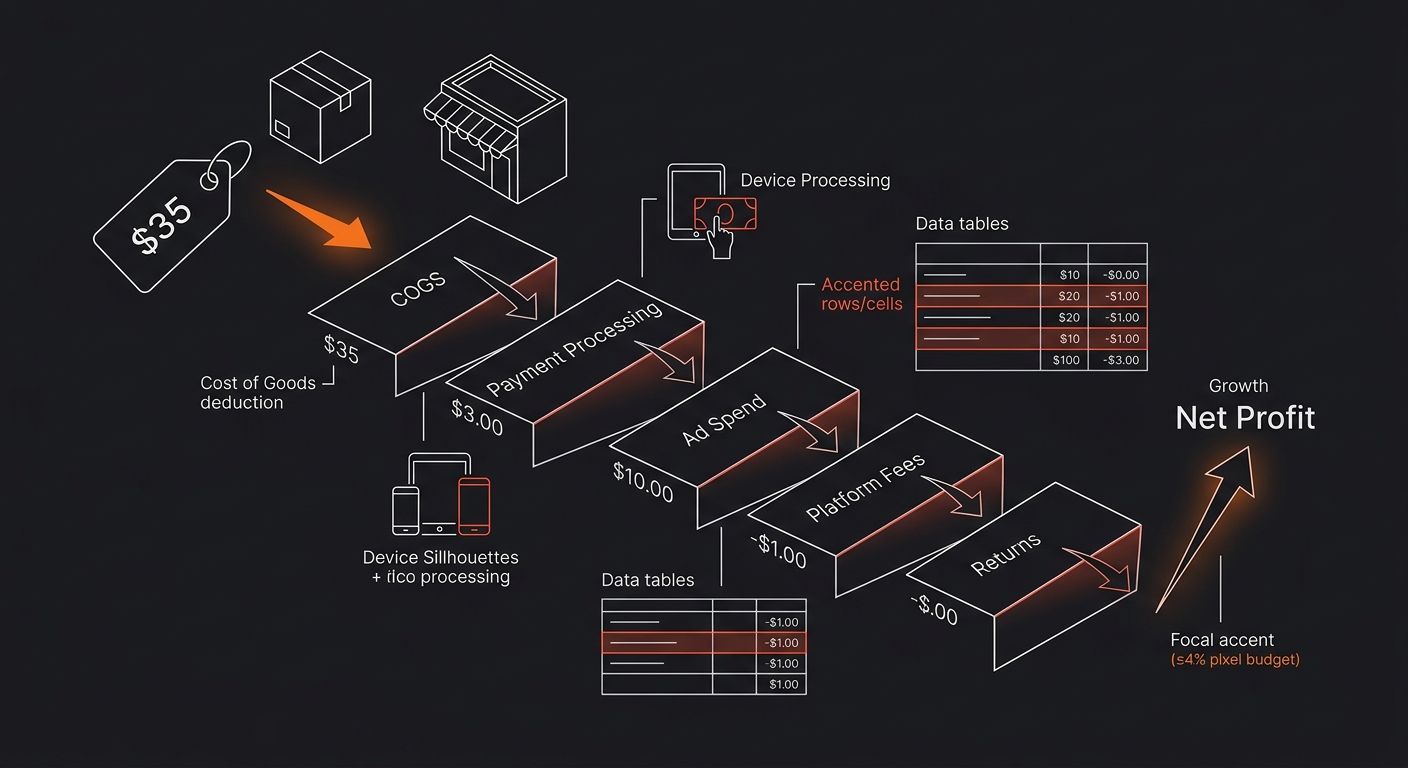
On 1,000 orders per month at a $35 AOV, payment processing alone costs roughly $1,315/month, or $15,780/year.
Platform and App Stack Costs
Shopify Basic runs $39/month. But the average store doesn't run on Shopify alone. A typical app stack includes:
Email marketing (Klaviyo): $20-45/month at low subscriber counts
Reviews app (Judge.me or Loox): $15-25/month
Upsell/cross-sell app: $20-30/month
Oberlo/DSers or CJ integration: $0-20/month
Analytics or heatmap tool: $0-30/month
A modest app stack runs $100-150/month on top of Shopify's base fee. That's $1,680-2,280/year in fixed costs before you sell a single unit. As Entrepreneur's analysis of hidden small business costs notes, tech-related expenses often fall into three categories: tools you barely use, wrong tools for your needs, and right tools used inefficiently. Auditing your app stack quarterly can recover $30-60/month in wasted subscriptions.
Advertising and Customer Acquisition Cost (CAC)
This is the big one. Ad spend is the largest variable cost for most dropshipping stores, and it's the line item that transforms a seemingly healthy gross margin into a thin or negative net margin.
A $35 AOV product with a 28.6% gross margin gives you $10 of gross profit per order. If your blended CAC (cost to acquire one paying customer across all channels) is $12, you lose $2 on every first-time order. You're betting on repeat purchases or upsells to ever see profit.
Winning stores target a CAC-to-AOV ratio below 30%. At a $35 AOV, that means keeping CAC under $10.50. If you've been building your ad budgets around a perceived 40% margin when your real margin is 28.6%, your maximum allowable CAC is 29% lower than you thought.
Refunds, Chargebacks, and Returns
Industry average return rates for ecommerce sit around 20-30% for apparel, 5-15% for general merchandise. In dropshipping, you typically eat the full cost of a refund because reshipping from a Chinese or overseas supplier isn't practical.
If 10% of orders result in full refunds, your effective revenue per 100 orders drops by 10%, but your ad spend to acquire those 100 customers doesn't change. That 10% refund rate functionally raises your CAC by about 11% (you paid for 100 customers but only kept 90 sales).
Chargebacks add insult to injury. Each one costs $15-25 in fees from your payment processor on top of the refunded amount. Two percent chargeback rates trigger processor warnings. Three percent can get your merchant account frozen.
Shipping Cost Variability
If you're sourcing from AliExpress or CJ Dropshipping, shipping costs fluctuate by weight, destination, and method. ePacket to the US might run $3-7 for a small item. Faster options (CJ Packet, Yanwen Special Line) can run $8-15. Offering "free shipping" means absorbing these costs into your product price, which either raises your sticker price (hurting conversion rates) or compresses your margin further.
As Printify's margin analysis points out, choosing print providers or suppliers located close to your customer base can meaningfully reduce per-order shipping costs. A domestic supplier charging $2 more per unit but $6 less per shipment nets you $4 in savings. This is exactly the kind of supplier due diligence that pays for itself. If you're evaluating suppliers systematically, building a supplier reliability scorecard helps you weigh landed cost alongside fulfillment speed and defect rates.
A Real Cost Breakdown Analysis on a $35 Order
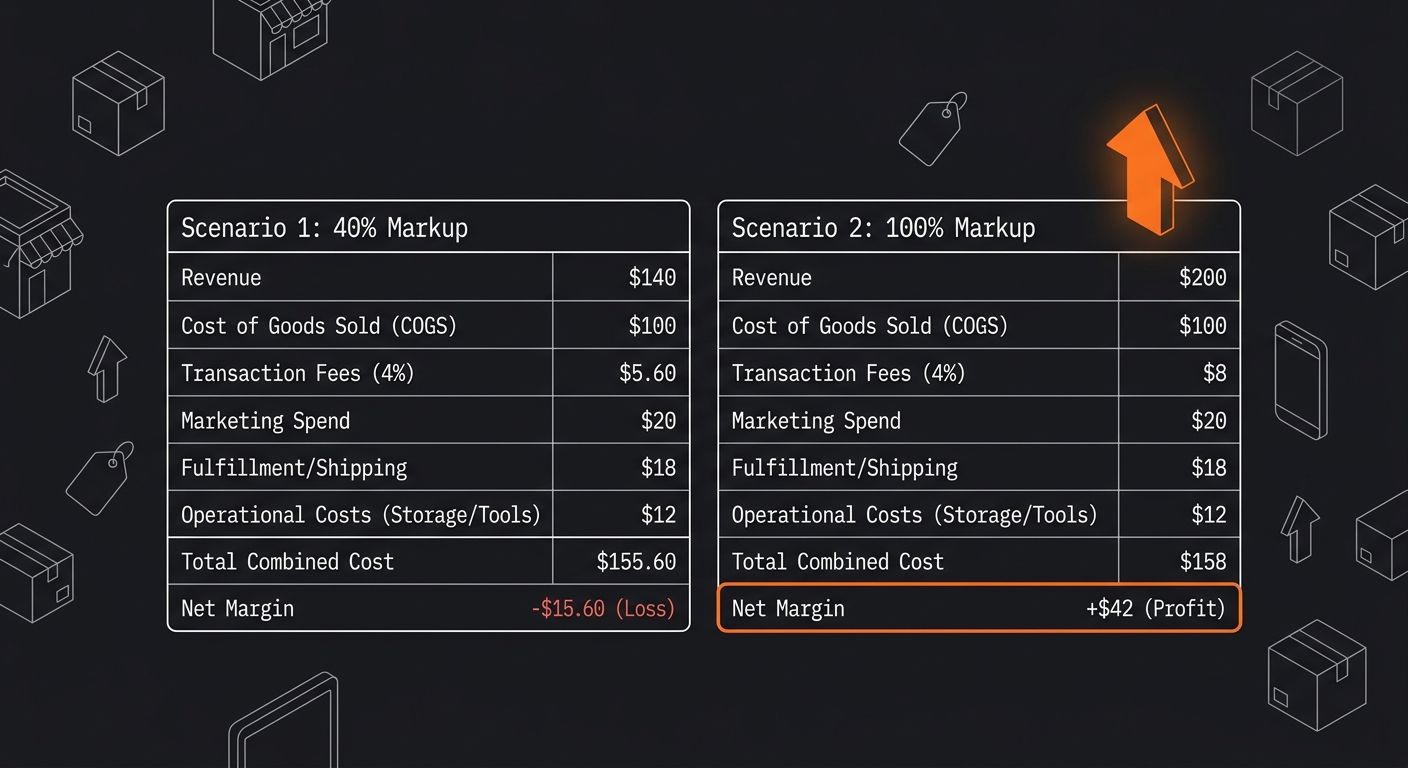
Here's a representative cost breakdown analysis for a general merchandise dropshipping store selling a product with a 40% markup:
Line Item | Amount |
|---|---|
Selling price | $35.00 |
Supplier cost (product) | $25.00 |
Shipping to customer | $4.50 |
Gross Profit | $5.50 |
Gross Margin | 15.7% |
Payment processing (2.9% + $0.30) | -$1.32 |
Allocated platform/app costs (per order at 500 orders/mo) | -$0.35 |
Blended CAC (Facebook + Google) | -$9.00 |
Refund reserve (8% of revenue) | -$2.80 |
Net Profit Per Order | -$7.97 |
You read that right. This store loses nearly $8 per order. And the operator who set that 40% markup thought they were building a profitable business.
The fix requires working backward from a target net margin. If you want 15% net margin on a $35 selling price ($5.25 net profit per order), and your hidden operational expenses total roughly $13.47 per order (processing + platform + CAC + refund reserve), you need your COGS plus shipping to come in at $16.28 or less. That means your supplier cost plus shipping can't exceed 46.5% of your selling price.
If your current supplier charges $25 plus $4.50 shipping ($29.50 total, or 84.3% of your selling price), no markup adjustment alone will save you. You need a cheaper supplier, a higher selling price, or a fundamentally different product with better cost structure. Verifying what suppliers actually deliver before you commit is worth the upfront effort. Stores that skip supplier inventory verification often discover cost overruns after they've already sunk ad spend into a product.
Where the Real Margin Comes From
Profitable dropshipping stores don't survive on first-order economics. They build margin through three mechanisms:
Higher AOV through bundling and upsells. If your CAC is $9 regardless of order size, a $35 order with $5.50 gross profit gives you almost nothing after acquisition cost. A $65 order with $22 gross profit gives you $13 after the same $9 CAC. Every dollar of AOV increase above your breakeven point flows almost entirely to profit. Stores that reverse-engineer successful competitors often find that bundling strategy, not product selection, separates profitable stores from cash-burning ones.
Repeat purchases that carry zero acquisition cost. A returning customer acquired through email or SMS costs $0.01-0.05 to reach. If 25% of your customers buy twice, those second orders carry dramatically higher margin because the CAC line disappears. This is why email list building isn't a nice-to-have. It's the mechanism that makes the entire business model work.
Supplier negotiation at volume. Moving from AliExpress retail pricing to direct supplier pricing through Alibaba or 1688 can cut unit costs 30-50%. A product that costs $25 at retail sourcing might cost $14-17 at 100+ units through a direct relationship. That single change can shift a money-losing SKU into a profitable one.
Why the Model Breaks
The mechanism described above works when your traffic converts predictably and your supplier costs stay stable. It breaks in specific, common scenarios:
Ad platform cost spikes. CPMs on Meta and TikTok can jump 40-60% during Q4 or when a new competitor enters your niche aggressively. If your margin model assumes a $9 CAC and your actual CAC hits $15 during November, every order burns cash. Stores that don't model seasonal CAC variation often show a profitable Q1-Q3 and then give it all back in Q4 when they scale spend into expensive auctions.
Currency fluctuation on supplier payments. Paying Chinese suppliers in USD while they price in RMB means your cost basis shifts with exchange rates. A 5% RMB appreciation against the dollar raises your effective COGS by 5%, which on thin margins can eliminate profit entirely.
The refund spiral. Some product categories (fashion, electronics accessories) carry 15-25% return rates. When you model profitability at an 8% refund rate and reality delivers 18%, the math collapses. You've already spent the ad dollars, processed the payments, and eaten the fees. The refund doesn't give those back. As ToolE's analysis of hidden ecommerce costs puts it, unexpected fees quietly eat away at margins, and what starts as a profitable product can become a consistent loss center once actual return data rolls in.
Ignoring micro-costs. Transaction fees, currency conversion fees, Shopify's additional 2% charge if you don't use Shopify Payments, domain renewals, SSL certs, accounting software, VA wages. Individually small. Collectively, they can add $1-3 per order in costs that never appear in your quick mental math.
The stores that survive long-term don't set a markup and walk away. They track net margin per SKU, per channel, per month, and they kill products or raise prices the moment the math stops working. Profitability in dropshipping is a maintenance task, not a one-time setup decision. The operators who understand that distinction are the ones still around a year from now.
365 Dropship Editorial
Editorial team writing about E-commerce, dropshipping, and product discovery — reviews of dropshipping suppliers and platforms, trending niche guides (jewelry, beauty, pets, home, fashion), supplier due diligence, ecom operations, shipping & fulfillment strategy, product research, AOV optimization, and profitable dropshipping case studies.
Explore more topics