The Marketing Myth in Dropshipping Success Stories: Why Product Alone Won't Save a Failing Store
Cycling through ad creatives every 72 hours, swapping audience segments when cost-per-purchase crosses $12, and killing ad sets that don't hit a purchase within $30 of spend. This is the actual machinery behind the dropshipping success stories that get attributed to "finding the right product.
The Marketing Myth in Dropshipping Success Stories: Why Product Alone Won't Save a Failing Store
Cycling through ad creatives every 72 hours, swapping audience segments when cost-per-purchase crosses $12, and killing ad sets that don't hit a purchase within $30 of spend. This is the actual machinery behind the dropshipping success stories that get attributed to "finding the right product." The mechanism everyone misunderstands is this: product selection is an input to the system, but the system itself is a marketing engine. When a store fails, the default diagnosis is "wrong product." The real cause, in the vast majority of cases, is an underfunded, untested, or structurally broken dropshipping marketing strategy that never gave the product a fair trial.
According to research from Appscenic, the core reasons why dropshipping stores fail include ineffective marketing strategies alongside factors like long shipping times and poor customer service. Product selection makes the list, but it shares the stage with operational and marketing failures that get far less attention in YouTube thumbnails.
The Revenue Equation Everyone Simplifies
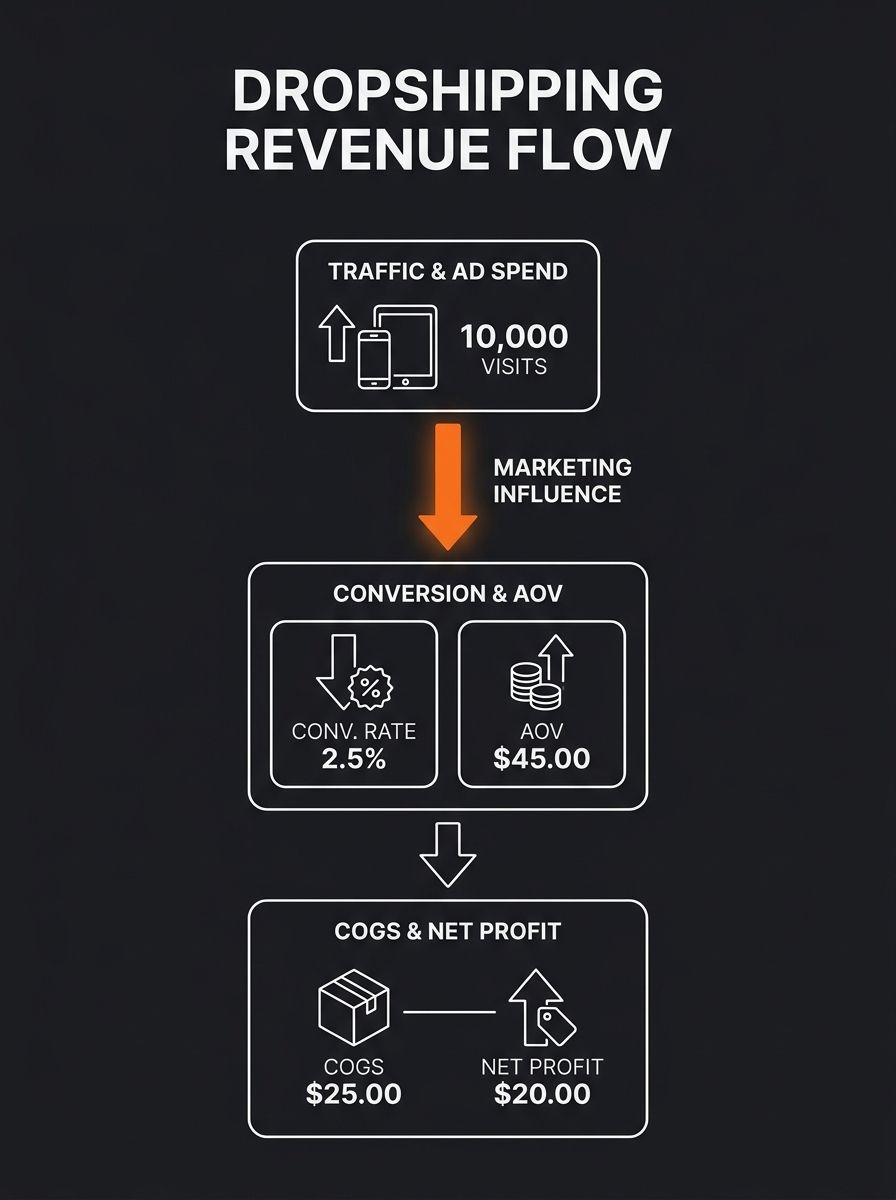
The story people tell themselves: find a winning product, list it, run some ads, collect profit. The actual equation looks more like this:
Revenue = (Traffic × Conversion Rate × AOV) − (Ad Spend + COGS + Platform Fees + Refunds + Chargebacks)
Each of those variables is influenced primarily by marketing decisions, not product decisions. Traffic depends on your ad targeting, creative quality, and channel mix. Conversion rate depends on your landing page, offer structure, trust signals, and urgency mechanics. AOV depends on your upsell flow and bundle strategy. The product affects COGS and has some influence on conversion rate, but it's one variable among many.
Here's where the math gets uncomfortable. A store running a product with a $12 landed cost and a $34.99 selling price has roughly $23 in gross margin per unit. If their Facebook CPM is $18 and their click-through rate is 1.2%, they're paying about $1.50 per click. At a 2% landing page conversion rate, that's $75 to acquire one customer. They lose $52 per sale. The product is fine. The ad funnel is what's bleeding money.
Swap that same product into a store with a 3.5% conversion rate (better landing page, stronger offer), a 1.8% CTR on ads (better creatives), and a $48 AOV (bundle or upsell added), and the same product becomes profitable. The product didn't change. Everything around it did. Understanding this dynamic is essential if you've already done your margin math and are wondering why the numbers still don't work in practice.
How Facebook Ad Spend Actually Converts
Paid ads are the fastest path to scaling a dropshipping business, but they're also the fastest path to burning cash if you don't understand how the conversion mechanism works. AdStellar's research describes the core challenge well: you need to test dozens of products, scale winners fast, and cut losers before they drain your budget.
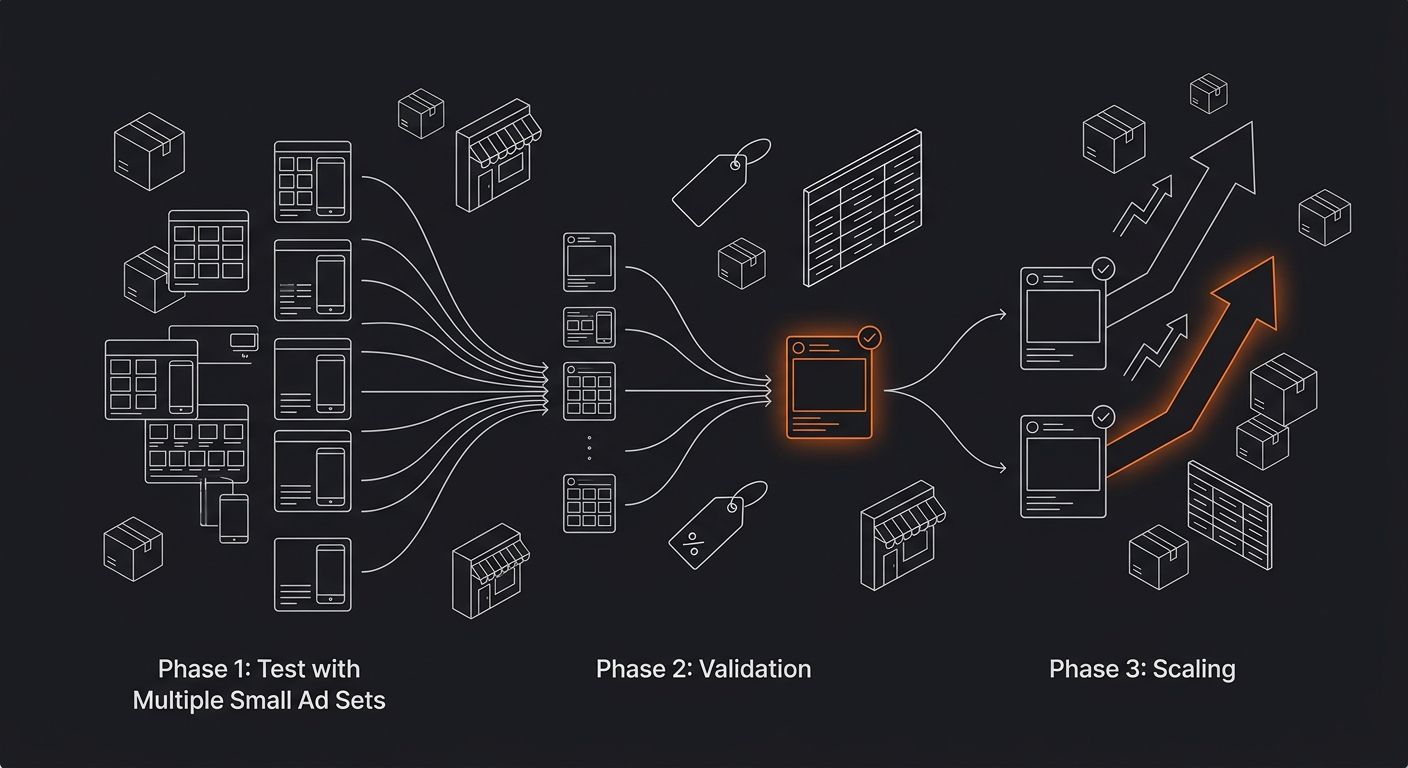
The mechanism works in phases:
Testing phase: You spend $200–$500 testing 3–5 ad sets per product, each targeting a different audience segment with different creatives. The goal here is data, not profit. You're buying information about which audience-creative combinations produce purchases at an acceptable cost.
Validation phase: Winners from testing get scaled to $50–$100/day budgets. You monitor cost-per-purchase closely. If CPA stays below your break-even threshold (usually 40–50% of your selling price minus COGS), the ad set lives. If it drifts above, you cycle in new creatives or new audiences.
Scaling phase: Validated ad sets get budget increases of 20–30% every 48–72 hours. Aggressive jumps (doubling overnight) typically reset Facebook's learning phase and tank performance.
The case study from Endless Digital Agency illustrates this mechanism at work. They generated $398k in revenue from $68k in ad spend over 60 days. The key moves: consulting on creative direction, cycling in new audiences and ads once spend per ad set hit a defined threshold, and continuously collecting data to inform the next round of creatives. The product mattered, but the Facebook ads ROI came from disciplined creative cycling and audience management.
The Creative Engine Behind Every "Winning Product"
When someone says they found a winning product, what they usually mean is they found a creative angle that converts for a specific audience on a specific platform. The product is the same one available to 500 other stores on AliExpress. The creative is what's unique.
A creative engine looks like this in practice: you produce 5–10 variations of ad creative per product test. Some are UGC-style videos (unboxings, reaction clips, problem-solution demos). Some are static images with different headlines. Some are carousel ads comparing your product to a competitor or a generic alternative. You run all of them simultaneously against different audience segments.
The winning creative often surprises you. A shaky phone video shot in someone's kitchen might outperform a polished studio ad by 3x on cost-per-purchase. The mechanism behind this is platform-specific: Facebook and TikTok algorithms reward content that looks native to the feed. Overproduced ads trigger ad blindness.
Most dropshippers who complain about products not working have tested one or two creatives and declared the product dead. They haven't tested the marketing. They've barely started. As one Reddit discussion put it bluntly: dropshippers approach these businesses with the wrong attitude, give up if they don't see instant sales from "some crappy TikTok post," and blame the product.
Product-Market Fit Is a Continuous Process, Not a Moment
The Silicon Valley concept of product-market fit has seeped into dropshipping culture in a distorted form. Operators treat it like a checkbox: find product-market fit, then scale. Brian Balfour has written extensively about why this framing is dangerous. As he argues, the product-market fit mantra has been taken to an extreme that creates tunnel vision. Statements like "product-market fit is the only thing that matters" have become too common.
The product-market fit myth in dropshipping goes like this: if you find the right product for the right audience, the store will print money. But fit is dynamic. Shopify's own research points out that fit shifts as customers' needs change. A product that converts well in Q1 might flatline in Q3 because trends shifted, competitors entered, or the audience's attention moved to a different platform.
What actually sustains a store is ongoing market testing. This means regularly introducing new creatives, testing new audience segments, trying new traffic channels, and adjusting your offer structure. The stores that survive past six months are the ones treating marketing as an ongoing experiment, not a setup-once activity.
This is closely related to why competitor analysis matters more than passion when picking your niche. If you're choosing products based on gut feeling rather than competitive data, you're already behind.
The Channel Dependency Trap
Stores that scale entirely on Facebook ads develop a dangerous dependency. Facebook's algorithm changes, CPMs fluctuate seasonally, and ad account bans happen without warning. A dropshipping marketing strategy that relies on a single paid channel is structurally fragile.
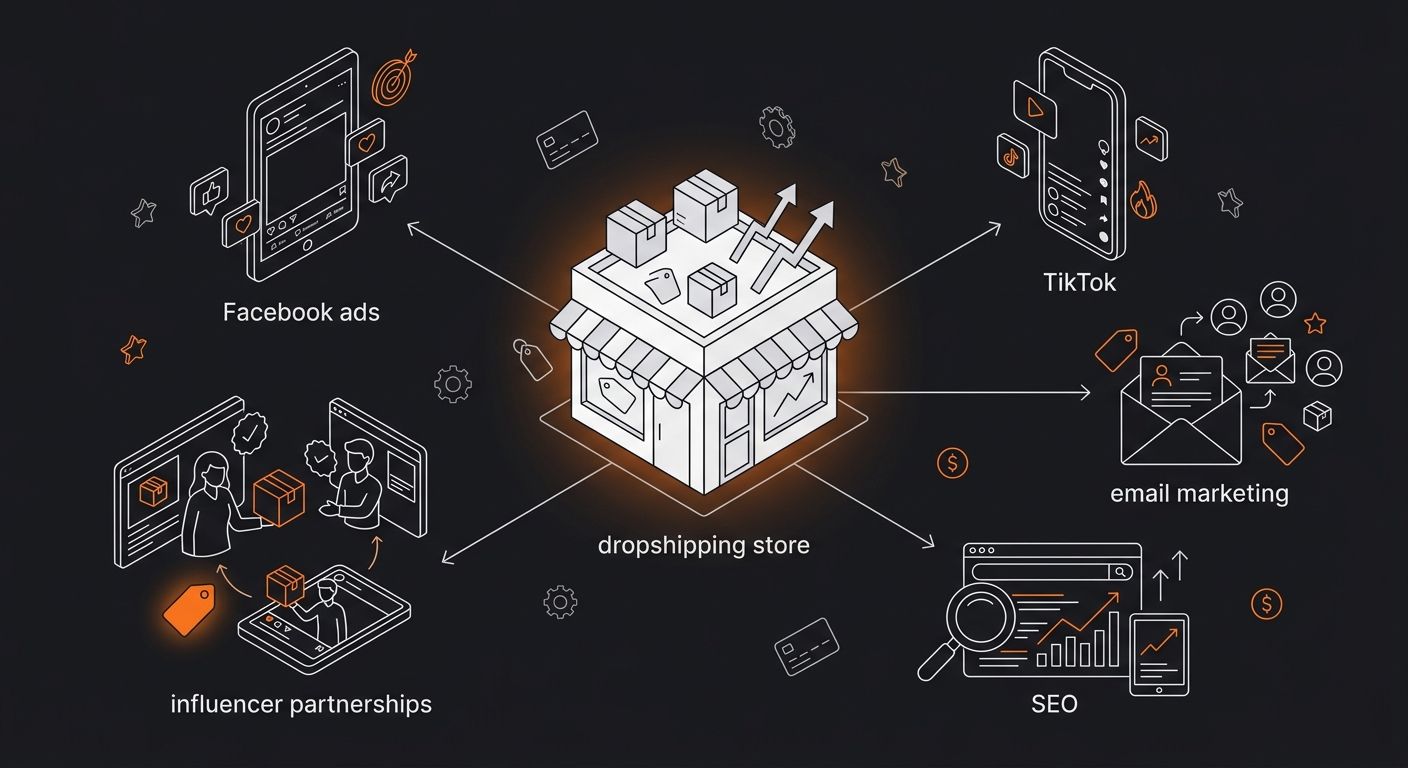
The stores with staying power diversify across multiple channels:
Paid social (Facebook, TikTok, Instagram) for immediate traffic and product testing
Email and SMS for repeat purchases and recovering abandoned carts (this is where lifetime value lives)
SEO and content for long-term organic traffic that doesn't cost per click
Influencer partnerships for social proof and reach into warm audiences
ZIK Analytics recommends that beginners start with low-cost strategies and scale into paid advertising as data and revenue increase. This is sound advice. Running Facebook ads at scale before you have a converting store is like pouring gasoline on wet wood.
The unit economics should also be solid before you spend heavily on paid channels. If your supplier quality doesn't hold up under volume, all the ad spend in the world won't save you from a wave of refund requests and chargebacks that eat your margin.
Why Scaling With Paid Ads Requires Operational Maturity
Here's a pattern that plays out constantly: a store finds a product-creative combination that works, scales ad spend from $50/day to $500/day, and then falls apart. Orders flood in, but the supplier can't keep up. Shipping times balloon from 8 days to 22 days. Customer service tickets pile up. Chargebacks start hitting. The store's Shopify payments account gets flagged.
Scaling with paid ads only works when the operational backend can absorb the volume. This means your supplier has verified inventory (not claimed inventory), your customer service response time stays under 24 hours, and your refund/return process is documented and fast. Many operators discover these gaps too late, which is exactly why verifying supplier inventory claims before scaling is a non-negotiable step.
The mechanism at work here is a feedback loop. Paid ads drive volume. Volume stresses operations. Operational failures create bad customer experiences. Bad experiences generate refunds, chargebacks, and negative reviews. Negative signals raise your ad costs (Facebook's algorithm penalizes advertisers with poor customer feedback scores). Higher ad costs kill your unit economics. The store dies, and the owner blames the product.
Where The Model Breaks
This marketing-first model has real limits. No amount of creative testing or audience targeting will save a product with a landed cost that leaves less than $10 in gross margin. You can't buy your way to profitability when the numbers don't work at the unit level. You also can't market your way out of a 25-day shipping time when competitors offer 5-day delivery from US warehouses.
The model also breaks when operators treat marketing as a one-time setup cost rather than an ongoing operating expense. Ad performance decays. Creatives fatigue. Audiences saturate. You need to continuously reinvest in new content, new angles, and new tests. Cloudways' research found that most dropshippers lack the patience to maintain a store over time, and this impatience shows up most clearly in marketing. They run one round of ads, see mediocre results, and conclude the business doesn't work.
The honest picture is this: product selection gets you into the game. It determines your ceiling and your floor on margins. But the marketing engine is what generates actual revenue between those boundaries. Stores fail because operators spend 90% of their time picking products and 10% building the system that sells them. The ratio should be closer to the reverse. Product research takes days. Building, testing, and iterating a marketing system takes months. The stores that survive are the ones where the operator understood that distinction before they spent their first dollar on ads.
365 Dropship Editorial
Editorial team writing about E-commerce, dropshipping, and product discovery — reviews of dropshipping suppliers and platforms, trending niche guides (jewelry, beauty, pets, home, fashion), supplier due diligence, ecom operations, shipping & fulfillment strategy, product research, AOV optimization, and profitable dropshipping case studies.
Explore more topics