Niche Research Tool Paradox: Free vs. Paid Tools—When Your $500 Subscription Costs You More Than It Saves
Exploding Topics, Dropship.io, Jungle Scout, Tradelle, a CompetitorLens seat, and maybe Helium 10 stacked on top. Add up those monthly invoices and you're staring at $400–$600/month in niche research tooling before you've validated a single product or shipped a single order.
The Niche Research Tool Paradox: When Your $500 Subscription Costs More Than It Saves
Exploding Topics, Dropship.io, Jungle Scout, Tradelle, a CompetitorLens seat, and maybe Helium 10 stacked on top. Add up those monthly invoices and you're staring at $400–$600/month in niche research tooling before you've validated a single product or shipped a single order. The implied promise behind every one of those subscriptions is the same: pay us, and we'll surface profitable niches faster than you could find them on your own. And for certain operators at certain stages, that promise delivers. For many others, the subscription stack becomes the most expensive form of procrastination in ecommerce, a monthly autopay that feels like progress while producing nothing but browser tabs full of dashboards you barely check.
The real question in any niche research tool comparison isn't which platform has the best UI or the deepest database. It's whether the output of that tool, measured in validated product ideas you actually launch, justifies the compounding cost of keeping it active. That calculation looks radically different depending on where you sit in the dropshipping lifecycle.
The Math Nobody Runs Before Subscribing
Consider a concrete example. Dropship.io pushes 40 curated product picks every Monday, each screened by an algorithm and then reviewed by a human team. At roughly $29-$49/month depending on tier, that sounds like a bargain if even one of those products becomes a winner. Tradelle's Lite plan pitches itself as sufficient to pick a winning product and start a successful dropshipping business, pricing entry-level access around $30/month. Exploding Topics, which tracks emerging search trends before they hit mainstream saturation, offers generous free access but gates its most valuable trend data behind a paid tier north of $39/month.
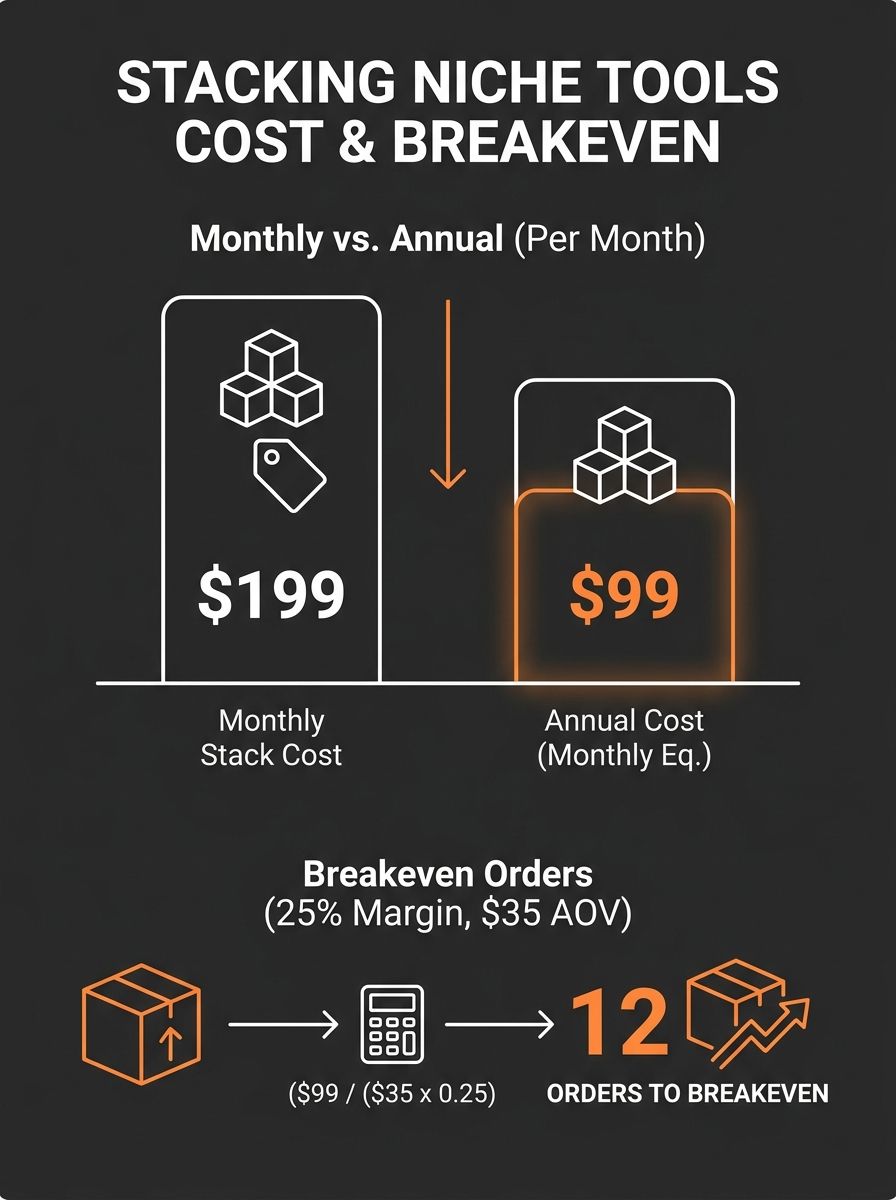
Individually, none of these tools costs an outrageous amount. The trap is cumulative. A store owner who subscribes to two product research platforms, one trend discovery tool, and one competitor analysis suite easily crosses $150/month. Over a year, that's $1,800. If your store runs at 25% net margins on a $35 AOV, you need roughly 206 incremental orders just to break even on tool costs. That's real math, and it's math that very few people run before entering their credit card number. We've written about how markup percentages mislead operators on actual profit, and the same numeracy gap applies to tool ROI. Your dropshipping research ROI on any subscription is zero until a tool-sourced product actually generates margin dollars that exceed the tool's cost.
The compounding problem gets worse when you factor in time. Paid tools don't eliminate research hours; they redirect them. Instead of scrolling TikTok for trending products or mining Reddit threads, you're scrolling dashboards, filtering databases, and comparing trend charts. A NicheValidator.app study estimated their paid tool saves roughly 22 hours compared to free methods for the same research output, valuing that time at $15/hour. But that valuation only holds if you would've earned $15/hour doing something else during those 22 hours. For a solo operator building their first store, the alternative use of that time is often more research, not billable work. The time-savings argument for paid niche validation tools assumes an opportunity cost that many early-stage dropshippers don't actually have.
Where Free Tools Still Generate Signal
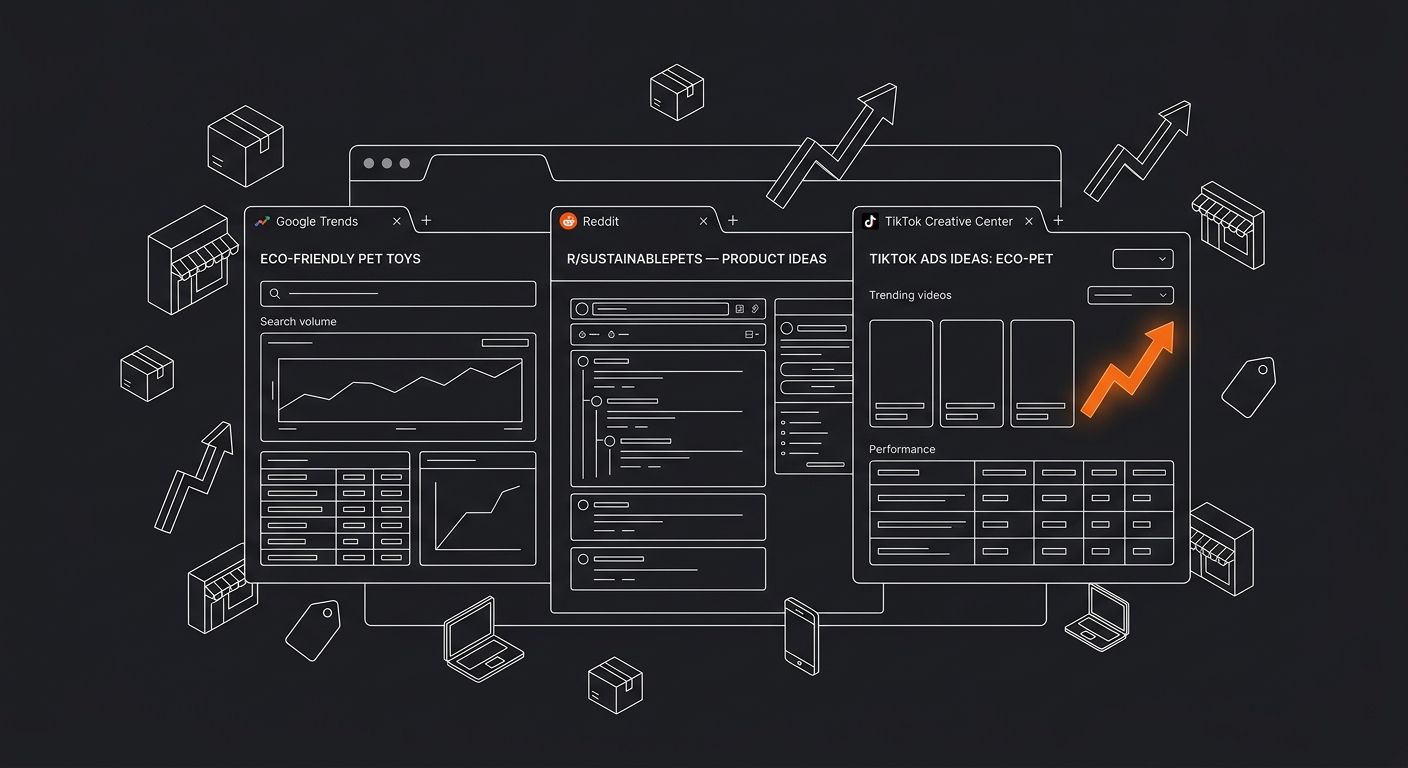
Google Trends, the TikTok Creative Center, Reddit's niche-specific subreddits, Pinterest Trends, and the free tiers of tools like Exploding Topics and Ubersuggest collectively provide an enormous amount of market signal analysis at zero cost. The data quality is lower per-query, and you'll spend more hours triangulating signals across sources. But the signal itself is real, and for pre-revenue operators, the learning that comes from manual research has compounding value that dashboards don't replicate.
When you manually track a niche through Google Trends, cross-reference it against Amazon bestseller movement, and then validate demand by reading actual customer complaints on Reddit, you develop pattern recognition that no tool can install in your brain. You start to notice which product categories show seasonal spikes versus genuine secular growth. You learn to distinguish between viral curiosity (a product gets millions of TikTok views but nobody actually buys it) and durable purchasing intent (the product shows steady search volume growth over 12+ months with rising review counts on Amazon). That instinct matters more than any database filter, and it's built through hours of free-tool grunt work early in your career.
The actual gap between free and paid tools is organizational, not informational. Free research produces scattered insights across a dozen tabs. Paid tools organize the same underlying data into ranked, filterable, scored outputs. That organization is genuinely valuable when you already know what you're looking for and need to move fast. It's considerably less valuable when you're still developing the judgment to evaluate what the tool is showing you. If you've read our breakdown of why micro-niche strategies fail without real competitor analysis, you'll recognize the pattern: tools surface data, but the interpretation layer is entirely on you.
When Paid Tools Actually Earn Back Their Cost
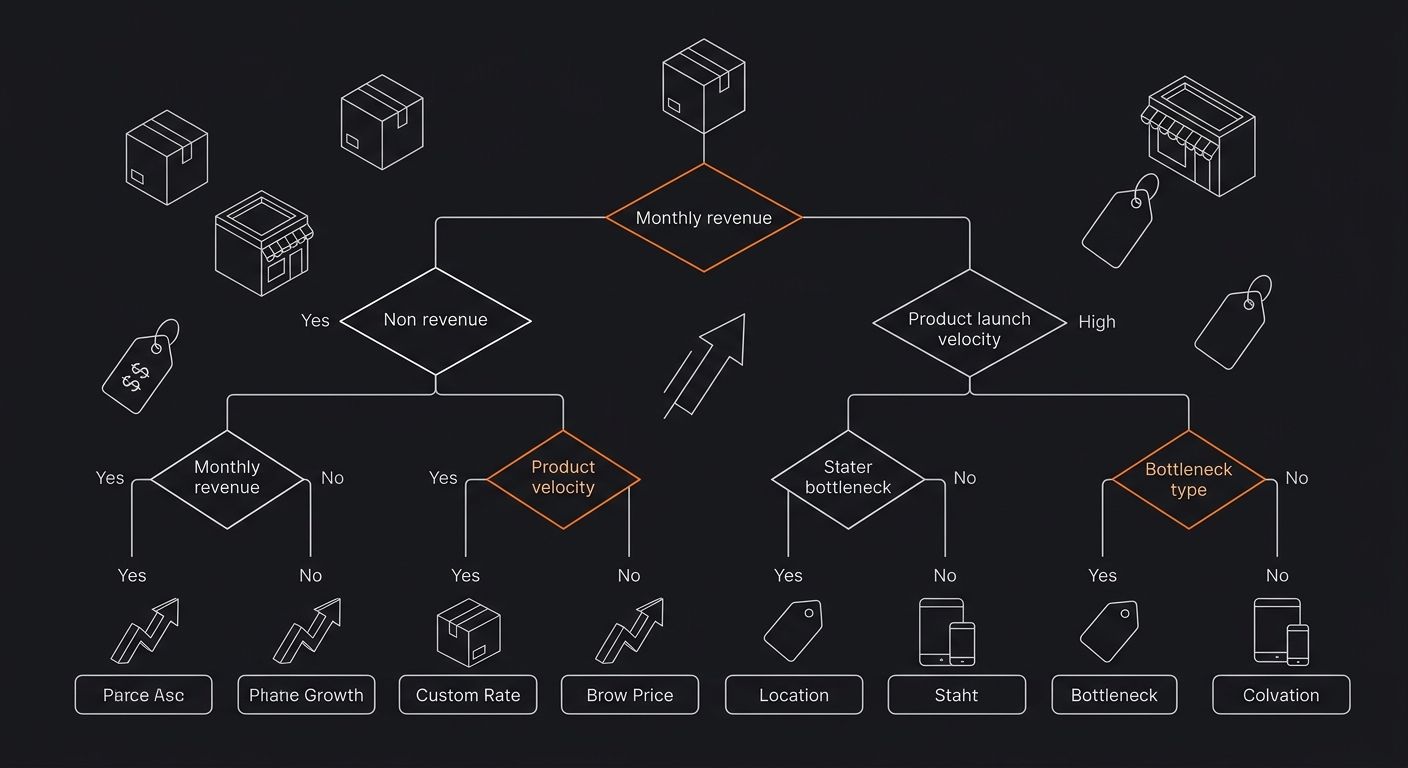
There's a specific operator profile where paid research tools generate clear positive ROI, and it's narrower than most vendors want to admit. You need three conditions to be true simultaneously. First, you're already generating revenue from at least one product line, which means you have a baseline understanding of your unit economics and can evaluate new product opportunities against a known margin structure. Second, your bottleneck is genuinely idea velocity, meaning you can source, list, run ads, and fulfill a new product within two weeks of identifying it, so faster research directly compresses your revenue timeline. Third, you're testing enough products per month (four or more) that the per-test cost of the tool drops below $10, which is negligible against your ad testing budget.
When all three conditions hold, something like Dropship.io's weekly curated picks or Tradelle's product database becomes a genuine speed advantage. You're not paying for data you could find elsewhere; you're paying for data pre-organized in a format that plugs directly into your existing launch workflow. The ROI calculation from OutlierKit illustrates this well: if a tool helps you identify even one profitable niche generating consistent traffic, the return dwarfs the monthly fee. The same logic applies to dropshipping product research, scaled by your store's conversion rate and average order value.
But here's where the paradox bites hardest. The operators who meet all three conditions tend to be the ones who could succeed with free tools anyway, because they've already built the judgment and execution speed that makes any research input valuable. And the operators who most want paid tools to rescue them from uncertainty are exactly the ones least positioned to extract ROI from them, because they lack the execution infrastructure to act on what the tool surfaces. When your problem is that you don't know whether a product can actually carry a store, paying $49/month for a fancier product database doesn't solve it. It just makes the uncertainty more expensive.
The hybrid model that's gained traction through 2025 and into 2026 makes sense on paper: use paid tools for validation and discovery, free tools for learning and execution. In practice, most operators who adopt this model still over-index on the paid discovery phase and under-invest in the free execution phase. They subscribe to Helium 10 and Jungle Scout and then never build the supplier verification habits that turn a promising product into an actual profitable SKU. The research stack keeps growing while the store stays stuck.
Where the Confidence Gap Remains
The honest answer to the free vs paid market research debate is that neither category reliably predicts which products will work. Free tools give you raw signals that require interpretation. Paid tools give you processed signals that still require interpretation. The processing saves time, and time has value, but the interpretation layer is where stores actually win or lose. No subscription removes the fundamental uncertainty of testing a new product against a live audience with real ad dollars.
What I haven't seen from any tool vendor is honest data on hit rates. When Dropship.io surfaces 40 products per week, how many of those actually generate sustained revenue for the stores that pick them up? When Tradelle's database flags a product as trending, what percentage of users who launch that product achieve at least a 2x return on their ad spend within 30 days? Those numbers would make free vs paid market research a genuinely answerable question. Without them, every ROI claim is theoretical, and every niche research tool comparison comes down to anecdote and inference. The tools themselves might be excellent. The data to prove it, in a way that would satisfy anyone who takes margins seriously, doesn't exist in public. And that gap between tool confidence and outcome uncertainty is exactly where the $500/month subscription habit lives, in the space between hoping a tool makes you money and knowing whether it actually did.
365 Dropship Editorial
Editorial team writing about E-commerce, dropshipping, and product discovery — reviews of dropshipping suppliers and platforms, trending niche guides (jewelry, beauty, pets, home, fashion), supplier due diligence, ecom operations, shipping & fulfillment strategy, product research, AOV optimization, and profitable dropshipping case studies.
Explore more topics