France Implements €12 Per-Garment Tax on AliExpress, Temu, and Shein Ultra-Fast Fashion Imports
France enacted a €12-per-garment tax on ultra-fast fashion imports from AliExpress, Temu, and Shein on September 1, 2026, according to La Tribune, directly increasing landed costs for dropshippers sourcing clothing from China-based platforms.

France Implements €12 Per-Garment Tax on AliExpress, Temu, and Shein Ultra-Fast Fashion Imports
France enacted a €12-per-garment tax on ultra-fast fashion imports from AliExpress, Temu, and Shein on September 1, 2026, according to La Tribune, directly increasing landed costs for dropshippers sourcing clothing from China-based platforms.
The tax represents a fourfold increase over the European Union's existing €3 small-package levy, which reduced imports from these three platforms by 30 to 40 percent in its first two months of implementation starting July 1, 2026. France's surcharge applies specifically to apparel items, creating a separate penalty layer beyond the bloc-wide import duty.
La Tribune characterized the measure as France "deploying the penalty against" the three dominant ultra-fast fashion retailers, using the French term "malus" to describe the surcharge structure. The timing positions France as the first EU member state to implement a garment-specific levy that exceeds the union's broader small-package tax framework.
Impact on Dropshipping Unit Economics
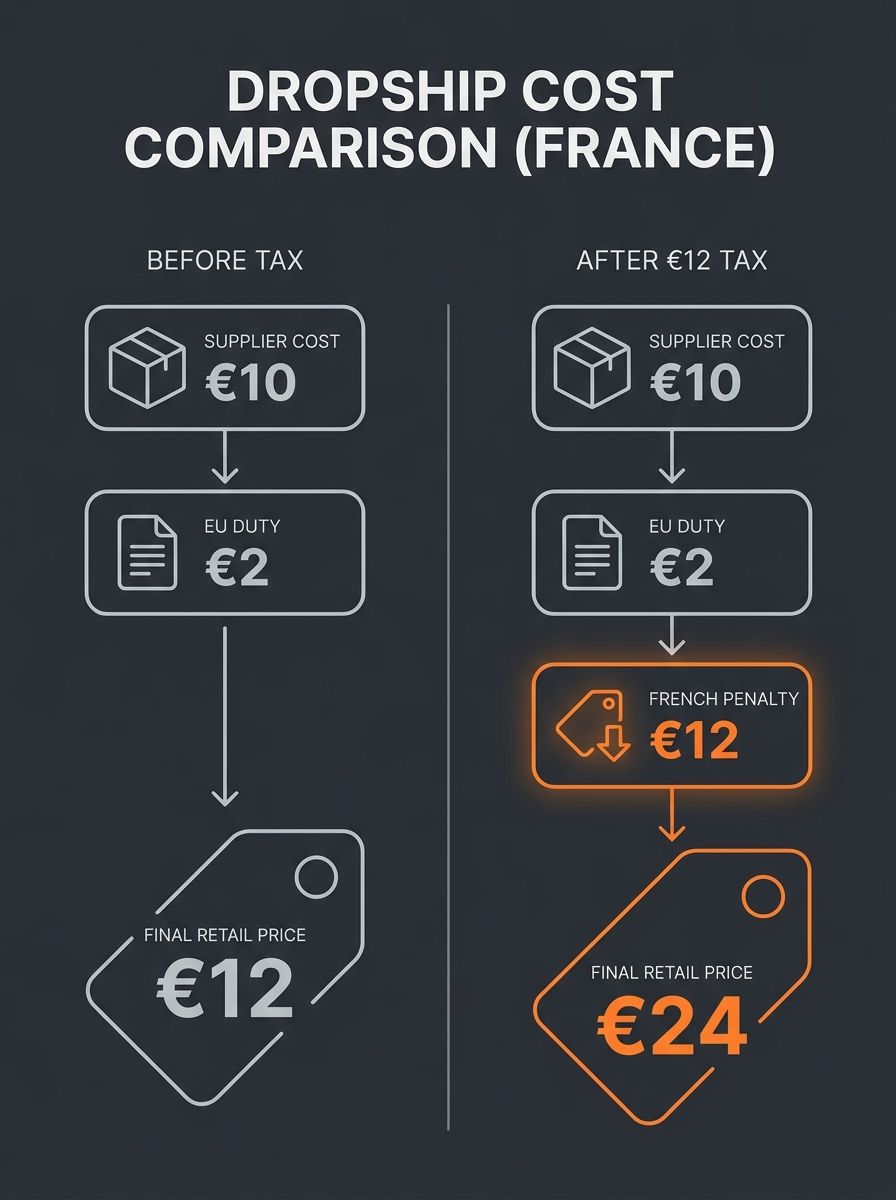
The €12 tax adds fixed cost to every clothing item cleared through French customs from the three named platforms. A $4 t-shirt sourced from AliExpress now carries €12 ($13.20 at current exchange rates) in French tax alone before factoring the €3 EU small-package duty, platform fees, and shipping costs.
For dropshipping apparel operators selling into France, the math shifts significantly. A product with a €4 supplier cost and €12 French fashion tax reaches €16 landed cost before adding the €3 EU duty, creating a €19 floor. Operators targeting 40 percent margins require a €31.67 retail price to maintain profitability, pushing many low-ticket clothing items out of viable margin bands.
The penalty structure hits highest-volume SKUs hardest. Ultra-fast fashion platforms built market share on sub-€10 garments with thin per-unit margins and high inventory turnover. The new tax floor eliminates profitability on items retailing below €25-30 when factoring payment processing, returns, and customer acquisition cost.
Platform-Specific Enforcement
France's tax targets AliExpress, Temu, and Shein by name, creating a platform-based enforcement mechanism rather than a product-category levy. The structure suggests customs declarations will flag shipments originating from these three marketplaces, regardless of the seller identity or factory source behind individual listings.
This platform-level targeting differs from product-based duties that apply to HS codes or material classifications. Garments shipped from the same Guangzhou factory through alternative channels may avoid the €12 penalty if they bypass the three named platforms, creating incentive for dropshippers to explore direct supplier relationships or alternative sourcing marketplaces.
The policy follows France's broader regulatory stance on textile waste and fast-fashion environmental impact. French lawmakers have previously proposed extended producer responsibility schemes and garment recycling mandates targeting high-turnover fashion retailers.
Timing Relative to EU Small-Package Tax
France's €12 garment penalty took effect two months after the EU's €3 small-package import duty began July 1, 2026. The sequential rollout suggests member states retain authority to layer additional levies beyond bloc-wide tariff structures, potentially opening the door for other countries to implement similar surcharges.
The combined tax burden—€15 per garment when stacking the French penalty and EU duty—creates the highest import cost floor in Europe for ultra-fast fashion shipments. Germany, Spain, and Italy have not announced parallel garment-specific taxes as of September 1, leaving France as the sole member state with a double-layer import penalty on clothing from the three platforms.
Cross-border shopping behavior may shift in response. French consumers ordering from German or Spanish Shopify stores could avoid the €12 French penalty if sellers ship from non-French warehouses, though the €3 EU duty would still apply to China-origin inventory entering any EU country.
The Takeaway
France's €12 ultra-fast fashion tax eliminates margin viability on low-ticket apparel from AliExpress, Temu, and Shein for stores selling into the French market. Dropshippers sourcing clothing under €10 from these platforms face a hard cost floor that pushes minimum sustainable retail prices above €25-30 after stacking the French penalty, EU duty, and standard margin requirements. Operators with French customer concentration need to either shift to higher-AOV garments that can absorb the tax, explore direct factory sourcing outside the three named platforms, or pivot inventory mix away from apparel categories entirely. The platform-specific enforcement creates a two-tier cost structure where identical garments cleared through alternative channels avoid the €12 penalty, rewarding sellers who establish supplier relationships beyond marketplace dependencies.

Ryan Torres
Ryan Torres is a former Amazon FBA seller turned dropshipping consultant who has generated over $2.8M in ecommerce revenue across 14 product launches. He specializes in supplier vetting, margin optimization, and scaling DTC operations for sub-$1M brands. Ryan focuses on actionable frameworks that drive measurable results for independent operators.
Related Articles

EU Tax on Small Packages From China Cuts AliExpress, Temu, Shein Imports by 30-40% in First Two Months
Small-package imports from AliExpress, Temu, and Shein dropped 30 to 40 percent across the European Union in the first two months following a three-euro-per-item tax that took effect July 1, 2026, according to French customs estimates released by the country's Economy Ministry on August 27.

EU Eliminates €150 Duty Exemption for Small Packages; €3 Per-Item Fee Takes Effect July 1
European Union member states will begin collecting a flat €3 customs duty on each tariff line item in packages valued under €150 starting July 1, 2026, eliminating a longstanding duty-free threshold that allowed millions of small shipments from China-based suppliers to enter the bloc without border

Cross-Border Tariffs & Import Duties: The Hidden Margin Killer Dropshippers Overlook
Every package entering the U.S. from China now triggers a full customs entry.
Explore more topics