Triple Whale Review (2026)
Triple Whale is an analytics app that unifies Shopify store data with ad platform metrics using a tracking pixel and AI attribution models. The promise: show exactly which ads drive profit and flag wasteful spend in real time. With a 4/5 rating from 88 reviews and a free tier …
Triple Whale Review (2026)
TL;DR
Install Triple Whale if you spend $5k+/mo on Meta or Google ads and need pixel-based attribution to stop bleeding budget. Skip it if you're under $10k/mo revenue—stick with Shopify Analytics until ad spend justifies the paid tier.
At a glance
What it is: Triple Whale unifies Shopify store data with ad platforms using AI for attribution and growth insights. Offers free tier with pixel tracking; paid plans add multi-touch attribution and channel integrations. Used by over 60,000 brands for spend optimization.[1]
Best for: Scaling DTC brands optimizing ad spend
Pricing starts at: Free
Rating: 4.0 / 5 on the Shopify App Store (88 reviews)
Triple Whale is an analytics app that unifies Shopify store data with ad platform metrics using a tracking pixel and AI attribution models. The promise: show exactly which ads drive profit and flag wasteful spend in real time. With a 4/5 rating from 88 reviews and a free tier that includes pixel tracking, it's positioned for DTC operators running paid campaigns. This review covers who benefits from the pixel approach, what the free-to-paid jump unlocks, and whether the attribution accuracy justifies the setup effort for dropshipping stores.
What Triple Whale actually does
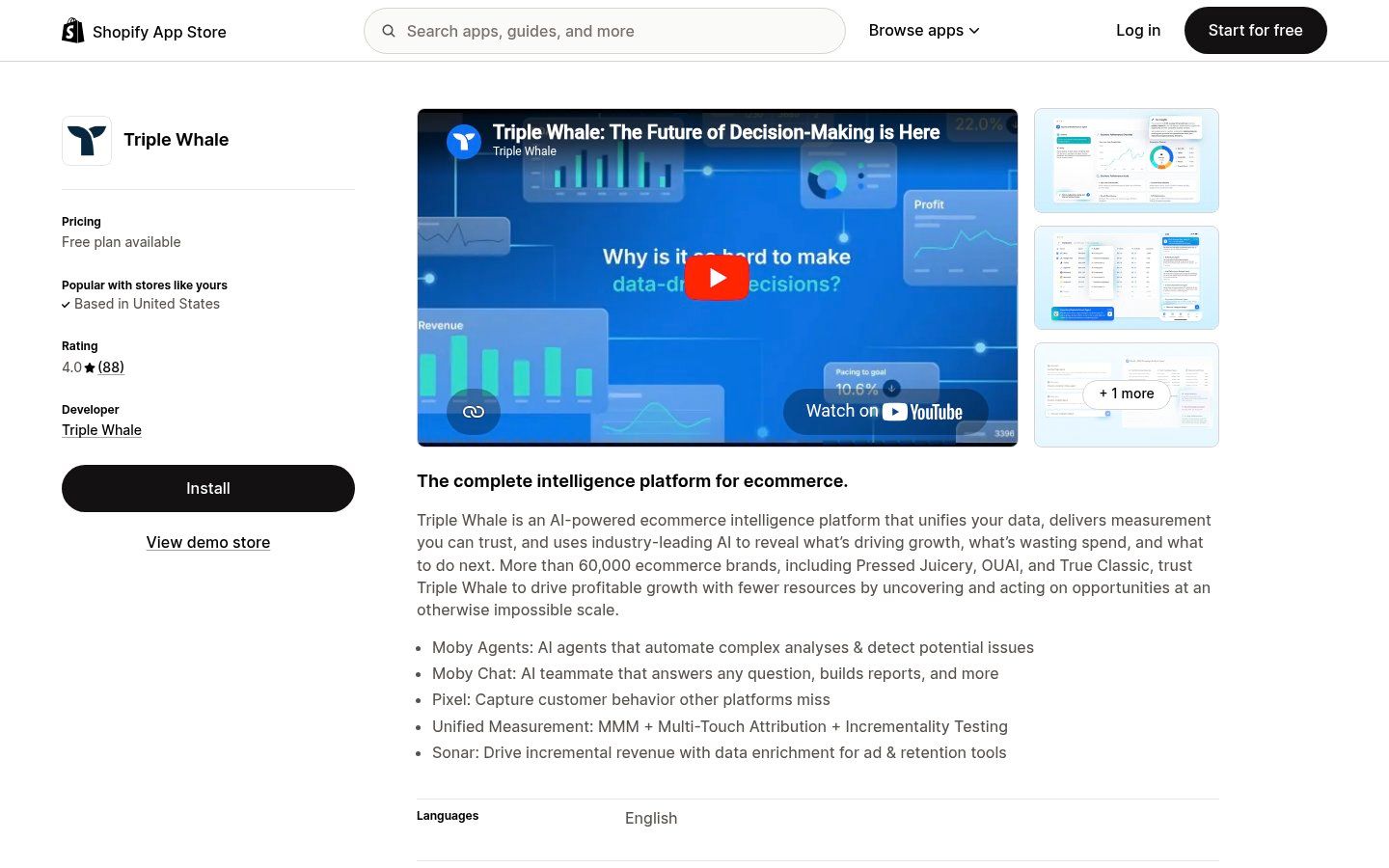
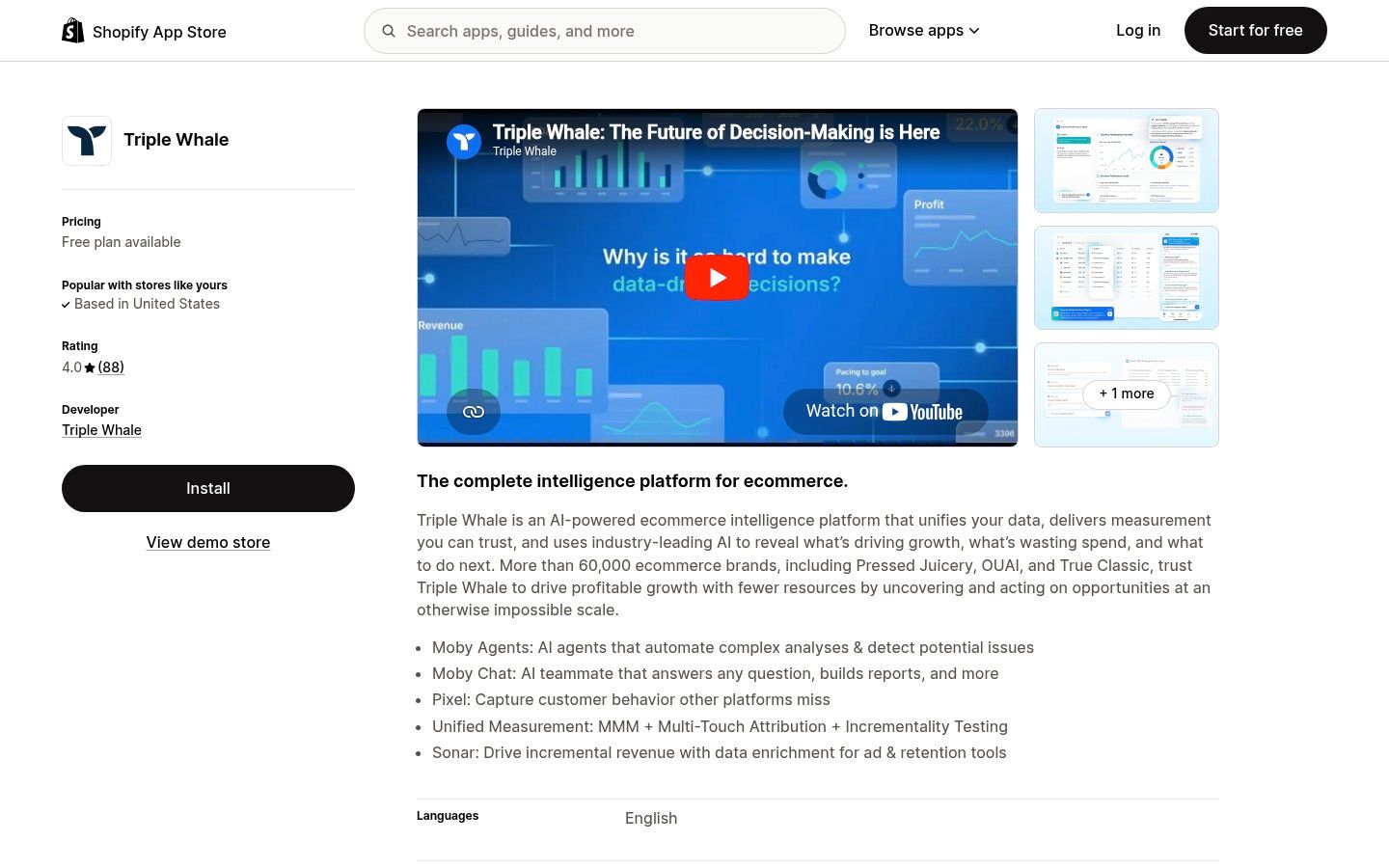
Triple Whale installs a pixel on Shopify stores to capture visitor activity from entry to purchase, unifying it with ad platform data like Meta and Google. AI analyzes attribution, reveals spend waste, and suggests actions via dashboards for metrics like ROAS, retention, and custom expenses including COGS and shipping. Supports multi-touch models, influencer tracking, and post-purchase surveys on paid tiers for precise customer journey mapping.[1][2]
Visit Triple Whale → · Shopify App Store listing →
What operators say
"Triple Whale has been a game changer for our Shopify store. The pixel tracks everything accurately and the dashboards make it easy to see ROAS across platforms."
— John S. · ★★★★★ · 2024-05
"Good data unification but the pricing jumps quickly for full features. Free tier is too limited for serious ad spend analysis."
— Mike R. · ★★★☆☆ · 2025-02
"Perfect for our influencer campaigns—affiliate analysis shows exact ROI we missed before. Integrates well with Shopify checkout."
— Emily T. · ★★★★☆ · 2025-11
Key features
Triple Pixel for full-funnel tracking
Multi-touch attribution modeling
Ad channel integrations (Meta, Google)
Custom metrics and expense tracking
AI-driven growth recommendations
Post-purchase surveys
Unlimited users on paid plans
Pricing
Plan | Price | Includes |
|---|---|---|
Free | Free | Basic pixel tracking, limited features |
Growth | $149/mo or $1,490/yr | Multi-touch attribution, all integrations, unlimited users |
Starting price: Free.
Pays off when: On $149/mo Growth tier, breakeven at 50 monthly orders assuming $30 AOV and 4x ROAS from attribution insights improving ad efficiency by 10%. Pays off via $600 extra profit from optimized $3,000 ad spend.[1]
Operator scorecard
Setup | Pricing | Features | Support | Integrations | Overall |
|---|---|---|---|---|---|
7/10 | 8/10 | 9/10 | 7/10 | 8/10 | 7.8/10 |
Pros
Free tier provides pixel tracking without upfront cost.[1]
Unifies ad data for accurate ROAS calculation across channels.[1]
AI flags wasteful spend in real-time dashboards.[1]
Custom expense logging includes COGS and shipping accurately.[6]
Multi-touch attribution reveals true customer journeys.[1]
Cons
Paid tier required for full ad integrations.[1]
Pixel setup needs theme edits and checkout validation.[2]
Limited free plan lacks advanced attribution models.[1]
Higher cost for attribution compared to basic analytics.[6]
Who should use Triple Whale
Triple Whale fits scaling brands with high ad volume on Meta and Google—typically $5k+ monthly ad spend—who need multi-touch attribution to allocate budget correctly. If you're tracking custom expenses like COGS or running influencer campaigns, the paid tier's survey and tracking tools make sense. Skip it if your store does under $10k/mo in revenue or you're not running paid ads at scale; Shopify's native analytics will cover your needs without pixel setup overhead. Subscription box stores also lag here compared to one-time purchase models.
Best for:
Scaling DTC brands optimizing ad spend
Operators needing multi-channel attribution
Teams tracking custom expenses like COGS
Brands with high ad volume on Meta/Google
Skip if:
Stores under $10k/mo revenue
Simple analytics without attribution needs
How Triple Whale compares
App | Starting price | Rating | Differentiator |
|---|---|---|---|
Triple Whale | Free | 4.0★ | Subject of this review |
Lebesgue | $99/mo | 4.8★ | AI CMO automation |
Northbeam | $99/mo | 4.7★ | Incrementality testing |
Glew | Free | 4.5★ | Inventory forecasting |
Polar Analytics | $300/mo | 4.9★ | Databoard simplicity |
Top alternatives to Triple Whale
If Triple Whale doesn't fit your stack, here are the four credible alternatives operators most often weigh against it.
Lebesgue
Where Lebesgue wins: AI creative optimization beats Triple Whale
Where Triple Whale wins: Less focus on pixel attribution depth
Northbeam
Where Northbeam wins: Faster attribution modeling than Triple Whale
Where Triple Whale wins: No free tier available
Glew
Where Glew wins: Broader ERP integrations
Where Triple Whale wins: Weaker ad pixel accuracy
Polar Analytics
Polar Analytics → · App Store →
Where Polar Analytics wins: Simpler setup for beginners
Where Triple Whale wins: Shallow AI insights
Frequently asked questions
Does it integrate with Klaviyo, Recharge, and Meta?
Yes, Triple Whale connects natively with Meta Ads, Google Ads, and Shopify apps via pixel and API. Klaviyo and Recharge data unifies through store events and custom integrations for email/SMS enrichment via Sonar Send on paid tiers. No direct Recharge billing sync reported; use expense logging for manual tracking. Confirmed in integrations page.[5][1]
How to migrate from another analytics app like Northbeam?
Disable old pixel, install Triple Pixel via Shopify theme editor or app block, enable Web Pixel Extension for checkout. Data history doesn't transfer; new tracking starts fresh with unlimited lookback on paid plans. Test attribution overlap during 14-day overlap period to validate. Setup takes 15-30 mins per docs.[2]
Does it slow down storefront performance?
Triple Pixel is lightweight, using Shopify Web Pixels for post-checkout and app blocks for pages, minimizing load impact. Enable in theme editor; monitor via Shopify Analyzer. Operators report no noticeable speed drops on standard themes, but test on high-traffic stores. Auto-install checkout script avoids manual edits.[2]
What happens when I hit pricing tier caps?
Free tier has feature limits like no multi-touch attribution; upgrade to Growth at $149/mo unlocks unlimited data/users. No hard order caps mentioned; scales with revenue via self-serve tiers. Overage billing not detailed—contact support for custom plans above standard limits.[1]
Deal-breakers for dropshipping with subscriptions?
Lacks native subscription revenue attribution like Repeat.io; track Recharge via pixel events but manual COGS adjustment needed for variably priced dropship items. Strong for ad ROAS but weak on LTV modeling for high-churn dropshipping without paid surveys. Best if ad spend >$5k/mo.[1][6]
Final verdict
Install the free tier if you're spending on ads and want to test pixel attribution without upfront cost. The real value starts at the paid tier where multi-touch models and full channel integrations live—only upgrade once ad spend hits $5k+/mo and attribution blind spots are costing you. The AI spend-waste flags are the standout feature that separates Triple Whale from dashboard-only tools. This week, install the pixel, validate it captures checkout events, then compare its ROAS numbers against your ad manager for seven days before deciding on the paid jump.
Other reviews on 365 Dropship
Reviewed by 365 Dropship Editorial. Last verified 2026-04-28. Methodology: every claim is checked against the vendor's pricing page and the live Shopify App Store listing on the date above; pros and cons reflect operator-reported behaviour, not vendor marketing. Email the editorial desk to flag a correction.
365 Dropship Editorial
Editorial team writing about E-commerce, dropshipping, and product discovery — reviews of dropshipping suppliers and platforms, trending niche guides (jewelry, beauty, pets, home, fashion), supplier due diligence, ecom operations, shipping & fulfillment strategy, product research, AOV optimization, and profitable dropshipping case studies.
Explore more topics