Cross-Border Tariff Calculator: Building Your Own Margin Model for International Dropshipping
The $800 de minimis exemption on Chinese imports to the U.S. was suspended in February 2025. Every parcel from a Chinese supplier now clears customs with duties attached, whether the product costs $4 or $400.
Cross-Border Tariff Calculator: Building Your Own Margin Model for International Dropshipping
The $800 de minimis exemption on Chinese imports to the U.S. was suspended in February 2025. Every parcel from a Chinese supplier now clears customs with duties attached, whether the product costs $4 or $400. Dropshippers who priced their entire catalogs around duty-free low-value shipments saw their margins evaporate within weeks. The tools designed to calculate these costs — tariff calculator apps like Zonos, Payoneer's estimator, and TariffDutyCalculator.com — became overnight necessities. But they don't all agree with each other, and none of them tell you how to build an actual margin model around their outputs.
This piece explains how the landed cost formula works at each layer, compares three popular tariff calculator tools on accuracy and usability, and shows where the entire model falls apart if you trust the numbers blindly.
The Landed Cost Formula, Unpacked
Every cross-border margin math exercise starts from the same place. DHL's landed cost formula breaks it down as: Product Price + Freight Cost + Customs Duties & Taxes + Other Regulatory Fees + Insurance Cost. A slightly more operator-friendly version reads: product + shipping + customs + risk + overhead = landed cost.
The mistake most new international dropshippers make is treating only the first two variables as real numbers and guessing at the rest. They'll know their AliExpress unit cost ($6.80) and their ePacket shipping ($3.20), then slap a 2x markup and call it profitable. Customs duties, VAT or sales tax at the destination country, broker fees, and currency conversion spreads are either ignored or rounded to some imaginary 5% buffer.
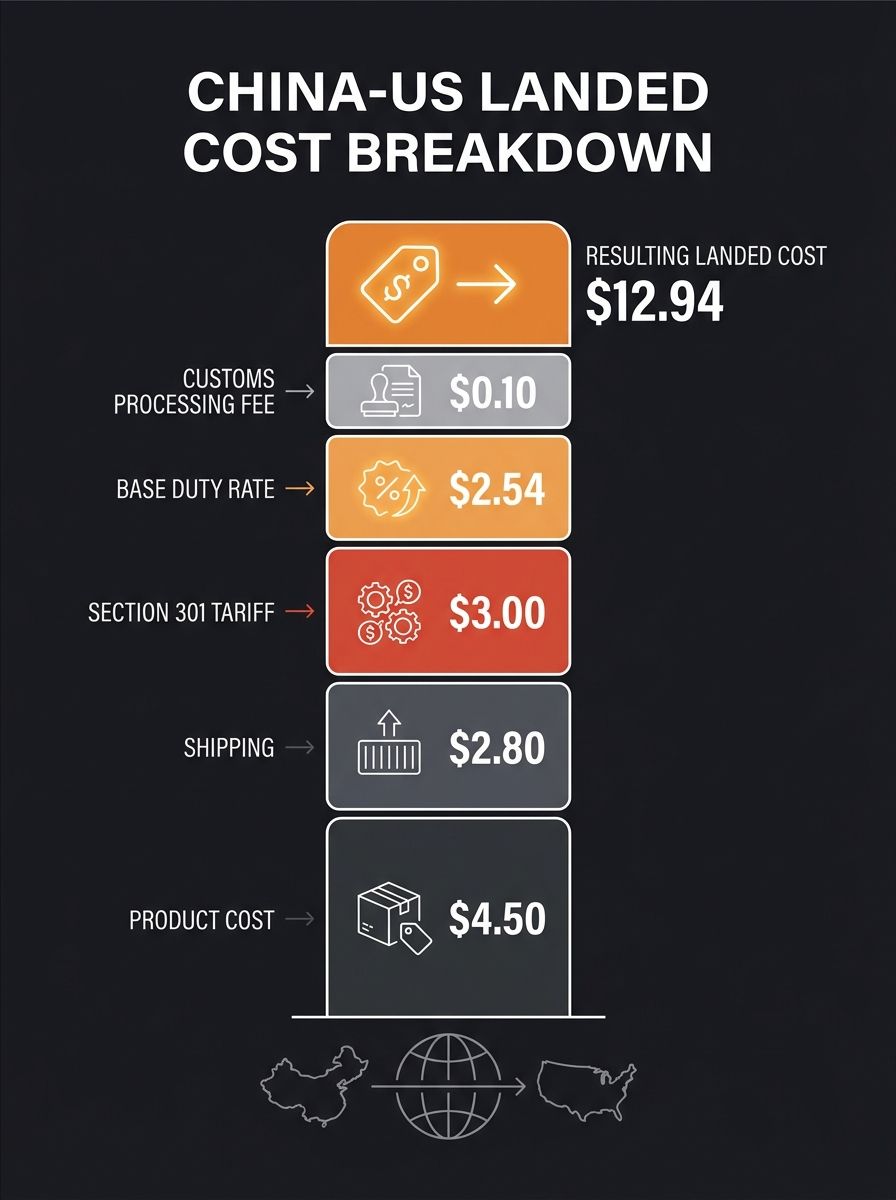
Here's a concrete example. You source a silicone kitchen gadget from a Guangzhou supplier at $4.50 per unit. Shipping via CJ Dropshipping runs $4.80 to the U.S. The HTS code for silicone kitchen tools puts the duty rate around 3.4%, but the Section 301 tariff on Chinese goods adds another 25%. So duties alone on a $9.30 declared value hit roughly $2.64. Add $0.50 for a customs processing fee on low-value parcels. Your actual landed cost is $12.94 before you've paid for your Shopify subscription, payment processing, or a single ad dollar. That $24.99 retail price you thought gave you 60% margins? Your real gross margin is closer to 48%, and net margin after ad spend and payment fees will land somewhere around 15-22%.
If you haven't already reviewed how markup percentages deceive on actual profit, this is where that gap gets dangerous. Cross-border adds three to five additional cost layers that domestic dropshipping never touches.
How Tariff Calculators Source Their Data
A tariff calculator for dropshipping works by mapping three inputs to a duty estimate: the product's Harmonized System (HS) code (a 6-digit international classification), the origin country, and the destination country. Some tools extend to 8 or 10 digits, which captures country-specific sub-classifications. The U.S. uses the Harmonized Tariff Schedule (HTS) maintained by the U.S. International Trade Commission.
The quality of any calculator depends entirely on how current its tariff database is. Trade policy in 2025 and 2026 moved fast: the U.S. imposed 10% tariffs on Chinese goods in February 2025, doubled to 20% by March, and layered Section 301 tariffs on top. India faces a 26% tariff, while Mexico has potential USMCA advantages for qualifying products. A calculator pulling from a database last updated in January 2025 will understate Chinese import duties by 20-30 percentage points.
The second critical variable is how the tool handles VAT, GST, and consumption taxes for non-U.S. destinations. If you sell to UK customers, 20% VAT applies. Selling to Australia means 10% GST. These aren't tariffs in the traditional sense, but they're part of landed cost, and not every calculator includes them by default.
Three Tariff Calculators Compared
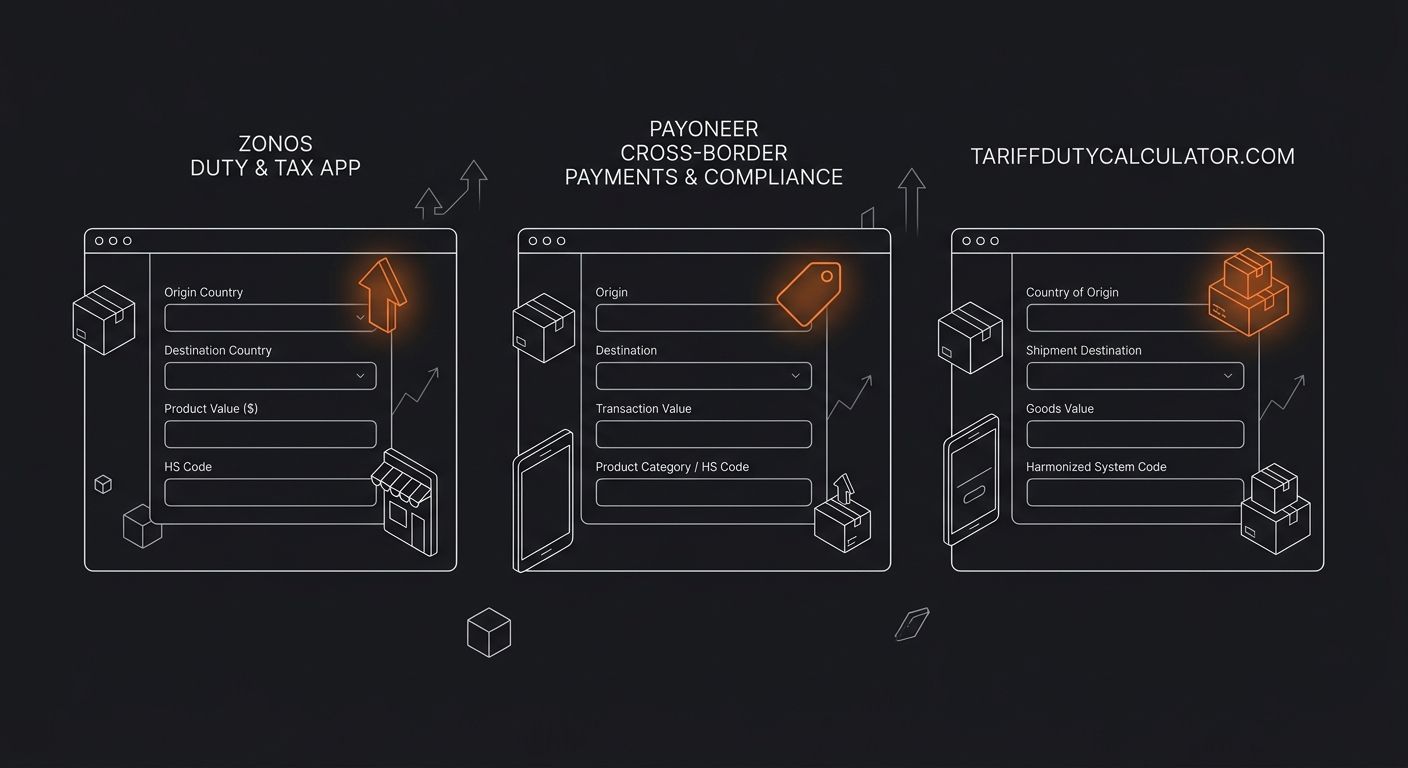
Zonos
Zonos is the most feature-rich option for ecommerce operators. It covers 190+ countries and territories, supports HS code lookup, and provides landed cost estimates that include duties, taxes, and fees in a single output. The free calculator on their site works for quick checks, but the real value is their API integration for Shopify and WooCommerce stores. That API can display all-inclusive DDP (Delivered Duty Paid) pricing at checkout, which matters because cart abandonment on international orders with surprise fees at delivery runs 55-70%.
Zonos is the tool to pick if you're processing more than 50 international orders per month and want to automate duty calculation at the checkout layer. The downside: their paid tiers aren't cheap, and the free calculator lacks the granularity needed for Section 301 tariff overlays on Chinese goods. You'll want to cross-check results against the HTS database directly for high-volume SKUs.
Payoneer Tax and Tariff Calculator
Payoneer's calculator covers 190+ countries and provides general estimates for informational purposes. It's a lighter tool — enter origin, destination, product category, and declared value, and you get a ballpark number. The interface is clean and fast. But "general estimates for informational purposes" is doing a lot of work in that description. Payoneer's output won't account for Section 301 additions, anti-dumping duties, or country-specific exemptions under trade agreements like USMCA.
Use this tool for early-stage product research when you need a rough sense of whether international supplier pricing makes a category viable. Don't base your final retail pricing on it.
TariffDutyCalculator.com
TariffDutyCalculator.com targets ecommerce sellers specifically, calling out Amazon FBA import charges and Shopify dropshipping costs as primary use cases. The tool covers 190+ countries and provides duty and tax estimates based on HS code classification. The interface is straightforward, and it handles the most common product categories well.
Where it struggles is the same place most free calculators struggle: edge cases. Products with mixed materials (a bag that's part leather, part nylon), goods that fall under multiple HS headings, and items subject to anti-dumping duties all require manual verification. This tool gives you a starting point, and for many standard dropshipping products — phone accessories, beauty tools, pet supplies — the starting point is close enough to build your model around.
Plugging Calculator Output Into Your Margin Spreadsheet
The calculator gives you one number. Your margin model needs at least seven. Here's the formula structure that actually works for cross-border margin math:
Product cost from your supplier (in their currency, converted at the rate you'll actually get from your payment processor — typically 2-3% worse than the mid-market rate)
Shipping cost per unit from your fulfillment agent or supplier
Import duties from your tariff calculator (use the highest of your three calculator estimates, not the average)
VAT/GST/sales tax at destination, if applicable
Customs brokerage or processing fee (often $1-5 per parcel for low-value shipments)
Payment processing fee (typically 2.9% + $0.30 per transaction on Shopify Payments)
Ad cost per acquisition (your target CAC)
Your gross margin formula after all landed costs: (Sales Price – Landed Cost) ÷ Sales Price × 100. Your net margin subtracts ad spend and platform fees from the numerator.
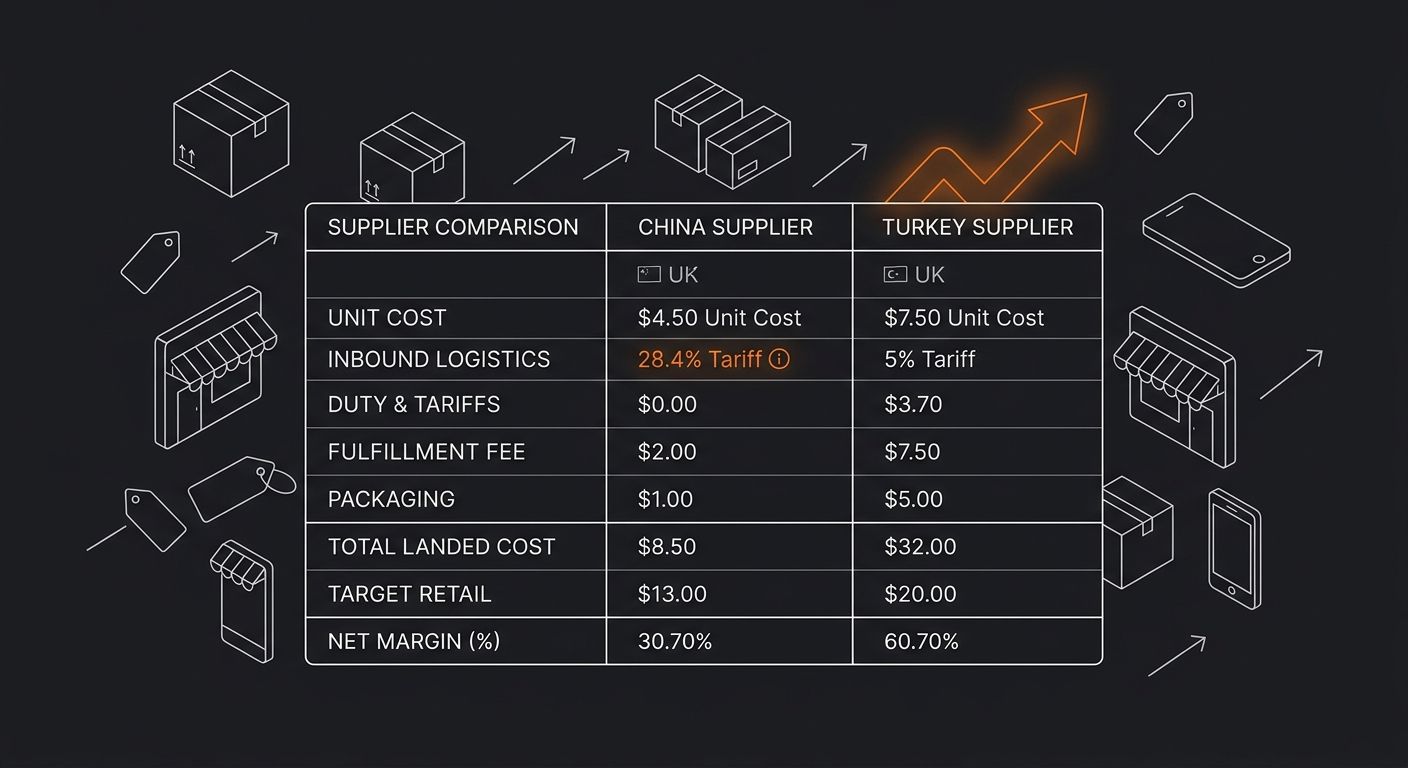
When you're evaluating suppliers across different origin countries, this model lets you compare apples to apples. A Turkish supplier quoting $7.50 per unit with a 5% duty rate to the U.S. may beat a Chinese supplier at $4.50 with a combined 28.4% duty rate, once you run every line through the spreadsheet. Grant Thornton notes that many businesses now treat supplier diversification as long-term insurance against tariff volatility, even when the per-unit cost is higher in the short run.
Before committing to any supplier based on these calculations, run through a proper due diligence framework that covers reliability beyond price. And before your first order ships, a structured test order evaluation will confirm whether the declared values and actual shipping weights match what your model assumes.
Where the Model Breaks
Three failure points show up consistently.
Tariff rates change faster than databases update. The U.S. tariff landscape shifted four times in the first quarter of 2025 alone. Free calculator tools may lag by weeks or months. If you're running international supplier pricing through a calculator that hasn't updated its Section 301 overlay, your margin projections are fiction. Check the date of your tool's last database update, and cross-reference against the USITC HTS database directly for any SKU that accounts for more than 20% of your revenue.
HS code misclassification is common and expensive. A product classified under the wrong 6-digit code can swing duties by 15+ percentage points. Multi-material products, products with electronic components embedded in non-electronic items, and anything marketed differently from its physical composition are classification risks. A "stainless steel tumbler with silicone lid" might classify under stainless steel articles or under composite goods depending on which component accounts for more value. When your margins depend on a 5% duty rate and the correct classification puts you at 20%, your entire product line goes underwater.
Currency conversion eats margin invisibly. Your supplier quotes in CNY or TRY. You pay through Payoneer, Wise, or your supplier's preferred payment method. Each conversion takes 1-3% depending on the platform and the currency pair. On a $10 product cost, that's $0.10-0.30 per unit. Multiply by thousands of orders and you've lost a meaningful chunk of gross margin that never appeared in your tariff calculator output. Build a fixed conversion spread into your model — 2.5% is a safe default for most payment platforms.
And one structural limitation applies to all three tools reviewed here: none of them model the full picture of supplier credibility. A calculator can tell you that duties on a given product from Vietnam are 8%. It can't tell you whether your Vietnamese supplier will actually ship the product that matches the HS code you based your model on. Mismatched product descriptions at customs trigger inspections, delays, and penalties that no spreadsheet can predict.
The model works when you treat every calculator output as an estimate with a 5-10% error band, verify HS codes independently for your top SKUs, and rebuild the spreadsheet quarterly as trade policy evolves. Treat it as a living document tied to specific suppliers and specific destination markets, and you'll catch margin compression before it shows up in your bank account.
365 Dropship Editorial
Editorial team writing about E-commerce, dropshipping, and product discovery — reviews of dropshipping suppliers and platforms, trending niche guides (jewelry, beauty, pets, home, fashion), supplier due diligence, ecom operations, shipping & fulfillment strategy, product research, AOV optimization, and profitable dropshipping case studies.
Explore more topics