From Case Study to Revenue: How to Reverse-Engineer Successful Dropshipping Stores for Your Niche
Copying a successful dropshipping store's product catalog will lose you money faster than ignoring case studies altogether.
From Case Study to Revenue: How to Reverse-Engineer Successful Dropshipping Stores for Your Niche
Copying a successful dropshipping store's product catalog will lose you money faster than ignoring case studies altogether.
That's the uncomfortable truth about dropshipping case study analysis as most operators practice it. Aspiring store owners screenshot homepages, duplicate product listings, and run similar Facebook ads—then wonder why they're burning cash at a $40 CPA on a product that nets them $8 after COGS. The stores they're copying aren't successful because of their product selection. They're successful because of margin architecture, traffic mix, and brand positioning that took months to construct. None of that shows up in a surface-level teardown.
The way to actually extract value from case studies is to reverse-engineer competitor stores at the unit economics level: what they pay, what they charge, where their traffic comes from, and how those ratios hold up under ad spend pressure.
Here's how to do that with three specific lenses.
The Margin Math Hiding on Every Product Page
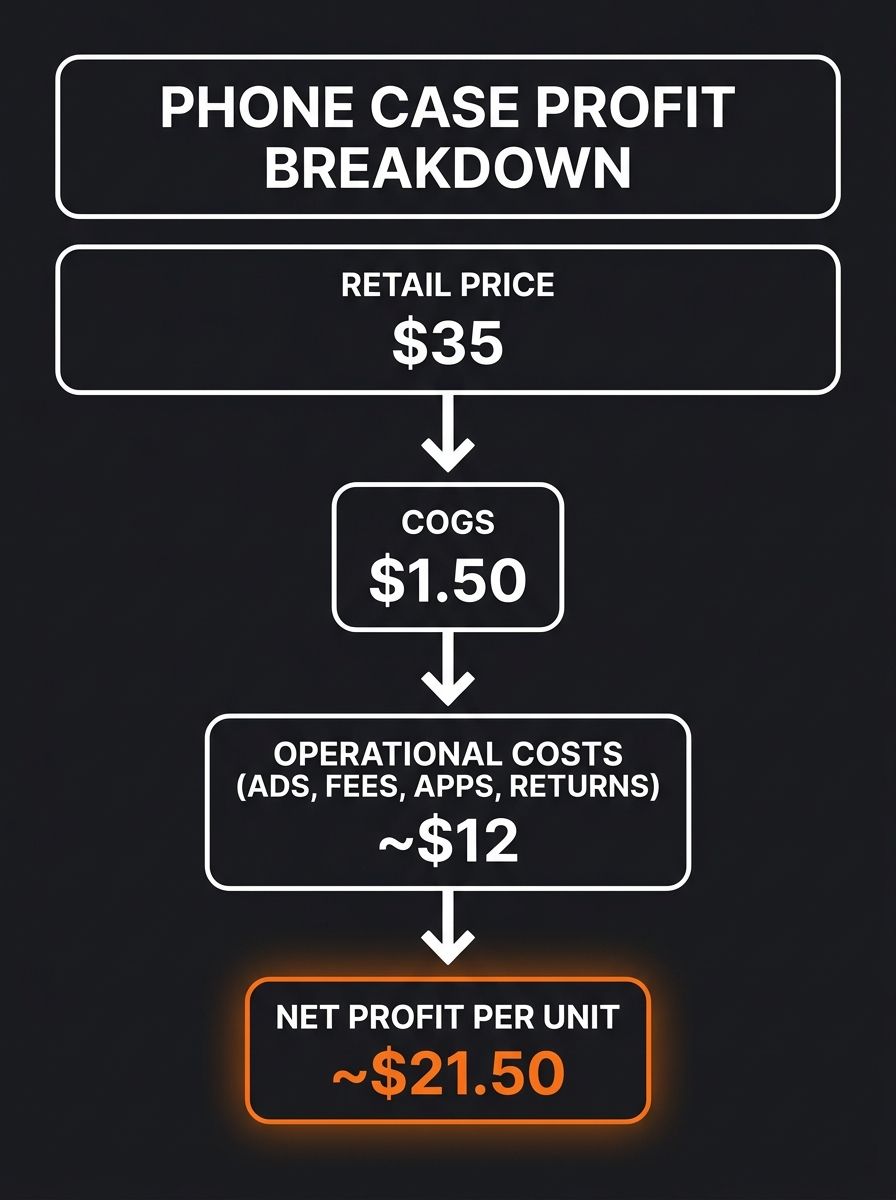
BURGA sells phone cases for $35+. The same cases, or functionally identical ones, source from AliExpress at roughly $1.50. That's a 23x markup on paper. According to SaleHoo's analysis of profitable dropshipping stores, BURGA drives 2.6 million monthly sessions and pulls in nearly $7,000,000 in monthly revenue.
But copying BURGA's product at BURGA's price fails immediately if you don't understand their margin structure benchmarking. Here's the breakdown that matters:
COGS per unit: ~$1.50
Retail price: ~$35
Gross margin per unit: ~$33.50
Estimated blended CAC (given 2.6M sessions, mix of paid and organic): If even 30% of sessions are paid at $0.50 CPC, that's $390K/month in ad spend against roughly 200K orders, or about $1.95 per acquisition on the paid portion
AOV boost from bundling ("Buy 2 Get 2"): pushes effective AOV north of $50
The per-product profit formula is straightforward—selling price minus COGS minus additional costs per product—but the "additional costs" line is where most teardowns fall apart. According to Spark Shipping's margin guide, that line includes payment processing (2.9% + $0.30 on Shopify Payments), returns and refunds (budget 5-8% of revenue), and whatever you're spending on apps, subscriptions, and customer service labor.
When you reverse-engineer a competitor, you need all five numbers: retail price, estimated COGS (check AliExpress, CJ Dropshipping, and Spocket for comparable products), traffic volume (SimilarWeb free tier), traffic source percentages (also SimilarWeb), and conversion rate benchmarks for their niche. Without those, you're window shopping.
BOOMBA, the sticky bra insert brand, illustrates the other end of the spectrum. Their product costs more to source than a phone case, but they hit a 6.6% conversion rate—roughly triple the ecommerce average—because the product solves a specific, painful problem. With $1,000,000 in monthly revenue and 211,000 monthly visitors, their revenue per visitor sits around $4.74. Compare that to a typical dropshipping store converting at 1.5-2% with a $30 AOV, where revenue per visitor hovers around $0.45-$0.60.
That metric collapses traffic quality, conversion rate, and AOV into one figure you can benchmark against your own store before you've even launched.
Traffic Source Mix Tells You What the Store Actually Spends
Old Money, the fashion brand riding the "old money aesthetic" trend, hit 504,000 monthly visitors and $750,000 in monthly revenue by splitting traffic across three channels: 32% direct, 30% paid, and 21% social. That mix is the strategy. Understanding it is more valuable than knowing which products they sell.
Here's why: 32% direct traffic means a significant chunk of their audience types the URL directly into their browser or clicks bookmarks. That kind of brand recall doesn't happen from one viral TikTok. It's built by consistent content, PR mentions, and repeat purchase behavior over months. If you're planning to replicate their results with a brand-new store and a $2,000 ad budget, you're missing two-thirds of their traffic engine.
The 21% social number is equally revealing. According to DoDropshipping's case study roundup, only about 1.5% of dropshipping businesses exceed $50,000 in monthly recurring revenue. The stores that reach those numbers almost always have diversified traffic. They aren't dependent on a single paid channel.
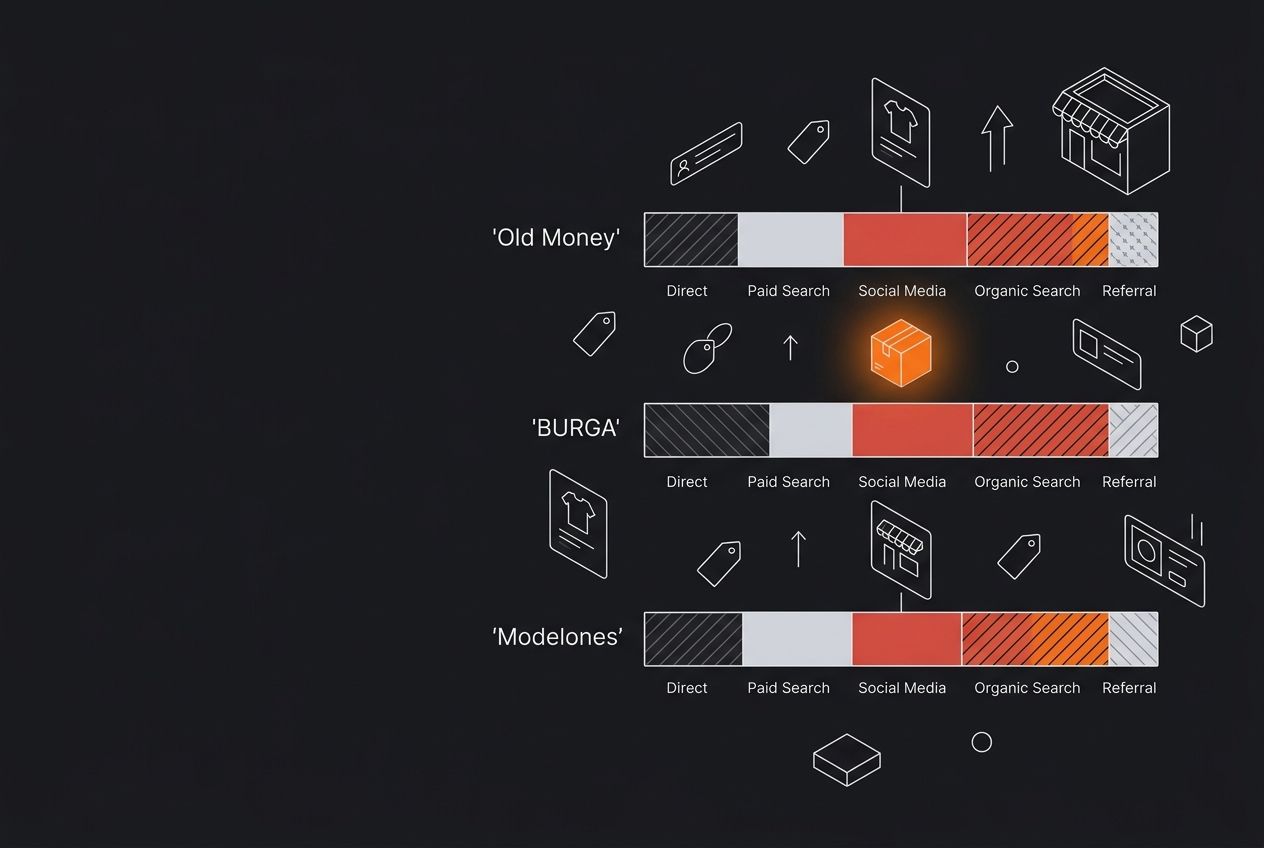
When you're studying niche profitability patterns on a competitor, map their traffic sources before anything else. SimilarWeb's free tier gives you enough to work with. Look for these three profiles:
Paid-heavy stores (50%+ paid traffic): These are buying growth. Margins need to be fat enough to absorb CAC. If their product retails at $25, they're probably spending $8-12 to acquire each customer, which means COGS needs to stay under $5 for the math to survive.
Organic-heavy stores (30%+ organic search): Modelones, the gel nail polish brand, built over a third of its traffic through SEO, targeting terms like "gel nail polish kit." Their 14,000-member Facebook group feeds repeat purchases, cutting the need for constant re-acquisition. That's a multi-month investment you can't replicate by launch day, but it signals a niche where content marketing has room to breathe.
Social-heavy stores (30%+ social): These live and die on content production velocity. Multiple 2026 analyses show the limiting factor for TikTok-led growth is creative refresh rate. You need 3-5 new ad creatives per week at minimum to keep pace with algorithm decay.
Each pattern implies a different launch budget, timeline, and skill set. A store with 40% organic traffic took 6-12 months to build that channel. You can't replicate their monthly revenue number in your second month with paid ads alone.
Supplier Selection Signals Buried in the Store Itself
The product page tells you more about supplier selection from case studies than any supplier directory will. Here's what to examine when you reverse-engineer competitor stores:
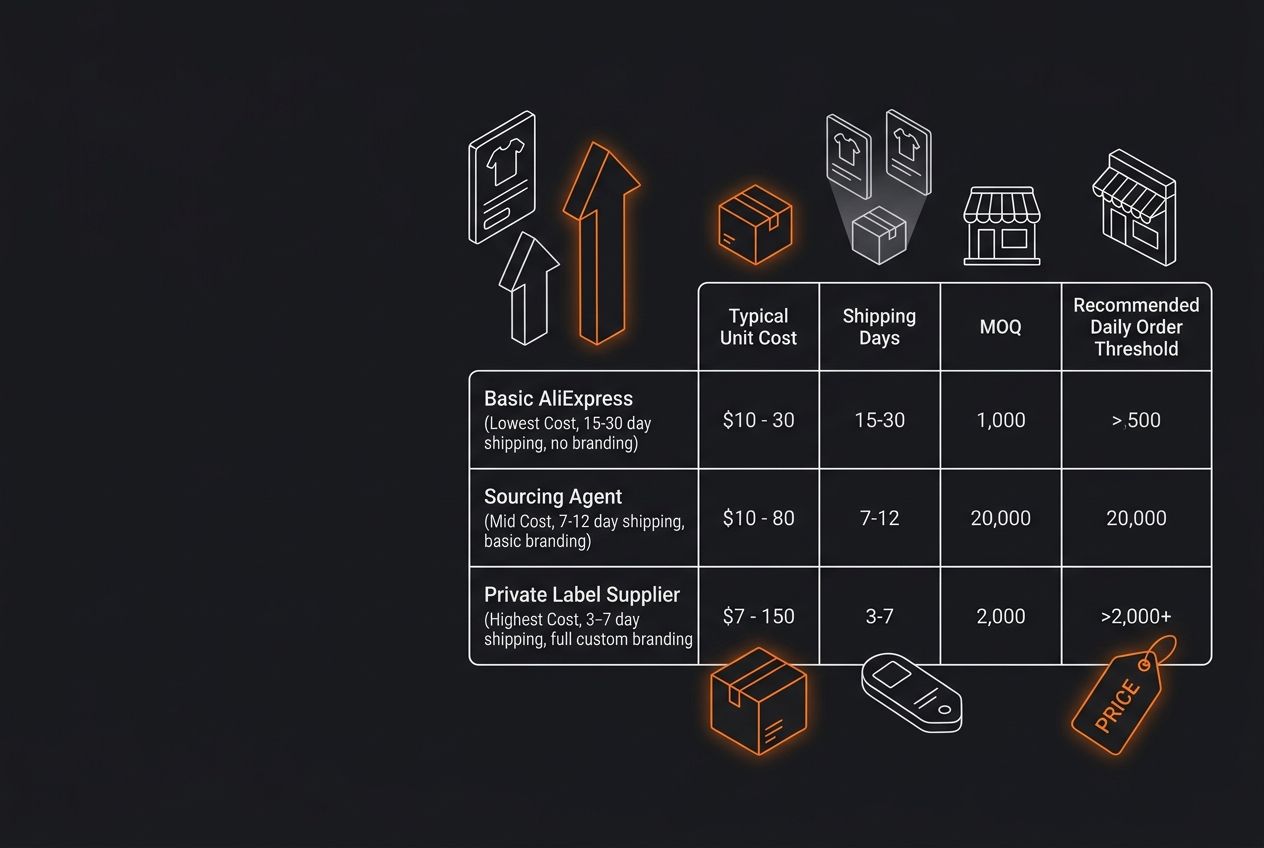
Shipping time estimates. If a store promises 5-7 day delivery to the US, they aren't shipping from mainland China via ePacket. They're either using a domestic fulfillment center (Zendrop's US warehouse, CJ Dropshipping's US stock, ShipBob) or they've negotiated dedicated inventory with a sourcing agent. A Reddit case study from early 2026 detailed a store that hit $40,000 in sales within 20 days but nearly collapsed from fulfillment chaos—the operator was manually processing 70 orders per day through EPROLO and advised switching to a sourcing agent once past 20-30 daily orders.
Product photography style. Lifestyle photos shot on models or in styled settings mean the store has either ordered samples and produced its own imagery, or they're working with a supplier who provides branded content. AliExpress default photos—white background, inconsistent lighting, visible Chinese text on packaging—signal a store that hasn't invested in supplier relationships. BOOMBA got Vogue and Cosmopolitan coverage partly because their product presentation was editorial-grade from the start.
Variant depth. BOOMBA offers multiple sizes and skin tones. That level of variant customization requires either a flexible supplier or custom manufacturing. If a competitor has 8+ variants of a product that only shows 2 variants on AliExpress, they've moved beyond basic dropshipping into white-label or private-label territory. Note this during your teardown because it changes the competitive dynamics entirely.
As noted in Carro's guide to profitable niches, the baseline supplier research method is comparing AliExpress sourcing costs against competitor retail prices. But the real edge comes from understanding where in the supply chain a competitor has invested. A store charging $35 for a $1.50 commodity can do so because they've spent money on brand photography, packaging design, and influencer seeding that creates perceived value the listing never had.
Beauty, tech gadgets, wellness, and home lifestyle products consistently deliver markups of 5x to 18x on items costing under $5 to source. But the markup only becomes profit margin if your supplier can fulfill reliably at scale. The niche profitability patterns you identify from case studies remain theoretical until you've validated the supplier side with a real purchase order.
The Claim, Pressure-Tested
The argument through this entire piece is simple: dropshipping case studies consumed as inspiration are entertainment. Dropshipping case studies consumed as margin spreadsheets are competitive intelligence.
Every store profiled above—BURGA, Old Money, BOOMBA, Modelones—looks impressive at the revenue headline. Millions per month. Hundreds of thousands of visitors. But the actual lessons live in the ratios. BURGA's 23x markup means nothing without knowing their blended CAC. Old Money's $750K/month means nothing without understanding that 32% of their traffic is direct and therefore free at the margin. BOOMBA's million-dollar months mean nothing without recognizing their conversion rate runs 3x the industry norm, which makes their traffic worth 3x what yours would be on the same products.
When you sit down to reverse-engineer competitor stores for your niche, build the spreadsheet first. Revenue per visitor. Gross margin per unit after realistic COGS estimates. Traffic source distribution. Estimated CAC by channel. Then ask the question that actually matters: can I replicate this traffic mix at this margin structure in the next 90 days? If the honest answer is no, that case study isn't your roadmap. It's someone else's finish line. Find a store whose economics you can match at your current budget and skill level, then beat their execution on one dimension—product photography, shipping speed, content volume, or conversion rate optimization. That one dimension is where the margin lives, and it's the only part of a case study worth copying.
365 Dropship Editorial
Editorial team writing about E-commerce, dropshipping, and product discovery — reviews of dropshipping suppliers and platforms, trending niche guides (jewelry, beauty, pets, home, fashion), supplier due diligence, ecom operations, shipping & fulfillment strategy, product research, AOV optimization, and profitable dropshipping case studies.
Explore more topics