Printify Claims Top Print-on-Demand Platform Spot in 2026 Rankings
Printify secured the top position in a newly published comparison of print-on-demand platforms, ranked ahead of four competitors based on production cost, product catalog size, print quality, shipping speed, and storefront integration, according to Costbench. The evaluation, last updated April 1, 20
Printify Claims Top Print-on-Demand Platform Spot in 2026 Rankings
Printify secured the top position in a newly published comparison of print-on-demand platforms, ranked ahead of four competitors based on production cost, product catalog size, print quality, shipping speed, and storefront integration, according to Costbench. The evaluation, last updated April 1, 2026, placed Printify's free plan and network of 80-plus print providers offering more than 900 product types as the leading option for independent sellers launching POD operations.
The rankings signal continued market consolidation around platforms that prioritize per-item cost control and catalog breadth over proprietary fulfillment networks. Printify's zero-subscription entry point contrasts with traditional POD models that bundle platform access with higher per-unit production fees, the analysis found.
Sellfy earned recognition as the second-tier choice for creators selling both physical and digital products, combining POD fulfillment with digital delivery infrastructure at a $29 monthly base rate, the report stated. Most POD operators pair their chosen fulfillment platform with Shopify storefronts priced at $29 per month under annual billing, creating a combined monthly overhead of $29 to $58 before first-sale revenue.
Production Economics and Margin Benchmarks
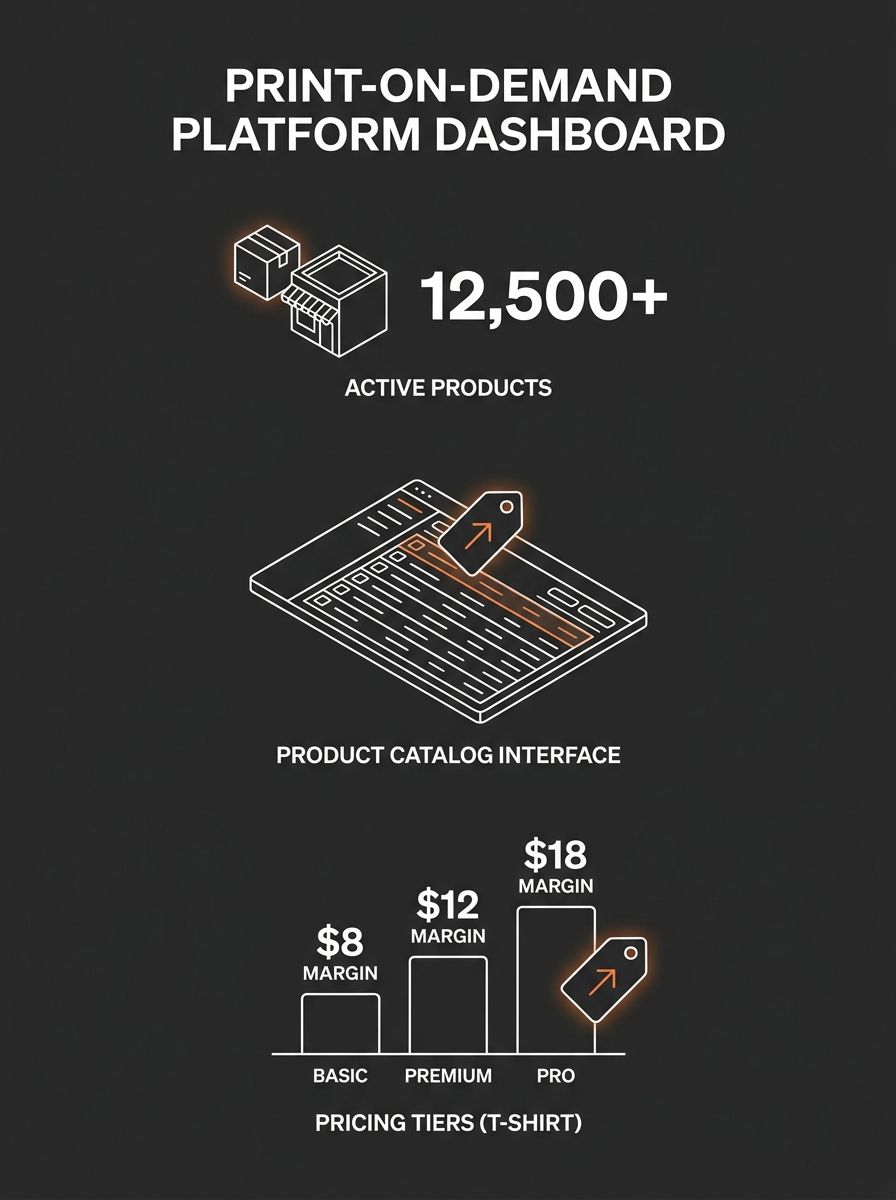
Printify's free-tier pricing structure sets production cost for an 11-ounce mug at $5.75 plus shipping fees ranging from $3 to $8 for domestic orders, according to the platform comparison. The Premium subscription tier, priced at $24.99 monthly under annual commitment, delivers 20 percent discounts on per-item production costs for sellers processing volume orders.
Typical profit margins on standard t-shirt sales land between $5 and $7 per unit for free-plan users, expanding to $10 to $15 per shirt for Premium subscribers, the evaluation reported. Profitable POD sellers consistently process 50 or more monthly sales and migrate to Premium plans to capture margin expansion through volume discounts, the analysis concluded.
The margin structure positions POD fulfillment below traditional dropshipping gross-profit percentages. A $5 profit on a $20 t-shirt sale yields a 25 percent gross margin before advertising spend, while conventional dropshipping product selections frequently achieve 40 to 50 percent margins on similar sale prices, as documented in operator margin-math breakdowns.
Fulfillment Timeline and Quality Benchmarks
Production timelines span 2 to 7 business days across evaluated platforms, with domestic shipping adding 3 to 10 days for a combined fulfillment window of 5 to 17 business days, the report detailed. International orders extend total delivery to 2 to 4 weeks from purchase to doorstep.
The evaluation weighted print quality and shipping speed as 5-out-of-5 and 4-out-of-5 priority factors respectively, reflecting operator concerns about consistency across distributed print-provider networks. Printify's model distributes production across 80-plus independent print facilities, introducing quality-variance risk that centralized fulfillment models avoid through single-facility control.
Spocket received mention as an alternative supplier offering 2-to-5-day shipping through US and EU-based partners, though with reduced customization capacity compared to made-to-order POD platforms. The speed advantage positions Spocket for pre-made inventory dropshipping rather than design-on-demand applications, the comparison noted.
Print quality consistency emerged as a top-weighted criterion alongside production cost, both rated at maximum 5-out-of-5 importance in the evaluation framework. Product selection breadth and shipping performance received 4-out-of-5 weight, while storefront integration capability ranked at 3-out-of-5, indicating operator priorities favor unit economics and fulfillment reliability over technical connectivity features.
Integration Requirements and Store Pairing
Most POD platforms including Printify and Printful require separate storefront infrastructure, with Shopify and Etsy representing the dominant sales-channel choices, the report found. Shopify's $29 to $39 monthly subscription fees combine with POD platform costs to establish baseline operating overhead, while Etsy charges no upfront listing fees but extracts 6.5 percent transaction fees on completed sales.
Sellfy differentiates by bundling storefront hosting with POD fulfillment in a single $29 monthly package, eliminating the need for separate e-commerce platform subscriptions. The integrated approach targets creators managing both physical product sales and digital file delivery through unified infrastructure.
The evaluation framework assigned product selection a 4-out-of-5 importance rating, measuring catalog depth against customization flexibility and material variety. Printify's 900-plus product types span apparel, home goods, accessories, and stationery categories, providing breadth for multi-category store builds without supplier fragmentation.
Platform integration scored 3-out-of-5 in the weighting system, reflecting matured API connectivity across major POD providers. Storefront setup complexity has diminished as a differentiation factor, with Shopify app-store integration now standard across evaluated platforms, the analysis indicated.
Operators. Implications
The Printify ranking validates zero-subscription POD entry as the preferred launch path for margin-sensitive operators testing design concepts before committing to Premium-tier volume discounts. The $24.99 monthly threshold for 20 percent production-cost reduction creates a clear break-even calculation: operators crossing 50 monthly unit sales gain immediate margin expansion that funds the subscription fee within first-week revenue.
Tighter POD margins compared to traditional dropshipping products demand higher conversion rates and lower customer-acquisition costs to maintain profitability. A $7 gross profit per shirt sale leaves minimal room for paid traffic when Facebook CPM rates push cost-per-purchase above $8 in competitive apparel niches. Operators must either achieve organic traffic traction through platform marketplaces like Etsy or accept break-even customer acquisition on first purchase while banking on repeat-order margin, similar to credibility-verification practices that protect long-term supplier relationships.
The 5-to-17-day domestic fulfillment window positions POD suppliers outside fast-shipping expectations that drive impulse purchases in conventional dropshipping stores. Operators should set delivery-expectation messaging during checkout and follow up with tracking updates to offset extended transit times, treating fulfillment transparency as margin protection against refund requests and chargebacks.

Ryan Torres
Ryan Torres is a former Amazon FBA seller turned dropshipping consultant who has generated over $2.8M in ecommerce revenue across 14 product launches. He specializes in supplier vetting, margin optimization, and scaling DTC operations for sub-$1M brands. Ryan focuses on actionable frameworks that drive measurable results for independent operators.
Explore more topics